
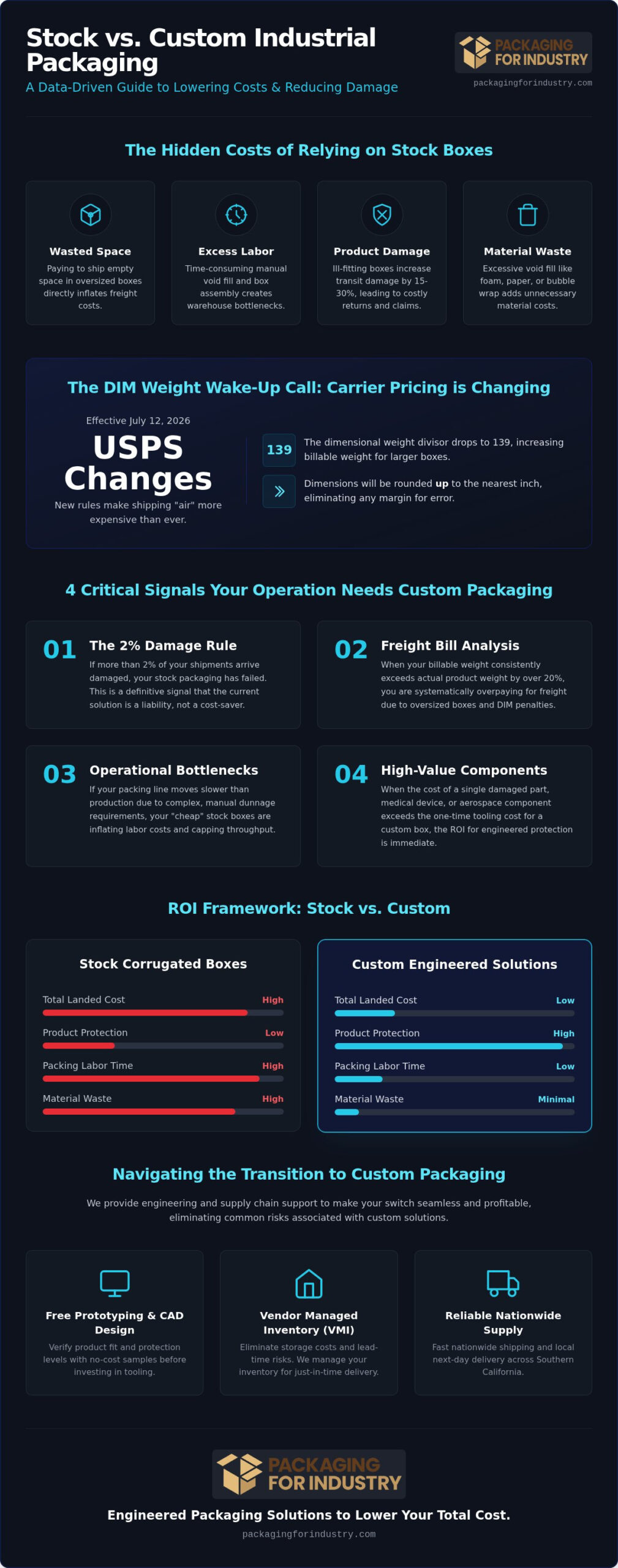
In the industrial sector, custom boxes aren’t for branding; they’re precision tools for reducing freight penalties and transit damage. Many logistics managers rely on catalog suppliers for convenience, but there comes a point where off-the-shelf solutions become a liability. Determining when to switch from stock to custom boxes is a critical financial decision that impacts your bottom line far more than your marketing budget. With the USPS changing its dimensional weight divisor to 139 and rounding dimensions up to the nearest inch as of July 12, 2026, the cost of shipping air in an oversized stock box has never been more expensive.
You likely feel the pressure of rising carrier surcharges and the frustration of repairing products damaged by inadequate protection. It’s a common challenge for manufacturers who need more than just a standard container to maintain operational flow. This guide identifies the specific volume, cost, and protection thresholds that signal your operation is ready for engineered packaging. We’ll examine how custom corrugated designs and integrated foam solutions reduce total shipment costs, streamline warehouse labor, and ensure a reliable supply through programs like Vendor Managed Inventory and local next-day delivery across Southern California.
Key Takeaways
- Analyze the total landed cost model to see how custom-engineered boxes outperform cheaper stock options by eliminating excessive void fill and manual labor.
- Identify the specific volume and freight thresholds that signal exactly when to switch from stock to custom boxes to mitigate rising carrier DIM weight surcharges.
- Recognize the “2% damage rule” as a definitive operational signal that standard off-the-shelf packaging is no longer sufficient for specialized industrial components.
- Utilize free prototyping and CAD/CAM design services to verify product fit and protection levels before investing in permanent tooling or large production runs.
- Discover how Vendor Managed Inventory (VMI) programs eliminate the storage and lead-time risks often associated with transitioning to custom packaging.
The Hidden Costs of Relying on Stock Corrugated Boxes
Standard catalog boxes are designed for general commodities, not specialized industrial equipment. When your product doesn’t fit a standard footprint, you’re essentially paying to ship empty space. In industrial logistics, packaging is more than a container; it’s a coordinated system of preparing goods for transport, distribution, and storage. If the outer shell is poorly sized, every subsequent step in your supply chain becomes more expensive. Identifying when to switch from stock to custom boxes often starts with a freight audit. If your billable weight consistently exceeds actual weight by more than 20%, you’re losing money on every shipment.
The correlation between ill-fitting stock boxes and transit-related product loss is well-documented. Research indicates that custom packaging can reduce product damage rates by 15-30% compared to stock boxes using generic void fill. When a box is too large, the product shifts during transit, leading to internal impact damage even if the exterior looks intact. For specialized sectors like aerospace or medical devices, this level of risk is unacceptable and often leads to costly returns and production delays.
Understanding Dimensional (DIM) Weight Penalties
Carriers use a formula to determine billable weight based on package dimensions. Effective July 12, 2026, the USPS has tightened these rules, moving the DIM weight divisor to 139 and requiring all dimensions to be rounded up to the nearest whole inch. DIM weight is the intersection of box volume and carrier pricing factors. A box that’s just two inches too large in each dimension can trigger a higher weight tier, resulting in thousands of dollars in annual waste for high-volume operations. These “air taxes” are often the primary driver for manufacturers to request a packaging quote for custom-sized alternatives.
Labor and Material Inefficiency in the Warehouse
Stock boxes require an excessive amount of protective foam packaging or paper void fill to secure the product. This creates two distinct costs: material waste and labor time. Every extra minute spent on manual dunnage application is a minute your team isn’t fulfilling new orders. Custom corrugated boxes engineered for your specific SKU eliminate the need for “fixing” the fit with tape and bubble wrap. By moving to custom inserts or engineered sizing, you don’t just save on material; you streamline the entire packing process, allowing your existing staff to handle higher order volumes without increasing headcount.
4 Critical Signs Your Industrial Operation Needs Custom Packaging
Identifying the right moment to transition your packaging strategy requires a data-driven approach. While stock corrugated boxes serve as a baseline for general shipping, they often fall short when handling high-precision components or heavy-duty machinery. If your logistics team is struggling with inconsistent results, it’s time to evaluate specific operational triggers. Knowing when to switch from stock to custom boxes depends on tracking four key performance indicators: damage rates, product value, regulatory needs, and packing speed.
A primary indicator is your transit damage rate. If more than 2% of your shipments arrive with damage, your stock packaging has failed. In an industrial environment, a 2% failure rate is not just a statistic; it represents a significant drain on your bottom line through replacement costs and freight claims. While some e-commerce brands focus on crafting a memorable brand experience, industrial leaders must prioritize structural integrity. When the cost of a single damaged part exceeds the one-time expense of a custom tooling run for cutting dies, the financial choice is clear.
Operational bottlenecks also signal a need for change. If your packing line is moving slower than your production line due to complex dunnage requirements, your “cheap” stock boxes are actually inflating your labor costs. You can request a packaging quote to see how an engineered fit can eliminate these delays and lower your total cost per shipment.
Protection for High-Value and Fragile Components
Aerospace and medical electronics manufacturers cannot risk the shifting and vibration inherent in oversized stock containers. These sectors require custom foam packaging integrated directly with heavy-duty corrugated boxes to stabilize delicate parts. For example, moving from a standard box with loose-fill peanuts to a custom-fit crate with polyethylene inserts ensures that heavy industrial parts remain stationary. This precision prevents internal component failure that generic packaging cannot mitigate.
Compliance and Regulatory Requirements
Many specialized industries face strict legal mandates that off-the-shelf boxes cannot meet. If you are handling government contracts, you must adhere to specific mil-spec packaging standards for durability and environmental resistance. Hazardous materials also require specialized corrugated testing and certification that stock catalog suppliers rarely provide. Furthermore, international shipping often demands ISPM-15 compliant wood or hybrid corrugated solutions to pass customs without quarantine. When these regulations apply, the question of when to switch from stock to custom boxes is answered by the necessity of compliance.
Stock vs. Custom Boxes: A Real-World ROI Framework
Many purchasing managers evaluate packaging solely by the unit price on a quote. This is a mistake. While a stock box may appear cheaper at $1.00 per unit, it often carries hidden liabilities that inflate the total landed cost. When you account for the labor required to apply excessive void fill and the carrier penalties for oversized dimensions, that stock box quickly becomes a financial drain. Determining when to switch from stock to custom boxes requires a shift from price-per-piece thinking to a comprehensive ROI analysis.
By utilizing custom shipping boxes, you optimize your logistics flow and prevent dimensional weight surcharges from eroding your margins. Industry data suggests that custom packaging becomes financially viable for most operations once they reach a volume of approximately 1,000 orders per month. Below this threshold, the initial setup costs are harder to justify. However, once you hit this benchmark, the savings in freight and reduced damage typically outweigh the higher per-unit cost of engineered corrugated. Custom sizing also maximizes pallet footprints and shipping container density, ensuring you aren’t paying to transport air.
The Cost of Tooling and Setup
Transitioning to custom manufacturing involves two primary one-time expenses: cutting dies and printing plates. Regular Slotted Cartons (RSC) are the standard for many industrial needs, but die-cut designs allow for more complex shapes and integrated structural support. These tools ensure every box is identical, providing the precision needed for automated packing lines. Tooling is a one-time investment that amortizes over the first few thousand units, eventually dropping your cost per shipment as your volume scales. You’ll also find that printed corrugated boxes improve industrial branding and simplify inventory tracking in the warehouse. For companies looking to extend this professional image to their technical field equipment, you can learn more about KP Innovations and their guide to branding precision tools.
Calculating Your Freight and Damage Savings
To build your business case, use a simple formula: (Stock Box Price + Dunnage Cost + Labor Time + DIM Weight Penalty) vs. (Custom Box Price + Amortized Tooling). You must also factor in the cost of failure. If custom packaging reduces your return rate even by a fraction of a percent, the savings on reverse logistics and replacement parts can be substantial. For a more detailed breakdown, you can perform a packaging cost savings analysis to see the impact on your specific SKUs. Reducing “returns and replacements” protects your reputation and keeps your production schedule on track.
Navigating the Transition: Engineering, Prototyping, and Lead Times
Transitioning from stock to custom is an engineering upgrade, not just a procurement change. While catalog boxes are purchased reactively, custom solutions involve a design phase using CAD/CAM technology. This ensures a precision fit that accounts for the exact dimensions and weight distribution of your industrial parts. Choosing the right material is a critical part of this process. You’ll need to decide between heavy-duty double-wall, triple-wall, or specialized weather-resistant corrugated based on your specific shipping environment. Knowing when to switch from stock to custom boxes often coincides with a shift toward these high-performance materials that standard catalogs don’t offer in bulk.
The Role of Prototyping in Industrial Design
Utilizing custom design packaging services allows you to eliminate engineering errors before they reach the warehouse floor. Free prototyping is a vital step in this transition. It provides a physical sample to test for shock, vibration, and compression resistance under real-world conditions. During this phase, you can integrate foam packaging and corner protection directly into the box design. This holistic approach ensures that the entire unit functions as a single protective system, which is far more effective than trying to assemble disparate stock components on the fly.
Managing Custom Lead Times
Custom production cycles require more planning than off-the-shelf catalog items. As of April 2026, industry lead times for custom corrugated solutions typically range from 15 to 20 business days for specialized runs. This shift requires a proactive inventory strategy. You’ll need to balance your remaining stock boxes while your first custom run is in production to avoid stockouts. Working with a local Southern California packaging manufacturer is a strategic advantage. Proximity to hubs in Los Angeles, Orange County, San Diego, and the Inland Empire significantly reduces transit times and allows for more agile responses to production spikes. When to switch from stock to custom boxes is often determined by your ability to move from a reactive model to a structured, reliable supply chain.
Why Choose PFI for Your Move to Custom Packaging?
Transitioning to custom packaging is a strategic move that requires more than just a new supplier; it requires a logistics partner. PFI specializes in this transition, providing the engineering expertise and inventory management necessary to scale your operation. Knowing when to switch from stock to custom boxes is only half the battle. The other half is ensuring your warehouse can handle the new requirements without operational disruption. We bridge the gap between complex engineering and fiscal responsibility by designing integrated systems that combine heavy-duty corrugated with custom foam packaging and specialized crates.
Our team speaks the language of purchasing managers and operations directors. We focus on total landed cost rather than just the price per unit. We understand that in the industrial sector, your packaging must perform under the stress of long-haul transit and heavy stacking. By acting as a seasoned industrial consultant, we identify the inefficiencies in your current stock-based system and replace them with engineered solutions that stabilize your supply chain and protect your bottom line.
Vendor Managed Inventory (VMI) and JIT Programs
A common concern regarding when to switch from stock to custom boxes is the increased demand for warehouse space. Custom runs often require higher minimum order quantities than stock catalog items, which can clutter your facility. PFI’s VMI services solve this challenge by storing your custom inventory in our own facilities. We implement scheduled replenishment cycles based on your actual production usage. This Just-In-Time (JIT) approach keeps your production lines moving without forcing you to manage massive amounts of on-site dunnage or empty containers. It eliminates the risk of stockouts and ensures you always have the right box at the right time.
Local Support and Nationwide Shipping
Our Anaheim headquarters serves as a central hub for rapid prototyping and site visits for manufacturers across Southern California. We provide next-day delivery to facilities in Los Angeles, Orange County, San Diego, and the Inland Empire. This local presence allows our engineers to visit your facility, evaluate your packing line, and provide immediate CAD/CAM design adjustments that remote suppliers simply can’t offer. For companies with multi-state distribution hubs, our nationwide shipping capabilities ensure that your custom packaging standards remain consistent across all your locations. Whether you need heavy-duty triple-wall corrugated or specialized military-spec protection, we provide the local responsiveness and national reach your operation demands.
Optimize Your Industrial Logistics Strategy
Deciding when to switch from stock to custom boxes is a pivotal moment for any expanding industrial operation. It marks the transition from reactive procurement to a precision-engineered supply chain. By prioritizing total landed costs over simple unit pricing, you capture significant savings in freight and labor while virtually eliminating the risk of transit damage. This shift ensures that your packaging is a tool for efficiency rather than a source of hidden waste.
PFI provides the technical expertise needed to navigate this transition with confidence. We offer free prototyping and CAD support to verify your design before you commit to production. With local next-day delivery across Southern California and fast nationwide shipping, we maintain the logistical flow your business requires to stay competitive. Our team is focused on providing the specialized corrugated and foam solutions that keep your shipments secure and your freight bills predictable.
We’re ready to help you lower your packaging costs and improve your operational reliability starting today.
Frequently Asked Questions
What is the typical minimum order quantity (MOQ) for custom corrugated boxes?
Minimum order quantities for custom boxes typically range from 100 to 500 units for digitally printed runs. For wholesale industrial orders, MOQs are often between 500 and 1,000 units, with the most competitive pricing starting at 2,500 units. These volume thresholds are a primary factor in determining when to switch from stock to custom boxes based on your recurring monthly usage.
How much does custom box tooling usually cost for industrial applications?
Tooling involves one-time investments for cutting dies and printing plates tailored to your specific product dimensions. While costs vary based on design complexity and the number of colors required, these are non-recurring expenses; for reference, you can look into Custom Packaging Manufacturing and Printing Fees to understand how these costs are typically structured. Once the initial investment is made, the tooling is stored for future runs, allowing your per-unit cost to remain stable and predictable over the life of the product line.
Can custom boxes really reduce my UPS or FedEx shipping rates?
Custom boxes significantly lower shipping rates by optimizing dimensional (DIM) weight. Carriers calculate freight costs based on package volume rather than just actual weight. By eliminating the empty space found in oversized stock boxes, you reduce the billable weight. This is especially critical following the July 2026 USPS changes that require dimensions to be rounded up to the nearest whole inch.
How long does the design and prototyping process take for a custom box?
The engineering and prototyping phase generally takes 3 to 5 business days to ensure a precision fit. After you approve the final prototype, full production lead times for custom corrugated solutions are approximately 15 to 20 business days. Working with a local Southern California manufacturer can often shorten these timelines by accelerating the delivery of physical samples for your review.
Do I need custom boxes if I already use heavy-duty double-wall stock boxes?
Wall strength is only one part of the protection equation. If your product shifts inside a heavy-duty stock box, it remains vulnerable to internal impact damage. Custom boxes allow for the integration of foam packaging or specialized corrugated inserts that stabilize the component. This engineered fit provides superior protection that a standard double-wall box with generic void fill cannot achieve.
What information do I need to provide to get an accurate custom packaging quote?
To receive a precise quote, you should provide the internal dimensions of the box, the total weight of the loaded product, and your expected order frequency. It’s also vital to mention any specialized needs, such as aerospace standards or military-spec requirements. Providing these details allows us to recommend the correct material grade, such as double-wall or triple-wall corrugated, for your specific application.
Can custom packaging help with military or aerospace compliance (Mil-Spec)?
Custom packaging is essential for meeting rigorous military and aerospace specifications that stock boxes cannot satisfy. These industries require documented material grades, specific burst strengths, and precise internal bracing to pass inspection. We engineer custom solutions that adhere to these strict regulatory mandates, ensuring your components are compliant and fully protected against the environmental stresses of global transit.
How does Vendor Managed Inventory (VMI) work for custom-sized boxes?
VMI solves the storage challenges often associated with custom packaging programs. PFI monitors your stock levels and manages the replenishment of your custom boxes from our own facility. We deliver the required quantities on a scheduled basis, such as weekly or biweekly, based on your actual production usage. This system eliminates the risk of stockouts while freeing up valuable square footage in your warehouse.