
Treating industrial pallet wrap as a generic commodity is the fastest way to inflate your shipping budget and compromise your load integrity. You probably recognize the frustration of seeing a carefully staged pallet arrive at a customer’s facility with shifted layers or punctured film. With LLDPE and LDPE resin prices seeing significant increases as of July 2026, the financial cost of making a mistake in your film selection has never been higher.
It’s understandable that procurement managers feel caught between the need for lower consumable costs and the mandate for zero transit damage. This guide provides the technical framework you need to move beyond catalog-style purchasing and master load stabilization. You’ll learn how to optimize gauge thickness and resin types to secure your shipments effectively while reducing plastic waste. We will also examine how switching to a specialized industrial packaging supplier in Southern California can provide the reliable, local inventory that national distributors often fail to maintain.
Key Takeaways
- Learn the critical performance differences between cast and blown extrusion to select the right film for your specific load profile.
- Master the technical principles of load containment force to ensure your industrial pallet wrap provides maximum stability during transit.
- Discover how down-gauging with high-performance resins allows you to reduce material waste while maintaining superior puncture resistance.
- Shift your procurement focus from “cost per roll” to “cost per pallet wrapped” to uncover hidden operational savings and improve your bottom line.
- Leverage the logistical benefits of a local Southern California supplier to secure reliable next-day delivery and eliminate supply chain disruptions.
Industrial Pallet Wrap: Ensuring Load Integrity and Reducing Shipping Damage
In a high volume warehouse environment, industrial pallet wrap is much more than a simple plastic covering; it’s a precision engineered tool designed to maintain the structural integrity of your shipments. Most professional grade films are manufactured from high performance linear low density polyethylene (LLDPE). This material is chosen for its superior puncture resistance and tensile strength, which are critical for stabilizing heavy or irregular loads during the rigors of transit.
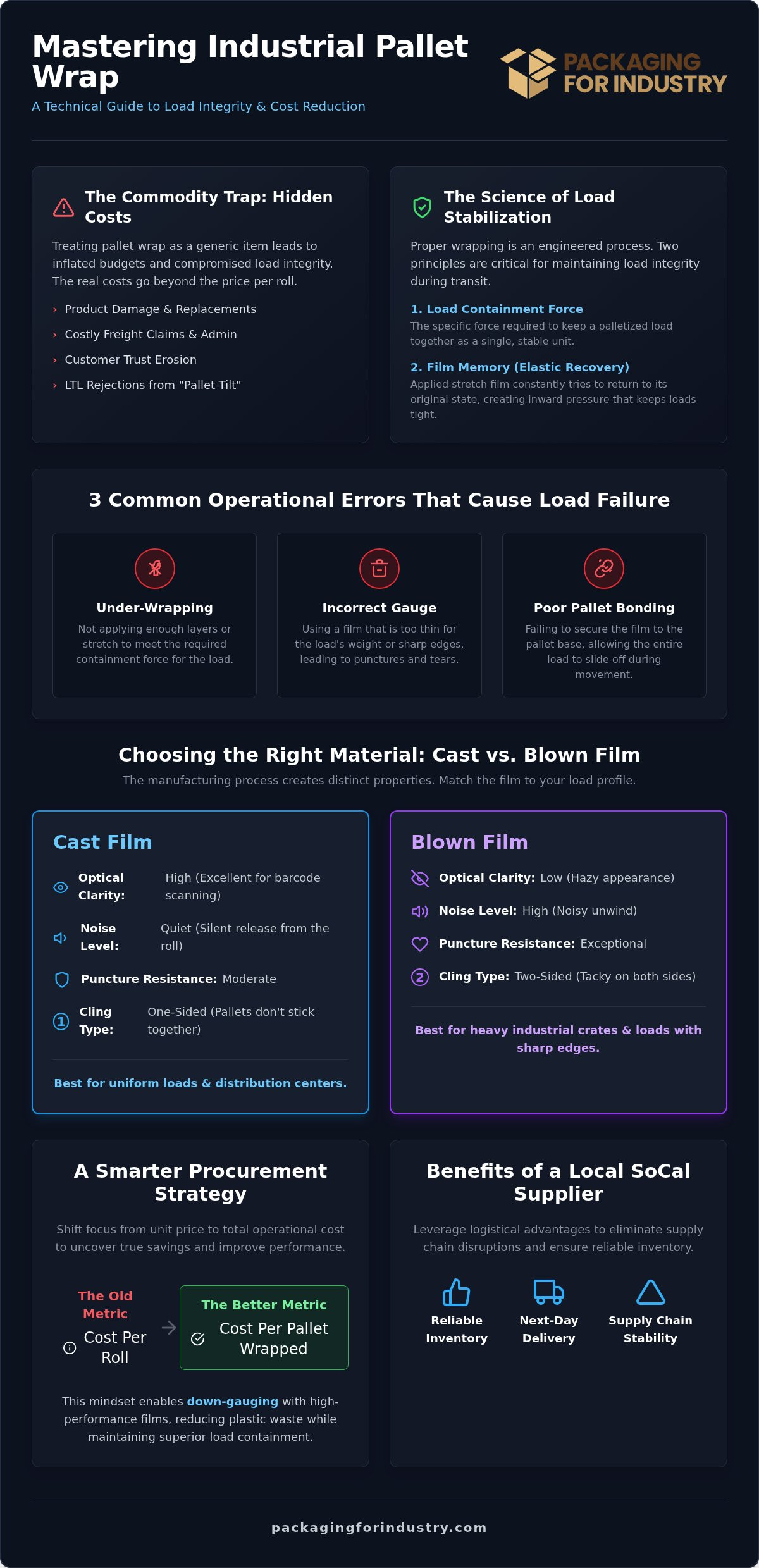
Success in shipping depends on load containment. This is the specific amount of force required to keep a palletized load together as a single unit. Achieving the right containment force involves more than just wrapping a pallet until it looks secure. It requires understanding elastic recovery, often called the film’s “memory.” When stretch film is applied correctly, it wants to return to its original state. This constant inward pressure keeps the load tight, even as the products settle or shift slightly during movement.
Most load failures aren’t caused by the film itself, but by how it’s used. Common operational errors include:
- Under wrapping: Not applying enough layers to meet the required containment force.
- Incorrect gauge: Using a film that is too thin for the weight or sharp edges of the products.
- Poor film to pallet bonding: Failing to secure the film to the actual pallet, which allows the entire load to slide off the base.
The Hidden Costs of Poor Load Stabilization
When a load fails, the visible damage to the product is just the beginning. You also face the administrative burden of processing freight claims, the cost of shipping replacement goods, and the potential loss of customer trust. In the LTL shipping environment, improper wrapping often leads to “pallet tilt” or “load dumping.” These issues occur when vibration and G-forces during transit cause an unsecured load to shift, potentially damaging adjacent shipments and leading to costly rejections at the receiving dock.
Environmental Protection Beyond Stabilization
While stabilization is the primary goal, industrial pallet wrap also serves as a critical barrier against environmental hazards. It shields high value components from dust, moisture, and warehouse debris. For industries like aerospace or electronics, using opaque films can provide an added layer of security by concealing sensitive parts from view. Conversely, for moisture prone shipments, vented films allow for airflow to prevent condensation, ensuring that your products arrive in the same condition they left your facility.
Choosing the Right Material: Cast vs. Blown and Machine vs. Hand Film
Selecting the correct industrial pallet wrap requires an understanding of how the film is manufactured. The two primary methods, cast and blown extrusion, result in distinct physical properties that dictate how the film performs under stress. Choosing the wrong type often leads to wasted material or, worse, load failure during transit. Professional procurement involves matching the specific resin performance to your unique load profile.
Cast vs. Blown Stretch Film: Performance and Clarity
Cast film is produced by feeding molten resin through a flat die and onto chilled rollers. This process is fast and efficient, resulting in a film with excellent clarity and a quiet release from the roll. It’s the standard choice for most uniform loads where barcode scannability is a priority. Blown film, however, is created by blowing a large bubble of plastic. While it’s noisier and less transparent, it offers superior puncture resistance and a much higher “force-to-load” ratio. This makes it the preferred material for heavy industrial crates or loads with sharp, protruding edges.
| Feature | Cast Film | Blown Film |
|---|---|---|
| Optical Clarity | High (Clear) | Low (Hazy) |
| Noise Level | Quiet | High |
| Puncture Resistance | Moderate | Exceptional |
| Cling Type | One-sided | Two-sided |
Hand Film vs. High-Volume Machine Wrap
For operations wrapping fewer than 10 pallets per day, hand wrap is usually the most cost-effective solution. However, manual application is physically demanding and often results in inconsistent tension. Pre-stretched film is an excellent middle-ground for these environments. Because the film is already stretched during manufacturing, workers don’t need to exert as much physical force to achieve proper containment. This significantly reduces warehouse fatigue and ensures a more consistent wrap even with manual labor.
Once your volume exceeds 15 to 20 pallets per day, investing in a stretch wrap machine becomes a matter of fiscal responsibility. Machine-grade industrial pallet wrap is engineered to handle 200% to 300% pre-stretch. This means a single foot of film on the roll can cover up to three feet of the pallet, drastically maximizing your material yield. If you aren’t sure if your current volume justifies automation, you can request a packaging quote to compare the long-term material savings against the equipment cost.
Optimizing Film Gauge and Type for Industrial Applications
While standard 80-gauge film was once the default for almost every warehouse, modern material science has introduced high-performance resins that allow for significant down-gauging. This trend involves using thinner, technologically advanced industrial pallet wrap to achieve the same or better containment force as traditional thick films. By reducing the volume of plastic used per pallet, you lower your total packaging spend and decrease environmental waste without sacrificing load security. As a specialized stretch wrap supplier, we help procurement managers navigate these technical specifications to match the correct resin performance to their specific load profiles.
To optimize your selection, you should categorize your shipments into one of three load types. A-loads are uniform, square pallets with no protrusions, typically consisting of stacked corrugated boxes. B-loads are less predictable, featuring some protruding edges or non-uniform stacking. C-loads are highly irregular and often feature sharp corners, such as heavy machinery or unfinished metal components. Matching the film gauge to these categories prevents the common problem of over-specifying for simple loads or under-specifying for hazardous ones, which is where most hidden costs originate.
Beyond thickness, environmental factors play a major role in film selection. For outdoor staging or long-term yard storage, UV inhibitors are vital. Standard film degrades quickly under direct sunlight, which leads to brittleness and eventual load failure. Colored films also serve a pragmatic purpose; they’re frequently used for inventory dating, preventing tampering, and quickly identifying international shipments in a crowded distribution center.
Understanding Film Gauges: From Light to Heavy-Duty
Selecting the right gauge is a balance between material cost and puncture resistance. Professional grade industrial pallet wrap is generally categorized by these performance tiers:
- 37–50 Gauge: Often referred to as “micron” films, these are engineered for lightweight, uniform A-loads and internal warehouse transfers where high puncture resistance isn’t the primary concern.
- 60–80 Gauge: This remains the industry standard for general manufacturing and e-commerce applications, providing a versatile balance of stretch and strength.
- 90–150 Gauge: These heavy-duty films are reserved for C-loads, providing the extreme puncture resistance needed for steel components, machinery, and rough-hewn wooden crates.
Specialized Wraps for Aerospace and Electronics
In specialized sectors like aerospace and electronics, standard film is often insufficient. Anti-static (ESD) stretch film is essential for protecting sensitive circuit boards and electronic assemblies from static discharge during the wrapping process. When combined with protective foam packaging, these films create a comprehensive barrier against both physical impact and electrostatic damage. For complex logistics operations, high-clarity cast film ensures that barcodes and tracking information printed on thermal transfer ribbons remain perfectly readable through multiple layers of plastic. Additionally, vented wrap provides a critical solution for parts that require airflow to prevent corrosion, off-gassing, or moisture buildup during transit.
Procurement Strategies: Lowering Total Cost of Ownership (TCO)
Lowering your total packaging spend requires a fundamental shift in how you evaluate industrial pallet wrap. I often see procurement departments prioritize the price per roll on a purchase order; however, this metric is frequently misleading. The only figure that truly impacts your bottom line is the Cost Per Pallet Wrapped (CPPW). By focusing on CPPW, you account for the actual efficiency of the film, the amount of waste generated, and the labor required to apply it correctly. As a reliable provider of wholesale packaging supplies, we help our clients realize that high-performance resins allow for higher pre-stretch ratios, which reduces the total pounds of plastic purchased annually.
High-performance films offer superior pre-stretch capabilities, which directly translates to lower material consumption per load. While a standard roll might cost less upfront, a performance film that achieves 250% pre-stretch allows you to wrap significantly more pallets with less plastic. This doesn’t just lower costs; it aligns with corporate sustainability goals by reducing the total volume of plastic entering the waste stream. Additionally, reducing the number of rolls used in your facility lowers the labor costs associated with roll changes, allowing your warehouse team to focus on higher-value tasks like picking and staging.
The Myth of “Price Per Roll”
Consider a scenario where a facility uses a standard 80-gauge roll. If that film suffers from “neck-down”—where the film narrows significantly under tension—workers must apply extra layers to compensate for the lost surface area. If an 18-inch film narrows to 14 inches during application, you’re losing nearly 25% of your coverage per revolution. This leads to more material used per pallet and inconsistent load containment. To audit your current efficiency, weigh the plastic removed from a finished pallet. You’ll likely find that a more expensive, high-yield 63-gauge performance film results in a lower weight of plastic per load. This simple audit reveals how the “cheaper” roll was actually the more expensive choice when measured by material weight.
Streamlining Supply with Vendor Managed Inventory (VMI)
Relying on large catalog distributors often leads to inconsistent supply and expensive rush shipping fees when inventory runs low. Implementing VMI programs eliminates these operational bottlenecks. A local partner monitors your usage and ensures you always have the necessary industrial pallet wrap on hand, especially during peak production cycles. Consolidating these supplies with your custom corrugated boxes or protective foam packaging simplifies your procurement process and reduces the administrative burden of managing multiple vendors.
Why Southern California Manufacturers Choose PFI for Bulk Pallet Wrap
Manufacturers across Southern California face unique logistical challenges, from navigating regional traffic to meeting strict compliance standards for the aerospace and medical sectors. Packaging For Industry (PFI), headquartered in Anaheim, understands these local pressures. If you are searching for a reliable industrial packaging supplier near me to support high-volume operations, our proximity is a strategic advantage. As a dedicated Anaheim packaging supplier, we offer local next-day delivery to warehouses in Orange County, Los Angeles, and the Inland Empire, ensuring your production lines remain active without the delays common to national catalog distributors.
Our role extends beyond simple order fulfillment. We act as industrial consultants who audit your entire wrapping process to identify hidden inefficiencies and reduce transit damage. By integrating high-performance industrial pallet wrap with protective foam packaging, we develop an end-to-end protection strategy that secures your products from the inside out. This holistic view of the packaging system is what separates a transactional supplier from a strategic logistical partner focused on your bottom line.
Local Support and Technical Audits
We provide on-site technical reviews for SoCal manufacturers to evaluate current wrapping techniques and containment force. These audits often uncover material waste caused by improper machine settings or manual over-wrapping. Our team helps you recalibrate your equipment and train warehouse staff on proper stabilization principles. As a versatile Los Angeles packaging supplier, we also provide direct access to packaging engineers for custom crate design and stabilization. We offer custom stocking programs that align with your specific production lead times, providing a level of responsiveness that distant competitors can’t match.
Request a Quote for Bulk Industrial Pallet Wrap
Procuring industrial pallet wrap shouldn’t be a guessing game based on fluctuating resin prices. We provide a transparent process for obtaining wholesale pricing on both hand and machine films tailored to your specific volume requirements. As your San Diego packaging supplier and Riverside packaging supplier, our primary goal is to help you lower total costs by optimizing your material usage and reducing product loss. Whether you’re shipping sensitive electronics or heavy machinery, we provide the wholesale packaging supplies and technical expertise needed to support your operation.
Secure Your Supply Chain and Lower Operational Costs
Mastering load stabilization requires a proactive approach that treats packaging as a precision engineering tool. You’ve seen how identifying the correct film gauge and understanding the physics of containment force can protect high-value shipments from the hazards of LTL transit. By shifting your procurement focus toward the total cost of ownership and the actual weight of plastic used per load, you achieve both fiscal efficiency and your corporate sustainability targets.
Partnering with a local Southern California supplier provides the added benefits of expert technical audits to identify waste and Vendor Managed Inventory (VMI) to stabilize your supply chain. Whether you’re shipping heavy industrial machinery or sensitive aerospace components, having a reliable partner ensures your operations stay on schedule with local next-day delivery. Choosing the right industrial pallet wrap isn’t just about protection; it’s about building a more resilient and cost-effective distribution system.
We’re ready to help you optimize your wrapping process and ensure your products arrive in perfect condition every time.
Frequently Asked Questions
What is the difference between cast and blown stretch film?
Cast film is extruded onto chilled rollers for high clarity and quiet application, making it ideal for uniform loads and barcode scannability. Blown film is manufactured through a bubble process that creates a much tougher material with superior puncture resistance. You should choose blown film for heavy industrial loads or shipments with sharp, irregular edges that would easily puncture standard cast wrap.
How do I know which gauge of pallet wrap I need for my load?
You select your gauge based on the weight and profile of your load. A-loads with uniform boxes can often use 37 to 50 gauge high-performance films to reduce material costs. Irregular C-loads with sharp edges require 90 to 150 gauge wraps to prevent puncturing during transit. Matching the gauge to the specific load profile is essential for effective industrial pallet wrap optimization.
Can I use hand stretch film on a machine?
You shouldn’t use hand film on a stretch wrap machine under any circumstances. Hand rolls are designed for manual tension and lack the reinforced core and high pre-stretch capacity required by automated equipment. Attempting to use hand film on a machine will result in frequent snapping, inconsistent load containment, and potential damage to the wrapping equipment’s tension rollers.
What is pre-stretch film and is it worth the extra cost?
Pre-stretch film is material that has been mechanically stretched during the manufacturing process before it’s wound onto the roll. It’s an excellent investment for manual operations because it requires significantly less physical effort from workers to achieve proper containment force. This reduces warehouse fatigue while ensuring a more consistent wrap and better material yield compared to standard hand film.
How can I reduce the amount of stretch film my warehouse uses?
Reducing material usage involves switching to high-performance resins and optimizing your wrapping patterns. Implementing machine wrapping with high pre-stretch ratios can increase your material yield by up to 300%. Regular technical audits from a specialized industrial pallet wrap supplier can also identify over-wrapping habits and incorrect tension settings that lead to unnecessary plastic waste.
Does colored stretch film provide the same level of protection as clear?
Colored film provides the same structural protection as clear film while adding security and inventory management benefits. Opaque colors like black or white conceal high-value goods to prevent theft and tampering. Many colored films also include UV inhibitors, which are critical for protecting products and the film’s integrity when pallets are stored in outdoor staging areas.
Why is my stretch film snapping or tearing during application?
Film failure is typically caused by excessive tension settings or using an inadequate gauge for sharp protrusions. If your film tears frequently, you may need to switch to a blown film with higher puncture resistance or increase your gauge thickness. Inconsistent film quality from low-grade resins can also lead to weak spots that snap under the stress of application.
How does pallet wrap help with shipping compliance for aerospace parts?
Pallet wrap ensures aerospace components remain stabilized and free from environmental contaminants like dust or moisture during complex logistics cycles. Specialized options like anti-static (ESD) film protect sensitive avionics from static discharge during the wrapping process. Using high-clarity film also ensures that critical logistics labels and compliance documentation remain perfectly readable through multiple layers of plastic.