
What if the very film you use to secure your pallets is actually the primary cause of your shipping damage? For manufacturers and distributors in Los Angeles and Orange County, trapped moisture inside a load is a silent profit killer that leads to rusted components and mold. Traditional wrap often causes “sweating” during transit, but switching to air-permeable stretch film allows your cargo to breathe while maintaining the containment force needed for heavy industrial loads.
It’s a common struggle to balance load integrity with the need for ventilation, especially during long-haul shipping. We’ll show you exactly how breathable stabilization eliminates moisture-related losses and lowers your overall packaging costs by reducing product spoilage and transit damage. This guide provides a detailed look at the engineering behind vented wrap and how it secures transit for specialized sectors from San Diego to nationwide fulfillment centers.
Key Takeaways
- Learn how to eliminate the “greenhouse effect” that causes rust and mold by switching from standard wrap to specialized breathable solutions.
- Understand the engineering behind air-permeable stretch film, which uses reinforced edges to maintain high load containment without trapping heat or moisture.
- Discover how industries like aerospace and automotive use perforated pallet wrap to protect precision parts from oxidation and manage thermal expansion.
- Identify how to lower packaging costs by conducting a spoilage audit to quantify the hidden expenses of moisture-damaged inventory.
- Find out how PFI provides custom-engineered stabilization systems and next-day delivery to facilities across Los Angeles and Orange County.
What is Air-Permeable Stretch Film? Solving the Condensation Crisis
Standard stretch wrap or stretch film is designed to be an airtight barrier. While this is effective for dust protection, it often creates a “greenhouse effect” that traps heat and humidity inside a palletized load. For industrial manufacturers, this moisture buildup is a primary cause of rust on metal components, mold on organic materials, and the failure of corrugated box integrity. Air-permeable stretch film solves this operational challenge by utilizing macro-perforations that allow continuous airflow throughout the shipping and storage cycle.
By allowing the load to breathe, you eliminate the conditions that lead to label peeling and product spoilage. This is particularly vital for goods that are wrapped while warm or stored in environments with high humidity. Beyond protection, there is a clear sustainability advantage. Most breathable wraps are constructed from 100% recyclable polyethylene. This allows your facility to maintain high ESG compliance standards while simultaneously improving the reliability of your supply chain. For many businesses, moving to a ventilated stretch film is the most direct way to reduce moisture-related transit damage.
Breathable Film vs. Standard Stretch Wrap
The structural differences between these two materials are significant. Standard film relies on a solid sheet for tension, but air-permeable stretch film features reinforced edges surrounding each perforation. These reinforcements allow the film to maintain high containment force without tearing, even under the high-tension settings of an automatic wrapper. Performance metrics indicate that ventilated films can reduce cooling times for hot-filled products by up to 50%. You should consider the switch if you notice “sweating” on the inside of your film during your shipping cycle, which indicates your current wrap is working against your product’s chemistry.
The Science of Moisture Management
Condensation frequently occurs during transit cycles between the coastal humidity of Orange County and the fluctuating temperatures of the Inland Empire. When warm air is trapped against a cold product surface, moisture precipitates. Breathable technology enables rapid temperature equalization by allowing internal air to move freely through the wrap. This prevents the dew point from being reached inside the pallet. Air-permeable film is a specialized stabilization tool designed to maintain load integrity while providing vital ventilation for moisture-sensitive industrial goods.
The Engineering Behind Perforated Pallet Wrap: Strength and Stability
Many operations managers hesitate to adopt air-permeable stretch film because they assume the macro-perforations act as failure points. In reality, modern engineering ensures that holes do not equal weakness. These films are designed with reinforced strands that distribute the tension across the web. This structural design allows you to apply the same high-containment force used with traditional films without the risk of the wrap snapping under pressure. By focusing on the tensile strength of the vertical bands, manufacturers provide a solution that breathes without compromising the safety of the load.
The choice between cast and blown manufacturing processes determines the film’s specific performance characteristics. Cast perforated films offer higher clarity and quieter discharge, which is ideal for high-speed automated warehouses. Blown films, however, provide superior puncture resistance and “cling” properties, making them better suited for heavy, irregular industrial parts. Whether you use machine or hand application, the goal is to optimize the wrap pattern. Proper overlap ensures that airflow remains constant while the load stays rigid during transit through the fluctuating temperatures of Southern California. If you’re looking to optimize your specific setup, you can request a packaging quote to get a custom engineering assessment for your facility.
Macro-Perforation Patterns and Airflow
Effective air-permeable stretch film relies on precise hole distribution. Small perforations might work for light moisture, but high-density industrial parts often require larger macro-perforations for effective heat dissipation. The size and spacing of these holes directly impact the control of moisture condensation within the pallet. While you might worry about film yield, the reinforced structure of these wraps often allows for thinner gauges that maintain the same stabilization power as thicker, non-vented alternatives.
Load Retention and Safety Standards
Load safety is non-negotiable for heavy-duty manufacturing shipments. High-quality breathable films are tested to meet ASTM standards for pallet stabilization, ensuring they can withstand high-vibration environments without shifting. These testing protocols simulate the stresses of long-haul trucking and rail transport. By using a film engineered for both ventilation and retention, you protect your bottom line from the dual threats of moisture damage and physical impact. We help you select a pattern that maintains integrity even when your pallets face the most demanding transit conditions.
Strategic Applications Across Southern California Industries
While many associate ventilated wrap with agricultural products, its most critical role today is in protecting high-value industrial inventory. In Southern California, from the aerospace hubs of Los Angeles to the manufacturing centers in San Diego, air-permeable stretch film is a precision tool for quality control. It prevents the moisture accumulation that triggers oxidation on untreated metal surfaces. This is essential for components that must arrive at their destination in pristine, ready-to-assemble condition. By ensuring continuous airflow, you remove the risk of condensation forming during the transition from cool morning warehouses to the midday heat of a delivery truck.
Automotive manufacturers use this technology to manage heat dissipation. When freshly cast or machined parts are palletized while still cooling, standard film traps the heat and creates a pressurized environment. This moisture can degrade the finish or cause micro-corrosion. By using a breathable wrap, these parts can be secured immediately and moved to the shipping dock without a cooling delay. In the medical sector, preventing moisture buildup is vital for maintaining the integrity of sterile barriers. Logistics providers must ensure that humidity doesn’t compromise the adhesive seals on sterile pouches, making ventilation a key safety requirement for medical device distribution.
Food and beverage facilities also rely on this film for hot-fill products. When liquids are bottled hot, they continue to release heat long after they’re placed on a pallet. Standard wrap forces that heat back into the product, which can alter the taste or texture. Using a vented solution allows the heat to escape, ensuring the product reaches its target temperature faster. This also applies to frozen goods where airflow is necessary for the blast-freezing process to be effective. It provides the stabilization needed for heavy cases while allowing the cold air to penetrate the core of the load.
Aerospace Packaging: Beyond the Box
Protecting sensitive aerospace components requires a multi-layered approach. We often integrate air-permeable stretch film with custom foam inserts to provide both physical cushioning and atmospheric control. This combination ensures that the air remains dry around the part, even during the temperature swings of cross-country transit. For defense contractors, these solutions meet the rigorous standards for ventilated packaging while maintaining the high containment force required for heavy assemblies and military-spec hardware.
Manufacturing and Warehouse Efficiency
The impact on warehouse operations is immediate. By allowing products to cool while they’re already wrapped, you significantly reduce dwell time on the production floor. You don’t have to wait for pallets to reach ambient temperature before securing them for transport. Additionally, eliminating the fogging caused by trapped humidity improves label scanability. This is a crucial factor in manufacturing packaging workflows where automated sorting systems rely on clear line-of-sight for barcodes. Every minute saved in the cooling phase translates directly to faster fulfillment and lower operational overhead.
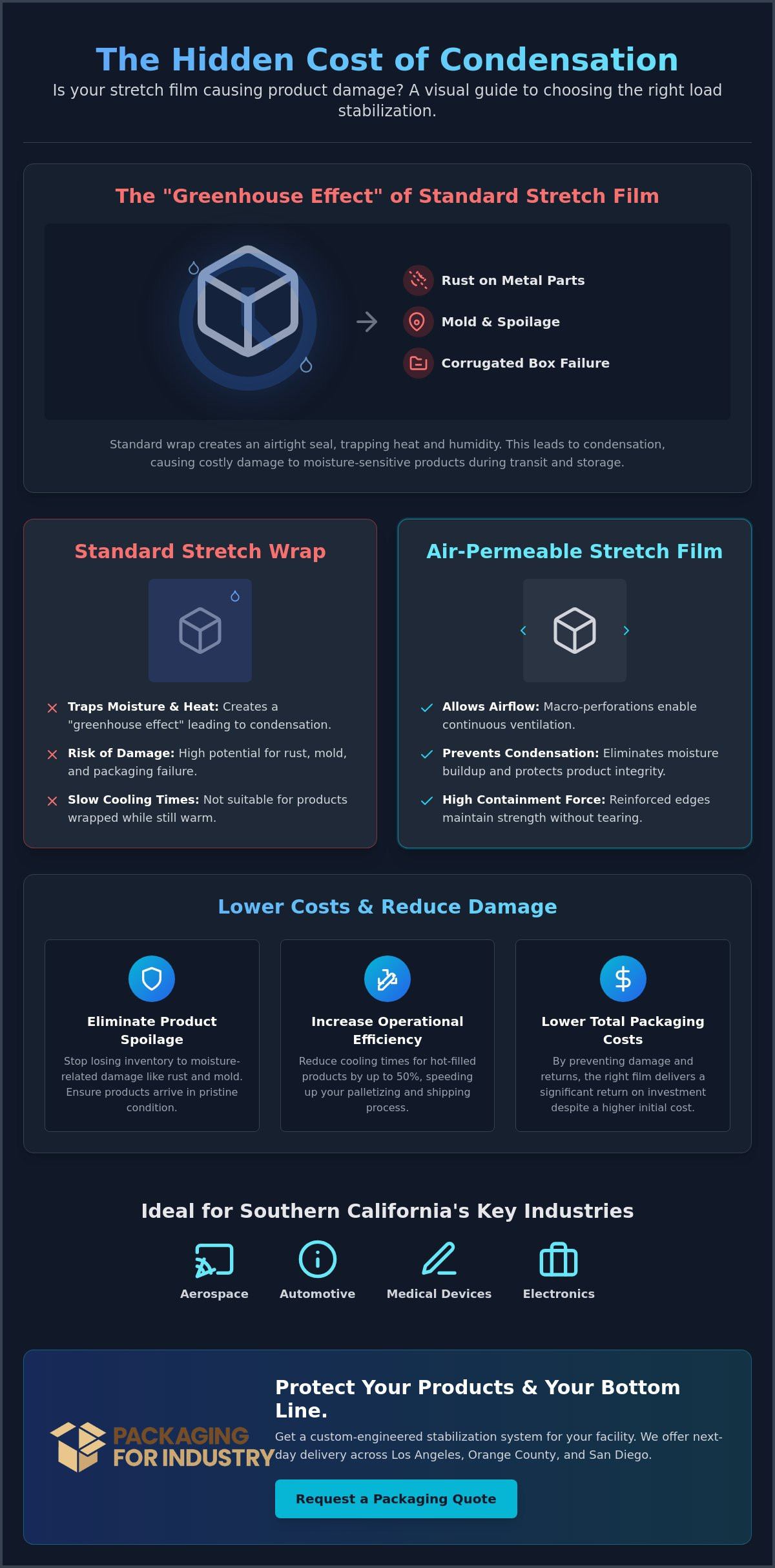
Calculating the ROI: Lowering Costs and Reducing Damage
When evaluating packaging materials, many procurement officers focus solely on the price per roll. However, the direct cost of the film typically represents only 10% of the total expense associated with pallet stabilization. To understand the true return on investment, you must look at the indirect costs of transit damage and operational delays. By implementing air-permeable stretch film, you address the root causes of moisture-related loss rather than just paying for containment.
A “Spoilage Audit” is a practical way to quantify these hidden costs. Track how many units arrive at their destination with surface rust, compromised labels, or softened corrugated boxes due to “sweating.” These aren’t just minor shipping issues; they represent lost revenue, administrative labor for claims, and potential strain on client relationships. When you account for the cost of inventory replacement and expedited re-shipping, the slightly higher initial cost of a breathable wrap often pays for itself within a single shipping cycle.
Labor efficiency also improves on the shipping dock. Because breathable film allows for immediate wrapping of warm or damp products, you eliminate the need for pallets to sit idle while cooling or drying. This faster throughput increases your warehouse capacity and ensures that your fulfillment schedule remains predictable. Additionally, because these films are often pre-stretched and reinforced, they can be thinner than standard wraps. This reduces the total weight of the pallet, which can lead to marginal but consistent freight savings over thousands of shipments.
Reducing Shipping Damage and Surcharges
Proper load stabilization is the best defense against high UPS or FedEx damage claims. When cargo shifts because the film failed or the box softened from trapped humidity, you face expensive surcharges and denied claims. Air-permeable stretch film provides the structural rigidity of a traditional wrap while allowing internal air circulation. This often eliminates the need for expensive secondary measures like moisture-absorbing desiccants or VCI bags. Air-permeable film reduces the total cost of ownership by preventing product rework and returns.
In the context of international trade, where goods are often subjected to extreme humidity during maritime transit, you can discover Adimar Shipping, Inc. to learn how specialized ship agencies manage vessel movement through the Panama Canal.
Procurement Strategies for Bulk Buyers
For high-volume operations, the most effective way to lower expenses is through strategic sourcing. By leveraging wholesale stretch film pricing, you can secure bulk rates that make the transition to breathable wrap even more cost-effective. We recommend integrating these materials into your broader packaging cost savings audits to identify exactly where ventilation can replace more expensive protective layers. Maintaining a consistent stock through our local delivery network also ensures you don’t face supply chain shortages that could halt production. If you are ready to evaluate the ROI for your facility, you can request a packaging quote for a customized analysis of your shipping data.
Why Choose PFI for Your Load Stabilization Needs?
At Packaging For Industry (PFI), we treat load stabilization as a critical engineering requirement rather than a simple procurement line item. We don’t just supply rolls of film; we design comprehensive stabilization systems that protect your bottom line. Our team serves as a technical partner for manufacturers throughout Los Angeles, Orange County, and San Diego. We ensure that your choice of air-permeable stretch film integrates perfectly with other components like heavy-duty corrugated boxes and high-impact corner protection. This holistic approach guarantees that your pallets remain secure and moisture-free from the moment they leave your dock until they reach the end-user.
Operational reliability is the foundation of our service model. Much like how Foundation Care Pros ensures structural stability through expert foundation repair and waterproofing, we focus on the core integrity of your supply chain. We offer local next-day delivery across the Inland Empire and nationwide shipping to support your multi-site operations. Our goal is to lower your packaging costs by improving supply reliability and reducing the administrative burden of inventory management. By combining high-performance materials with just-in-time delivery, we help you maintain a lean operation without the risk of stockouts. Whether you are shipping precision aerospace parts or temperature-sensitive food products, we provide the steady partnership you need to eliminate professional stress and focus on your core production goals.
Vendor Managed Inventory (VMI) for Stretch Film
Managing inventory for specialized materials like air-permeable stretch film can be complex due to fluctuating production demands. PFI simplifies this through our Vendor Managed Inventory (VMI) programs. We take full responsibility for monitoring your stock levels, utilizing customized review cycles based on your actual consumption patterns. This proactive management prevents critical shortages and frees up valuable warehouse space by allowing you to stock only what you need. It’s a pragmatic solution for facilities looking to streamline their logistical flow and reduce the overhead of manual ordering.
Request a Custom Packaging Quote
Transitioning to a breathable stabilization system requires technical precision. PFI provides free prototyping and technical reviews to ensure your wrap pattern provides maximum airflow and load retention. Our expert consultants work directly with Southern California manufacturers to conduct on-site audits and performance testing. We’ll help you determine the exact perforation pattern and tension settings required for your specific cargo. We invite you to contact our team today to request a packaging quote and discover how our engineered solutions can reduce shipping damage and optimize your industrial shipping operations.
Secure Your Shipments with Engineered Breathable Solutions
Implementing air-permeable stretch film is a pragmatic decision that addresses the critical intersection of engineering and economics. By eliminating the moisture buildup that causes rust, mold, and label failure, you protect high-value inventory while significantly lowering your total cost of ownership. We’ve examined how modern macro-perforations maintain load integrity without trapping heat; now it’s time to apply these specialized stabilization tools to your specific operational needs.
PFI provides more than just high-performance wrap. We support manufacturers with custom engineering and free prototyping to ensure your stabilization pattern is perfectly tailored to your cargo. Our expert VMI programs manage your stock levels with precision, while our local next-day delivery in Southern California keeps your fulfillment cycles efficient. It’s time to eliminate the professional stress of moisture damage and move toward a more reliable supply chain that prioritizes both protection and fiscal responsibility.
Request a Custom Packaging Quote Today to begin your facility audit. We look forward to helping you optimize your pallet stabilization and reduce transit losses through our specialized industrial solutions.
Frequently Asked Questions
Is air-permeable stretch film as strong as regular pallet wrap?
Modern engineering ensures that breathable films provide comparable containment force to standard wraps. Reinforced strands distribute tension across the web to prevent tearing during application. This allows you to secure heavy industrial loads without the structural failure often associated with basic perforated materials. It provides the rigidity needed for transit while maintaining vital ventilation for your cargo.
Can I use breathable stretch film on my existing automatic pallet wrapper?
Most high-performance breathable films are fully compatible with standard automatic pallet wrappers. You don’t need to purchase specialized equipment; however, we recommend adjusting your tension settings to optimize the film’s reinforced edges. Our technical team provides free prototyping to ensure your machine settings maximize both airflow and load stability for your specific production line.
Which industries benefit most from using perforated stretch film?
Aerospace, automotive, and medical industries see significant benefits alongside the traditional food and beverage sectors. Any operation dealing with moisture-sensitive metals or precision components prone to oxidation should utilize air-permeable stretch film. It’s also essential for logistics providers moving goods through the fluctuating humidity levels found between coastal Los Angeles and the Inland Empire.
Does breathable film help with condensation in refrigerated shipping?
It is highly effective at preventing condensation during temperature-controlled transit. When cargo moves from cold storage to a refrigerated truck, the macro-perforations allow for rapid temperature equalization. This prevents the “sweating” that occurs when warm air meets cold product surfaces, which protects your corrugated boxes from softening or collapsing due to moisture absorption.
Is air-permeable film recyclable in Southern California?
Yes, these films are typically manufactured from 100% recyclable polyethylene. Manufacturers in Orange County and Los Angeles can integrate this material into their existing plastic recycling streams. This helps your facility stay ahead of California’s SB 54 regulations, which require all single-use plastic packaging to be recyclable or compostable by the year 2032.
How much does air-permeable stretch film cost compared to standard film?
The initial roll price is often higher than standard film, but the total cost of ownership is generally lower. You save money by eliminating product rework, reducing mold-related spoilage, and removing the need for secondary moisture barriers. We focus on helping you lower packaging costs by quantifying these indirect savings during our initial facility audits and technical reviews.
Can I get custom perforation patterns for specific industrial parts?
Custom macro-perforation patterns are available to meet specific airflow and containment requirements. High-density industrial parts may require larger holes for heat dissipation, while lighter cargo might benefit from a denser pattern of smaller perforations. We work with you to design a stabilization system that matches the unique dimensions and thermal properties of your specific industrial cargo.
What is the lead time for bulk orders of breathable film in Los Angeles?
PFI offers local next-day delivery for many stocked items throughout Los Angeles, San Diego, and Orange County. For specialized or custom bulk orders, our lead times are designed to support just-in-time manufacturing schedules. Our Vendor Managed Inventory programs also ensure we maintain your air-permeable stretch film stock levels automatically, which prevents production delays due to material shortages.