
Is your pallet wrapping strategy a calculated logistics asset or a growing financial liability under California’s SB 54 regulations? With the May 1, 2026, regulatory deadline now in effect, warehouse managers in Los Angeles and Orange County are facing a new reality of producer fees and strict plastic reduction targets. You’ve likely noticed that the old way of simply adding more layers to secure a load is no longer sustainable or cost-effective. The pressure to reduce stretch film usage has shifted from a corporate sustainability goal to a mandatory fiscal necessity.
We understand that your primary concern is maintaining load integrity while navigating these new mandates. This article provides a roadmap to optimize your pallet stabilization through material engineering and precise application. You’ll learn how to lower your cost per pallet wrapped and achieve zero transit damage while staying compliant with the Circular Action Alliance’s latest requirements. We’ll examine high-performance film alternatives, machine calibration techniques, and the strategic downgauging needed to hit your August 1 plastic-reduction plan deadlines.
Key Takeaways
- Shift your focus from the price-per-roll to the cost-per-load to uncover the true economic impact of your pallet wrapping operations.
- Discover how transitioning to high-performance, multi-layer films allows you to reduce stretch film usage without risking load failure or safety.
- Learn to calibrate your wrap machine settings and pre-stretch carriages to cut material consumption by up to 50% while maintaining containment force.
- Explore the synergy between corner protection and film performance to maximize vertical stack strength and eliminate shipping damage.
- Identify hidden inefficiencies in your supply chain with a professional packaging review and leverage local next-day delivery in Orange County and Los Angeles.
The Economics of Stretch Film Efficiency in 2026
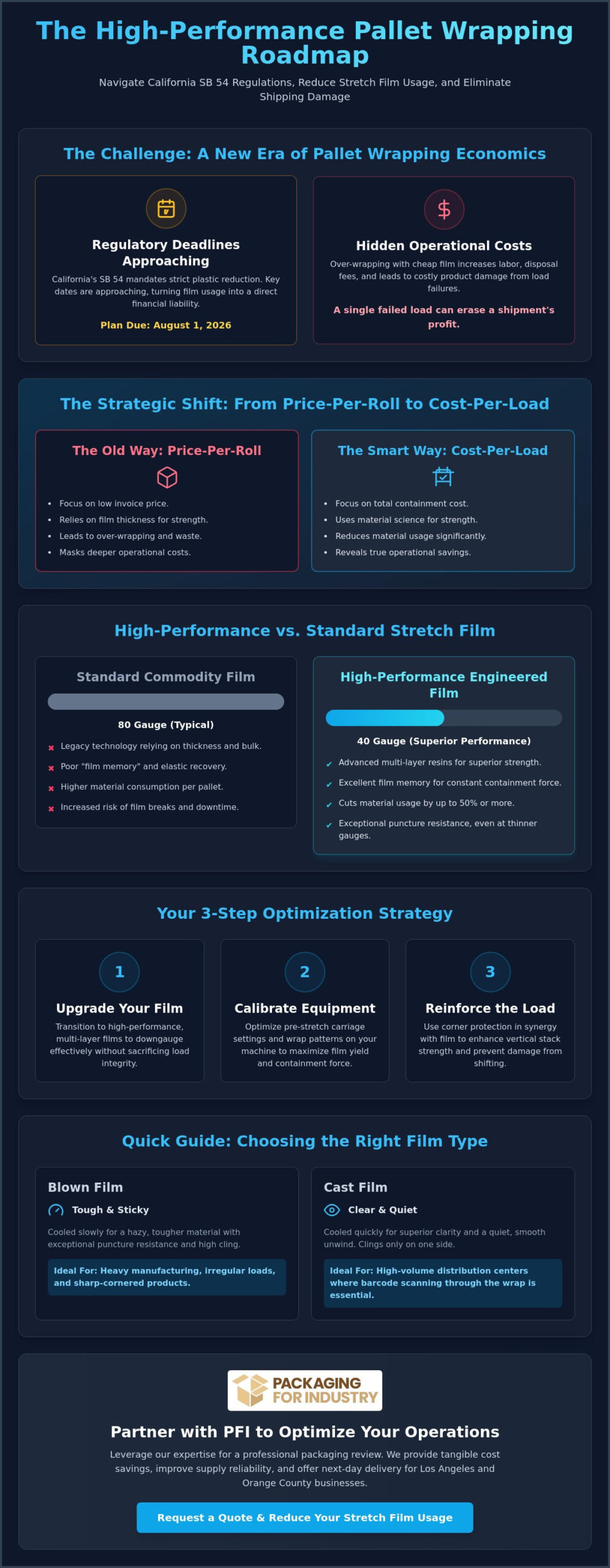
Many procurement managers make the mistake of focusing solely on the price per roll of stretch wrap. While a lower invoice price for a pallet of film looks good on a monthly budget report, it often masks a deeper operational inefficiency. In 2026, the true measure of fiscal responsibility is the cost-per-load rather than the cost-per-pound of resin. If your team uses three pounds of a standard commodity film to secure a pallet that could be stabilized with one pound of high-performance material, your actual expenses are skyrocketing.
Over-wrapping creates a cascade of hidden costs that extend far beyond the initial purchase. You’re paying for additional labor hours as operators spend more time circling pallets. You’re also paying disposal fees for the excessive plastic waste generated at the destination. Most importantly, improper stabilization often leads to product damage. A single failed load can result in freight claims that erase the profit margin of an entire shipment. Modern logistics standards now prioritize high-performance resins that offer superior puncture resistance and elastic recovery at thinner gauges.
Calculating Your Cost-Per-Load
To reduce stretch film usage effectively, you must first establish a baseline measurement. We recommend a simple “cut and weigh” test. Weigh a wrapped pallet, remove the film, and then weigh the film alone. This reveals the exact amount of material consumed per shipment. You should also track “film breaks” per shift. Every time a film snaps, your automated line stops or your manual wrapper must restart. This downtime is a silent killer of warehouse throughput. By identifying these gaps, you can secure tangible packaging cost savings while improving operational reliability.
The Environmental and Regulatory Pressure
California’s SB 54 regulations have fundamentally changed the math for warehouses in San Diego, Los Angeles, and Orange County. Producers are now financially responsible for the end-of-life management of plastic packaging, with the first major reduction plans due by August 1, 2026. Every extra ounce of film you use is now a potential regulatory liability and a source of unnecessary fees. Leading manufacturers are prioritizing source reduction to meet these mandates. By choosing thinner, engineered resins, you can maintain load integrity while drastically lowering the plastic footprint of your Southern California warehouse operations. It’s a pragmatic approach that aligns corporate sustainability goals with the bottom line.
High-Performance vs. Standard Stretch Films
Standard commodity films are often a relic of legacy procurement strategies. For decades, the industry relied on thickness as the primary indicator of strength. Material engineering has evolved significantly. Modern high-performance films utilize advanced resin blends and multi-layer construction to provide superior containment with less material. This shift is essential for any facility looking to reduce stretch film usage while maintaining load safety. This technological leap is the most effective way to optimize your pallet stabilization without compromising the structural integrity of your shipments.
The core of this evolution lies in film memory. When high-performance film is stretched during application, it possesses a natural tendency to return to its original state. This creates a constant compressive force that secures the load more effectively than the “bulk” of a thicker, standard film. It allows a 40-gauge engineered film to outperform an 80-gauge commodity film in almost every metric, including puncture resistance and load retention. You can explore these advanced options in our Stretch Film inventory to see how downgauging can work for your facility.
Material Science: Gauges, Microns, and Puncture Resistance
Gauge and micron are measurements of thickness, but they don’t define performance. Puncture resistance is the critical metric for industrial loads with irregular shapes or sharp corners. Blown film is cooled slowly, resulting in a tougher, stickier material with exceptional puncture resistance. It’s the preferred choice for heavy manufacturing. Conversely, cast film is cooled quickly over chilled rollers. It’s quieter to unwind and offers high clarity, which is vital for high-volume distribution centers in Los Angeles and San Diego where barcode scanning through the wrap is a daily requirement.
Selecting the Right Film for Your Industry
Different sectors require specialized film properties to ensure supply reliability. In aerospace and defense, opaque or UV-protected films prevent light degradation and secure sensitive components from prying eyes. Medical and electronics manufacturers often require anti-static (ESD) films to prevent electrostatic discharge during transit. As you evaluate these materials, consider how they align with California’s packaging regulations. Using less material through downgauging is the most direct way to comply with state mandates. If you’re unsure which resin blend fits your load profile, you can request a custom packaging assessment to identify the most efficient film for your specific operations.
Optimizing Machine Settings and Wrap Patterns
Selecting a high-performance film is a critical first step, but the way you apply it determines whether you actually capture those savings. Many warehouses in Los Angeles and San Diego operate with equipment that hasn’t been calibrated in years. This oversight leads to massive material waste and inconsistent load stability. To reduce stretch film usage, you must shift your focus from the number of layers to the actual containment force. Containment force is the total pressure applied to the load by the film; it’s the only metric that reliably predicts whether your pallet will survive the rigors of transit.
The most significant tool in your arsenal is the pre-stretch carriage. Modern carriages mechanically stretch the film before it ever touches the pallet, often reaching levels of 250% or more. This process essentially turns one foot of film into three. By maximizing your machine’s pre-stretch capabilities, you can cut material consumption by up to 50% while maintaining superior load security. If your turntable or rotary arm is still set to factory defaults, you’re likely leaving money on the warehouse floor. Precision application is the difference between a secure shipment and a costly freight claim.
The 5-Step Calibration for Stretch Wrappers
Calibration should be a standard part of your operational maintenance. First, measure your current containment force at the top, middle, and bottom of a test load using a specialized gauge. Second, increase the tension settings incrementally to find the “sweet spot” just before the film breaks. Third, adjust the turntable speed to ensure a consistent 50% overlap. Fourth, focus your wrap pattern on the base of the load. A common mistake is over-wrapping the top while failing to secure the boxes to the pallet itself. Finally, verify the results with a transit test to ensure the load remains unified.
Hand Wrapping vs. Machine Wrapping Efficiency
Manual hand wrapping is rarely consistent and often leads to excessive material waste. It’s physically taxing for employees, which frequently results in poor tension as the shift progresses. If your facility wraps more than 10 to 15 pallets per day, transitioning to a machine will significantly lower your per-load costs. Machines provide a level of precision that human operators cannot replicate, ensuring every pallet receives the exact amount of film required. This transition is one of the most effective ways to reduce stretch film usage across a high-volume operation. For lower volumes, training staff on proper hand-wrap techniques is still essential to prevent fatigue and unnecessary waste.
Load Stabilization Beyond the Film
Achieving a secure load without excessive material consumption requires looking beyond the film roll itself. Many operators try to solve stability issues by adding more layers, but this is a reactive and expensive approach. Instead, integrating corner and edge protection provides the structural rigidity needed to maintain stack integrity. These components allow you to reduce stretch film usage because the film no longer has to compensate for weak corners or shifting boxes. When you reinforce the vertical strength of a pallet, you can reach the required containment force with fewer revolutions of the wrapper.
The synergy between pallet quality and film performance is often overlooked. A pallet with broken boards or inconsistent dimensions forces the wrapper to work harder, leading to more film breaks and wasted material. Similarly, anti-slip sheets or adhesives can lock layers together, preventing horizontal shifting during transit. These tools are discussed in depth within our Industrial Packaging Guide, which outlines how engineering and economics intersect in modern logistics. By using these secondary stabilization tools, you create a more resilient unit that relies on physics rather than just bulk plastic.
Integrated Load Protection Strategies
A holistic system combines corrugated boxes, pallets, and film into a single unit. If your box-to-pallet fitment is poor, you’ll inevitably use more plastic to bridge the gaps. By optimizing the dimensions of your RSC or double-wall boxes to fit the pallet footprint perfectly, you eliminate the need for excessive webbing or over-wrapping the base. This precision doesn’t just save on film; it also reduces the risk of product damage by ensuring the load is centered and balanced from the moment it leaves your Los Angeles or Orange County facility.
The Role of Inventory Management
Operational efficiency is often a data problem. Implementing Vendor Managed Inventory (VMI) allows you to track film consumption patterns in real-time. This visibility helps you identify when usage spikes due to poor machine calibration or operator error. Combined with Just-In-Time (JIT) management, you can ensure that your warehouse always has the right high-performance resins on hand without cluttering your floor space. This proactive oversight is the most reliable way to maintain consistent reduce stretch film usage targets across multiple shifts. If you’re ready to optimize your supply chain and lower per-load costs, request a packaging quote to see how our VMI programs can streamline your operations.
Why Partner with Packaging For Industry (PFI)?
Optimizing your warehouse operations requires more than just a new pallet of resin. While large catalog suppliers focus on high-volume transactions, PFI operates as a technical partner and a strategic “fixer” for your logistics challenges. We don’t just ship rolls. Our team conducts on-site reviews to evaluate your current wrap patterns and machine settings, ensuring your warehouse meets the strict requirements of SB 54. This consultative approach is the most reliable way to reduce stretch film usage while simultaneously lowering your per-load costs and improving shipping safety.
Our expertise bridges the gap between material engineering and economic reality. For manufacturers in the aerospace and medical sectors, we design custom-engineered solutions that account for sensitive components and strict defense specifications. We challenge the pricing of large catalog giants by offering specialized knowledge that prevents over-wrapping and material waste. When you partner with us, you gain access to a seasoned packaging consultant who understands the nuances of load containment, not just a call center representative reading from a script.
Similarly, for other critical facility needs like fire safety, working with a specialized contractor such as Firemex Solutions Inc. ensures your California warehouse remains compliant and protected from unforeseen risks.
While specialized contractors handle system design and compliance, sourcing reliable hardware is equally important; you can learn more about Fire Protection Parts and their selection of high-quality suppression system components for industrial facilities.
The PFI Advantage in Southern California
Proximity is a vital component of supply reliability. As a local Southern California packaging supplier, we provide next-day delivery to facilities in Orange County and Los Angeles. Our local expertise extends to the industrial hubs of Anaheim, Riverside, and San Bernardino, where we help distributors navigate high-velocity shipping demands. We offer free prototyping and comprehensive packaging analysis to identify where your current system is failing. By analyzing the physical properties of your loads, we can recommend the exact high-performance film that will reduce stretch film usage without risking a single freight claim.
Request Your Custom Quote
Starting a film usage audit is the first step toward significant operational improvement. Our technical team will help you measure your current containment force and identify specific opportunities for downgauging. We offer bulk pricing advantages for high-volume manufacturers and fulfillment centers, ensuring your supply chain remains both lean and resilient. Whether you need a local partner for vendor-managed inventory or a custom solution for complex aerospace logistics, we are ready to stabilize your bottom line. To begin your assessment and lower your packaging costs, Request a Stretch Film Quote today.
Future-Proof Your Warehouse Operations
Moving toward a lean, efficient pallet wrapping process is no longer just an option; it’s a requirement for staying competitive in the California logistics market. By shifting your focus from the price of the roll to the actual cost-per-load, you can unlock significant savings while meeting the strict demands of SB 54. Integrating high-performance resins and optimizing your machine’s pre-stretch settings are the most effective ways to reduce stretch film usage without compromising the safety of your shipments. We fix operational gaps that large catalog suppliers often ignore.
At PFI, we provide the specialized expertise needed to navigate these technical and regulatory challenges. Our team offers a pragmatic, engineering-minded approach to aerospace and industrial manufacturing logistics. We combine custom-engineered solutions with the convenience of local next-day delivery across Southern California to ensure your supply chain remains reliable and cost-effective. Your bottom line deserves precision, not just bulk supplies.
Take the first step toward eliminating transit damage and minimizing plastic waste. Request a Packaging Quote to Lower Your Costs and discover how a professional film audit can transform your warehouse efficiency. We look forward to building a more resilient operation with you.
Frequently Asked Questions
How can I calculate how much stretch film I am currently wasting?
You can calculate waste by performing a “cut and weigh” test on a typical wrapped pallet. Remove the film from a finished load, weigh it on a precision scale, and multiply that weight by your annual pallet volume to determine total material consumption. Comparing this figure to the weight achieved after a professional calibration reveals the exact amount of plastic waste your facility generates.
Is pre-stretched film actually better than standard film for reducing usage?
Pre-stretched film is highly effective for facilities looking to reduce stretch film usage because it’s already extended near its breaking point during manufacturing. This allows operators to achieve high containment force with minimal physical effort and less material. It’s especially useful for manual wrapping operations where human fatigue often leads to inconsistent tension and over-wrapping.
What is the ideal containment force for a standard 2,000 lb pallet?
The ideal containment force for a 2,000 lb pallet typically ranges between 12 and 20 pounds. You should measure this force at the top, middle, and bottom of the load using a specialized gauge to ensure uniformity. Maintaining this specific range prevents the load from shifting during transit while ensuring you aren’t using excessive film that adds unnecessary cost.
Can high-performance thin films really hold heavy industrial equipment?
High-performance thin films utilize advanced, multi-layer resin blends that offer superior load retention compared to thick commodity films. These engineered materials have a higher “elastic memory,” meaning they pull back tighter against the load once applied. This allows a thinner gauge film to secure heavy industrial equipment more effectively than a standard 80-gauge film.
How does temperature affect stretch film performance in non-climate-controlled warehouses?
Temperature extremes can compromise the integrity of your pallet loads. High heat often leads to “film creep,” where the plastic loses its tension and stretches out, causing the load to loosen. In cold environments, film can become brittle and snap during application. We recommend selecting resin blends specifically engineered to maintain their properties in your specific warehouse climate.
Does PFI offer local delivery for stretch film in Orange County?
Yes, PFI provides local next-day delivery for stretch film and other packaging supplies throughout Orange County, Los Angeles, and San Diego. Our local delivery fleet ensures that you have access to the materials you need without the high shipping costs or long lead times of national catalog suppliers. This proximity helps you maintain a lean inventory while ensuring supply reliability.
What is the difference between cast and blown stretch film for load stability?
Blown film is cooled slowly to create a tough, high-cling material with exceptional puncture resistance, making it ideal for heavy or sharp-edged loads. Cast film is cooled quickly over chilled rollers, resulting in a quieter, high-clarity film that’s perfect for barcode scanning. Selecting the right type based on your load profile is a key step to reduce stretch film usage effectively.
How can Vendor Managed Inventory (VMI) help me reduce my packaging costs?
Vendor Managed Inventory (VMI) allows us to monitor your film consumption patterns and identify usage spikes caused by poor machine calibration or operator error. By analyzing this data, we can implement corrective measures that lower packaging costs and prevent material waste. This system ensures you always have high-performance film in stock without the burden of over-ordering or managing complex inventory counts.