
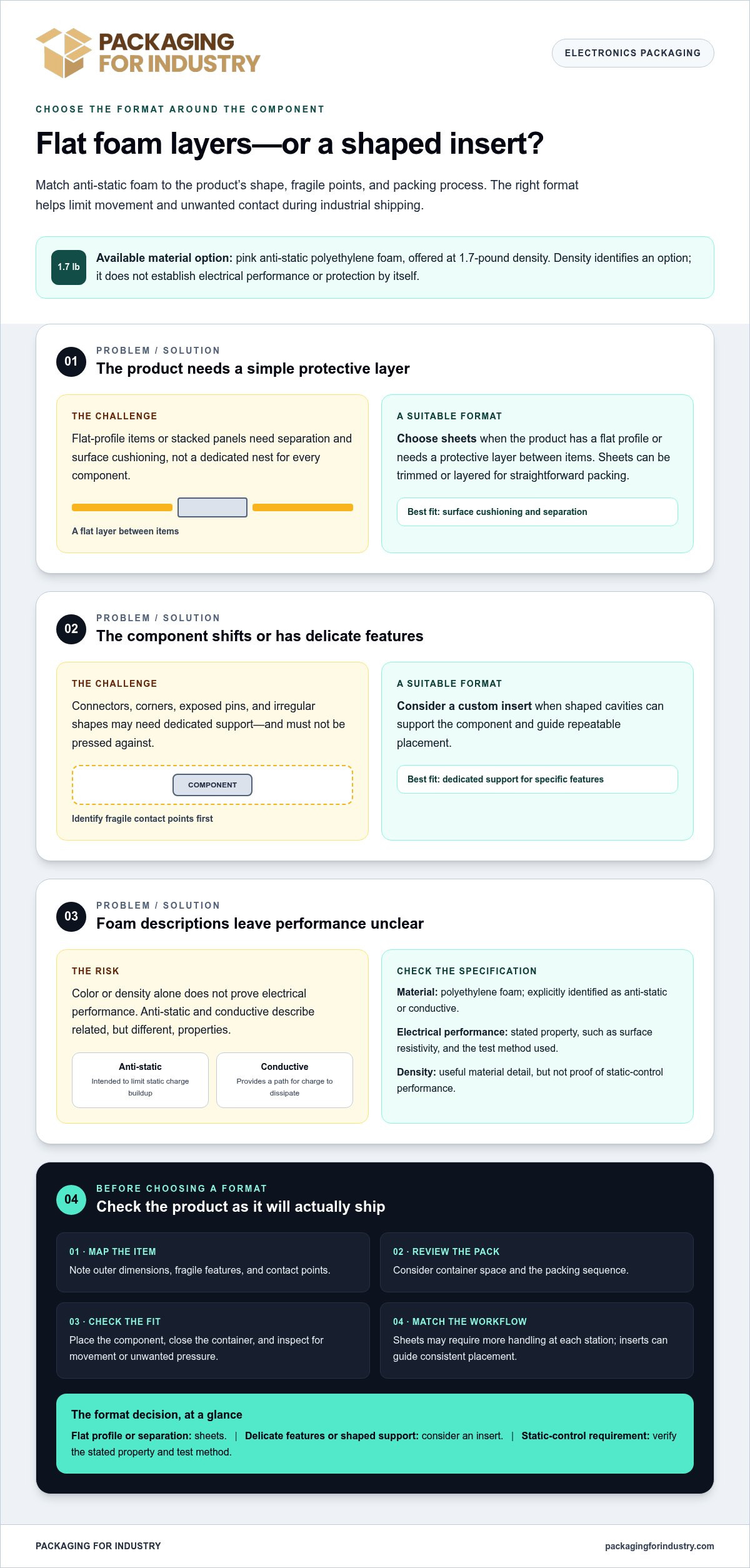
The standard sheet may be the smarter choice when electronics need a simple protective layer; custom inserts make more sense when parts need to stay positioned in shaped cavities. Anti-static polyethylene foam sheets in Los Angeles are available as 1.7-pound pink foam, giving buyers a defined material option for electronics packaging. The right format depends on the product’s shape, how it will be packed, and the protection needed in transit.
It’s reasonable to want reliable protection without adding unnecessary material or packing steps. This guide explains how anti-static foam helps protect electronics during industrial shipping and how to choose between standard sheets and custom inserts. You’ll also learn what to consider when matching foam cushioning to your products and shipping process.
Key Takeaways
- Choose standard sheets for straightforward surface cushioning; consider custom inserts when components need shaped compartments and consistent positioning.
- Pink anti-static polyethylene foam is offered at 1.7-pound density, a useful starting point when evaluating foam for electronics packaging.
- Match the cushioning format to the component’s shape, packing workflow, and shipping conditions to help reduce movement and damage in transit.
- Plan bulk sheet purchasing around packaging volume and storage needs so replenishment supports production and shipping schedules.
- PFI’s foam packaging can support projects that need a more tailored approach to protecting products during industrial shipping.
Protection for sensitive electronics
Electronic components can be damaged by static discharge, impact, and vibration during handling and shipping. Anti-static polyethylene foam provides cushioning and helps address static concerns around products such as circuit boards, control modules, and sensors. For buyers comparing anti-static polyethylene foam sheets in Los Angeles, the first decision is whether a flat layer will protect the item or whether it needs a shaped nest.
Anti-static polyethylene foam is offered as 1.7-pound pink foam. Density is one selection factor, not a complete measure of protection: the component’s weight, shape, fragile points, and packing arrangement also matter. A small circuit board may need support around its edges, while a heavier electronics assembly may need cushioning that limits movement inside its shipping container.
Static control and physical cushioning solve different packaging problems. Anti-static foam is intended for packaging sensitive electronics where static buildup is a concern. Foam thickness and how the product is held address contact and movement. A sheet between stacked components can separate surfaces, while a cutout can keep a single device from shifting. Neither format replaces careful handling during packing, loading, or unpacking.
Use these checks to narrow the format:
- Choose sheets when the product has a flat profile or needs a protective layer between items, such as panels separated in a shipping pack.
- Consider an insert when connectors, corners, or irregular shapes need dedicated support and repeatable placement.
- Map contact points by identifying delicate areas, including exposed pins or display surfaces, before cutting or arranging foam.
- Review the packed unit by checking whether the component moves, presses against the container, or contacts another item.
A standard sheet can be trimmed or layered for a straightforward packing task, though it may require more handling at each packing station. A custom insert requires more design consideration but can guide packers toward consistent placement. For example, a sensor with a projecting connector may need a recess that protects the connector without putting pressure on it. A smooth-sided module may fit securely between flat foam layers instead.
Before selecting a format, assess the product as it will actually ship. Include its outer dimensions, delicate features, container space, and packing sequence. Then evaluate a sample pack: place the component, close the container, and inspect it for movement or unwanted pressure. This practical check helps match foam packaging to the electronics and workflow, rather than choosing a sheet by density alone.
Anti-static and conductive specialty foam
Anti-static polyethylene foam is offered as 1.7-pound pink foam. Its color and density identify a material option, but neither alone proves its electrical performance. A useful specification names the anti-static property and states the electrical measurement or test method used. That distinction matters when packaging circuit boards, sensors, or other electronic components.
What specifications indicate that polyethylene foam is genuinely anti-static? Look for an explicit anti-static designation and a stated electrical property, such as surface resistivity, along with its test method.
Anti-static and conductive foam serve related but different purposes. Anti-static foam is intended to limit static charge buildup; conductive foam provides a path for charge to dissipate. Match the material description to the component’s handling needs instead of treating the terms as interchangeable. For example, packaging a circuit board for routine movement through a warehouse may call for a different approach than securing a sensitive assembly within a controlled process.
Read the product specification for these details:
- Material identification: Confirm that the description identifies polyethylene foam and explicitly calls it anti-static or conductive.
- Electrical performance: Look for the measured property and the method used to test it, rather than relying on color or marketing language.
- Density: The available anti-static option described here is 1.7-pound pink foam. Density helps characterize the foam but does not, by itself, establish static-control performance.
- Intended use: Compare the stated application with the item being packed, such as a board, sensor, or electronic assembly.
Conductive foam may be appropriate when a conductive path is part of the packaging requirement. Anti-static foam may suit applications focused on controlling charge buildup. Neither label describes cushioning performance by itself. The product’s shape, contact points, and required support still affect whether flat sheets or a custom-cut form will work. A component with exposed contacts, for instance, needs packaging that avoids unwanted contact while holding it securely.
For repeatable packing, record the material designation and selected format in the packaging instructions. This helps purchasing, receiving, and production teams distinguish anti-static sheets from standard polyethylene foam and reduces substitutions based only on appearance. If a component’s geometry requires shaped cavities, custom design can help align the foam layout with its profile and packing sequence.
For a specialty foam project, request a foam packaging quote with the component description, packing method, and required electrical specification. Those details help frame a practical material and format selection.
Anti-static foam for industrial shipping
Typical applications include packaging circuit boards, sensors, control modules, and electronic assemblies for industrial shipment. Handle each item according to its packaging specification, and keep the foam identified so it isn’t confused with standard cushioning.
For a circuit board moving from production to a distribution center, foam can separate it from neighboring parts and help limit shifting inside the package. A sensor with delicate projections may need a layout that keeps those features clear of contact. The packaging should address both static concerns and physical movement, since anti-static material alone doesn’t secure a product during transit.
Shipping adds multiple handoffs: packing, staging, loading, transport, and receiving. At each step, a loose component can move against the container or another item. Select a sheet or insert based on the product’s dimensions, contact points, and how employees pack it. For example, flat sheets can separate stacked electronic panels, while a shaped cavity can hold an irregular assembly in position.
Use a repeatable packing routine for electronics shipments:
- Identify the item: Record the component type and any sensitive areas, such as exposed contacts or projecting connectors.
- Select the format: Use a sheet for simple separation; choose a shaped layout when the part needs defined placement.
- Pack consistently: Keep the component orientation and foam arrangement the same across repeat shipments.
- Inspect the closed pack: Check for movement, pressure on delicate features, or contact with other packed items.
- Preserve material identification: Store the anti-static foam separately from standard foam and retain its product description.
Anti-static polyethylene foam is offered as 1.7-pound pink foam. That product detail helps distinguish this specialty material during purchasing and warehouse handling. It doesn’t replace checking the package design: foam thickness, cutout shape, and container fit affect how the part is supported. A flat sheet may suit a uniform component, while a custom cavity can prevent an assembly from sliding during routine handling.
Keep packaging instructions specific to the application. A production team shipping circuit boards may need separation between units; a warehouse sending a single control module may need a stable nest and clear orientation. Documenting the chosen foam, placement, and inspection step helps packers follow the same process. This supports consistent preparation without assuming the same layout suits every electronic product.
Before a shipment enters the regular workflow, pack a representative item and inspect the closed container. Look for shifting or pressure on connectors, then adjust the foam arrangement to address those points. This practical review connects material selection to the actual shipping application.
Bulk foam sheet availability and delivery
For bulk purchasing, start by defining the exact foam grade and the role it will play on the packing line. The listed anti-static polyethylene sheet is pink and 1.7-pound density. Keep the material description clear when comparing standard cushioning with electronics packaging.
Estimate consumption from the actual packing method. If workers cut sheets into pads, record the cut dimensions and how many pieces each shipment uses. If a sheet lines a container, base the estimate on the container’s interior and the area requiring coverage. Include anticipated production changes in the purchasing plan so excess stock does not take up space or complicate inventory.
Use a consistent specification when comparing packaging and bulk packaging prices. Include the foam type, color, density, sheet dimensions, and expected usage. Note custom sizes needed for the packing operation, such as pads sized to separate components or liners fitted to a container. This gives suppliers and purchasing teams a clear basis for comparing equivalent requirements rather than different material formats.
Delivery planning matters as much as the material description. For packaging operations in Los Angeles, coordinate local delivery with receiving procedures, warehouse space, and production schedules. Identify the delivery location and any dock or storage constraints in advance. Once received, keep the foam clean, preserve its identifying labels, and store anti-static sheets apart from standard foam to reduce the chance of substitution.
Before placing a larger order, confirm the purchasing details:
- Grade: Specify anti-static polyethylene foam and the listed pink, 1.7-pound option.
- Format: State sheet dimensions and whether the process uses whole sheets or cut pieces.
- Usage: Estimate consumption from the packing method and planned production needs.
- Receiving: Note delivery location, storage capacity, and receiving requirements.
These details help align an order with actual consumption and warehouse capacity. Store closed-cell foam sheets so they stay clean and retain their intended form. If the product or packing method changes, update the specification and usage estimate before the next replenishment. This keeps purchasing records useful and helps teams plan supply without treating all polyethylene foam as interchangeable.
Share the foam grade, sheet dimensions, expected usage, and delivery requirements when you request a packaging quote. This provides a practical starting point for discussing bulk supply needs for your packaging workflow.
Foam cushioning and shock absorption
Polyethylene foam is a closed-cell material with shock absorption and vibration-dampening properties. It can also resist moisture, tearing, and chemicals, making it useful for industrial packaging. These properties help protect equipment during handling and transit, but the foam grade and package design still need to match the load.
Density provides a practical starting point. A 1.2-pound foam is often used for lightweight cushioning or protective wrapping around delicate surfaces. A 1.7-pound foam is often used as a baseline for custom inserts. These examples describe common applications, not a universal selection rule. Product weight, shape, and the way it’s supported in the package affect the result.
For general industrial packaging, 2.2-pound polyethylene foam is a workhorse variation. It may suit parts that need cushioning during repeated handling, provided the package supports them without unwanted movement. At the heavier end, 4.0-pound high-density foam is used for exceptionally heavy machinery or structural blocking. Blocking can help hold large equipment in place within its shipping configuration.
Match foam to the job by reviewing these factors:
- Product weight: A light instrument and a heavy machine place different demands on cushioning and support.
- Contact points: Identify edges, delicate surfaces, and areas that should not bear pressure.
- Movement inside the pack: Check whether the product can shift, rub, or strike the container during transit.
- Exposure conditions: Consider moisture or contact with chemicals as part of the packaging environment.
- Pack style: Decide whether the product needs wrapping, flat cushioning, an insert, or structural blocking.
For example, a delicate finished panel may need protective wrapping that limits surface contact. A heavy machine may need structural foam blocks positioned to support its base and prevent shifting. In both cases, the foam’s thickness, placement, and fit influence how it cushions the product. Dense material alone cannot correct a package that leaves the load unsupported.
Before adopting a foam layout, pack a representative product and inspect the closed container. Confirm that the item stays supported and that the cushioning does not press on fragile areas. For moisture-sensitive equipment, assess the complete packaging arrangement rather than treating moisture resistance as a substitute for appropriate protection. A practical review can reveal whether the chosen foam and package work together.
Use these density examples to narrow the material discussion, then base the final design on the product and shipping application. This helps align cushioning with the item’s weight and handling needs, rather than selecting foam by density alone.
Packaging For Industry (PFI): Foam Packaging
Packaging For Industry (PFI) supplies foam packaging for businesses protecting products during handling and industrial shipping. Turn to PFI when you need to assess how foam fits your product, packing process, and supply requirements. Sharing the item’s dimensions, sensitive areas, and packing method helps focus the discussion on a practical packaging approach.
If foam is part of a broader packaging workflow, PFI also offers Vendor Managed Inventory (VMI) and Just-In-Time (JIT) inventory management for packaging. These services can help teams coordinate packaging supply with operational demand. Describe the product and shipping application, then discuss your foam packaging requirements with PFI.
Make the Next Packaging Decision Operational
For teams sourcing anti-static polyethylene foam sheets in Los Angeles, the next step is to turn the material choice into a repeatable packing process. Run a trial with the actual product and shipping container, then document how the foam is placed and how the item is secured. That record gives purchasing and warehouse teams a clear specification to follow as orders repeat. Use the trial to identify practical changes, such as adjusting the foam layout or clarifying packer instructions. Keep the product description and handling steps together so future replenishment supports the same packaging method. A defined process can help reduce avoidable variation and make shipping protection easier to manage across production and fulfillment.
Share your product and packaging requirements with Packaging For Industry (PFI) to discuss a suitable next step for your operation.
A clear specification is a practical foundation for protecting electronics as your shipping workflow moves forward.
Frequently Asked Questions
How do I determine if I need custom foam inserts or standard sheets?
Choose standard sheets when the packing task is consistent and the product needs a flat separator or protective layer. Consider a custom insert if the item has projections, varying contours, or a repeatable orientation requirement. For example, a production line packing the same instrument repeatedly may benefit from a shaped nest that guides placement. Compare the packing steps, product variation, and container space before deciding.
How does anti-static foam work for industrial shipping?
Anti-static foam is used in packaging to help limit static charge buildup around sensitive components. Its role is one part of the shipping system, alongside secure placement, cushioning, and suitable handling. For example, a control module can be arranged so its contact points avoid rubbing against other items. Set clear packing instructions for staff, and keep specialty foam identifiable during storage and replenishment.
Is polyethylene foam safe for sensitive electronics?
Polyethylene foam is used to package sensitive electronics, and anti-static grades are intended for applications where static control matters. Select the grade based on the component’s packaging requirements, not the foam’s appearance alone. A circuit board and a finished display may need different contact protection. Include the product type, exposed features, and packing method in the material specification so purchasing and warehouse teams use the intended foam.
Where can I buy anti-static polyethylene foam sheets in Los Angeles?
For industrial packaging in Los Angeles, Packaging For Industry (PFI) offers foam packaging, including anti-static and ESD foam options. Its packaging solutions serve electronics, aerospace, and medical device manufacturers, whose components may have distinct protection and handling needs. Describe the product, sheet format, and shipping application to define the requirement. For example, explain whether the material separates components or lines an individual shipping container.
Which Los Angeles suppliers stock anti-static polyethylene foam sheets?
Packaging For Industry (PFI) serves industrial buyers in the Los Angeles area and offers foam packaging, including anti-static foam. When sourcing, identify the required material grade and whether the job calls for sheet stock or a designed foam layout. This distinction helps frame the order around the packing process, whether the foam will be used as cut pads or integrated into a protective assembly.
What sizes and thicknesses of anti-static polyethylene foam sheets are available?
Sheet dimensions and thickness should match the product, container, and packing method. Provide the required length and width, the space available inside the package, and whether packers will use whole sheets or cut sections. For example, a liner needs to fit the container, while a separator may need to cover only the product’s contact area. These specifications help define a suitable sheet format.
Can Los Angeles suppliers cut anti-static polyethylene foam sheets to custom sizes?
Custom foam design can address applications that need shaped components rather than simple flat sheets. Packaging For Industry (PFI) offers custom packaging design, including foam inserts. Share a product drawing or dimensions, note any delicate features, and describe how employees load the item. This information helps define a layout for the packaging application, especially when consistent positioning matters across repeat shipments.
What is the difference between anti-static and conductive polyethylene foam?
Anti-static foam is intended to limit static charge buildup, while conductive foam provides a path for charge to dissipate. The terms describe different electrical properties, so don’t substitute one for the other based on color or appearance. In a purchasing specification, identify the required material type and stated electrical performance. Then match that requirement to the component’s handling process and the packaging design used for shipment.