
Outsourcing packaging can free up space, labor, and equipment, but it doesn’t automatically lower costs or improve service. Transitioning from in-house packaging to a 3rd party provider makes sense when the value of shared logistics resources and external expertise outweighs the control and flexibility your team would give up. The right choice depends on your operating costs, volume, packaging needs, and ability to manage the work internally.
It’s reasonable to weigh the full operation, not just the per-order charge. This comparison explains how in-house and outsourced packaging differ in cost structure, staff and equipment demands, product-specific support, logistics capacity, visibility, and technology fit. You’ll also find a practical decision guide to help identify which tasks to keep in-house and which may be better handled by an outside provider.
Key Takeaways
- Compare total operating costs, including labor, space, equipment, storage, and service fees, rather than relying on a per-order figure alone.
- Assess how much control your packaging process requires and whether outside expertise or shared logistics resources address current capacity constraints.
- Map required inventory visibility, software integrations, packing instructions, and service metrics before moving work to a 3PL.
- Use a pilot and a documented transition plan to surface process or inventory issues before shifting more packaging work.
- Consider a hybrid approach, keeping specialized or tightly controlled tasks in-house while outsourcing work that is harder to scale internally.
Assessing customer support and product-specific expertise
A 3PL can manage warehousing, transportation, fulfillment, and returns, but its capabilities must match your packaging operation. During evaluation, map each product family to its handling instructions, packaging configuration, and customer delivery requirements. A business shipping fragile components, for example, needs different packing procedures than one shipping standardized cartons.
Set service-level agreements around measurable performance, such as order accuracy, delivery times, and customer satisfaction. Define how each metric is calculated, how often results are reported, and what happens when a target is missed. Document approved materials, packing instructions, inspection steps, and escalation contacts so both teams share the same operating standards.
U.S. regulatory and labeling requirements depend on the product, claims, and shipment. Assign responsibility in the contract for reviewing applicable requirements and approving label content before packaging begins; a 3PL may assist with regulatory requirements, customs documentation, and environmental standards.
Test product-specific capabilities with a representative order before transferring broader work. Confirm the provider can follow custom packaging instructions, add inserts, print boxes, or assemble kits. For a kit with several components, document the bill of materials and the check used to confirm that every item is included.
Contract flexibility matters when volume, product mix, or demand changes. Review minimum commitments, scope-change procedures, renewal terms, and exit clauses. The agreement should explain how revised packaging instructions and added services become part of the operating plan, rather than leaving updates to informal communication.
Customer experience depends on more than dispatch speed. Agree on order-status updates, exception notifications, and responsibility for delayed or incorrectly packed orders. Specify how returns are handled, including whether the provider inspects returned products, updates inventory, and restocks or disposes of items according to your policy. A pick-pack-ship agreement may exclude returns unless it expressly includes them.
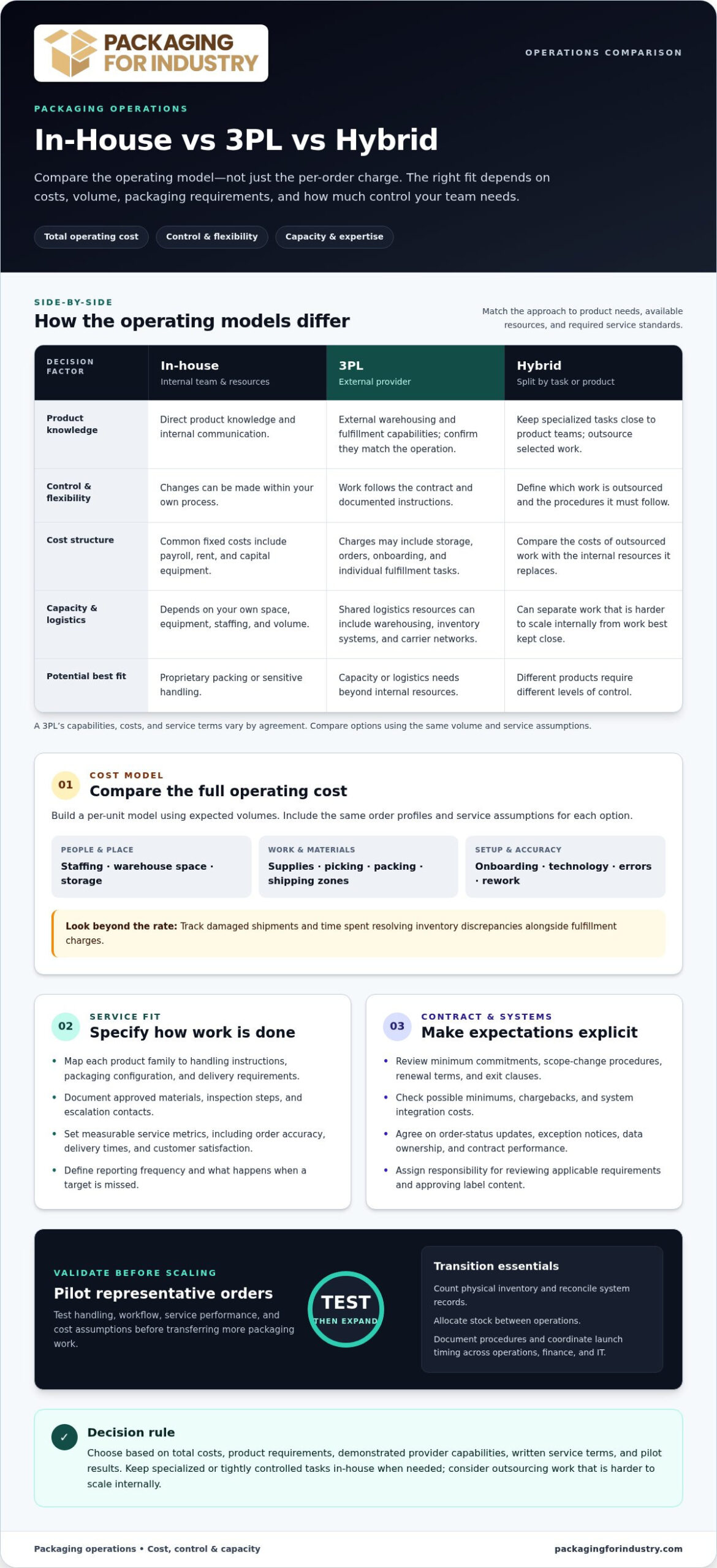
| Option | Support and expertise | Control and flexibility | Best fit |
|---|---|---|---|
| In-house team | Direct product knowledge and internal communication | Changes can be made within your own process | Proprietary packing or sensitive handling |
| 3PL | External warehousing and fulfillment capabilities | Work follows the contract and documented instructions | Capacity or logistics needs beyond internal resources |
| Hybrid approach | Specialized tasks stay close to product teams | Selected work is outsourced under defined procedures | Different products need different levels of control |
Choose based on product requirements, demonstrated capabilities, written service terms, and a pilot order. Track accuracy, delivery, and customer feedback.
Cost efficiency and shared logistics resources
Compare the full cost of handling, storage, labor, and distribution, not just the charge per shipment. A 3PL may share logistics infrastructure across clients, while in-house costs depend on your own space, equipment, and staffing.
Potential Time and Cost Savings
Outsourcing can reduce time spent recruiting, training, scheduling, and retaining packaging staff. A 3PL may also use route planning and a broader carrier network to manage distribution across shipping channels. Shared warehousing and inventory systems can spread infrastructure costs across clients, helping avoid unused space or equipment during slower periods.
The value of outsourcing depends on the work included in the agreement. Compare handling, storage, and shipping charges with the internal resources the work would replace. Seasonal peaks may make flexible capacity useful, while steady volumes may help existing staff and equipment work more productively.
Cost and Operational Impacts
In-house operations commonly carry fixed costs such as payroll, rent, and capital equipment. A 3PL commonly charges for storage, orders, onboarding, and individual fulfillment tasks. Contracts may also include minimums, chargebacks, or system integration costs, so compare every line item against the same volume and service assumptions.
Outsourcing shifts agreed handling work to an external operation, but it adds dependency risks involving quality, data security, and contract performance. Reduce those risks by documenting packing instructions, agreeing on performance metrics, and defining data ownership and exit terms. A 3PL should follow the agreed materials and procedures.
Accuracy affects the total cost too. Track incorrect orders, rework, damaged shipments, and time spent resolving inventory discrepancies alongside fulfillment charges. These operational costs can change the comparison even when the per-order rate looks simple.
Pilots and Cost Modeling
Build a per-unit model using expected volumes and the same assumptions for each option. Include staffing, warehouse space, supplies, shipping zones, order errors, storage, picking, packing, onboarding, and technology integration. Then pilot representative orders to test handling, workflow, and cost assumptions before transferring more volume.
Plan the transition to cover both outgoing orders and new inbound receipts. Count physical inventory and reconcile it with system records before the transfer. Allocate stock between operations, document procedures, and coordinate the launch schedule across operations, finance, and IT.
- Use identical order profiles and service assumptions in each cost comparison.
- Record pilot accuracy, handling exceptions, and actual service charges.
- Stage inventory transfers to maintain distribution while new receipts arrive.
To compare packaging costs for a defined operation, request a packaging quote with your volume and handling requirements.
Supply chain visibility and technology integration
A connected system can show inventory locations, low stock, and orders needing action. Before moving packaging workflows, evaluate integration, data ownership, and channel coverage.
Systems and Data Sharing
Map the information that must move between your ERP, warehouse management system (WMS), transportation management system (TMS), and order tools. For example, shipment confirmation should update order status, while a receiving record should adjust available inventory.
Define who owns inventory and order data, who can access it, and how often updates arrive. Set access controls and breach-notification procedures for system connections. Agree on dashboard fields and update frequency, including inventory levels, shipment status, and exception details.
Check that the provider supports your actual platforms and workflows, not just a general integration claim. A new WMS requires selection, contracting, and implementation, which may take 6-12 months. Include that work in the transition schedule if your operation depends on a new system.
Integration Pilots and Operations
A pilot tests data flow and warehouse execution before the full operation moves. Use sample orders to test receiving, inventory adjustments, order routing, pick-and-pack confirmation, and shipment tracking. Compare system records with physical stock to catch mismatched SKUs, units, or package configurations.
Test exceptions too, including a short shipment, a changed order, and a return if returns are part of the workflow. Record whether the right team receives each alert and can resolve it without duplicate entry. A controlled launch gives operations and IT time to correct workflow gaps.
Bring inventory data up to date before the pilot, then monitor launch results. Track order accuracy, inventory discrepancies, delivery times, and customer satisfaction. Assign owners to resolve integration errors, and document the fallback process if system updates stop.
Omnichannel fulfillment requires coordination across ecommerce, marketplaces, and business-to-business orders. Confirm how each channel sends orders, reserves inventory, and receives shipment updates. If two channels draw from one stock pool, for example, define how the system prevents both from allocating the same units.
Use a transition checklist to align systems and daily operations:
- Standardize SKU names, units, weights, dimensions, and kit configurations.
- Set data permissions, update schedules, and exception contacts.
- Test receiving, storage movements, order processing, and shipping confirmations.
- Compare system inventory with a physical count before transfer.
For packaging workflows tied to inventory replenishment, vendor-managed inventory planning can help align stock visibility with supply needs.
Choosing an approach based on business priorities
Choose the operating model based on product control, demand patterns, and internal capacity. A manufacturer with proprietary packing steps may keep those orders in-house, while a business with seasonal volume swings may outsource selected work.
Separate packaging tasks instead of treating the whole operation as one decision. List products, order types, handling needs, and customer deadlines. For example, keep specialized packing for sensitive components in-house while outsourcing routine distribution orders. A hybrid model preserves control over critical processes while adding capacity for work that strains staff or space.
In-house operations can suit stable, long-term volumes, demanding customer-experience requirements, or proprietary processes. Teams can directly update work instructions and oversee labor, machinery, and materials, which is useful when a special configuration changes often. Internal staff remain responsible for scheduling, equipment, and consistent processes.
A 3PL may fit rapid growth, complex multichannel shipping, or limits on scaling internal costs. Evaluate its product experience, warehouse locations, inventory tracking, pick-and-pack accuracy, communication, and returns handling. If products need temperature-controlled, secure, or hazardous-material handling, match those needs to the provider’s infrastructure and expertise before assigning the work.
Choose a location that supports the distribution plan, not just one that looks convenient on a map. Compare warehouse locations with customer regions, inbound suppliers, shipping routes, and volume by channel. A multi-site network may reduce transit times and freight costs when expanding into new regions. For orders in Orange County, Los Angeles, and San Diego, compare local origin and destination patterns with the needs of broader U.S. distribution.
- Keep in-house: retain proprietary packing, sensitive products, or processes needing frequent direct changes.
- Outsource: move repeatable work when growth, seasonal demand, or channel complexity exceeds internal capacity.
- Use a hybrid model: divide tasks by product, order type, or destination while documenting handoffs.
Before choosing a provider, compare its technology integration, communication practices, product experience, warehouse locations, scalability, and service scope with your requirements. Define which orders it will handle and which stay in-house. Clear boundaries prevent duplicate work and make performance easier to assess.
Plan the move around demand. Schedule inventory allocation and process testing for an expected low-volume period, avoiding peak seasons and other high-demand windows. Align operations, finance, and IT on the schedule, then communicate changes to affected teams and customers. A documented continuity plan helps maintain order flow as responsibilities shift.
Choose the model that protects essential process control while addressing the clearest capacity or distribution constraint. If needs differ by product or channel, assign workflows separately rather than forcing one approach across every order.
How do in-house packaging costs compare with contract packaging costs?
In-house packaging means the company finances and manages the operation. Contract packaging transfers agreed work to an outside provider, changing which costs are fixed and which vary with activity. To compare pricing fairly, model the full operation instead of focusing only on the charge per order.
For in-house work, include warehousing, utilities, packaging machinery, materials, labor, training, logistics, and line maintenance. Account for space used by inventory, packing tables, supplies, and outgoing-order staging. Equipment can require higher upfront spending, while ongoing costs depend on utilization, materials, labor, and volume. For manufacturers, warehouses, and distribution centers, include the actual space and labor each workflow uses.
Contract packaging may include labor, machinery, automation, materials, utilities, logistics, and space for the contracted work. It can reduce the need to buy equipment, maintain a packaging line, or hire dedicated staff. The agreement determines how the provider manages labor and which machinery and materials are available. If custom packaging sizes are part of the solution, include their effects on handling, storage, and shipping in your assumptions.
Contract pricing often includes per-order charges, storage rates, and onboarding fees. Some providers also charge for individual fulfillment tasks, such as picking, packing, and shipping. Review minimums, chargebacks, technology integration, and extra-service fees, as well as internal IT and compliance overhead. For bulk packaging, compare equivalent quantities, service scope, and assumptions rather than isolated unit rates.
Volume and utilization affect the comparison. In-house packaging may become more efficient at high volumes when the company fully uses its space and labor. A 3PL may spread warehousing and inventory-management costs across multiple clients, which can suit changing demand or limited facility capacity. Include shipping zones and local packaging delivery in the model, since distribution patterns affect the total operating picture.
Build a per-unit model using expected volumes and consistent service assumptions. Compare labor, warehouse expansion, equipment, freight, order errors, storage, picking, packing, onboarding, and integration. Track damage and rework too, since packaging changes should support efforts to reduce shipping damage. Pilot representative work and compare actual handling and accuracy with your model.
Neither structure guarantees lower costs, faster delivery, or fewer errors. Identify where you can reduce packaging costs without sacrificing necessary process control. For example, keep a proprietary packaging line in-house while outsourcing a repeatable task that needs extra space or seasonal capacity.
Packaging For Industry (PFI): Foam Packaging
Packaging For Industry (PFI) supports manufacturers and aerospace, electronics, and medical device companies with industrial packaging needs. Its offerings include foam packaging for product protection, stretch film for packaging operations, and Vendor Managed Inventory (VMI) for recurring supply needs. These options can help businesses address shipping damage, coordinate packaging stock, and simplify purchasing.
PFI is a practical fit when your business needs packaging tailored to its products or better management of recurring materials. Contact Packaging For Industry to discuss your packaging requirements.
Set the Next Packaging Decision in Motion
If transitioning from in-house packaging to a 3rd party provider is on your roadmap, start by identifying the work you want to move and the outcomes that matter. You may not need to outsource the entire operation. A targeted change to packaging materials or inventory planning can address a specific constraint while your team keeps control of other processes.
Packaging For Industry (PFI) provides foam packaging, stretch film, and Vendor Managed Inventory (VMI) for packaging. These services can help businesses protect products and coordinate recurring packaging supplies, without requiring them to outsource every fulfillment task. Share your packaging requirements and operational priorities with PFI to discuss a practical next step.
Use your comparison to choose an approach that fits your products, workflow, and capacity. A clearly defined scope gives your team a sound basis for improving packaging operations.
With a focused plan, you can move forward with greater clarity and confidence.
Frequently Asked Questions
How do the two models compare?
In-house work keeps routine decisions close to production, while a 3PL operates within agreed instructions and escalation paths. For a team transitioning from in-house packaging to a 3rd party provider, decide which decisions need immediate product or engineering input. Classify orders as standard, configurable, or exception-based. That distinction helps define what can follow a repeatable workflow and what still needs internal review.
How do you make a practical comparison?
Choose representative orders that reflect your product mix, packaging variations, and delivery patterns. For each order, record the work sequence, handoffs, and exceptions, then compare how each operating model would handle them. Keep assumptions consistent across teams. This makes the comparison useful beyond an average order and reveals where a process depends on specialized knowledge or frequent coordination.
How should packaging and shipping fit the decision?
Include receiving and delivery constraints, not just the package leaving the line. Note customer requirements such as delivery appointment windows, pallet configuration, dock access, and shipment labeling. A package that is easy to prepare may create extra handling at the customer’s receiving area. Map requirements by destination so the chosen workflow supports the entire handoff from packing station to recipient.
How should you compare labor and space?
Assess how packaging work interacts with production flow, not just how much floor space it occupies. Observe where materials wait, where completed orders stage, and whether workers cross active production paths to retrieve supplies. A layout with enough nominal space may still restrict movement or create extra handling. Document these conditions during normal operations and busy periods before assigning work elsewhere.
What are the benefits and drawbacks of outsourcing packaging to a third-party provider?
Outsourcing can provide operating capacity without requiring your team to direct every task, but coordination becomes part of the work. Product revisions, special orders, and engineering changes need a clear route to the people performing the packaging. Consider how often changes occur and how quickly they must take effect. A workflow with frequent exceptions may require more coordination than a stable, repeatable process.
What factors should businesses consider when choosing a contract packaging provider?
Assess day-to-day governance, including named operational contacts, issue escalation, and responsibility for correcting process deviations. Clarify how revised work instructions are distributed and how teams know they have the current version. In multi-department operations, determine how purchasing, production, and customer-service teams will share updates. These arrangements can matter as much as the physical packaging process.
What questions should I ask when evaluating packaging providers?
Ask who receives urgent change requests, how substitutions are approved, and how unresolved order exceptions are escalated. Clarify what happens when materials arrive short or an order needs rework. Specify how routine updates reach your team and who owns each issue. Clear answers establish responsibilities before launch, rather than leaving staff to resolve gaps informally during daily operations.
What are the steps for transitioning packaging operations to a third-party provider?
For transitioning from in-house packaging to a 3rd party provider, define cutover rules for open orders and work already underway. Set a point when new instructions take effect, identify who can authorize urgent exceptions, and decide how unresolved issues return to the internal team. Keep those decisions in one shared operating document so production, purchasing, and fulfillment teams follow the same handoff plan.