
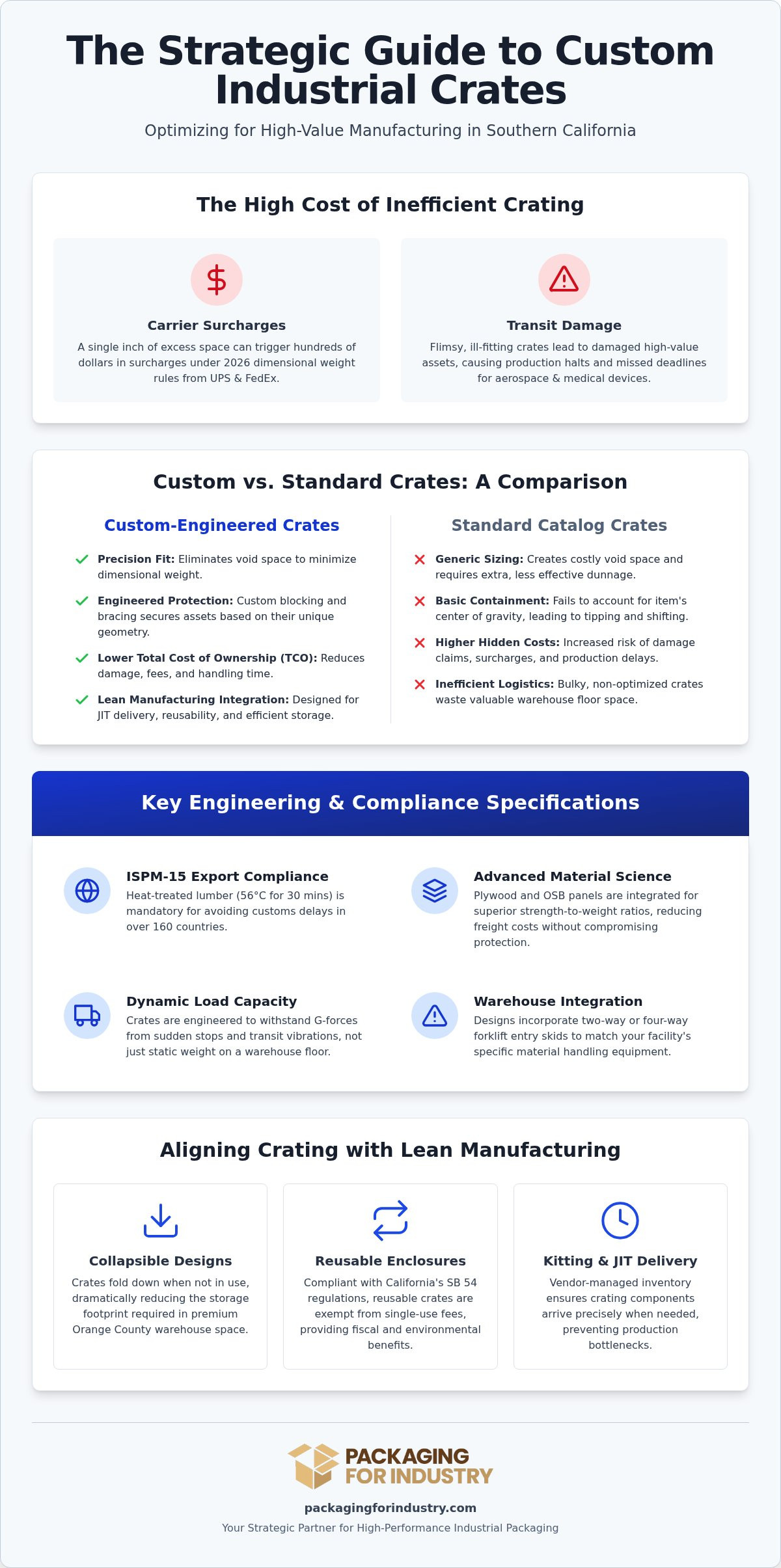
A single inch of excess space in your shipping crate can trigger hundreds of dollars in carrier surcharges under the 2026 dimensional weight rules used by UPS and FedEx. For high-stakes sectors like aerospace and medical devices, procuring the right custom industrial crates for manufacturing Anaheim is no longer just about wood and nails. It’s a critical engineering decision that directly impacts your bottom line. At Packaging For Industry (PFI), we believe you shouldn’t have to choose between protecting a multi-million dollar component and maintaining your profit margins. We solve the frustration of dealing with transit damage from flimsy catalog options or waiting weeks for a national supplier to ship a standard size that doesn’t quite fit your needs.
This guide will show you how to specify and engineer custom crates that eliminate shipping damage while significantly lowering your logistical overhead. We’ll explore ISPM 15 compliance for international export, the cost-saving benefits of reusable designs under California’s SB 54 regulations, and how local next-day delivery across Orange County and the Inland Empire can streamline your production line. By the end, you’ll know how to turn your packaging from a sunk cost into a strategic asset that protects your equipment and your budget.
Key Takeaways
- Avoid 2026 carrier surcharges by optimizing crate dimensions to stay below specific dimensional weight thresholds.
- Ensure international shipping compliance using ISPM-15 heat-treated materials that meet strict global export standards.
- Learn how to specify custom industrial crates for manufacturing Anaheim to protect high-value assets and minimize transit damage.
- Evaluate the total cost of ownership by comparing the ROI of custom-engineered crates against standard catalog options.
- Leverage local next-day delivery and vendor-managed inventory programs to maintain a lean, reliable supply chain.
Optimizing Anaheim Manufacturing Logistics with Custom Industrial Crates
An engineered industrial crate differs fundamentally from a standard shipping box. While a box merely contains a product, a custom crate is a technical asset designed to integrate with your specific machinery and logistical requirements. In the advanced manufacturing corridors of Anaheim, where aerospace and medical device production drive the local economy, these enclosures provide the necessary structural integrity for multi-million dollar assets. Utilizing custom industrial crates for manufacturing Anaheim allows firms to move beyond commodity packaging and adopt solutions that prioritize precision engineering over simple containment.
Optimizing your crating strategy directly impacts your Total Cost of Ownership (TCO). A well-engineered crate reduces expenses across the entire supply chain by preventing transit damage, minimizing billable weight, and speeding up the crating process on the warehouse floor. It’s a strategic investment that protects your profit margins as much as it protects your hardware. When you lower packaging costs through better design, you free up capital for core manufacturing operations.
Reducing Transit Damage in SoCal Industrial Corridors
Local freight handling in Southern California involves frequent mechanical shocks, vibrations, and multiple touchpoints that can compromise sensitive equipment. Standard packaging often fails to account for an item’s specific center of gravity, leading to tipping or internal shifting during transit. The financial impact of a damaged component extends far beyond the repair cost; it often causes catastrophic production stops and missed delivery deadlines for your clients. Custom-engineered crates solve this by using internal blocking, bracing, and specialized foam to secure the asset based on its unique geometry and weight distribution.
Lean Manufacturing and Crating Efficiency
Efficiency on the production line requires packaging that keeps pace with “just-in-time” schedules. With the Orange County industrial vacancy rate sitting at 6.0% in 2026, warehouse floor space is at a premium. Bulky, non-optimized crates create unnecessary line-side clutter and waste valuable square footage. We help Anaheim manufacturers implement lean crating solutions that include:
- Collapsible designs: These crates fold down when not in use, significantly reducing the footprint required for storage.
- Reusable enclosures: Under California’s SB 54 regulations, reusable crates are exempt from many single-use packaging fees, providing both environmental and fiscal benefits.
- Kitting and JIT delivery: Integrating packaging kitting ensures that every component needed for crating arrives exactly when the production line needs it.
By aligning your crating strategy with manufacturing best practices, you ensure that your logistics don’t become a bottleneck. It’s about creating a seamless flow from the final assembly in Anaheim to the end user, regardless of whether they’re across the street or across the globe.
Engineering Specifications for Heavy-Duty Industrial Crating
Engineering a crate for industrial use requires a deep understanding of material science and mechanical stress. For export shipments, we use ISPM-15 compliant heat-treated lumber to ensure your goods pass through international customs without delays. This process involves heating the wood core to 56°C for 30 minutes to eliminate pests, a mandatory requirement for over 160 countries. Plywood and OSB are often integrated into the panels for their superior strength-to-weight ratios. When specifying custom industrial crates for manufacturing Anaheim, it’s vital to differentiate between static and dynamic load capacities. A crate that holds 5,000 lbs on a warehouse floor might fail under the G-forces of a sudden stop during transit. We design our base configurations with two-way or four-way forklift entry skids to accommodate the specific handling equipment used in your facility.
The closure system you choose depends on how the crate will be used at its destination. Bolted panels and lag screws provide maximum security for heavy-duty, one-way shipments. However, if your production line uses a circular logistics model, quick-release latches allow for easy opening and reuse without damaging the wood. These technical choices ensure the crate remains a functional part of your supply chain rather than a disposable expense.
Internal Protection and Foam Integration
The crate’s exterior is only half the story. High-value components require integrated foam packaging to neutralize vibration. Polyethylene (PE) foam is the standard for heavy industrial parts due to its high load-bearing capacity and resilience. For lighter, highly fragile instruments, polyurethane (PU) foam provides a softer “ride” by absorbing lower-frequency shocks. In Anaheim’s electronics manufacturing sector, we utilize anti-static (ESD) foam to prevent electrostatic discharge from damaging sensitive circuit boards during the shipping process.
CAD/CAM Design and Free Prototyping
Precision starts with a digital model. Our CAD/CAM support allows us to visualize the crate’s internal geometry before the first board is cut. We offer free prototyping for custom designs, which lets your team verify the fit and function of the enclosure on your own production line. These engineering reviews often reveal cost-reduction opportunities, such as thinning walls where structural strength isn’t compromised or optimizing dimensions to avoid carrier surcharges. If you’re ready to see how an engineered solution can protect your assets, you can request a packaging quote to begin the design process.
Custom vs. Standard Crates: Which Fits Your Anaheim Production Line?
Choosing between a standard container and a custom-engineered solution is a matter of calculating the Return on Investment (ROI) across your entire supply chain. Stock options like standard heat-treated pallets or RSC boxes reinforced with corner boards are often sufficient for low-risk transit of uniform, durable goods. However, when you compare packaging pricing, it’s vital to look beyond the initial unit cost. For the high-precision assets found in Southern California’s aerospace and medical sectors, generic solutions are a gamble that often lead to transit damage. With custom sizes available for even the most complex geometries, utilizing custom industrial crates for manufacturing Anaheim ensures that your assets are secured with engineering precision rather than excess dunnage.
Standard solutions usually require significant labor to fill gaps with void-fill, which increases both handling time and billable weight. A hybrid approach, such as combining heavy-duty triple-wall corrugated boxes with wood-reinforced bases, can provide a middle ground for items that need more than a standard box but less than a full timber enclosure. By opting for a tailored design, you ensure the dimensions are optimized to the millimeter. This precision prevents the structural failures common with oversized generic crates and ensures your assets remain secure throughout the shipping cycle.
The Local Advantage: Why Customization Beats Large Catalogs
National catalog suppliers offer convenience at a steep price premium without the engineering oversight needed to solve complex logistical problems. In contrast, a local partner offers on-site consultations to identify the specific mechanical risks your components face. One of the most significant advantages of local customization is the ability to bypass carrier surcharge thresholds. As discussed, a crate that’s slightly too large can easily trigger an Additional Handling Surcharge if it exceeds the 10,368 cubic inch threshold. We engineer crates to stay just below these critical limits, helping you lower packaging costs significantly over a high-volume production run.
Export Compliance: ISPM-15 and Beyond
International transit adds a layer of regulatory complexity that standard domestic packaging cannot handle. To avoid the risk of rejected shipments or customs delays, all wood packaging must meet ISPM-15 standards. Using non-compliant wood can result in your shipment being quarantined or destroyed at the port of entry. We ensure every custom crate is properly stamped with the official IPPC mark, providing the peace of mind that your assets will reach global markets without regulatory interference. For more details on compliance, see our guide on Engineering Custom Crates for International Transit.
How to Specify Custom Crate Requirements for High-Value Manufacturing
Procuring custom industrial crates for manufacturing Anaheim requires a precise transfer of technical data from your engineering team to the packaging manufacturer. A vague request often results in over-engineered crates that inflate your budget or under-engineered designs that fail during transit. To ensure your assets are protected without wasting capital, follow a structured specification process. Start by documenting the exact dimensions, total weight, and the center of gravity. Knowing the center of gravity is particularly vital for heavy machinery; it determines where the internal blocking and bracing must be positioned to prevent tipping or structural failure under dynamic loads.
Next, identify specific fragile points and surface finish sensitivities. If a component has a polished exterior or a delicate sensor, it needs specialized internal cushioning or non-abrasive liners. Your choice of transit mode also dictates the crate’s construction. Ocean freight necessitates moisture barriers and specific anti-corrosion treatments, while air freight requires a focus on weight optimization to avoid the steep dimensional weight surcharges mentioned earlier. Finally, define your recurring volume. If you’re managing a high-volume production line but have limited warehouse floor space, specifying collapsible or stackable designs will help you maintain a lean operation.
Specifying for Aerospace and Defense
Anaheim’s defense contractors and aerospace firms operate under rigorous compliance frameworks. When specifying for this sector, your crates must often meet aerospace packaging standards and MIL-SPEC requirements for materials. This includes using specific grades of heat-treated lumber and specialized protective barriers that prevent oxidation during long-term storage. For oversized components like fuselage sections or satellite hardware, the crate design must also account for specialized lifting points and crane-compatible skids to ensure safe handling at every touchpoint.
Specifying for Medical Device Manufacturing
Medical device logistics demand a high level of cleanliness and security. Crates destined for medical facilities often require debris-free construction and cleanroom-compatible materials to prevent contamination. For sensitive lab equipment, we integrate shock and vibration monitoring devices directly into the crate. These sensors provide a documented history of the shipment’s environment. To protect high-value gear from theft or unauthorized access, specify tamper-evident closures and secure bolting systems that ensure the asset remains untouched from your facility to the end user.
Why PFI is the Strategic Crating Partner for Anaheim Manufacturers
Packaging For Industry (PFI) operates as more than a vendor; we are a strategic partner for the entire Southern California industrial landscape. While our headquarters are in the heart of the OC, we provide daily logistics support to manufacturing hubs across Los Angeles, San Diego, and the Inland Empire. By centralizing your procurement for custom industrial crates for manufacturing Anaheim, you eliminate the fragmented supply chains that lead to delays. We integrate heavy-duty corrugated boxes, protective foam, and timber enclosures into a single delivery, ensuring all components of your packaging system arrive simultaneously and ready for the line. This holistic approach allows you to compare packaging pricing across your entire bill of materials rather than managing multiple disparate suppliers.
Our proximity to the 5 and 91 freeways facilitates local next-day delivery, a critical component for high-velocity production environments. Manufacturers throughout the region rely on our “Just-in-Time” inventory management to keep their operations lean. This localized support means you don’t have to wait for cross-country shipments or deal with the impersonal service of national distributors. Whether you require standard pallets or have custom sizes available for specialized machinery, our regional footprint ensures your supply chain remains resilient and responsive.
Vendor Managed Inventory (VMI) for Custom Crates
With industrial space at a premium from San Pedro to the Inland Empire, utilizing our VMI program allows you to streamline with Vendor Managed Inventory. We take full responsibility for monitoring your crate stock levels through recurring review cycles tailored to your production schedule. This proactive oversight ensures you never face a stock-out while simultaneously freeing up your warehouse floor for revenue-generating production equipment. It is a pragmatic solution for manufacturers looking to reduce administrative burden and optimize their square footage.
Next Steps: Requesting Your Anaheim Crating Quote
Moving from a generic shipping container to a precision-engineered crate requires professional consultation. We offer on-site reviews and free prototyping to ensure your design meets the exact mechanical demands of your distribution network. When you request a packaging quote, our engineering team evaluates your asset’s weight distribution and fragility to provide a stable, cost-effective solution. If you are ready to stabilize your logistics costs and improve your shipping reliability, our team is prepared to develop a tailored system for your facility.
Securing Your Anaheim Supply Chain with Engineered Protection
Effective logistics in Orange County requires a shift from viewing packaging as a commodity to treating it as a strategic asset. By integrating CAD/CAM design and free prototyping into your workflow, you ensure that every component remains secure during the most rigorous transit cycles. Utilizing custom industrial crates for manufacturing Anaheim doesn’t just prevent physical damage. It also shields your business from the hidden costs of carrier surcharges and international regulatory fines. We’ve designed our service model to eliminate the stress of transit damage through better engineering and material science.
Our guarantee of ISPM-15 export compliance and local next-day delivery across Southern California provides the reliability your production line demands. You can stop worrying about transit delays or damaged high-value components and focus on scaling your core manufacturing operations. We’re here to solve your most complex crating challenges with engineering precision and fiscal responsibility. Whether you’re shipping sensitive medical electronics or heavy aerospace parts, our team provides the stability your logistics network requires.
Take the first step toward a more efficient, zero-damage shipping record today.
Frequently Asked Questions
What information do I need to provide for a custom crate quote in Anaheim?
Provide the asset’s exact dimensions, total weight, and center of gravity. Identify fragile points or surface sensitivities requiring specialized dunnage. If shipping via ocean freight, specify if you need moisture barriers or anti-corrosion treatments. This data allows our team to design custom industrial crates for manufacturing Anaheim that balance structural integrity with logistical efficiency. Accurate specs ensure the final enclosure fits your product perfectly without wasted volume or unnecessary carrier surcharges.
Are your custom industrial crates ISPM-15 compliant for international shipping?
Yes. Every wooden enclosure intended for international export is manufactured using ISPM-15 compliant heat-treated lumber. This wood is debarked and heated to a core temperature of 56°C for at least 30 continuous minutes to eliminate pests. We apply the official IPPC mark to at least two opposite sides of the crate. This certification is mandatory for over 160 countries and prevents your high-value shipments from being quarantined or destroyed at foreign ports of entry.
Can you design a crate that includes custom foam inserts for sensitive parts?
We provide fully integrated foam packaging solutions within our crates. Depending on your asset’s weight and fragility, we utilize polyethylene for heavy-duty shock absorption or polyurethane for lighter, sensitive instruments. For electronics manufacturers in Southern California, we offer anti-static (ESD) foam inserts to protect against electrostatic discharge. This integrated approach ensures that the internal cushioning and the external timber structure work together as a single, engineered system to eliminate transit damage.
Do you offer local next-day delivery for manufacturers in Orange County?
We provide local next-day delivery for manufacturers located throughout Anaheim and the broader Orange County area. Our facility’s proximity to the 5 and 91 freeways allows us to maintain a highly responsive logistics schedule. This service supports your “just-in-time” production requirements by ensuring that packaging materials arrive exactly when your finished goods are ready for crating. It eliminates the need for you to store large volumes of bulky crates on your warehouse floor.
What is the difference between a custom crate and a heavy-duty skid?
A custom crate is a fully enclosed wooden or hybrid structure that provides 360-degree protection for its contents. It’s designed for high-value or fragile assets that cannot be exposed to the elements or mechanical risks. In contrast, a heavy-duty skid is a reinforced platform, often called a pallet, that supports the weight of the item but offers no lateral or top protection. Skids are typically used for robust machinery that only requires a stable base for forklift handling.
How does a Vendor Managed Inventory (VMI) program work for custom crates?
Our Vendor Managed Inventory program offloads the burden of stock tracking to our team. We monitor your crate levels through scheduled weekly or monthly review cycles tailored to your production volume. When stock reaches a pre-determined minimum, we automatically trigger a replenishment order. This system ensures you never face a crate shortage that halts your production line. It also frees up valuable warehouse space by allowing you to maintain a leaner on-site inventory.
Do you provide free prototyping for complex aerospace crating projects?
We offer free prototyping and CAD/CAM support for complex industrial projects, including aerospace and medical device applications. Our engineers create a digital model of the crate to verify internal clearances and structural points before any material is cut. This process allows your team to test the physical prototype on your own production line to ensure a perfect fit. It’s a critical step for identifying cost-reduction opportunities and verifying protection levels for multi-million dollar assets.
Can you help reduce our shipping costs by optimizing crate dimensions?
We help you lower packaging costs by optimizing crate dimensions to stay below carrier surcharge thresholds. In 2026, UPS and FedEx apply Additional Handling Surcharges for packages exceeding 10,368 cubic inches or 50 lbs. By engineering your crates to the minimum required dimensions, we help you avoid these steep fees. Our design process focuses on reducing billable dimensional weight while maintaining the structural integrity needed to protect your high-value manufacturing assets during transit.