
What if your packaging budget wasn’t a recurring consumable expense, but a strategic investment in a high-performance asset? Implementing returnable packaging solutions for B2B supply chains allows manufacturers to stop treating containers as waste and start treating them as durable logistical tools. You’re likely dealing with high disposal fees, the constant risk of product damage from flimsy materials, and warehouse floor space wasted on bulky single-use inventory. It’s a common frustration in industrial logistics where the focus is often on the immediate shipment rather than long-term fiscal responsibility.
We understand that reliability and cost-effectiveness are the pillars of a successful operation. Transitioning to a closed-loop system helps you achieve zero-waste goals while providing superior protection for sensitive aerospace, medical, or electronic components. This guide provides a pragmatic roadmap for building a system that lowers your cost per shipment and integrates naturally with programs like Vendor Managed Inventory. We’ll examine the engineering behind custom foam inserts, the durability of returnable crates, and the logistical frameworks needed to turn your packaging into a reliable, reusable asset that protects your bottom line.
Key Takeaways
- Learn how to transition from recurring consumable expenses to high-performance logistical assets that lower your long-term packaging costs.
- Identify the core components of effective returnable packaging solutions for B2B supply chains, including heavy-duty crates and custom high-density foam inserts.
- Understand the break-even framework used to calculate when the initial investment in reusable systems becomes more profitable than single-use alternatives.
- Discover the step-by-step process for auditing shipping lanes and prototyping custom designs to ensure structural integrity over dozens of trips.
- See how PFI utilizes free prototyping and Vendor Managed Inventory (VMI) to streamline returnable programs for aerospace and medical manufacturers.
What Are Returnable Packaging Solutions for B2B Supply Chains?
Industrial operations often view packaging as a necessary drain on the budget. However, What Are Returnable Packaging Solutions really? In the industrial sector, returnable packaging refers to durable, multi-trip containers specifically engineered for a closed-loop system where the same units move between a supplier and a customer repeatedly. Adopting returnable packaging solutions for B2B supply chains transforms how you manage your warehouse. Instead of buying single-use corrugated boxes that end up in a baler, you’re investing in logistical assets that provide a lower cost-per-trip over their entire lifecycle.
The materials used in these systems are built for endurance and repeated handling. We typically see heavy-duty plastics, reinforced double-wall corrugated boxes, and custom wood crates designed for easy stackability. The real value, however, lies in the internal dunnage. High-density foam packaging inserts are often used to cradle high-value parts, ensuring they remain secure through dozens of shipping cycles. By eliminating waste and providing superior protection, these systems address the primary pain points of high disposal costs and frequent product damage.
The Role of Circular Logistics in Modern Industry
Circular logistics focuses on keeping materials in use for as long as possible. This supports your ESG goals by drastically reducing the volume of waste entering landfills. A closed-loop supply chain is the most efficient model; it’s a dedicated circuit where the packaging returns to the point of origin after each delivery. In contrast, an open-loop system involves packaging that might not return to the original shipper but is reused elsewhere. This is why the aerospace and automotive sectors lead the way in returnable adoption. They ship high-value, sensitive components that require the precision of custom design packaging to prevent catastrophic damage during transit.
Standard vs. Custom Returnable Systems
Choosing between standard and custom systems depends on your specific inventory and shipping frequency. Off-the-shelf plastic bins or standard pallets work well for uniform, durable goods that don’t require specialized cushioning. However, if you’re shipping oddly shaped components or fragile electronics, custom returnable packaging solutions for B2B supply chains are a necessity to ensure a proper fit. Industrial returnable packaging is a durable, reusable system of containers and dunnage designed to protect assets and minimize waste across multiple shipping cycles. At PFI, we help you lower packaging costs by identifying which parts of your supply chain are ready for this transition through free prototyping and site audits.
Core Components of a High-Performance Reusable System
A successful returnable program depends on engineering rather than just choosing a sturdier box. For returnable packaging solutions for B2B supply chains to deliver actual ROI, every component must be rated for multiple transit cycles. This involves a strategic combination of durable outer shells, precision-engineered inserts, and reliable asset tracking. When these elements work together, they eliminate the need for constant repurchasing and reduce the waste associated with single-use materials.
Custom Crates and Heavy-Duty Outer Shells
The outer container provides the primary defense against warehouse hazards and transit vibrations. While plastic bins are common for small parts, custom shipping crates are often required for heavy industrial assets or aerospace components. Wood crates offer superior structural integrity and can be designed with custom footprints to maximize pallet density. For lighter applications, reinforced double-wall or triple-wall corrugated boxes provide a balance between durability and weight reduction. Effective designs prioritize stackability and space optimization, ensuring that empty units don’t consume excessive floor space during the return leg of the trip.
Engineered Foam Inserts for Multi-Trip Protection
Internal dunnage is where most returnable systems succeed or fail. Standard cushioning often degrades after just two or three trips, leading to increased damage rates and compromised part safety. High-performance systems utilize custom foam packaging made from high-density polyethylene or cross-linked polyethylene. These materials maintain their shape and protective properties over dozens of shipments. When shipping sensitive electronics, ESD-safe foam is a critical requirement to prevent static discharge. We focus on designing inserts that make loading and unloading intuitive, which improves warehouse efficiency and reduces labor costs.
Even the most durable containers require proper load stabilization. High-performance stretch film secures returnable units to pallets, preventing shifting during transit. Because the financial success of these programs relies on the units actually returning, identification and tracking are non-negotiable. Using thermal transfer ribbons and RFID tags allows operations managers to monitor asset location and calculate the “break-even” point effectively. As noted in the Returnable vs. Single-Use: A Cost-Benefit Framework, the durability of these individual components directly impacts the overall life-cycle cost of the system. You can request a packaging quote to begin building a custom system tailored to your recurring shipping lanes.
Returnable vs. Single-Use: A Cost-Benefit Framework
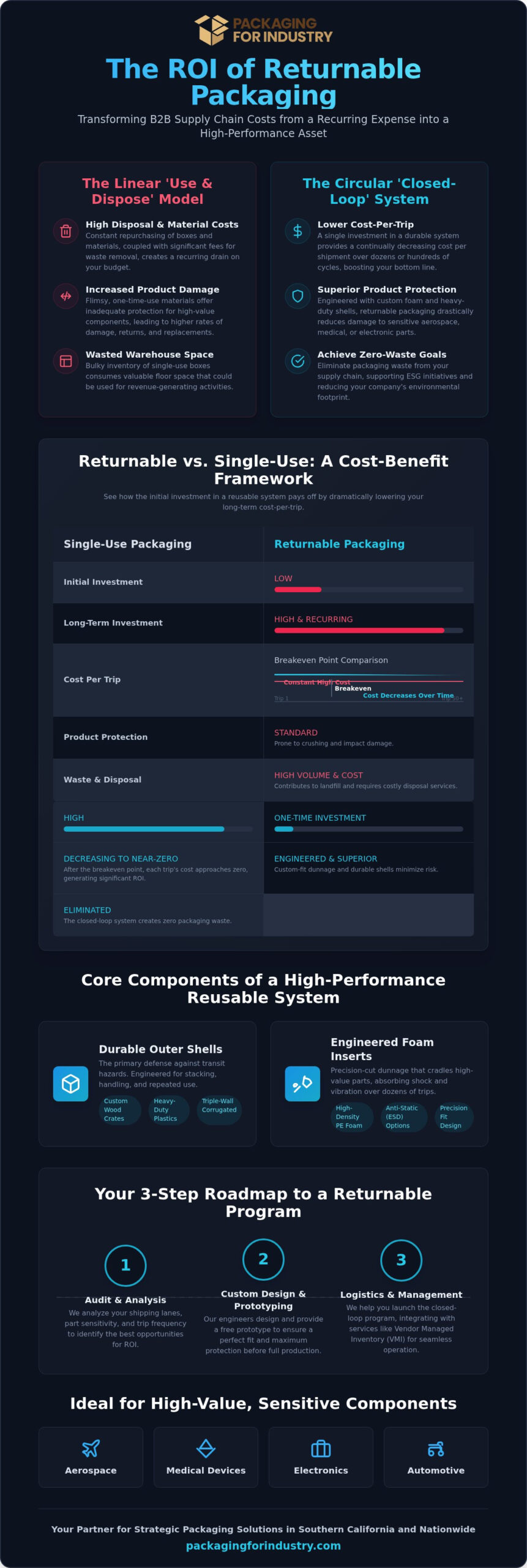
Deciding to implement returnable packaging solutions for B2B supply chains requires a shift in how you view your budget. Single-use packaging is typically treated as an operational expense; you buy it, use it once, and pay for its disposal. Returnable systems are capital investments. While the upfront cost is higher, the investment is spread across hundreds of trips. You’re no longer paying for the material every time a shipment leaves the dock. Instead, you’re investing in a durable asset that maintains its value over time.
Hidden costs often make single-use packaging more expensive than it appears on a quote. Consider the labor required for assembly and taping, the floor space occupied by massive inventories of flat boxes, and the fees paid to haul away waste. Returnable units are typically ready for immediate loading, which significantly improves labor efficiency. By removing the need for box assembly and constant taping, your warehouse team can focus on high-value tasks like picking and kitting. Additionally, the superior structural integrity of returnables minimizes damage claims, which is a critical factor in protecting your bottom line.
Calculating Your Cost-Per-Trip
The true measure of value is the cost-per-trip. To find this, take the total cost of the returnable asset and divide it by the expected number of cycles. Even with the added costs of return logistics, the math often favors reusables in high-volume, predictable lanes. Achieving significant packaging cost savings depends on hitting the break-even point, which is the specific number of trips where the asset pays for itself. Because returnable systems are engineered for precision, damage reduction plays a vital role in ROI; every part that arrives without a scratch represents a direct preservation of your profit margin.
When to Stay with Single-Use Corrugated
There are scenarios where returnables aren’t the right fit. In “leaky” supply chains where you can’t guarantee the return of the packaging, or for one-off shipments to distant locations, custom corrugated boxes remain the most efficient choice. If your shipping lanes are inconsistent or if you’re sending products to customers who don’t have the infrastructure to send containers back, single-use materials are more practical. Some manufacturers use a hybrid model, utilizing a one-way corrugated outer box paired with a returnable high-density foam insert. This approach provides high-level protection while acknowledging the logistical realities of certain delivery routes.
Implementing a Returnable Program: Logistics and Management
Transitioning to a reusable system requires a methodical approach to ensure the logistical loop remains efficient and cost-effective. While the financial benefits are clear, the success of returnable packaging solutions for B2B supply chains depends on precise execution. You can’t simply buy durable containers and expect them to manage themselves. A structured implementation plan prevents asset loss and ensures your production lines always have the protection they need.
- Step 1: Packaging Audit. Identify high-volume shipping lanes with predictable, recurring deliveries. These “closed loops” offer the highest potential for ROI.
- Step 2: Prototyping. Develop and test custom designs. We use free prototyping to verify that custom foam and crates withstand the rigors of multiple trips without compromising structural integrity.
- Step 3: Reverse Logistics. Establish a clear process for collecting, inspecting, and cleaning assets. This ensures every unit returning to the production line meets your quality standards.
- Step 4: Inventory Integration. Use management tools to track asset levels. This prevents shortages and ensures you don’t over-purchase inventory that sits idle in the warehouse.
Leveraging Vendor Managed Inventory (VMI)
One of the biggest risks in a returnable program is a stockout of your shipping containers. If the packaging isn’t available, your shipments stop. Implementing a Vendor Managed Inventory (VMI) program solves this by shifting the responsibility of tracking and replenishment to your supplier. We perform scheduled inventory reviews to monitor your returnable asset levels. For manufacturers in Southern California hubs like Anaheim and Irvine, this localized oversight ensures just-in-time delivery of clean, ready-to-use packaging. It eliminates the stress of manual tracking and allows your operations team to focus on production rather than procurement.
Reverse Logistics and Asset Tracking
Ensuring that returnable containers actually find their way back to your facility is the most critical part of the management cycle. Without a reliable tracking system, the “leaky supply chain” mentioned earlier will quickly erode your cost savings. Durable identification is essential. We recommend using high-quality thermal transfer ribbons to create tracking labels that resist smearing, moisture, and abrasion over dozens of trips. These labels allow you to use RFID or barcode systems to monitor the location of every crate and foam insert. Managing these protocols effectively ensures that your assets are inspected for damage and cleaned before they’re reintroduced to the shipping cycle.
Why PFI is the Ideal Partner for Returnable Packaging in Southern California
Selecting a partner for returnable packaging solutions for B2B supply chains is a decision that impacts your long-term operational efficiency. Packaging For Industry (PFI) operates as a seasoned industrial consultant rather than a simple vendor. We specialize in the complex intersection of engineering and economics, ensuring that every reusable asset we create serves a functional purpose while protecting your bottom line. Our expertise lies in our ability to combine disparate materials like high-density polyethylene foam, custom-built wood crates, and reinforced plastics into a single, integrated solution. This direct, industrial-focused service model eliminates the middleman markup found with traditional catalog suppliers, providing you with high-performance packaging at a competitive price point.
Local Support for Southern California Manufacturers
Our deep understanding of the Southern California industrial landscape allows us to provide hands-on support that national competitors simply cannot offer. We provide local next-day delivery for returnable components to manufacturers in Anaheim, Irvine, and the surrounding Inland Empire. This proximity is a logistical advantage; it enables our team to conduct on-site packaging reviews to identify immediate packaging cost savings. Our strategic stocking programs are also designed to solve one of the most common pains for local businesses: limited storage. We manage your packaging inventory through our VMI programs, freeing up valuable warehouse floor space in Los Angeles and Orange County for your primary production activities.
Aerospace and Medical Grade Returnable Solutions
In specialized sectors like aerospace and medical device manufacturing, the margin for error is non-existent. We provide aerospace packaging solutions that are engineered to protect high-value, sensitive components through dozens of transit cycles. These systems often require specialized custom design packaging that incorporates anti-static foam or mil-spec crate construction. We offer free prototyping for these returnable systems, allowing your engineering team to verify fit and function before a single unit is deployed. This methodical approach ensures that your returnable packaging solutions for B2B supply chains meet the most rigorous industry standards for protection and reliability. You can request a quote for custom returnable engineering today to see the PFI difference in action.
Optimize Your Logistics with Durable Returnable Assets
Implementing returnable packaging solutions for B2B supply chains is a pragmatic move to stabilize your logistics budget and protect high-value industrial assets. By shifting from recurring consumable costs to a system of durable, multi-trip containers, you can eliminate waste and improve warehouse efficiency. Success depends on precision engineering, utilizing custom high-density foam inserts and heavy-duty crates that withstand the rigors of circular logistics.
Packaging For Industry (PFI) provides the technical expertise and local support needed to manage this transition successfully. We’re ready to help you audit your shipping lanes and develop custom prototypes that fit your specific operational goals. With specialized experience in aerospace and defense packaging, our team ensures your components remain protected through every cycle while providing local next-day delivery across Southern California.
We look forward to helping you build a more resilient and cost-effective supply chain through expert engineering and a reliable partnership.
Frequently Asked Questions
How many trips are needed for returnable packaging to be cost-effective?
The break-even point typically occurs between 5 and 15 shipping cycles, depending on the complexity of the custom engineering and the cost of the single-use alternative. You must calculate the total lifecycle cost, including return freight and cleaning. In high-volume lanes, the investment pays for itself quickly by eliminating recurring material purchases. We recommend performing a lane audit to identify which routes offer the fastest return on investment.
What is the best material for returnable dunnage and inserts?
High-density polyethylene (HDPE) and cross-linked polyethylene foam are the industry standards for durable dunnage. These materials resist degradation over dozens of trips and maintain their protective properties better than standard polyurethane. For sensitive electronics, we provide ESD-safe foam variants to prevent static damage. Choosing the right material ensures that your returnable packaging solutions for B2B supply chains remain structurally sound throughout their intended lifecycle without requiring frequent replacement.
Can returnable packaging be customized for high-value aerospace parts?
Yes, we specialize in engineering custom returnable systems specifically for the aerospace and defense sectors. High-value parts often require precision-cut foam inserts housed within heavy-duty wood or plastic crates to mitigate vibration and impact. Our team utilizes advanced design software to ensure a perfect fit for complex geometries. This specialized approach protects sensitive flight hardware while providing a reliable, reusable logistical asset that meets strict industry compliance standards.
How do I prevent the loss of returnable assets in my supply chain?
Preventing asset loss requires a combination of durable identification and a disciplined reverse logistics process. We recommend using high-quality labels printed with thermal transfer ribbons to ensure barcodes remain readable through multiple cycles. Many operations also implement RFID tracking or deposit systems to incentivize the return of containers. Establishing clear accountability with your logistics partners and customers is the most effective way to maintain your inventory of reusable assets.
Is returnable packaging more sustainable than recyclable corrugated boxes?
Returnable systems are often more sustainable because they prioritize waste reduction over recycling. While corrugated boxes are recyclable, the energy required for constant manufacturing and processing is significant. A single returnable unit can replace hundreds of single-use boxes over its lifespan. This reduction in material consumption helps manufacturers achieve zero-waste goals and lowers the overall environmental footprint of the supply chain without sacrificing the protection of industrial goods.
Does PFI offer prototyping for custom returnable crate designs?
PFI provides free prototyping for custom returnable crate and foam designs to ensure every solution meets your specific requirements. This process allows you to test the structural integrity and ease of loading before committing to a full production run. Our engineers work closely with your team to refine the design based on real-world handling conditions. This hands-on approach minimizes risk and ensures your returnable packaging solutions for B2B supply chains deliver maximum performance.
What industries benefit most from returnable packaging solutions?
Industries with predictable, high-volume shipping lanes benefit most from returnable systems. This includes aerospace, medical device manufacturing, and automotive sectors where components are high-value and sensitive. Any business operating a closed-loop supply chain between dedicated facilities or long-term partners can see significant cost improvements. These sectors prioritize the superior protection and long-term fiscal responsibility that reusable crates and custom foam inserts provide over traditional one-way packaging.
How does Vendor Managed Inventory (VMI) work with a returnable system?
Vendor Managed Inventory (VMI) simplifies a returnable program by shifting the burden of asset tracking to PFI. We monitor your current stock of clean, reusable containers and trigger replenishment before you face a shortage. This ensures your production line never stops due to a lack of packaging. In Southern California, our VMI programs often include regular site visits to inspect and manage your returnable inventory, providing a seamless logistical flow for your warehouse.