
A low unit price can still produce a higher delivered packaging cost. For smaller or lighter orders, shipping can amount to 10 to 20 percent or more of the order value. Warehouse and distribution demands can also affect what a business ultimately spends.
When comparing packaging suppliers, it’s easy to focus on the per-item price. But order size, delivery charges, inventory needs, and packaging fit all affect the total cost.
This article explains how to compare the full cost of packaging orders, including shipping and handling, minimum quantities, and warehouse overhead. It also covers how supplier options and inventory planning can help businesses throughout Orange County, Los Angeles, and San Diego make practical purchasing decisions.
Key Takeaways
- Compare the delivered cost of packaging, not just the listed unit price.
- Account for warehouse space, handling, and inventory needs when assessing supplier overhead.
- Separate shipping and handling charges from other possible delivery-related fees before comparing orders.
- Low minimum order quantities can help smaller businesses manage purchasing and stock levels.
- Foam packaging and inventory management options can help align packaging supply with operational needs.
1. Alternative packaging suppliers
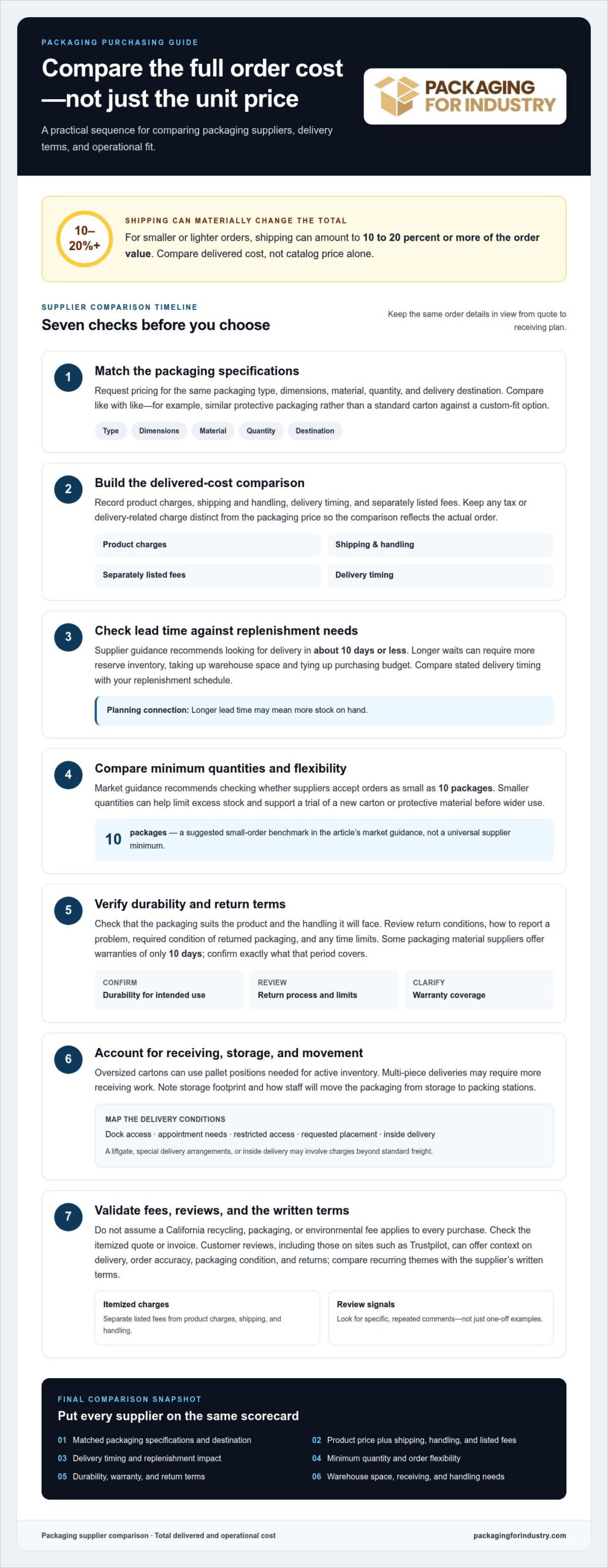
Compare packaging suppliers by the complete order, not one catalog price. For a California business, review delivery timing, minimum quantities, product durability, return terms, and warehouse fit. These details show whether a lower unit price suits your operation or creates extra inventory and handling demands.
Start with equivalent specifications. Request pricing for the same packaging type, dimensions, material, quantity, and delivery destination. For example, compare similar protective packaging rather than a standard carton with a custom-fit option. Record product charges, shipping and handling, delivery timing, and any separately listed fees.
Lead time affects how much stock a business needs to hold. Supplier guidance recommends looking for delivery in about 10 days or less. A longer wait can require additional reserve inventory, using warehouse space and tying up purchasing budget. For production, compare the stated delivery timing with the packaging replenishment schedule.
Order flexibility matters as well. The market guidance recommends suppliers that accept orders as small as 10 packages. Smaller quantities can help a small or medium-sized business avoid excess stock. They can also support a trial of a new carton or protective material before wider use. Compare minimum quantities alongside each unit price.
Assess durability and return terms before selecting a supplier. Packaging that fails during transit can add product damage, repacking, and fulfillment work. Read the return policy for its conditions, process, and time limits. Some packaging material suppliers offer warranties of only 10 days, so identify what that period covers.
Customer reviews can provide additional context. The market guidance recommends reading reviews on sites such as Trustpilot. Look for specific comments about delivery, order accuracy, packaging condition, and returns. Treat individual reviews as examples, then compare recurring themes with the supplier’s written terms.
Are California recycling, packaging, or environmental fees added to orders? Don’t assume a fee applies to every purchase. Review the itemized quote or invoice, separating any listed fee from product charges, shipping, and handling. This keeps the comparison tied to the actual order rather than an assumed surcharge.
Use a consistent checklist to compare options: match packaging specifications, confirm the ship-to destination, and record minimum quantities, delivery timing, fees, and return terms. Then consider the order’s effect on storage and replenishment. This helps California buyers assess whether an offer fits both operational and purchasing needs.
Include packaging, durability, and return terms in your comparison. Before ordering, confirm that the products suit the items being packed and the handling they will face. A product description can help, but check that it addresses the intended use. Review the written return terms, including how to report a problem and the required condition of returned packaging. This helps you judge whether an offer is practical, not just inexpensive.
Choose packaging that suits the job and review the written return terms. Keep those terms with the quote so you can revisit the comparison when replenishment is due. Clarify any uncertainty about durability or returns before ordering to avoid choosing packaging that does not fit your operation.
2. Warehouse and distribution overhead
A packaging order can create costs beyond its invoice through receiving, storage, and internal movement. In a California distribution center, oversized cartons may take pallet positions needed for active inventory. A shipment arriving in several pieces may also require more receiving work. Include these demands when assessing an order’s cost to the warehouse.
Delivery access affects the work required at the dock. A facility without a loading dock may need a liftgate, while a restricted-access site may require special delivery arrangements. Inside delivery adds handling beyond curbside or dock delivery. These services may involve extra charges, so distinguish them from standard freight when reviewing shipment terms.
Delivery delays can also disrupt warehouse schedules. A missed receiving window may force staff to rearrange unloading or shift other tasks. Accessorial charges depend on the service and delivery conditions involved. Record dock access, appointment needs, and requested placement details with each order to clarify the receiving plan.
Returns create a separate cost consideration. Review the seller’s terms for authorization steps, restocking charges, and responsibility for return shipping. These are distinct items, and the terms determine which may apply. Returning unused packaging, for example, could involve transportation back to the seller as well as order processing. Factor in these conditions when evaluating purchasing risk.
Keep sales tax separate from warehouse overhead. Record it apart from storage, receiving labor, freight, and handling. California district taxes can affect the tax calculation for a delivery destination. Separating tax from logistics expenses helps purchasing teams review operating costs consistently.
Packaging dimensions and receiving arrangements can shape warehouse workload even when the product charge stays the same. Bulky cartons may need more staging space; smaller units may require more frequent replenishment movements. Map where each type will be stored and how staff will move it to packing stations. This clarifies the order’s impact on daily workflows.
For each shipment, record storage footprint, receiving requirements, delivery services, and return terms alongside the invoice. Compare these details with actual warehouse use after delivery. This helps distinguish transportation charges from labor or space demands inside the facility and provides a practical basis for refining future orders.
For packaging that creates recurring storage or handling challenges, a packaging quote for your operation can help frame the requirements.
3. What shipping and handling fees apply to California orders?
Shipping and handling can materially change the delivered cost of a California packaging order. For smaller or lighter orders, shipping can amount to 10 to 20 percent or more of the order value. That share makes freight important when the merchandise subtotal is modest. Compare the full delivered total, not just the listed unit price.
Start by separating merchandise charges from shipping and handling. Record each amount from the order summary, then calculate shipping as a share of the product subtotal. This makes freight’s impact easier to compare across orders. Keep taxes separate so the comparison reflects delivery costs rather than other parts of the total.
Order composition affects how shipping compares with purchase value. A small carton order may have a modest product subtotal, while delivery still requires shipment handling. A different product mix or quantity changes the comparison. Use equivalent packaging specifications, quantities, and delivery destinations when evaluating quotes.
Handling also affects warehouse operations after delivery. Staff must receive, move, and store packaging. Multiple pieces can require separate receiving tasks, while bulky items may need more staging space. Include these internal demands in the total-cost review, even though they don’t appear as carrier charges.
Use consistent order details when comparing delivered costs. Record the product subtotal, shipping and handling, quantity received, and delivery format. Then calculate the delivered cost per usable package. A low unit price may not be the best value if the packaging requires extra handling or takes space needed for other inventory.
Purchasing cadence can affect the overall freight burden. Frequent small orders may mean repeated shipping charges. Larger orders can increase storage needs and the amount of packaging held before use. Compare ordering patterns with consumption, production schedules, and available warehouse capacity. Focus on the cost of packaging the business can actually use.
Review shipping as both a percentage of merchandise and a per-unit amount. The percentage shows freight relative to product charges. The per-unit calculation helps compare orders with different quantities. For smaller or lighter orders, shipping at 10 to 20 percent or more can materially affect purchasing decisions.
Keep a record for each order, including product subtotal, delivery charges, quantity received, and unused stock. Compare entries over time to identify recurring freight patterns. Consistent records help California purchasing teams understand delivered costs and make future decisions based on their own order history.
4. Fuel, delivery, and residential surcharges on California orders
Fuel, delivery, and residential surcharges are distinct charge types, and none should be assumed on every California order. Their application depends on shipment terms, the carrier arrangement, the delivery address, and the services involved. Separate them on the quote or invoice so each can be reviewed against the order details.
A fuel surcharge is a transportation-related charge, separate from the packaging itself. If it appears as a line item, record it apart from base freight. This makes it easier to see whether quotes differ because of fuel or another delivery charge. Avoid combining all transportation costs into one figure.
Delivery fees depend on the shipping method and destination. A warehouse dock, a site with restricted truck access, and a location requiring special arrangements may involve different services. Match each charge to the delivery setup shown on the order. This helps distinguish a service-related fee from product charges or standard freight.
Residential surcharges relate to how the delivery destination is classified. A business receiving packaging at a home address should account for that distinction. A company name on the shipping label doesn’t describe the site’s delivery conditions. Use the actual ship-to address when comparing order terms.
For each California shipment, review these details separately:
- Merchandise charges and base freight.
- Any separately identified fuel surcharge.
- Delivery or residential charges shown on the order.
- The ship-to address and its delivery classification.
- Services required by the receiving site.
These distinctions matter when comparing supplier quotes. One quote may include a delivery service that another excludes. Comparing only the merchandise subtotal can hide that difference. Keep the address and requested delivery arrangements consistent across quotes.
Businesses with multiple California facilities should compare each destination based on its actual receiving conditions. A warehouse dock, office entrance, and home-based receiving location may differ in access and delivery setup. Note those details alongside each order so the cost comparison reflects the correct site.
For smaller purchases, a separate surcharge can have a greater effect relative to the merchandise subtotal. Compare the complete delivered total and the quantity received rather than judging one line item alone. This gives purchasing teams a clearer basis for comparison without assuming every shipment has identical delivery needs.
Keep the order confirmation and invoice together. Match each listed charge to the shipment and delivery details, then record any differences for future comparisons. Consistent records help California buyers identify recurring charges and those tied to a specific address or delivery arrangement.
5. What are Uline’s minimum order requirements and small-order fees?
Minimum order requirements and small-order fees affect how much packaging a California business must buy and how often a warehouse replenishes stock. Treat the required quantity and any separate fee as distinct parts of the order, then compare both with expected use.
There isn’t one minimum quantity for every packaging purchase. The item, packaging format, and order terms determine the quantity available. A carton product and a roll of packaging material may have different ordering increments. Review each product line rather than assuming one minimum applies to the entire cart.
A small-order fee, if applied, differs from a minimum quantity. One adds a charge; the other sets or limits the quantity available to order. Check the order for separate fee lines and compare the required quantity with actual consumption. A larger required purchase may avoid a fee but create excess stock.
For a warehouse, the practical cost of a minimum can include space and handling. A business ordering more cartons than its production schedule requires must store them until use. That inventory can occupy pallet locations, complicate replenishment, and tie purchasing decisions to older packaging specifications. Consider these effects alongside the invoice total.
Look for packaging suppliers that allow low minimum order quantities when you need to test a change without committing to a large stock position. For example, a buyer trialing a revised protective format can assess product fit and packing workflow before adopting it more broadly.
Use this comparison process for each packaging item:
- Record the item, required quantity, and order increment.
- Separate product charges from any small-order fee.
- Estimate how much stock the operation will use before replenishment.
- Account for storage space and handling for unused units.
- Compare the resulting delivered cost per usable package.
Order frequency matters, too. Frequent small purchases may involve repeated processing and delivery, while larger purchases may increase storage demands. Compare the purchasing pattern with production schedules, warehouse capacity, and packaging consumption. Lower minimums can offer flexibility; larger orders may suit steady demand when space is available.
Before approving a California order, review the product quantity and every fee line together. Use the same item and destination when comparing supplier quotes. This keeps the comparison focused on the quantity you can use, not a headline unit price based on a different order size.
Packaging For Industry (PFI): Foam Packaging
Packaging For Industry (PFI) provides foam packaging for California operations where standard materials leave products exposed or add avoidable packing work. Custom foam inserts and other protective options can help match packaging to the product while addressing storage and handling needs.
For businesses managing recurring demand, PFI offers Vendor Managed Inventory (VMI) and Just-In-Time (JIT) inventory programs for packaging, helping coordinate supply with operational needs. PFI also supplies stretch film for shipping and warehouse workflows.
If you’re comparing suppliers, PFI can discuss your packaging requirements in context, including product protection and replenishment planning. Contact Packaging For Industry to discuss your packaging needs.
Make your next packaging decision with confidence
Understanding the hidden costs of ordering from Uline in California is a starting point for a consistent purchasing process. Set clear criteria for each packaging order, including product protection, receiving workflows, and replenishment planning. Apply those criteria across future purchases to compare options by operational fit, not just line-item price.
Packaging decisions affect the people handling products every day. A better fit can simplify packing, support reliable fulfillment, and help reduce avoidable product damage. If your current packaging creates extra work or doesn’t suit your products, a focused review can identify where design or supply planning may help. PFI can discuss your requirements and help you evaluate a practical way forward.
Take the next step with a clear view of your needs and priorities. A well-matched packaging approach can support smoother operations as your business moves forward.
Frequently Asked Questions
Are California recycling, packaging, or environmental fees added to Uline orders?
Don’t assume a recycling, packaging, or environmental fee applies to every order. Check the itemized quote or invoice for any separately listed fee.
How does Uline calculate California sales tax, including district taxes?
California district taxes can affect the tax calculation for a delivery destination. Keep sales tax separate from freight, storage, receiving labor, and handling in your cost records.