
What should a custom crate include to protect sensitive IT equipment through shipping and repeated handling? A strong exterior is only part of the solution. Custom crates for sensitive IT equipment should account for the hardware’s dimensions, handling requirements, and interior cushioning. A mismatch can leave equipment free to move or make packing and storage less efficient.
Servers, networking hardware, and other IT equipment need deliberate protection in transit. The challenge is choosing a crate and cushioning combination that fits the equipment and shipping route without adding unnecessary bulk. This guide compares wood crate configurations and interior options, including foam-lined crates, custom foam inserts, and ESD cushioning. It also explains what to include in a project brief, from equipment dimensions and handling steps to shipping and storage needs. PFI designs custom packaging and provides CAD/CAM support, prototypes, and samples to help assess fit before broader production. With clear project details, your team can plan a practical solution and prepare for a custom packaging quote.
Key Takeaways
- Plan custom crates for sensitive IT equipment around the hardware, cushioning, handling steps, and shipment route.
- Understand how crate structure, interior supports, cushioning, and ESD materials contribute to an integrated packaging approach.
- Compare single-use, reusable, foam-lined, and crate-plus-box configurations against shipment frequency, return logistics, storage, and packing workflow.
- Prepare quote-ready details by separating confirmed measurements from estimates and noting removable or protruding components.
- PFI’s custom wood crates, foam packaging, design support, and prototyping help assess equipment fit and plan a practical solution.
Why sensitive IT equipment needs a crate designed around the shipment
A custom IT equipment crate is designed around the equipment, its cushioning, and the way the shipment will be packed, handled, and transported. The crate forms one part of a complete packaging system. It provides an outer structure, while interior supports position the equipment and help prevent movement. A fit assessment brings the crate, interior supports, and packing workflow together before production.
For custom crates for sensitive IT equipment, the design brief should describe the actual shipment, not just the largest item’s dimensions. Equipment value, movement during transit, repeated handling, and the shipping route all help shape the crate and cushioning plan. Equipment moved between warehouses, for example, may go through different handling steps than a unit delivered directly to an installation site.
PFI provides custom wood crates, foam packaging, and packaging design support for businesses seeking an Irvine packaging supplier. Its custom solutions are planned around the equipment and shipment requirements.
Which IT equipment benefits from a custom crate?
Servers, networking hardware, storage systems, and sensitive peripherals vary in shape, weight distribution, and the surfaces that need support. A long server chassis, for example, may need a different interior layout from a compact storage unit. The cushioning plan should account for contact points, projecting features, and areas that should remain clear. Avoid assuming every surface can bear pressure.
List the main unit separately from its accessories. Power supplies, cables, removable modules, mounting rails, and rack hardware may need their own locations so they do not move against the equipment or become separated during unpacking. A single unit often requires a different layout from a coordinated shipment of several components. Identifying each piece helps determine the interior fit and makes packing more repeatable.
What shipment conditions should buyers describe?
Share the shipment’s origin, destination, mode of transport, and planned handling steps. Include how the equipment will be loaded and unloaded, whether it will be staged in a warehouse, and whether the crate is intended for reuse. These details affect access, closure, and the space needed for practical packing and unpacking.
Describe the equipment’s handling requirements, including any ESD considerations. An electrostatic-sensitive device may need ESD-conscious packaging as part of the overall plan. Note whether the shipment is one-time or recurring and whether the same configuration will travel along the same route each time. This information helps PFI coordinate crate design and cushioning with real operating conditions, with the goal of reducing damage without adding packaging that does not serve the shipment.
How crate structure, foam, and ESD materials work together
A protective crate works as a coordinated system. The outer wood structure encloses the shipment, while interior supports position the equipment and cushioning helps manage contact between the equipment and its packaging. Closures keep the crate assembled during handling. Each part has a distinct job, so a robust crate alone will not resolve a poor interior fit.
This system-based approach aligns with the broader scope of IEEE electronics packaging, which considers how packaging houses, supports, and protects electronic components. For shipping IT hardware, coordinate the outer crate with the equipment layout, support points, packing sequence, and stated ESD requirements.
Custom foam inserts can create defined locations for a server, network appliance, or separate component, helping keep pieces organized during packing and unpacking. Insert shapes should reflect item dimensions and contact areas rather than assuming all surfaces need the same support. Coordinate the crate’s interior dimensions with the foam design so components fit without forcing the equipment into place or leaving accessories loose.
When does a foam-lined wooden crate make sense?
A foam-lined wooden crate suits equipment that needs a rigid outer structure and a fitted interior. Shaped inserts can hold a main unit in position, end caps can support selected ends, and pads can separate surfaces or fill planned spaces. Foam-lined surfaces provide broader interior coverage. The right arrangement depends on the equipment, packing process, and shipping method. PFI combines custom wood crates and foam packaging, with custom foam designed around project requirements.
When should buyers consider ESD cushioning?
Consider ESD cushioning when equipment documentation or handling instructions call for materials intended to help manage electrostatic discharge concerns. It is not a universal substitute for other cushioning, and the appropriate selection depends on the equipment and how it will be handled. Share documented requirements and identify which components need ESD-conscious packaging. This gives the design team a basis for coordinating the cushioning with the crate and packing workflow.
For a custom crate quote, provide equipment dimensions, component layouts, packing steps, and any stated ESD requirements. PFI’s custom packaging design support includes CAD/CAM, prototypes, and samples to assess fit before broader production. Request a custom crate quote with the project details you have.
Compare custom crate configurations for sensitive IT equipment
The right setup depends on the equipment, how often it ships, and what happens to the packaging after delivery. A crate designed for a one-time shipment may not suit a recurring route with return logistics. Compare each configuration against your packing and storage workflow rather than treating one option as the default.
| Configuration | Shipment cycle and return logistics | Storage and packing workflow | Equipment fit |
|---|---|---|---|
| Single-use crate | Can suit a one-time shipment or a route without a planned return. | Does not require a return process, though the receiving site still needs a plan for handling the empty crate. | Interior supports can be set up for a specific unit or shipment. |
| Reusable crate | May fit recurring shipments when the return route and responsibility for sending the crate back are defined. | Requires space to store empty crates and a workflow to inspect them before reuse. | Plan for the same equipment configuration and packing process on each trip. |
| Foam-lined crate | Can be considered for one-time or recurring shipments, depending on the packaging plan. | Fitted foam can guide placement, but teams should consider how the insert will be handled and stored between shipments. | Foam layout can be tailored to equipment shape and intended support points. |
| Crate-plus-box system | Can organize a shipment that includes equipment and separate components. | A corrugated box can group smaller items inside the larger crate, supporting a defined packing sequence. | Useful when the main unit, accessories, or related parts need distinct locations. |
Single-use or reusable crate: which fits the shipping cycle?
Shipment frequency alone does not settle the choice. Map the full cycle: where the crate goes, who handles it after delivery, whether it returns, where it will be stored, and who inspects it before another shipment. A reusable approach needs a workable return-transport and inspection process. If that process adds friction or the crate has no planned return route, a single-use configuration may fit operations better. Neither option guarantees a particular service life or cost outcome.
Crate-only or integrated packaging system?
A crate-only setup may be suitable when the equipment already has a defined way to stay positioned inside. Pairing the crate with custom foam and protective corrugated components can give the main unit and smaller parts separate, repeatable locations. Custom foam packaging helps establish the interior fit, while corrugated components can organize accessories or add a packaging layer where the design calls for one. The materials should work together with the packing sequence, not complicate it.
Review PFI’s wooden crate options as you compare configurations for custom crates for sensitive IT equipment. Align equipment fit, return logistics, storage, and packing steps before choosing a system.
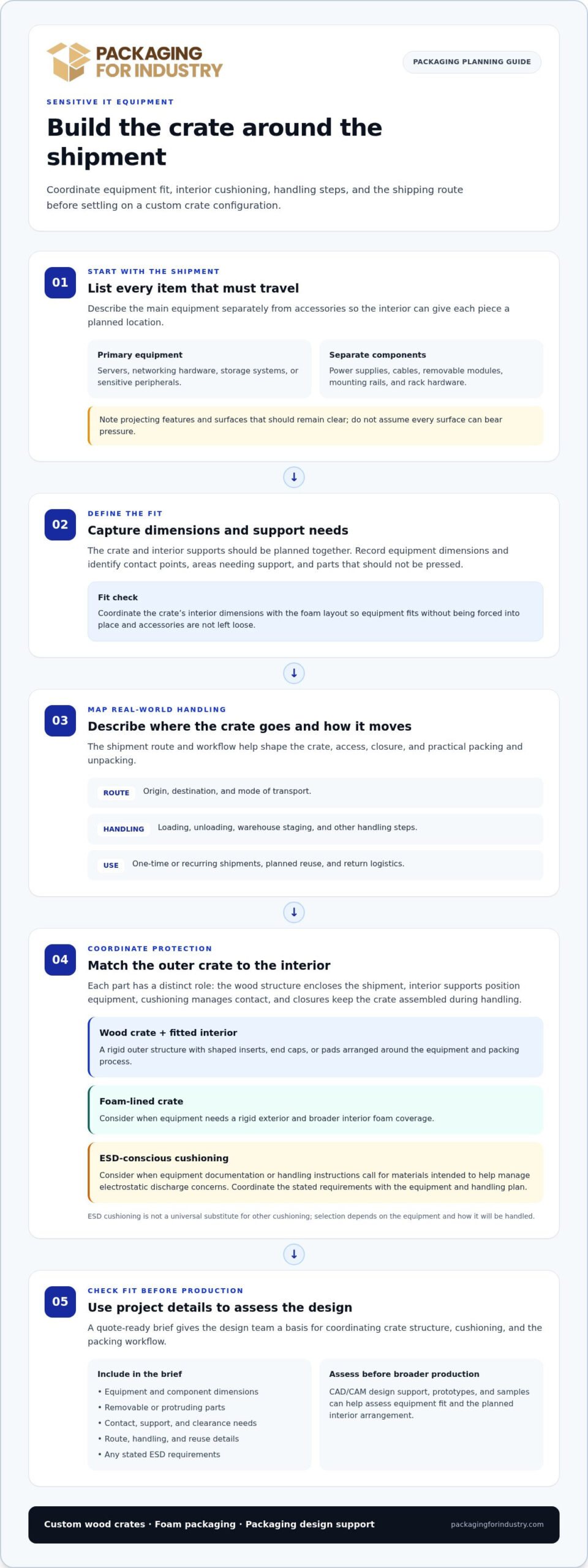
Specify a custom IT crate with a quote-ready project checklist
A clear project brief helps translate equipment and shipping needs into a crate concept that can be reviewed and priced. Separate verified details from estimates so the design starts with reliable information and assumptions are visible. For custom crates for sensitive IT equipment, include these five areas:
- Equipment: List each server, networking device, storage unit, or peripheral. Provide length, width, height, and weight, and identify which measurements are confirmed versus estimated. Include center-of-gravity information and designated handling points if available.
- Components: Note removable modules, protruding parts, rack or mounting hardware, cables, power supplies, and manuals. Specify what ships together, what ships separately, and which items need distinct locations.
- Shipment: Share origin, destination, shipping mode, handling steps, loading and unloading arrangements, and any warehouse staging. Identify whether the shipment is one-time or recurring.
- Protection and packing: Describe known equipment handling requirements, including any ESD considerations, and explain how the team currently packs and unpacks the equipment. Note any packing steps that need to remain consistent.
- Order planning: Include expected order quantities and frequency where known, along with any plans for crate return, reuse, or storage.
Call out unusual shapes early. A handle, connector, rail, or removable component can change how the interior supports the equipment and how staff access it during packing. Photos, drawings, or equipment documentation can clarify details, especially when dimensions are preliminary.
What information should an IT crate brief include?
Start with the equipment and component list, then describe the route and handling workflow. Distinguish confirmed measurements from estimates, and identify protrusions or parts that can be removed before packing. Include documented weight distribution or handling points if available. These details help connect the crate layout and cushioning plan to the configuration being shipped.
How do design review and prototyping support fit?
Design discussions turn the brief into a packaging concept that accounts for equipment dimensions, shipment method, and packing steps. PFI’s custom packaging design services include CAD/CAM support, prototypes, and samples. Reviewing a prototype helps teams assess equipment fit, component placement, and the packing workflow before broader production. It also gives stakeholders a practical way to identify layout changes while the design is being evaluated.
Organize available measurements, the component list, shipment details, and order pattern before requesting a quote. PFI uses these project details to develop a custom crate and cushioning approach for your operation.
Plan sensitive IT equipment crating with PFI
A practical crating plan starts with the equipment and its journey. Dimensions, weight, component layout, handling steps, and shipment frequency help guide crate structure and cushioning. PFI brings custom wood crates, foam-lined crates, and packaging design support together for electronics and semiconductor companies, manufacturers, and warehouse and distribution operations.
For technology businesses in Irvine and across Orange County, Los Angeles, San Diego, and Riverside, coordinated design can support product protection, efficient packing, and cost control. PFI serves the region as an Irvine packaging supplier, with packaging support for industrial customers and nationwide needs.
How can PFI support a custom crating project?
PFI’s custom packaging design process includes CAD/CAM support, design reviews, prototypes, and samples. These capabilities help translate equipment and shipping details into a packaging concept teams can assess for fit and packing workflow before broader production.
Custom crates, foam-lined interiors, custom foam inserts, and ESD cushioning can be considered together with related packaging materials. This integrated approach helps organize a main unit and its accessories, support repeatable packing, and avoid features that add complexity without serving the shipment.
What should buyers include when requesting a quote?
Share equipment dimensions and weight, photographs or drawings, and packing constraints. Include the shipment route, handling steps, order frequency, and any known ESD requirements. Identify removable parts and protruding components, and label estimated measurements clearly. These details help guide a project-specific crate and cushioning plan.
PFI uses your project information to develop a custom approach around the equipment and operating workflow.
Build a Crating Plan Around Your IT Shipment
Effective custom crates for sensitive IT equipment start with the equipment and the way it will move. Match crate construction, cushioning, and any ESD materials to documented requirements, then compare configurations against packing workflow, storage, shipment frequency, and return logistics. Clear dimensions, component details, and handling steps give the project a practical foundation.
PFI combines custom wood crates, foam-lined crates, and integrated packaging capabilities with CAD/CAM design support, prototypes, and samples. These steps help your team review fit and packing details before broader production, while keeping product protection, handling efficiency, and cost control in view.
Share equipment details and shipment requirements to start planning a project-specific solution.
With a well-defined packaging plan, your team can move forward with a clearer process for preparing, handling, and shipping equipment.
Frequently Asked Questions
What is the best crate for sensitive IT equipment?
The best option depends on the equipment, shipment route, handling process, and whether the crate will be reused. A custom wooden crate with fitted cushioning suits equipment that needs a rigid outer structure and an organized interior. Custom crates for sensitive IT equipment should be planned around the full shipment, including accessories and removable parts, rather than dimensions alone. Compare configurations after documenting equipment details and packing requirements.
Should servers ship in a wooden crate or a box?
A wooden crate can suit a shipment that calls for a substantial outer structure, while corrugated packaging can fit other shipping needs. The choice depends on equipment size, handling, shipping method, and interior protection. Some projects combine a crate with foam or corrugated components to organize the equipment and accessories. Assess the complete packaging system, including how equipment is positioned and packed, rather than choosing based only on the outer material.
Is ESD foam necessary for IT equipment crating?
Consider ESD cushioning when equipment documentation or handling requirements call for static-control protection. It is not automatically necessary for every IT shipment, and one foam type will not suit every configuration. Identify which components have documented requirements and share them during packaging design. PFI provides ESD cushioning as part of custom packaging solutions, with material selection coordinated with the crate, interior supports, and packing process.
Can custom crates be designed for server racks and accessories?
Yes. Custom packaging can be designed around specific equipment dimensions and packing needs. Describe the rack or main unit separately from cables, peripherals, removable parts, and mounting hardware, and clarify whether they ship together. PFI’s custom packaging design services include CAD/CAM support, prototypes, and samples. These tools help teams review equipment fit and packing workflow before establishing a production solution for a specific configuration.
When should a company choose reusable IT equipment crates?
Reusable crates may be worth evaluating for recurring shipments or routes between company locations, provided the return process works operationally. Include reverse transport, storage space, inspection, and packing workflow in the comparison. A single-use crate may be more practical when shipments do not have a planned return route. Compare the full process rather than assuming reuse will automatically lower total packaging costs or suit every shipment.
What information is needed for a custom IT equipment crate quote?
Share equipment dimensions and weight, photos or drawings if available, accessory details, shipment origin and destination, and handling steps. Identify removable or protruding components, packing constraints, and documented protection requirements. Include expected order quantities and shipment frequency if known, and label estimated measurements clearly. These details help PFI define the crate, interior cushioning, and packing workflow for a project-specific quote.
Can a custom crate include foam inserts and ESD cushioning?
Yes. A custom crate can include foam inserts, end caps, pads, or other cushioning materials, with ESD cushioning considered when equipment requirements call for it. The right combination depends on the equipment and packing process. PFI integrates custom wood crates and foam packaging to coordinate interior fit and component organization. Share known requirements and constraints so the design reflects the shipment.