
Adding more cushioning may not solve a shipping damage problem. A box can look adequate yet leave a product exposed to impact, vibration, compression, or movement during transit. An effective industrial packaging redesign to reduce damage starts with evidence from actual failures, not simply more material.
If products arrive damaged, review whether the box, cushioning, and pallet configuration fit both the product and its shipping conditions. A redesign also needs to account for freight dimensions, material use, and packing time. The goal is reliable protection that works in daily operations without adding unnecessary cost or slowing the warehouse.
This article explains how to use shipment evidence to identify failure points, compare product-specific protection, and validate a practical redesign before wider adoption. Corrugated boxes, foam, crates, and cushioning can work together as an integrated system. Packaging For Industry supports that process with custom design services, CAD/CAM, prototypes, samples, and packaging reviews focused on damage reduction and cost opportunities.
Key Takeaways
- Use damage records and shipment clues to determine whether the issue relates to product fit, packaging performance, handling, or shipment conditions.
- Match protection to the product’s fragility, weight, geometry, and route. Assess fit, restraint, cushioning, and closure together.
- Compare corrugated-only, insert, foam-lined, and crate-based designs for protection, packing steps, storage footprint, and freight dimensions.
- Plan an industrial packaging redesign to reduce damage around practical requirements, then review prototypes and packing steps before scaling.
- PFI can assess recurring damage patterns and develop custom corrugated, foam, crate, and cushioning solutions tailored to shipping needs.
Industrial packaging redesign starts with diagnosing where shipping damage occurs
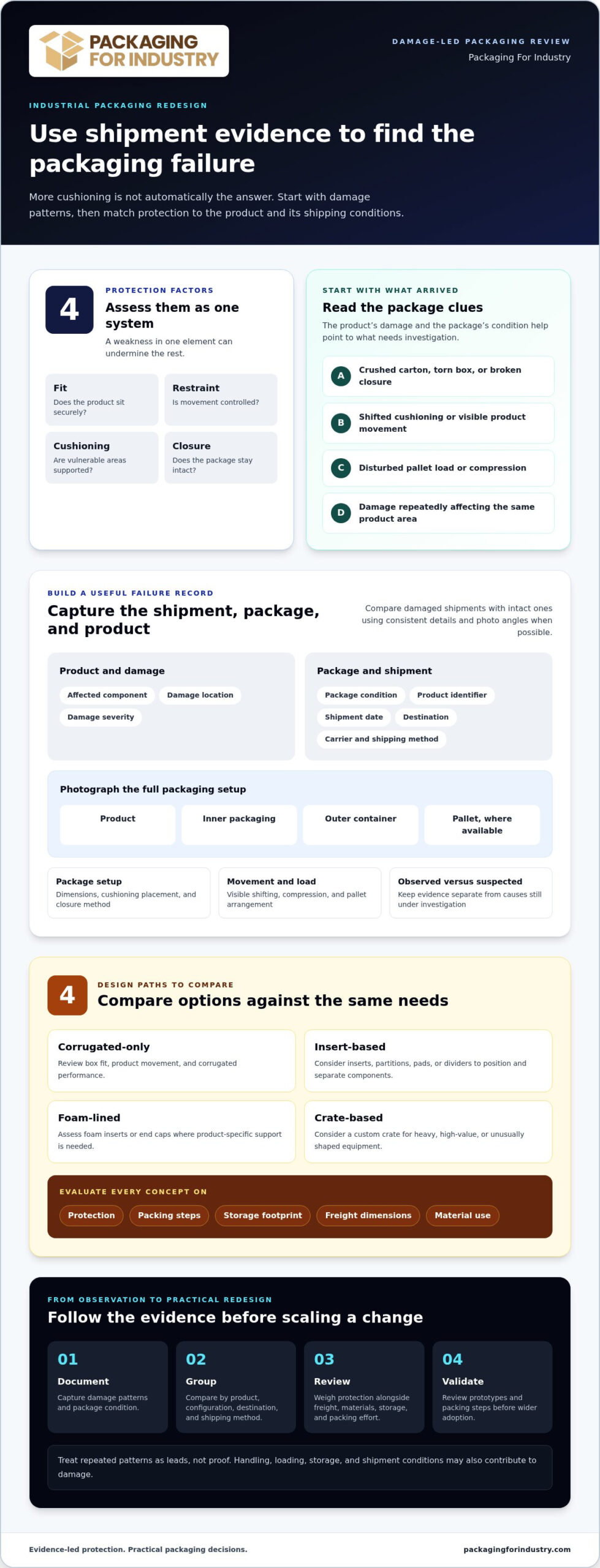
A damaged product is clear evidence that something went wrong, but it does not identify the cause. A crushed carton, shifted cushioning, broken closure, or disturbed pallet load can point to different problems. The location of product damage and the package’s condition on arrival offer clues about whether protection, handling, or shipment conditions need closer review.
Start with documented failure patterns rather than assuming the answer is heavier corrugated or more foam. Damage to the same component across shipments may indicate a fit or restraint issue. A crushed corner, torn carton, or shifted load calls for a different investigation. Separate observations from assumptions to give the redesign a useful starting point.
A damage-led packaging review uses shipment records and package evidence to identify recurring failure patterns before selecting a redesign. This approach supports an industrial packaging redesign to reduce damage while keeping material choices, freight dimensions, and packing steps in view.
Packaging has to contain and protect a product through storage, handling, and transport. The broad overview of Packaging and labelling provides context for these functions, but redesign decisions should be grounded in the product and shipment evidence your operation collects. PFI’s custom packaging design brings that evidence into a practical review of box, foam, crate, and cushioning options.
Which shipment details help identify a packaging failure?
Capture observations consistently for damaged and intact shipments. Record the affected product component, damage location and severity, and the package’s condition on arrival. Include photos of the product, inner packaging, outer container, and pallet where available. Add the product identifier, shipment date, destination, carrier, and shipping method so teams can compare similar shipments.
- Note package dimensions, cushioning placement, closure method, and any visible movement or compression.
- Record pallet configuration, including how products were arranged and secured.
- Compare damaged shipments with intact ones using the same records and photo angles when possible.
How should teams turn damage reports into redesign priorities?
Group reports by product, package configuration, destination, and shipping method. Look for repeated patterns, such as damage to the same edge with one configuration or problems concentrated on a particular route. Treat these patterns as leads, not proof. Handling practices, loading, storage, or other process factors may also contribute.
- Separate confirmed observations from suspected causes that need investigation.
- Prioritize recurring issues by operational disruption, product value, and frequency.
- Keep an open question list so the redesign addresses evidence without adding protection blindly.
A clear record helps the packaging team compare concepts against actual failure conditions. It also gives purchasing and warehouse teams a shared basis for assessing protection, packing effort, and recurring supply needs.
Match industrial packaging protection to the product and shipping conditions
Packaging should respond to the product’s actual risks, not a general preference for heavier materials. Start with fragility, weight, geometry, and how the item is handled during packing, storage, loading, and transit. A delicate surface may need separation from contact points, while a heavy component may need stable support to limit shifting. Long or irregular shapes can require a different arrangement from compact, uniform products.
Fit, restraint, cushioning, and closure work as a system. A close-fitting box can limit movement, but it still needs enough internal support for the product’s vulnerable areas. Inserts or cushioning help position the item, while a secure closure helps keep the package intact through handling. If one element fails, the rest may not provide the intended protection. The right industrial packaging redesign to reduce damage considers how these parts interact and how the package will be packed in practice.
Shipment format matters, too. An individual product needs protection inside its own container. Grouped components may need dividers or inserts to prevent contact, while palletized shipments also depend on a stable arrangement and load protection. Design for the full unit being handled, not just the product in isolation.
When should a redesign use corrugated boxes, partitions, or inserts?
Consider custom box dimensions when shipment records show excess movement or a persistent fit problem. Partitions, pads, and dividers can separate compatible components and maintain their positions during transit. Evaluate heavy-duty corrugated options, including double-wall or triple-wall boxes, against product weight, configuration, and shipment needs rather than selecting them by default. A packaging review can help balance protection with packing and storage requirements.
Where can foam, cushioning, or crates address specific risks?
Foam inserts or end caps can support product-specific positioning, especially when a component needs to stay clear of other surfaces. Consider cushioning materials when impact protection addresses a documented requirement. For heavy, high-value, or unusually shaped equipment, a custom crate may provide a suitable structure. Each option should fit the handling plan and avoid adding material that does not address an identified risk.
For an integrated design, corrugated, foam, and cushioning can be combined rather than treated as competing choices. PFI’s custom packaging design accounts for product geometry and packing requirements. CAD/CAM support, prototypes, and samples help teams review fit and assembly. Foam packaging can also provide shaped support or separation where the product needs it.
As the design moves toward testing, teams can use resources such as Flexpak’s overview of ASTM Packaging Standards to understand the role of standards in packaging evaluation. To translate product and shipment requirements into a tailored design, request a packaging quote with the relevant specifications and damage patterns.
Compare packaging redesign options by protection, freight, and packing workflow
A useful comparison looks beyond the amount of material in each concept. Assess whether it addresses the documented failure point, how reliably employees can pack it, where packaging will be stored, and how the finished shipment fits into the freight plan. A design that adds protection but increases package dimensions or complicates routine packing may create new operational friction.
Use the matrix as a starting point, then review each concept against your product and shipping requirements. The tradeoffs depend on the application.
| Concept | Protection focus | Packing steps | Storage and freight considerations |
|---|---|---|---|
| Corrugated only | Contains products that already tolerate contact and movement within the box. | Typically involves placing the item, closing, and securing the carton. | Can keep components simple. Box dimensions still need to fit the product and shipment. |
| Corrugated with inserts | Separates grouped parts or limits movement with partitions, pads, or shaped inserts. | Requires positioning inserts and loading products in the intended arrangement. | Insert inventory takes space. A better fit may help avoid unnecessary outer dimensions. |
| Foam-lined | Supports product-specific positioning and separation from the carton walls. | Requires placing the item into or between foam components in a repeatable orientation. | Foam and cartons require storage space. Assess the assembled package’s freight dimensions. |
| Crate-based | Provides a structured option for shipments that need a robust outer enclosure. | May require more involved loading and securing steps than a carton concept. | Consider crate storage, handling equipment, and the overall shipment footprint. |
The table does not identify a universal winner. Material quantity alone cannot establish the best total packaging choice. A smaller design may still miss a known risk, while extra layers may add effort without addressing the failure. PFI’s custom packaging design can help translate product and workflow needs into a configuration for review.
How do you compare protection without overbuilding the package?
Compare each concept against a specific failure point and the product’s requirements. If the issue is movement, assess restraint and fit. If contact between components is the concern, evaluate separation. Add cushioning where impact protection addresses an identified risk. Treat apparent excess packaging as a design question to investigate, not as proof that protection is unnecessary.
How can box dimensions and packing steps affect shipping operations?
Review the finished package’s length, width, and height alongside its handling needs. UPS or FedEx dimensional surcharges may affect shipping decisions, so consider dimensions without compromising protection. Then observe the packing sequence. Count handoffs, placements, and closure steps, and note where instructions or extra handling could slow the line.
For a crate-based concept, include loading, securing, and warehouse storage in the comparison, not only protection. A controlled review can reveal whether a design works for both the product and the operation. To compare concepts against your damage patterns and packing requirements, request a custom packaging quote.
Validate an industrial packaging redesign before scaling it across shipments
A promising concept still needs to work beyond the design screen. Validate the package with the product, the people who pack it, and the handling conditions it will face. Prototypes and samples help teams uncover fit or workflow problems before a new configuration becomes routine. For an industrial packaging redesign to reduce damage, keep validation tied to the original problem and the operating requirements the design must meet.
Use a controlled sequence:
- 1. Write the design brief. State the product, shipment configuration, intended destinations or shipping methods, documented damage pattern, and packing constraints. Define what the redesign should address and which operational indicators matter.
- 2. Develop the package concept. Translate the brief into a proposed configuration, including the outer container, internal supports, closure, and any pallet or crate arrangement. PFI’s custom packaging design brings corrugated, foam, crate, and cushioning components together in a tailored system.
- 3. Review a prototype or sample. Use the physical sample to check product fit, placement, closure, and packing steps. Record observations and adjustments rather than relying on assumptions about how the design will perform.
- 4. Run a controlled implementation. Use the approved sample in a limited, identifiable shipment group. Keep the configuration consistent and collect shipment and packing feedback before broad adoption.
- 5. Compare results and approve the specification. Review the same damage and operational indicators used to define the original issue. Document the accepted materials, arrangement, closure, and packing instructions for purchasing and operations.
What should teams review in a packaging prototype?
Have packers complete the normal task, not just inspect an empty sample. Check whether the product sits in the intended position, stays clear of vulnerable contact points, and can be loaded and removed without disrupting the process. Confirm that closure is practical and the finished package can be handled and stored as intended. Log each adjustment needed to make the design repeatable.
How should teams monitor a redesigned package after rollout?
Compare post-rollout reports with the original baseline across comparable shipments, noting product, configuration, destination, and shipping method. Include packing feedback, material use, and recurring shipment issues, since a damage trend may coexist with workflow changes. If reports reveal a new pattern, investigate it before revising the design. Keep the approved specification accessible so shifts, locations, and purchasing teams use the same configuration.
A documented review makes it easier to distinguish a design that looks suitable from one that fits the operation. It also gives teams a clear basis for deciding whether to maintain, adjust, or expand the approved package.
Work with PFI on custom industrial packaging designed to reduce damage
Recurring shipment damage calls for a review of the complete package, not an automatic switch to heavier materials. Packaging For Industry works with manufacturers and shipping operations to assess damage patterns, product requirements, and packing needs, then develop a practical direction for redesign. The goal is to connect product protection with the realities of packaging for warehouses and distribution centers, including recurring supply and packing efficiency.
Corrugated boxes, protective foam, crates, and cushioning can each address different risks or work together as one system. A fragile electronic assembly may need shaped support and separation inside a carton. Heavy industrial equipment may call for a crate-based approach that accounts for its shape and handling. Custom sizes are available to fit project requirements, and a review can help teams compare packaging pricing and identify opportunities to lower packaging costs without overlooking protection or workflow.
PFI’s custom packaging reviews focus on damage reduction and cost-reduction opportunities. CAD/CAM support, prototypes, and samples help teams assess a design, while integrated material solutions bring packaging components together around the product and shipment. Buyers can also discuss bulk packaging pricing and local packaging delivery needs when planning repeat orders. These capabilities support an informed industrial packaging redesign to reduce damage without promising a particular result.
Which industrial teams and products can benefit from a packaging review?
Operations, procurement, warehouse, and shipping teams can bring different project requirements together, from current materials and packing steps to recurring supply priorities. Reviews can suit manufacturers and distributors shipping aerospace components, electronics, medical devices, automotive parts, or industrial equipment, especially when products are heavy, fragile, high-value, or shipped repeatedly with documented damage concerns.
What information should buyers provide for a packaging quote?
A focused request helps scope the project. Share what the product is, how it is currently packed, how it ships, and what damage keeps recurring. Include available product and package dimensions, photos, and a description of packing steps, along with operating requirements such as storage limits or packing-line constraints. This information helps shape a tailored quote and a practical review of protection, workflow, and supply needs.
- Product: Describe its geometry, weight, components, and vulnerable areas.
- Current package: List the box, foam, cushioning, crate, closure, or pallet configuration in use.
- Shipment: Note the shipping method and whether products ship individually, grouped, or palletized.
- Project priorities: Share damage records, photos, packing steps, and purchasing or delivery requirements.
PFI supports industrial packaging buyers in Southern California, including Orange County, Los Angeles, San Diego, and Riverside, as well as nationwide. Sharing the information your team has gives the design process a grounded starting point.
Request a custom packaging quote and share your product details, current packaging, shipment method, and damage pattern.
Make packaging performance part of your operating plan
Packaging needs can change as product mix, order patterns, and shipping routes shift. Treating packaging as an operating input rather than a fixed purchase gives your team a reason to revisit the design when requirements change. An industrial packaging redesign to reduce damage should support the priorities your teams need to balance, from dependable protection to efficient packing and recurring supply.
Before the next design discussion, align the people who make or use packaging decisions. Shipping and warehouse teams can explain handling realities, procurement can clarify purchasing priorities, and product teams can identify features that need protection. Agreeing on what matters most keeps the project focused and gives a packaging partner useful context for tailoring the approach.
PFI helps manufacturers and shipping operations turn those requirements into a practical packaging project. Bring your team’s priorities and shipment concerns to the conversation, then determine a sensible next step for your operation.
A deliberate packaging plan can give your team a stronger foundation for reliable shipments and smoother operations.
Frequently Asked Questions
How can a manufacturer tell whether packaging caused shipping damage?
Packaging may be a factor when damage appears alongside a crushed carton, displaced internal supports, a broken closure, or repeated contact marks in the same area. These clues do not prove the cause, so compare damaged shipments with intact ones and consider handling and route conditions too. For example, a recurring scrape on one component may prompt a review of its position inside the package and any nearby dividers or supports.
Can packaging be redesigned without changing the product or packing line?
Yes. A redesign can be planned around the existing product and packing-line tasks. Share line constraints early, such as the direction a product is loaded, available workspace, and how cartons are closed. A sample can reveal whether a change fits the current sequence or requires an adjustment. PFI’s custom design work accounts for operational requirements, and the final configuration should be reviewed with the team that packs it.
What information should I include in a custom packaging quote request?
Include the product type, current packaging materials, shipment method, and a description of recurring damage. Available product and carton dimensions, photos, and a brief outline of packing steps help clarify the project. Note priorities such as easier assembly, product separation, or storage limits. PFI supports industrial packaging needs in Orange County, Los Angeles, San Diego, and Riverside, as well as nationwide requirements.
Can a smaller shipping box help reduce product damage?
A smaller box can reduce excess room for movement if the product still has the support and clearance it needs. Simply reducing dimensions is not enough. A tight fit that presses on a vulnerable surface or removes needed cushioning could create a different risk. Compare the package’s internal fit and external dimensions together, then review how the change affects protection, packing, and carrier dimensional charges.
How can a company compare redesigned packaging with its current packaging?
Use a defined trial with the current and proposed configurations, and record the same measures for both. Compare damage reports alongside packing feedback, material use, package dimensions, and recurring shipment issues. Keep product type and shipping conditions as comparable as practical so the review is useful. Document the trial period and configuration clearly, then use the results to decide whether to revise, maintain, or expand the new design.
Does industrial packaging redesign only apply to corrugated boxes?
No. A redesign can involve corrugated boxes, foam inserts, cushioning, crates, or a combination of materials. For example, corrugated packaging may provide the outer container while foam positions a sensitive component inside. A palletized shipment may call for a different integrated arrangement. The right scope depends on the product, its handling needs, and the shipping problem being addressed, rather than on one material category alone.