
A single microscopic shift in a sensor’s alignment during transit can turn a fifty thousand dollar diagnostic unit into an expensive paperweight before it even reaches the clinic. For manufacturers in the medtech hubs of Orange County and San Diego, the standard catalog foam used by most suppliers often fails to provide the vibration dampening required for sensitive optics. Investing in custom foam inserts for medical diagnostic equipment in Southern California isn’t just about cushioning; it’s a critical engineering step to preserve calibration and meet the strict FDA Quality Management System Regulation standards taking effect in February 2026.
You likely already know that off-the-shelf packaging solutions lead to inconsistent quality and frustrating lead time delays that stall your supply chain. We understand that your reputation depends on zero-damage delivery and a professional presentation that reflects the precision of your brand. This article will show you how precision-engineered foam inserts protect your equipment from the unique logistics hurdles of the Southern California corridor. We’ll preview the benefits of local prototyping, the advantages of ESD-safe materials, and how to maintain a reliable local supply to eliminate stockouts and lower your total cost of ownership.
Key Takeaways
- Learn why standard catalog packaging fails high-value diagnostic assets and how custom-engineered solutions prevent expensive calibration loss during transit.
- Compare the performance of Polyethylene and Polyurethane materials to determine the ideal shock absorption for your specific medical instruments.
- Discover how to mitigate the unique vibration risks found in the regional supply chain with custom foam inserts for medical diagnostic equipment in Southern California.
- Streamline your procurement process using Vendor Managed Inventory (VMI) and local next-day delivery to facilities in Orange County, Los Angeles, and San Diego.
- See how free prototyping allows your engineering team to verify product fit and protection levels before finalizing a bulk packaging order.
Protecting Sensitive Diagnostic Assets in Southern California
High-value diagnostic equipment like MRI components and automated lab analyzers represent a massive capital investment for healthcare providers. Shipping these items across the state requires more than just standard corrugated boxes and loose-fill peanuts. When you rely on off-the-shelf void fill, you risk the structural integrity and calibration of the device. Precision-engineered custom foam inserts for medical diagnostic equipment in Southern California are a necessity to ensure that sensitive sensors remain aligned throughout the chaotic transit process. Without a tailored solution, even a minor drop during loading can result in catastrophic internal failure.
The Cost of Shipping Damage in Medical Diagnostics
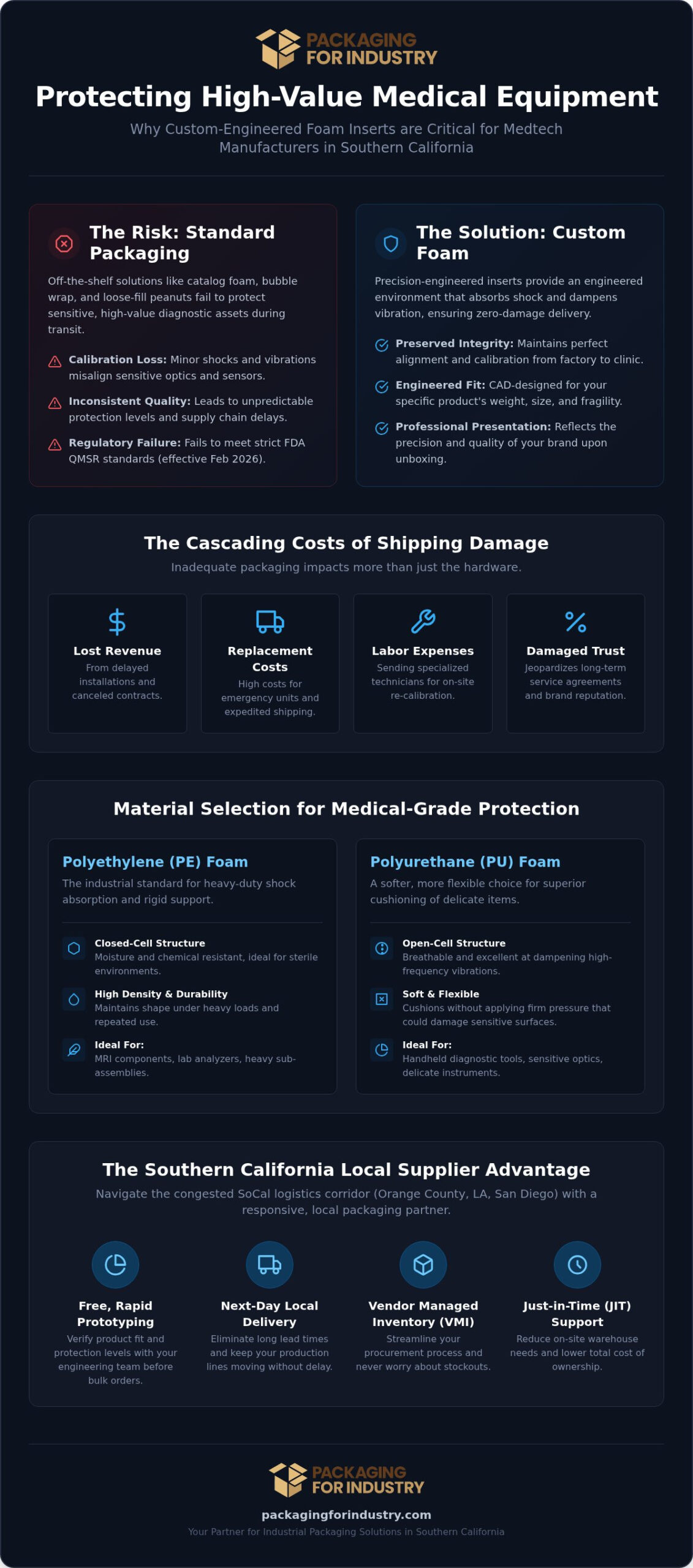
Shipping damage in the medical field is rarely just about the cost of the physical hardware. If a lab analyzer arrives with a misaligned laser or a cracked housing, the manufacturer faces cascading financial losses. Consider the following hidden costs of inadequate packaging:
- Lost revenue from delayed contracts and installation windows.
- High costs for emergency replacement units and expedited shipping.
- Labor expenses for sending a specialized technician to a client site for re-calibration.
- Damaged provider trust that can jeopardize long-term service agreements.
Generic materials like bubble wrap or thin cardboard can’t absorb the G-force impacts common in heavy truck transport. By utilizing specialized foam materials, we create a protective environment that dampens micro-vibrations and prevents shock-induced failures. This is especially critical as the FDA’s Quality Management System Regulation (QMSR) alignment with ISO 13485 takes effect on February 2, 2026, placing even more emphasis on maintaining device integrity throughout the entire supply chain.
Why Southern California Manufacturers Choose Custom Inserts
Manufacturers in Orange County, Los Angeles, and San Diego operate in one of the most congested logistics corridors in the world. The last mile of delivery through high-traffic hubs like the Port of Los Angeles or Inland Empire LTL centers subjects your equipment to frequent handling and constant road vibration. A local partner provides a significant operational advantage here. Working with an Anaheim-based team means you get rapid-response engineering and next-day delivery that supports your just-in-time (JIT) manufacturing lines.
Reliable local supply reduces the need for massive on-site warehouse space. Instead of waiting weeks for a custom packaging shipment from an overseas or out-of-state supplier, you can get the exact protection you need within 24 hours. This proximity allows for tighter control over your supply chain and ensures that your custom foam inserts for medical diagnostic equipment in Southern California are ready the moment your production run is complete. You can request a packaging quote to see how localized engineering can lower your total logistical costs.
Material Selection for Medical-Grade Foam Inserts
Engineering custom foam inserts for medical diagnostic equipment in Southern California begins with a technical assessment of the material’s physical properties. Not all foams are created equal. High-density Polyethylene (PE) is the industrial standard for heavy-duty shock absorption. It provides the rigid support needed for MRI sub-assemblies and floor-standing lab analyzers. For lighter, more delicate instruments, Polyurethane (PU) foam is often the better choice. Its soft, flexible structure offers superior cushioning for handheld tools and sensitive optics that cannot withstand the firm pressure of high-density materials.
Closed-Cell vs. Open-Cell Foam for Medical Devices
The structural difference between closed-cell and open-cell foam impacts both protection and hygiene. Closed-cell PE foam features sealed pores. This makes it resistant to moisture and chemical absorption, which is a requirement for equipment used in sterile environments. It is highly durable and maintains its shape under repeated heavy loads. Open-cell PU foam is more breathable and excels at dampening high-frequency vibrations. Choosing the right density depends entirely on the weight and fragility of your diagnostic tool. A density that is too high might be too abrasive for finished surfaces; a density that is too low will not prevent the device from bottoming out during a drop.
ESD Protection for Diagnostic Electronics
Diagnostic equipment often contains sensitive circuit boards that are vulnerable to electrostatic discharge. This is a major concern in Southern California where dry air increases the likelihood of static buildup during transit. Standard packaging materials can act as insulators, allowing charges to accumulate. We solve this by using ESD-safe foam. Pink anti-static foam prevents the generation of static, while black conductive foam actively moves charges away from the device. Integrating these materials into custom corrugated boxes ensures total electronic safety from the warehouse to the hospital.
Adhering to the FDA Quality System Regulation means ensuring that your packaging does not compromise the device’s functionality. Using the wrong foam can lead to costly field failures and regulatory scrutiny. Our Anaheim-based engineering team can help you select the precise material to meet these standards while keeping your total packaging costs low. You can request a packaging quote today to see how our material expertise can improve your supply chain reliability.
Engineering Precision: The PFI CAD and Prototyping Process
The manufacturing of custom foam inserts for medical diagnostic equipment in Southern California requires a level of precision that standard packaging suppliers cannot match. Our process begins with a comprehensive technical assessment. We don’t just measure the outer dimensions of your device; we identify the most vulnerable fragility points, such as protruding sensors, delicate glass components, or sensitive calibration dials. By understanding the center of gravity and the specific G-force limits of your equipment, our Anaheim-based engineering team can design a protective system that exceeds industry standards.
Once the assessment is complete, we move into the CAD/CAM design phase. This step creates a precise digital blueprint of the foam insert, ensuring that every contour of the diagnostic tool is supported. This digital model allows us to simulate how the foam will react to the pressures of the supply chain. We align our designs with testing protocols like ASTM D4169 to ensure the packaging can survive the rigors of LTL shipping and repeated handling at regional distribution centers. This data-driven approach eliminates guesswork and ensures that your high-value assets remain secure.
Eliminating Risk with Free Prototyping
We believe in a “measure twice, cut once” philosophy, which is why we offer free prototyping to ensure a perfect product fit. Before you commit to a bulk order, we provide a physical sample for hands-on testing. This allows your team to verify that every sensor and cable has a dedicated, secure compartment. Prototyping is the most effective way to avoid expensive mass-production errors. It gives you the confidence that the final custom foam inserts for medical diagnostic equipment in Southern California will perform exactly as expected in the field. If adjustments are needed, we can refine the CAD file and produce a new sample within days, not weeks.
CNC Precision vs. Traditional Die-Cutting
Choosing the right production method is a balance between volume, complexity, and cost. We offer two primary manufacturing paths:
- CNC Cutting: This method is ideal for complex, low-volume diagnostic gear and specialized prototypes. It doesn’t require expensive tooling, making it a cost-effective choice for small production runs or highly intricate designs with deep cavities.
- Die-Cutting: For high-efficiency, large-scale production runs of medical kits, die-cutting is the superior option. It allows for rapid manufacturing while maintaining the tight tolerances required for professional medical equipment organization.
Our custom design packaging services ensure that regardless of the production method, your inserts provide a professional presentation for your healthcare clients. By matching the manufacturing technique to your specific project needs, we help you lower packaging costs without sacrificing the safety of your diagnostic instruments. You can contact our team to discuss which method is right for your next production run.
Navigating the SoCal Supply Chain: Vibration and Impact Mitigation
Southern California’s logistics corridor is one of the most demanding environments in the country for sensitive freight. The “vibration profile” of regional freeways, especially the high-traffic routes connecting Orange County to the Inland Empire, creates a constant state of micro-oscillation during transit. For manufacturers of custom foam inserts for medical diagnostic equipment in Southern California, engineering for these specific road conditions is vital. Standard packaging fails to account for the sustained harmonic vibrations that can loosen internal diagnostic sensors or knock delicate optics out of alignment before the equipment even reaches its destination.
Transit through Inland Empire warehouses often exposes shipments to extreme temperature fluctuations. High-density polyethylene and specialized polyurethane foams maintain their structural integrity even in the 100-degree heat typical of Ontario or Riverside distribution centers. This stability ensures that the foam doesn’t soften or lose its shock-absorbing properties when your equipment is sitting on a loading dock. During Less-Than-Truckload (LTL) transit, your gear is subject to frequent stops and cross-docking. Custom foam acts as a dedicated shock absorber, protecting high-value components destined for the Port of Los Angeles or LAX from the rough handling inherent in multi-stop freight routes.
Vibration Dampening for Sensitive Optics and Sensors
Diagnostic gear is significantly more prone to vibration damage than standard electronics because it relies on precise mechanical tolerances and perfectly aligned light paths. We engineer foam thickness to absorb the specific frequencies encountered during road transit, preventing energy transfer from the truck bed to the device. For larger imaging gear, custom foam lined crates provide a secondary layer of isolation against heavy-duty impact and sustained road chatter. This engineering-first approach ensures that calibration remains intact, regardless of the distance traveled.
Optimizing for Regional Freight and LTL
Shipping costs are a major concern for operations managers looking to improve the bottom line. We help you lower packaging costs by optimizing the foam-to-box ratio, which reduces dimensional weight (DIM) surcharges without compromising safety. This ensures your diagnostic kits remain perfectly organized and protected even after rough handling in crowded regional distribution centers. Local Southern California delivery from our Anaheim facility significantly reduces total transit time and minimizes the number of touchpoints where damage typically occurs.
Custom Packaging Solutions for SoCal Medical Manufacturers
Manufacturers operating in the medical hubs of Anaheim, Irvine, and San Diego require a packaging partner that understands the intersection of engineering precision and supply chain economics. When you source custom foam inserts for medical diagnostic equipment in Southern California, you’re looking for more than a vendor; you’re looking for a logistical safeguard. We’ve positioned our Anaheim facility to serve as a proactive extension of your production line, providing the technical expertise needed to protect high-value assets while lowering your total packaging costs through engineering efficiency.
Vendor Managed Inventory (VMI) for Medical Packaging
One of the biggest hurdles for Southern California manufacturers is the high cost of industrial real estate. Storing bulky boxes and foam inserts on-site consumes valuable floor space that could be used for additional production lines. Our Vendor Managed Inventory (VMI) program solves this by housing your custom packaging off-site and delivering it exactly when you need it. This system ensures you never run out of critical components during a high-volume production run. It also provides predictable billing and absolute supply reliability for recurring diagnostic kit orders, allowing your purchasing team to focus on other priorities.
Integrated Packaging Solutions: Foam, Boxes, and Crates
Effective protection is rarely achieved with a single material. We provide integrated solutions that combine precision-cut foam with heavy-duty corrugated boxes and corner and edge protection. By acting as a single-source supplier, we eliminate the compatibility issues that often arise when sourcing from multiple vendors. This holistic approach ensures that your custom foam inserts for medical diagnostic equipment in Southern California fit perfectly within their outer containers, creating a unified system that survives the rigors of global transit.
Our team also offers custom kitting and assembly services. We can deliver pre-assembled packaging units directly to your facility, saving your production team hours of labor and streamlining the final pack-out process. This level of service is designed to improve your operational flow and ensure that every diagnostic unit leaves your facility with a professional, clinical presentation that reflects the quality of the technology inside.
Reliability in your supply chain is a requirement, not an option. Our local engineering team is ready to help you optimize your packaging for maximum protection and minimum waste. Request a custom medical foam quote today to see how we can support your next manufacturing cycle.
Secure Your Diagnostic Integrity and Lower Logistical Costs
Maintaining the precision of high-value medical instruments requires a packaging strategy that moves beyond generic cushioning. By selecting the right material density and utilizing ESD-safe foam, you protect sensitive electronics from the specific vibration and static risks found in the Southern California logistics corridor. Our Anaheim-based engineering team is dedicated to providing tailored solutions that preserve calibration and ensure your equipment arrives in clinical-ready condition.
Utilizing custom foam inserts for medical diagnostic equipment in Southern California allows your operation to benefit from free prototyping and rapid design iterations. This proactive approach, combined with local next-day delivery and Vendor Managed Inventory (VMI) services, eliminates the stress of stockouts and reduces the need for expensive on-site warehouse space. We’re here to help you streamline your procurement and protect your most critical assets.
Our team is ready to demonstrate how precision-engineered packaging can improve your supply chain reliability and protect your bottom line. Let’s build a solution that meets your exact technical requirements and keeps your production lines moving efficiently.
Frequently Asked Questions
What is the best foam material for shipping sensitive medical diagnostic equipment?
Polyethylene (PE) foam is the industrial standard for heavy machinery, while Polyurethane (PU) is best for delicate optics and lighter instruments. We analyze the G-force limits of your device to select the correct density for your specific application. This ensures the equipment doesn’t bottom out during impact while providing enough softness to prevent surface abrasion. Our engineering team helps you choose the right material for custom foam inserts for medical diagnostic equipment in Southern California based on weight and fragility.
Does PFI offer ESD or anti-static foam for medical electronics?
We provide a full range of ESD (Electrostatic Discharge) and anti-static materials specifically designed for sensitive medical electronics. Static buildup in dry Southern California climates can destroy circuit boards during transit if not properly mitigated. We use pink anti-static foam to prevent charge generation or black conductive foam to actively dissipate existing charges. Integrating these materials into your packaging system is a requirement for maintaining FDA compliance and ensuring long-term device integrity.
How long does it take to get a custom foam prototype in Southern California?
You can typically receive a physical prototype within a few business days because our engineering team is based locally in Anaheim. We offer free prototyping to ensure the fit is perfect before you move to a bulk production run. This local proximity allows for rapid design revisions that out-of-state catalog suppliers can’t match. It’s a critical step to eliminate the risk of mass-production errors and ensure your high-value diagnostic assets are fully protected.
Can custom foam inserts help reduce my shipping costs with UPS and FedEx?
Yes, custom foam can significantly lower your shipping costs by optimizing the dimensional (DIM) weight of your parcels. Carriers like UPS and FedEx charge based on box size as much as actual weight. By engineering a tighter foam-to-box ratio, we reduce the outer dimensions of your packaging without sacrificing protection. This optimization ensures you aren’t paying to ship empty air while still maintaining the safety of your diagnostic equipment during transit.
Is there a minimum order quantity for custom-cut medical foam?
We specialize in industrial and bulk packaging needs, but we remain flexible to support medical manufacturers during their scaling phases. While we don’t have a rigid one-size-fits-all minimum, our processes are optimized for production-level orders that require consistent quality and tight tolerances. For new projects, we start with a free prototype to prove the design. This allows you to verify the protection levels before committing to a full manufacturing run.
Do you provide local delivery for manufacturers in Orange County and Los Angeles?
We provide local next-day delivery to manufacturers throughout Orange County, Los Angeles, and San Diego. Our Anaheim facility is strategically located to bypass the long lead times associated with national catalog suppliers. This proximity supports your just-in-time (JIT) manufacturing lines and reduces the need for extensive on-site warehouse space. Local delivery also minimizes the number of shipping touchpoints, which helps lower the risk of transit damage during the final mile.
How does custom foam protect diagnostic equipment from vibration during transit?
Custom foam absorbs the harmonic frequencies generated by road transit on Southern California freeways. We engineer the thickness and cell structure of the foam to act as a mechanical filter, dampening vibrations before they reach sensitive internal sensors. This protection is vital for maintaining the calibration of optics and lasers. Without this specific dampening, constant road chatter can cause micro-shifts that lead to equipment failure or inaccurate diagnostic readings upon arrival.
Can you design foam inserts that fit into existing medical transport cases?
We can design custom foam inserts for medical diagnostic equipment in Southern California to fit perfectly into any existing transport case or crate. Our CAD team uses precise measurements or digital scans of your current cases to create a seamless fit. This is an excellent solution for field service kits or mobile diagnostic units that require high-durability protection in a portable format. We ensure every cable, sensor, and component has a secure, organized compartment.