
If your high-value machinery arrives at an overseas port with structural damage, the initial savings on cheap crates instantly vanish into replacement costs and lost client trust. Selecting the best packaging materials for export is a technical challenge where engineering meets economics. You already know that international transit is unforgiving; however, balancing durability with rising freight costs and strict ISPM 15 regulations often feels like a moving target. It’s a logistical hurdle that requires more than just a standard box to solve effectively.
We’ve developed this 2026 guide to simplify your procurement process and protect your bottom line. You’ll learn how to choose the right combination of heavy-duty corrugated, custom foam inserts, and load stabilization to ensure zero-damage arrivals. Whether you’re shipping from a facility in Los Angeles, Orange County, or San Diego, this overview provides the specific material insights needed to lower freight costs through dimensional weight optimization. We’ll cover everything from military-spec foam to triple-wall boxes, giving you a clear roadmap for international shipping compliance and total logistical efficiency.
Key Takeaways
- Engineering for the “Touchpoint Reality” is vital since international shipments endure significantly more handling than standard domestic routes.
- Selecting the best packaging materials for export, including triple-wall corrugated and custom wood crates, ensures your high-value machinery survives the rigors of global transit.
- You’ll understand how to adjust your packaging strategy based on transit mode, focusing on weight reduction for air freight and stacking strength for ocean shipments.
- Stay compliant with international standards like ISPM 15 and learn palletization best practices to avoid costly customs delays or structural failures.
- Learn how local Southern California expertise in custom engineering and prototyping helps manufacturers lower packaging costs while improving supply chain reliability.
The Critical Challenges of International Export Packaging
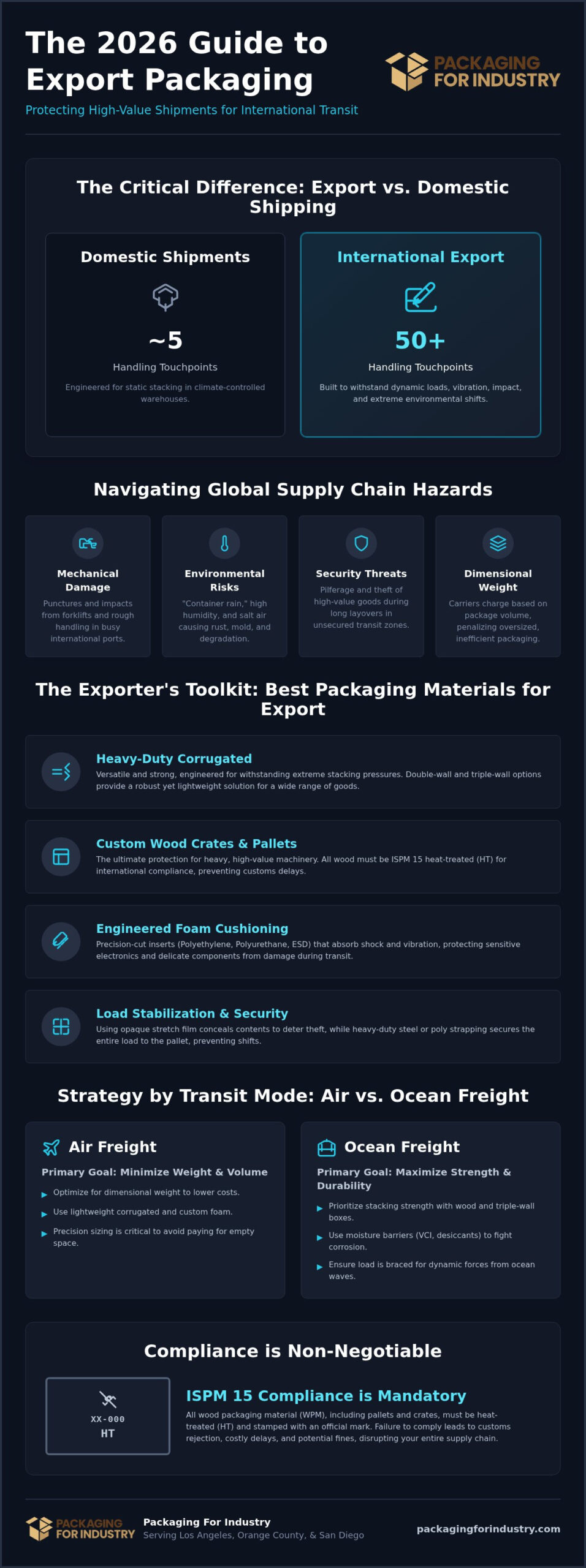
Export packaging is a specialized engineering approach designed to withstand the multi-modal rigors of global transit. It acts as a coordinated system of preparing goods to survive thousands of miles across land, sea, and air. Selecting the best packaging materials for export isn’t a matter of simple containment; it’s a strategic decision to protect your capital equipment and your reputation. Unlike domestic shipments that might be handled five times, international cargo often faces ten times that amount of handling. Every crane lift, forklift transfer, and customs inspection is a potential point of failure that your packaging must neutralize.
Environmental risks represent another layer of complexity that standard industrial supplies can’t handle. Ocean containers are subject to “container rain” caused by extreme temperature fluctuations, alongside the corrosive effects of salt air. Without the right moisture barriers or heavy-duty corrugated boxes, your products can arrive with rust, mold, or structural degradation. The financial stakes extend far beyond the immediate loss of a shipment. Frequent damage leads to increased insurance premiums and can permanently damage your standing with international distributors who rely on your reliability.
Export vs. Domestic Shipping: Why Your Standard Box Isn’t Enough
Domestic packaging is typically designed for static stacking in a climate-controlled warehouse. In contrast, export packaging must handle dynamic loads. On a cargo ship, the vertical force of the vessel hitting a wave can double the effective weight of the stack. Standard domestic boxes often buckle under this pressure. Vibration and impact are also constant threats; the steady hum of an aircraft engine or the pitch of a ship can shake sensitive electronics apart if they aren’t secured with custom foam packaging. Finally, compliance is non-negotiable. Domestic materials that lack proper heat treatment markings are frequently rejected at international customs, leading to costly storage fees and shipment delays.
Common Export Hazards in the Global Supply Chain
Mechanical handling remains the primary cause of damage in foreign ports. Whether your goods are leaving through the Port of Los Angeles or arriving in a complex European hub, forklift tines can easily puncture thin-walled containers. This makes the use of triple-wall corrugated or custom crates essential for high-value machinery. Security is another concern. High-value goods should be secured with opaque stretch film to conceal the contents and deter pilferage during long layovers in unsecured transit zones. It’s also vital to understand how your material choices impact your shipping budget. Dimensional weight is a pricing technique used by commercial carriers that calculates shipping costs based on the package’s volume relative to its actual weight. If your packaging is oversized, you’re paying for air, which is why precision sizing is critical for export profitability.
The Best Packaging Materials for Export: An Industrial Breakdown
Industrial buyers must look beyond standard stock items to find the best packaging materials for export that balance durability with logistical efficiency. In 2026, the focus has shifted toward high-performance materials that reduce weight without compromising compression strength. For manufacturers in Los Angeles or San Diego, choosing the right material combination is a matter of engineering and economics. A successful export strategy utilizes a coordinated system of heavy-duty corrugated, heat-treated timber, and precision-engineered cushioning to ensure zero-damage arrivals.
Heavy-Duty Corrugated: Triple-Wall and RSC Options
Heavy-duty corrugated remains a versatile workhorse for international transit. While a standard RSC (Regular Slotted Container) is sufficient for domestic freight, export requirements often demand double-wall or triple-wall construction to withstand extreme stacking pressures. These materials can be treated with weather-resistant coatings to survive the high humidity of tropical transit zones or the “container rain” common in ocean freight. You can explore our custom corrugated box options to find the specific grade and style required to lower your freight costs while maintaining protection.
Custom Crating and ISPM 15 Wood Standards
For heavy machinery and sensitive aerospace components, custom wood crates are the gold standard for structural integrity. However, international regulations require all Wood Packaging Material (WPM) to be heat-treated (HT) and stamped according to ISPM 15 standards. Failure to comply can lead to your shipment being quarantined or destroyed at the port of entry. Many savvy exporters now use hybrid designs that combine heat-treated wood bases with triple-wall corrugated sleeves to maintain compliance while reducing total tare weight. Learn more about Engineering Custom Crates for International Transit to optimize your heavy-duty shipping cycles.
Engineered Foam for High-Value Component Protection
Shock and vibration are constant threats during multi-modal transit. Polyethylene (PE) foam is the preferred choice for heavy items due to its moisture resistance and durability. Conversely, Polyurethane (PU) foam provides superior cushioning for lighter, more delicate parts. For sectors like electronics and aerospace in Orange County, utilizing ESD (Electrostatic Discharge) or anti-static foam is mandatory to prevent circuit damage during long-haul flights. Precision die-cutting ensures a perfect fit, eliminating the “box within a box” inefficiency common in standard packaging. If you need a specialized fit for complex geometries, check out our custom foam packaging solutions for industry.
Load stabilization is the final piece of the protection puzzle. High-performance stretch film prevents the load shifting that causes structural failure, while Vapor Corrosion Inhibitors (VCI) stop salt-air oxidation before it starts. If you’re ready to optimize your export strategy, request a packaging quote to compare pricing on these high-performance materials.
Choosing Materials Based on Transit Mode: Air vs. Ocean
The choice of transit mode dictates the physical forces and environmental conditions your shipment will face. While air freight is faster, it demands lightweight rigidity to combat high freight rates. Ocean freight, conversely, requires extreme structural integrity and chemical protection against corrosive environments. Selecting the best packaging materials for export requires a dual focus on these specific transit stressors to avoid both over-engineering and under-protecting. A strategy that works for a flight from Los Angeles to Tokyo will likely fail during a six week ocean voyage to Hamburg.
Most international shipments are intermodal by nature. Your goods might start on a truck in Orange County, move to a rail yard, transfer to a container ship, and finally reach a local delivery van in a foreign market. This “Last Mile” in foreign markets often presents the greatest risk, as infrastructure variations can mean limited forklift access or unpaved roads. Your packaging must be robust enough to survive every transition point, not just the primary leg of the journey. This requires a coordinated system of pallets, crates, and internal cushioning that accounts for every potential touchpoint.
Optimizing for Air Freight: Light but Rigid
Weight is the primary cost driver in air logistics. We recommend using high-density polyethylene foam because it provides superior shock absorption with a smaller footprint than standard fillers. This allows for a smaller outer box, which reduces dimensional weight charges and lowers your total landed cost. For manufacturers shipping roll goods, textiles, or specialized architectural components, heavy-duty tubes and cores for export offer a lightweight yet incredibly rigid solution. These materials prevent bending and crushing during the rapid loading and unloading cycles typical of air cargo hubs.
Ocean Freight: Battling Corrosion and Compression
Ocean transit exposes goods to high humidity and the weight of massive container stacks. To combat “container rain,” you should use desiccants and moisture barrier bags inside your crates. Stacking failure is a common cause of damage in maritime shipping, often occurring when the bottom pallet in a container collapses under dynamic pressure. Utilizing preventing edge damage with industrial corner protectors reinforces the vertical strength of your palletized loads. These protectors distribute weight evenly, ensuring that your products remain intact even when containers are stacked ten high in a pitching vessel. By focusing on moisture resistance and compression strength, you can ensure your goods arrive in factory condition regardless of the transit duration.
Compliance and Stabilization: Ensuring Your Load Arrives Intact
Compliance and stabilization are the final hurdles in ensuring your high-value goods survive the global supply chain. Selecting the best packaging materials for export involves more than just the outer container; it requires a disciplined approach to load integrity. ISPM 15 regulations are non-negotiable for wood pallets and crates. Every piece of wood packaging must carry the IPPC certification mark, indicating it has undergone proper heat treatment. Without this visible compliance, customs officials in foreign ports can quarantine your shipment, leading to massive demurrage fees and the potential destruction of your packaging.
Palletization requires precision to maintain structural integrity throughout the journey. You must avoid “pallet overhang,” where boxes extend beyond the edge of the pallet. This mistake causes the corners of your boxes to lose their vertical support, which can lead to a total stack collapse during the vibrations of ocean or air transit. Proper labeling is equally critical. International transit demands multilingual warnings and compliance with the Globally Harmonized System (GHS) for hazardous materials to prevent handling errors in foreign warehouses that don’t speak your native language.
Load Stabilization with Industrial Stretch Film
Export-grade stabilization starts with high-performance stretch film. While domestic shipments might use thinner gauges, 80-gauge or higher is the standard for international loads to ensure adequate containment force. Machine stretch film is generally preferred for high-volume export operations because it provides consistent tension that hand-wrapping cannot match. Measuring containment force is a vital operational step; it ensures the film exerts enough pressure to keep the load from shifting without crushing the boxes. You can source wholesale stretch film for industrial use that meets these rigorous export specifications.
Corner Guards and Edge Protection
Cardboard edge protectors are essential for loads secured with heavy-duty plastic or steel strapping. These guards prevent “strap-crush,” where the tension of the straps bites into the corners of your corrugated boxes and weakens their stacking strength. By reinforcing the vertical corners of a pallet, you can improve vertical stacking strength by up to 20%. This is vital for manufacturers in Los Angeles or Orange County who need to maximize container space without risking product damage. Corner guards are the cheapest insurance against pallet collapse.
Why PFI is the Strategic Partner for Southern California Exporters
Manufacturers searching for an industrial packaging supplier near me in Southern California need a partner that understands the specific demands of the Port of Los Angeles and Port of Long Beach. PFI provides more than just materials; we offer a localized logistics system including next-day delivery and Vendor Managed Inventory (VMI) to streamline your warehouse operations. While identifying the best packaging materials for export is a technical requirement, our role is to ensure those materials are available exactly when your production schedule demands them across Los Angeles, Orange County, and San Diego.
Our engineering team utilizes free prototyping to validate every design, ensuring that your high-value machinery or sensitive electronics are perfectly secured before a single shipment leaves your dock. This proactive approach eliminates the professional stress of transit damage and ensures your goods meet all international standards. By choosing a local partner with deep expertise in custom engineering, you gain a steady supply chain that adapts to your production peaks and protects your bottom line.
Serving Aerospace and Manufacturing in Orange County
Aerospace and defense contractors in Southern California operate under strict regulatory and quality requirements. We specialize in Mil-Spec packaging and custom kitting services that provide the precision protection these sectors demand. Our just-in-time delivery model keeps your shipping docks clear, allowing your team to focus on production rather than managing excess inventory. If you’re ready to improve your supply reliability and lower packaging costs, you can Request a custom export packaging quote to see how our expertise fits your specific operational needs.
From Anaheim to the World: Reliable Supply Chains
PFI serves as a premier bulk packaging supplier and a pragmatic, cost-saving alternative to massive catalog vendors who offer generic, one-size-fits-all solutions. We specifically help our clients navigate the rising costs of international freight by optimizing dimensional weight. Our design team identifies ways to reduce box footprints without sacrificing protection, helping you avoid the aggressive surcharges often imposed by carriers for oversized international shipments. Contact our Anaheim headquarters to optimize your export packaging today and ensure your high-value goods arrive safely at any global destination.
Optimizing Your Global Supply Chain for 2026
Protecting high-value industrial goods during international transit requires a shift from standard boxes to an engineered protection system. Success depends on matching the best packaging materials for export to your specific transit mode, whether that involves maximizing stacking strength for ocean freight or minimizing tare weight for air cargo. It’s a balance of engineering and economics that ensures your goods survive the rigors of the global supply chain without inflating your shipping budget.
Packaging For Industry (PFI) provides the specialized expertise needed for aerospace, manufacturing, and Mil-Spec compliance. Our Southern California headquarters offers local next-day delivery to Anaheim, Los Angeles, and San Diego; this keeps your operations moving at the speed of your production line. We support your procurement process with free prototyping and design reviews to validate every solution before it hits the shipping dock. Partnering with a proactive problem-solver means you can focus on your core business while we handle the logistical complexities of protection and compliance.
We’re ready to help you lower your packaging costs and improve your supply chain reliability for the year ahead.
Frequently Asked Questions
What is the best packaging material for heavy machinery export?
Heat-treated (HT) wood crates are the industry standard for securing heavy machinery because they provide the structural integrity required for concentrated weights. These crates withstand the mechanical handling risks at international ports where forklifts and cranes are used frequently. However, for lighter industrial components, we often suggest triple-wall corrugated to lower packaging costs without sacrificing vertical stacking strength. The ideal choice depends on your product’s weight and the specific handling requirements of your destination.
What are ISPM 15 standards and why do they matter for export?
ISPM 15 is a mandatory international regulation requiring all wood packaging materials to be heat-treated to eliminate timber pests. Every pallet or crate must carry the IPPC certification stamp to pass through customs without being quarantined or destroyed. We ensure all our wood products meet these global requirements so your exports move through foreign ports without delay. This compliance is essential for any Southern California manufacturer shipping to international markets.
How can I reduce shipping damage for fragile international exports?
Reducing damage requires a combination of precision-engineered cushioning and rigid load stabilization to survive the high handling rates of global transit. Utilizing custom foam inserts prevents internal shifting, while 80-gauge stretch film and corner guards maintain the pallet’s structural integrity. When you compare packaging pricing, it is vital to consider the cost of potential shipping damage; investing in engineered protection is significantly more cost-effective than replacing high-value goods and paying for return freight.
Is triple-wall corrugated as strong as a wood crate for export?
Triple-wall corrugated offers exceptional vertical stacking strength and is often the best packaging materials for export when air freight weight is a concern. While it does not offer the same puncture resistance as solid timber, it handles the dynamic loads of ocean transit effectively when properly stabilized. We ensure custom sizes available in triple-wall to provide a tight fit, which further enhances the container’s durability and minimizes dimensional weight surcharges.
How do I calculate the dimensional weight of my export packaging?
Dimensional weight is calculated by multiplying the exterior dimensions (L x W x H) and dividing the total by the carrier’s specific divisor. Carriers bill based on whichever is greater: the actual weight or the dimensional volume of the package. Our design team focuses on reducing the exterior footprint of your boxes to avoid these expensive surcharges. By using custom-engineered inserts, we can often shrink the overall container size without compromising product safety.
What is the difference between polyethylene and polyurethane foam for shipping?
Polyethylene (PE) is a durable, closed-cell foam ideal for heavy machinery and moisture resistance during long ocean voyages. Polyurethane (PU) is a softer, open-cell foam designed to cushion lighter, highly sensitive electronics or medical devices. For aerospace exports, we also provide ESD-safe versions of these foams to prevent circuit damage. Selecting the correct density ensures that your product does not “bottom out” during the high-vibration environment of international cargo holds.
How does Southern California location benefit my export logistics?
Our proximity to the Port of Los Angeles and Port of Long Beach allows for faster drayage and significantly reduced inland freight expenses. We offer local next-day delivery to facilities in Anaheim, San Diego, and Orange County, ensuring your shipping department never stalls due to material shortages. This local presence also facilitates rapid prototyping, allowing you to test and validate designs before committing to a full production run for international distribution.
Can PFI provide custom-sized export boxes on short notice?
Yes, our local manufacturing capabilities in Anaheim allow us to produce custom-sized boxes and crates with much shorter lead times than catalog-based distributors. We maintain custom sizes available for a wide range of industrial applications, from heavy-duty RSCs to specialized aerospace kitting. This flexibility is a core component of our Vendor Managed Inventory (VMI) programs, which are designed to support the recurring export needs of high-volume Southern California manufacturers.