
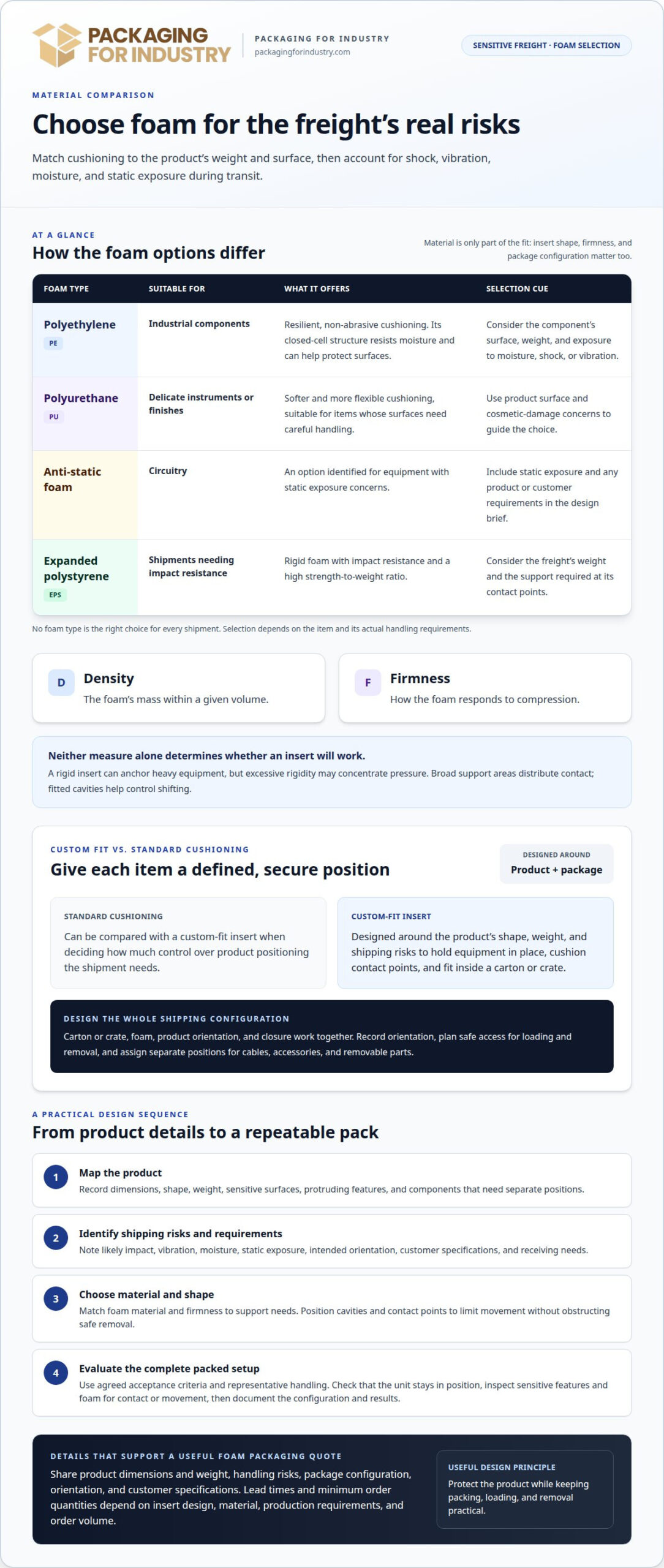
The softest foam is not always the right choice for sensitive freight. Custom foam packaging for sensitive freight can use polyethylene for resilient cushioning, polyurethane for delicate items, anti-static foam for circuitry, or rigid expanded polystyrene for impact resistance. The right fit depends on the product’s weight and surface, as well as its exposure to shock, vibration, or static during transit.
Choosing packaging for sensitive equipment means balancing protection with practical handling. An insert should hold the item securely without making warehouse packing unnecessarily complicated. This guide explains how foam types differ, when a custom-fit insert can outperform standard cushioning, and how its design can limit movement in a carton or crate. It also covers the details that shape material selection and help make packing operations consistent.
Key Takeaways
- Match foam material, density, and insert shape to the freight’s weight, surface, and handling needs.
- Account for shock, vibration, and static exposure when selecting cushioning for sensitive equipment.
- See where a custom-fit insert can offer more controlled positioning than standard cushioning materials.
- Pre-shaped inserts can make packing more consistent by giving each item a defined place in the package.
- Prepare product dimensions, weight, and shipping details to support a useful foam packaging quote.
What is Custom Foam Packaging?
Custom foam packaging is designed around a product’s shape, weight, and shipping risks. For sensitive freight, an insert can hold equipment in place, cushion contact points, and fit inside a carton or crate. Material, density, firmness, and cutout geometry all matter. An insert for a compact instrument, for example, needs different support from one designed for a heavy industrial component.
Design starts with the product. Its dimensions show where the insert needs clearance, while its weight helps determine the support required at each contact point. The shape guides the cutouts, cavities, and retaining features. A product with protruding connectors may need a recessed channel, while a flat panel needs broad, even support. These details limit unwanted movement while keeping the product easy to remove.
Material choice follows the product’s handling needs. Polyethylene foam offers resilient, non-abrasive cushioning for industrial components. Its closed-cell structure resists moisture and can help protect surfaces. Polyurethane foam is softer and more flexible, making it suitable for delicate instruments or finishes that need to avoid cosmetic damage. Expanded polystyrene, or EPS, is rigid and offers impact resistance with a high strength-to-weight ratio.
Density and firmness describe different foam characteristics. Density is the foam’s mass within a given volume; firmness describes how it responds to compression. Neither measure alone determines whether an insert will work. High-density, rigid foam can anchor heavy equipment inside a wooden crate or heavy-duty carton. Softer foam may better cushion a lightweight instrument, particularly when its surface needs careful handling.
- Map the product: Record its dimensions, shape, weight, and sensitive surfaces.
- Identify the risk: Note likely impacts, vibration, moisture exposure, or movement during transit.
- Choose the foam: Match material and firmness to the item’s support and cushioning needs.
- Shape the insert: Position cavities and contact points to hold the product securely.
High-density foam can help anchor heavy equipment, but excessive rigidity may concentrate pressure. Insert geometry matters: broad support areas distribute contact, while fitted cavities control shifting. For example, a machine component with a projecting shaft may need a protected recess rather than a tight cutout around the shaft. The foam must also fit the carton or crate surrounding it.
Lead times and minimum order quantities depend on the insert design, material, production requirements, and order volume. A repeat insert and a newly designed shape may follow different production paths, so project details determine the schedule and quantity.
Recyclable polyethylene inserts can be reprocessed into new industrial packaging materials at the end of their useful life. When selecting this option, consider both the required cushioning and the available route for reprocessing used material.
Custom-fit foam cushioning for shock, vibration, and static protection
For custom foam packaging for sensitive freight, design the complete shipping configuration, not just the insert. The carton or crate, foam, product orientation, and closure work together as one package. A tall component placed on its side may load the insert differently from the same component shipped upright. Record the intended orientation so the design reflects how the freight will travel.
Layout also affects loading and removal. A part that fits tightly but has no safe handhold can slow unloading or lead staff to pull on a delicate feature. Where the product allows, include access points for fingers or lifting tools. For equipment with cables or accessories, specify their positions separately so loose pieces do not press against the main unit.
Compare foam options against the shipment’s actual exposure and handling requirements. The material must suit both the product and package configuration, and the insert’s shape should keep components from interfering with one another. Use customer specifications and intended shipping conditions to guide the design.
Freight packaging criteria may come from customer instructions, product requirements, or the receiving operation. Include those specifications with the product details, especially required orientation, handling marks, or restrictions on contact with particular surfaces. This gives the packaging design a clear basis without assuming the same criteria fit every shipment.
Evaluate performance using the complete shipping setup and agreed acceptance criteria. Confirm that the packed unit stays in its intended position after representative handling, then inspect sensitive features and the insert for signs of contact or movement. Document the package configuration and results so production and warehouse teams can repeat the setup.
- Confirm orientation: Show how the freight sits during packing and transport.
- Plan access: Identify safe grasp points for loading and removal.
- Separate contents: Assign locations for accessories, cables, and removable parts.
- Record requirements: Include customer instructions and receiving needs in the design information.
U.S. industrial packaging suppliers and custom foam fabricators make inserts for sensitive freight. Choose a source that can work from the product’s dimensions, handling needs, and package configuration. When requesting a quote for custom foam packaging for sensitive freight, share those details and any customer specifications. This helps align the insert design with the shipment’s actual use.
A clear test plan defines what the packed shipment must demonstrate before the design moves into routine use. Agree on the package configuration and acceptance conditions with the relevant shipping and receiving teams. Keep the resulting instructions with the packaging design so future orders use the same setup.
Custom foam compared with standard packaging materials
Standard cushioning can work well for products with simple shapes and a low risk of movement. Kraft paper, bubble cushioning, and loose fill can surround items inside cartons. Custom foam takes a different approach: shaped cavities support specific areas of the product. For a control panel with projecting knobs, a fitted insert can hold the panel while keeping those parts clear.
The key difference is how each material controls movement. Loose fill shifts around a product, while paper cushioning depends on how it is packed. Bubble cushioning can wrap surfaces but does not create a precise position for every component. A fitted foam insert gives an instrument or machined part a designated location, making packing more repeatable.
Standard materials still have a role. Paper and loose fill can cushion irregular voids, while bubble cushioning can separate parts with delicate finishes. Corrugated partitions can divide multiple components in one carton. These options may suit shipments with changing dimensions or no need for a reusable fitted insert. For consistent freight, custom cavities can reduce the need for packers to shape loose material around each item.
The wrong foam can leave too much clearance, compress excessively, or press against a fragile feature. A heavy assembly may shift in soft foam, while rigid foam can concentrate pressure on a delicate edge. These mismatches can expose the product to abrasion or impact, or damage protruding features during handling.
Closed-cell foam can offer moisture resistance and structural rigidity, which may matter when a shipment faces damp handling conditions. Durable polymer foam inserts can also be reused across shipping cycles or repurposed for long-term product storage. Reuse depends on the insert retaining its shape and securely fitting the product after each cycle.
- Choose shaped foam for repeat shipments with consistent product dimensions and vulnerable contact points.
- Choose paper or loose fill when voids vary and packers need flexible fill around different items.
- Choose bubble cushioning to wrap surfaces that need separation from other package contents.
- Choose corrugated dividers when one carton must keep several components in separate spaces.
Compare materials by identifying what the package needs to control: movement, surface contact, moisture exposure, or separation between components. A machined metal part, for example, may need a fitted cradle, while a mixed kit may benefit from corrugated partitions and flexible cushioning. The outer packaging matters too. The insert must fit the carton or crate, and the complete pack should keep the freight stable during normal handling.
Custom foam is not automatically the best choice for every shipment. Standard cushioning can be practical for variable products or occasional packing. A fitted insert makes more sense when consistent positioning, repeatable packing, or protection for a specific shape is the priority.
Faster warehouse packing with pre-shaped inserts
A pre-shaped insert makes packing a repeatable sequence rather than an improvisation. At a warehouse station, the operator places each component in its matching cavity, then adds the specified top pad and carton. For a pump assembly with a separate control module, dedicated cavities keep both parts organized in one package.
Standard placement reduces the need to measure or shape cushioning for each order. Packing instructions can specify the insert orientation, component locations, and closure sequence. For example, a diagram can show the pump base entering the larger cavity first, followed by the control module in its own recess. Clear steps help both new and experienced packers use the same method.
Station layout also affects workflow. Keep each insert beside its matching carton and product instead of mixing several configurations at one table. A label or SKU identifier on the packaging can help the operator select the right set. This is particularly useful when similar-looking parts need different cavities or protection points.
- Match the order: Identify the product and its packaging configuration before packing.
- Stage the materials: Place the matching insert, carton, and closure materials within reach.
- Load by sequence: Fit each component into its designated cavity and add required pads.
- Confirm the pack: Check orientation, closure, and visible fit before moving the carton.
Pre-shaped inserts can make orders with multiple components easier to organize. A maintenance kit, for instance, may include a gauge, cable, and machined fitting. Separate recesses help prevent the parts from contacting one another. An empty cavity is also easy to spot, helping catch a missing item before the carton leaves the station.
Repeatability depends on keeping the insert in good condition and maintaining clear packing instructions. Store inserts flat or in their intended orientation to prevent damage or confusion. If an insert serves several product versions, clearly identify the applicable model. A changed component or revised product shape may require a different cavity, so keep old and new configurations identifiable.
Warehouse teams can assess the workflow by observing an order from picking through carton closure. Note where the packer pauses, searches for materials, or repositions a component. If a cable repeatedly catches on a cavity edge, the insert layout may need adjustment. These observations help distinguish a packaging issue from a station-staging or instruction issue.
For recurring shipments, consistent inserts can support predictable packing across shifts and locations. Pair each design with clear work instructions and a designated material location. Supervisors can then use the setup for training, replenishment, and reviewing packing errors without relying on memory or informal handoffs.
What information is needed to request a custom foam packaging quote?
A useful quote request starts with the product and its shipping requirements. Share the item’s length, width, height, and weight, with units such as inches and pounds, and identify any removable parts. A pump shipped with a separate controller needs different cavities from an assembled unit. Clear details help define the insert shape, support points, and material requirements.
Product details should identify what needs protection. Note fragile surfaces, projecting connectors, moving parts, and areas that must remain untouched. A photo can reveal a shape that measurements alone do not explain; a drawing or product model can clarify recesses, handles, and openings. For example, a metal housing with a delicate display needs support around the housing, not pressure on the screen.
Shipping conditions help determine the package design. Describe whether the freight travels by parcel, pallet, or crate, and how it moves through handling. Include known concerns such as vibration, impact, moisture exposure, or static-sensitive electronics. If the insert must fit an existing carton, provide its inside dimensions and explain how the product sits inside.
- Product: Dimensions, weight, orientation, and the number of components.
- Protection needs: Fragile areas, exposed circuitry, surface concerns, and impact risks.
- Current packaging: Carton or crate dimensions, materials, and observed damage points.
- Order context: Expected order volume, repeat frequency, and packing workflow.
- Design references: Photos, drawings, or a sample part when available.
Order context matters because a one-time shipment and a recurring production run have different requirements. State the expected quantity and whether the design will serve one product or several versions. If warehouse staff pack multiple configurations, identify each model and its differences. A shared base with alternate connectors, for example, may need separate cavities or clearly distinct insert layouts.
Existing packaging can show where a new design should improve. Describe what works and what does not, such as a loose fit, difficult removal, or a component rubbing against the carton. Include damage photos when available. For freight shipped in a wooden crate, note the interior space and loading direction. These details help align the foam geometry with the outer package.
Before submitting project details, organize them in one file. Label each photo with the matching part name and mark dimensions on drawings. Keep the product orientation consistent across references. If several components are involved, identify which ship together and which need separation. These steps reduce ambiguity during design review.
A complete request gives the packaging team a practical basis for evaluating fit, protection, and packing flow. Request a custom foam packaging quote with your product details and shipping requirements.
Packaging For Industry (PFI): Foam Packaging
Packaging For Industry (PFI) helps manufacturers address product movement, vulnerable surfaces, and inconsistent packing with foam packaging and custom packaging design services. Turn to PFI when a standard insert does not fit the product’s shape or warehouse packing needs. Design considerations can include component layout, protective contact points, and how the insert fits the shipping container.
For repeat shipments, a defined insert can support a consistent packing sequence. PFI also offers stretch film to secure packaged freight and Vendor Managed Inventory (VMI) for packaging when inventory coordination is part of the operation. These services connect product protection with the day-to-day needs of shipping and replenishment.
Share product dimensions, weight, sensitive areas, shipping conditions, and expected order volume to discuss a suitable approach. Contact Packaging For Industry to discuss foam packaging for your freight.
Make Your Next Packaging Review More Useful
Use your next packaging review to connect shipment outcomes with purchasing and warehouse decisions. Record where damage occurs, which products need repacking, and where teams pause during packing. These observations give operations and procurement a shared basis for refining a packaging plan instead of treating each issue in isolation.
For freight handled in Orange County, Los Angeles, and San Diego, consider how the package performs from the packing station through loading and delivery. Product changes, revised routes, or new handling steps can affect whether an existing design still fits. A focused review can help identify when custom foam packaging for sensitive freight needs adjustment and what details should guide that decision.
A clear next step can turn packaging concerns into a practical project. Bring the shipment requirements and operational priorities together, then develop a plan that supports your team’s work.
Frequently Asked Questions
What Types of Foam Materials Are Available?
Common industrial options include polyethylene, polyurethane, expanded polystyrene (EPS), expanded polyethylene (EPE), expanded polypropylene (EPP), cross-linked polyethylene (XLPE), and anti-static or conductive ESD foam. Each serves different packaging needs. ESD foam, for example, is used around static-sensitive electronic components, while convoluted foam can cushion equipment with uneven surfaces. Choose material based on the item’s shape, handling risks, and surface protection requirements.
What types of custom foam packaging protect sensitive freight?
Protective formats include die-cut inserts, end caps, pads, planks, convoluted foam, and foam-lined boxes or crates. An end cap can protect the ends of a long component, while a foam-lined crate combines cushioning with a rigid outer structure. For shipments containing several small parts, a custom foam assembly can organize individual components and reduce contact between them during handling.
How do you choose foam density and cushioning for fragile or heavy items?
Start with the item’s weight, shape, surface finish, and vulnerable areas, then consider how it will be handled and shipped. A heavy cast-metal part needs stable support beneath its load-bearing areas; a fragile instrument needs cushioning that avoids pressure on delicate controls. Density and firmness are related but distinct, so the design should account for both the foam’s mass and its response to compression.
How is custom foam packaging designed and manufactured?
Design begins with product dimensions, weight, and protection requirements. CAD/CAM support can translate those details into an insert layout, including cavities for separate components and clearance around delicate features. A prototype or sample helps assess product fit before production. The chosen foam is then cut or formed to the design, with the insert made to work with its carton, box, or crate.
What freight packaging and crating standards apply to sensitive shipments?
Packaging criteria may come from customer instructions, product requirements, or the receiving operation. Include orientation, handling marks, and restrictions on contact with sensitive surfaces. Agree on the complete package configuration and acceptance conditions with the shipping and receiving teams.