
Packaging shortages don’t have to catch a production team by surprise. Vendor managed packaging inventory for Irvine manufacturers gives a supplier responsibility for monitoring packaging stock and replenishing it using consumption, demand forecasts, and agreed inventory levels. The goal is to keep needed supplies available while avoiding unnecessary excess.
It makes sense to want dependable packaging availability without tying up warehouse space and cash in surplus stock. This article explains how vendor managed packaging inventory works for Irvine manufacturers, what information supports replenishment decisions, and how minimum and maximum stock levels help balance supply with production demand. You’ll also learn what to define in an agreement so inventory responsibilities and service expectations are clear.
Key Takeaways
- VMI assigns a supplier a role in monitoring packaging inventory and coordinating replenishment, with responsibilities agreed between both parties.
- Consumption data and demand forecasts help guide restocking decisions as production needs change.
- Setting minimum and maximum stock levels gives teams a framework for balancing supply availability with excess inventory.
- Clear usage data and service metrics help both sides assess whether a packaging inventory program is meeting operational needs.
- Matching materials such as foam packaging and stretch film to usage patterns can support a more reliable replenishment plan.
What Is Vendor Managed Inventory (VMI) for Industrial Packaging?
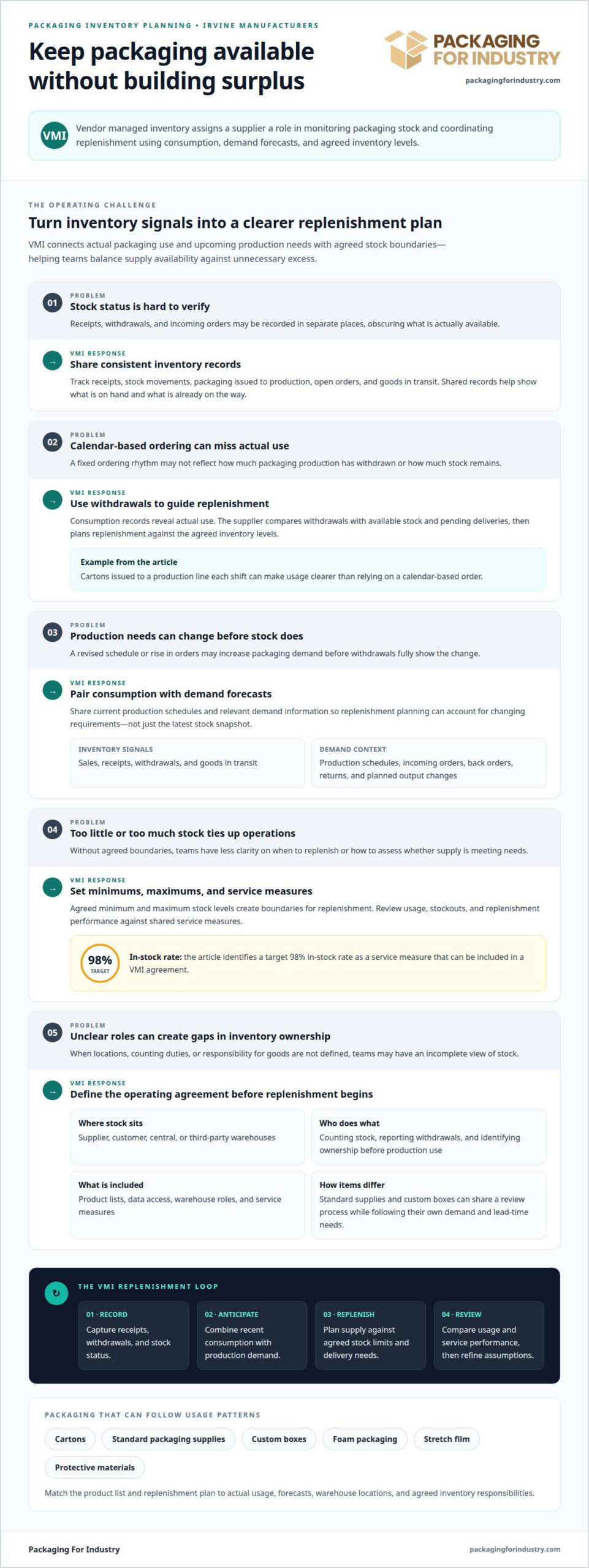
Vendor-managed inventory (VMI) assigns a packaging supplier responsibility for monitoring stock and coordinating replenishment. Irvine manufacturers can onboard a vendor by aligning data access, warehouse roles, product lists, ownership, and service measures.
Inventory Across Supplier and Customer Warehouses
VMI stock may sit in supplier, customer, central, or third-party warehouses. For Irvine production teams, splitting locations can keep frequently used cartons nearby while holding less-used custom packaging upstream. An agreement should identify who counts stock, reports withdrawals, and owns goods before production uses them. Clear location records reduce duplicate orders and show what is available.
Supply Planning and Warehouse Management
Supply planning turns consumption, forecasts, and agreed stock limits into replenishment decisions. Warehouse records should capture receipts, stock movements, and packaging issued to production. This ties orders to actual use instead of assumptions. Standard supplies and custom boxes can share a review process, while each item follows its own demand and lead-time needs. That distinction helps prevent custom items from being overlooked beside routine supplies.
Data integration connects supplier and customer systems through shared stock, withdrawals, incoming orders, and production schedules. Consistent records give both teams visibility for forecasting and replenishment. Shared risk means suppliers manage agreed planning tasks; manufacturers provide demand inputs and set stock boundaries. Select a vendor by aligning system access, warehouse roles, product lists, ownership, and service measures. During onboarding, connect inventory records before replenishment begins. Site plans should match packaging needs in Irvine with local warehouse flows.
Automated Replenishment Based on Consumption and Demand
A VMI program uses packaging consumption and production demand to guide replenishment. Vendor monitoring helps identify stock changes before supplies disrupt a scheduled production run.
Consumption-Based Replenishment
Consumption-based replenishment uses packaging withdrawals to show what needs replacing. If a production line issues cartons each shift, those records reveal actual use more clearly than a calendar-based order. The supplier compares consumption with available stock and pending deliveries, then plans replenishment against agreed levels. This gives purchasing a practical basis for orders and reduces manual tracking.
Vendor-Led Inventory Monitoring
Vendor-led monitoring means the supplier reviews inventory records and coordinates restocking. Visibility into stock, receipts, and withdrawals helps identify supplies nearing an agreed reorder point. For example, the supplier can distinguish a temporary rise in stretch film use from a sustained increase. That context supports appropriate replenishment and lets production teams focus on schedules instead of routine counts.
Forecast-Driven Replenishment
Forecast-driven replenishment combines recent consumption with upcoming production requirements. A scheduled increase in output can raise demand for cartons or protective materials before current stock runs low. The supplier uses forecasts alongside inventory status to plan delivery timing and quantities. Updated production schedules help align packaging supply with changing demand, while outdated inputs can lead to poorly timed replenishment.
Vendor Restocking
Vendor restocking is the physical follow-through: the supplier prepares and sends packaging as the program requires. The workflow distinguishes available stock from orders in transit, which matters when custom packaging needs separate planning. Receipt and withdrawal records help both parties refine future orders and avoid investing in excess supplies. You can request a packaging quote for replenishment needs.
Demand Forecasting and Stockout Prevention
Forecasting combines sales, inventory, and production data to anticipate packaging needs. Shared, current information helps teams respond to changes in use before supplies run short.
Sales and Inventory Data Sharing
Sharing sales and inventory data gives the supplier a view of demand and available stock. For an Irvine manufacturer, order activity alongside packaging withdrawals can reveal that shipments are rising while carton inventory is falling. That visibility helps the supplier adjust forecasts and replenishment plans. Accurate records of receipts and goods in transit also reduce the risk of treating incoming stock as unavailable.
Demand Information Exchange
Demand information provides context for inventory changes, not just a snapshot of stock. Manufacturers can share production schedules, incoming orders, back orders, returns, and planned output changes. For example, a revised production schedule can signal higher demand for protective packaging before withdrawals show the full increase. The supplier can use that information to plan supply, while the manufacturer remains responsible for communicating schedule changes that affect packaging use.
Inventory Levels and Service Metrics
A VMI agreement can record minimum and maximum inventory levels, usage, open orders, and goods in transit. It can also define service measures, including a target 98% in-stock rate. Tracking stockouts and replenishment performance against that target helps both parties identify where forecasts or timing need adjustment. Shared measures make it easier to distinguish a demand spike from a recurring planning issue, then revise assumptions using actual withdrawal records.
Clear data and agreed measures help prevent avoidable shortages. Discuss packaging inventory needs for your operation.
Agreed Minimum and Maximum Stock Levels
A VMI agreement sets a minimum trigger and maximum target for each packaging item. These limits give supply chain management a defined range for replenishment, rather than relying on a general estimate of warehouse needs. For example, an agreed inventory range might run from 1,000 to 1,500 units. The supplier replenishes as stock approaches the minimum, while the maximum helps limit excess materials.
Set stock levels item by item. A frequently used standard carton may need a different range from a custom insert used for a specific production run. Consider consumption records, forecast demand, storage capacity, and the time needed to replenish each material. When a production schedule changes, reviewing those inputs helps keep inventory aligned with actual requirements.
Manufacturers should review contract terms covering stock ownership, replenishment responsibilities, data sharing, delivery expectations, and how either party reports discrepancies. Minimum volumes should reflect expected usage and practical order quantities, with separate terms for standard and custom packaging. Service-level agreements can define measures such as in-stock performance, order accuracy, and replenishment timing, giving both parties a consistent way to assess the program.
Clear terms also define who manages supply planning and warehouse records. The contract should state when ownership transfers, which inventory locations are covered, and how changes in demand affect agreed levels. These details help prevent disputes when stock moves between supplier and customer facilities. Regular reviews of withdrawals, incoming orders, and production plans let both teams adjust stock levels as operating needs change.
Inventory Levels, Usage Data, and Service Metrics in VMI Agreements
A packaging agreement should identify inventory by item and storage location, not just by general supply category. For each SKU, records can distinguish on-hand stock, goods in transit, open orders, and quantities issued to production. This detail helps both parties reconcile system counts and spot discrepancies before they affect replenishment decisions.
Usage data should connect packaging withdrawals with the activity driving them. For example, a manufacturer can track corrugated cartons issued to a production line alongside scheduled output and customer orders. Reviewing those records together helps explain changes in consumption: increased shipments may drive carton use, while a revised production schedule may shift demand for protective materials.
Service metrics turn the agreement into a practical way to assess performance. A VMI agreement may target a 98% in-stock rate. Parties can also track stockout incidents, order fulfillment, replenishment timing, and inventory record accuracy. These measures show whether packaging remains available at the agreed levels and where planning or information flow needs attention.
Define how each metric is calculated, which records supply the data, and how often both teams review results. For instance, specify whether the in-stock measure covers every agreed item or only selected production-critical materials. A shared report can show usage, stock position, incoming supply, and missed service targets in one view. Clear definitions keep reviews focused on evidence and give supplier and manufacturer a common basis for adjusting the program.
Packaging Products for VMI Programs
A VMI program can cover packaging items that support recurring production and shipping needs. The scope may include standard supplies, custom packaging, foam packaging, and stretch film, depending on the manufacturer’s operations. Listing each item separately ties consumption records and replenishment decisions to the correct product, rather than treating all packaging as interchangeable.
Foam packaging can cushion products or provide a tailored fit during handling and shipment. A program can track foam items used for specific products, including custom inserts, and align replenishment with production plans. Assess foam options against product dimensions, packing processes, and storage needs. Clear item identification helps prevent an incorrect substitute from reaching a production line.
Stretch film stabilizes palletized loads for warehouse and shipping workflows. Tracking its use alongside shipping activity helps the supplier plan restocking around actual demand. Manufacturers can distinguish routine consumption from a temporary shipment increase, then adjust planned supply accordingly. This gives warehouse teams a clearer view of available packaging before dispatch activity builds.
For standard and custom supplies, the agreement should connect each item to its purpose, usage record, and replenishment plan. A standard item may follow recurring consumption, while custom packaging may need planning around the product or production schedule it serves. Grouping supplies this way helps purchasing teams manage stock without overlooking specialized materials. It also gives suppliers practical information for coordinating packaging availability with manufacturing and shipping requirements.
Industries Served
Vendor-managed packaging inventory suits businesses that use packaging repeatedly for production, storage, or shipping. Irvine manufacturers may coordinate supplies across a production floor and warehouse, while distributors and fulfillment centers need packaging aligned with changing order activity. In each case, shared usage and stock information connects replenishment decisions to the work consuming the materials.
Aerospace operations may use packaging selected for specific components and handling needs. Food and medical businesses also rely on supplies suited to their production and distribution workflows. Electronics manufacturers may plan around protective packaging for products moving between production and shipping. A VMI arrangement organizes these materials by item and demand pattern instead of treating every supply as interchangeable. For manufacturers, this can make supply planning more closely reflect scheduled output.
Construction suppliers and other industrial businesses may have varied packaging needs across product lines. A supplier can use withdrawal records and upcoming demand information to plan replenishment for frequently used materials alongside less predictable items. This helps purchasing teams manage packaging for production and outbound shipments without relying solely on periodic manual orders.
Warehouses, distributors, and fulfillment centers can also benefit when packaging consumption follows order volume. For example, a change in outbound activity may affect how quickly shipping supplies are used. Sharing inventory and demand information gives the supplier context for planning replenishment. VMI is most relevant when packaging is a recurring operational input, stock visibility matters, and teams can coordinate records across purchasing, warehouse, and production functions.
Benefits of Vendor Managed Packaging Inventory
Reliable packaging availability helps manufacturers keep production and shipping moving. A supplier that monitors agreed inventory can coordinate replenishment before essential cartons, foam, or stretch film run short. That reduces the need for purchasing teams to react manually to every stock change. For Irvine operations, dependable supply planning helps connect packaging availability with production requirements.
A stockout can delay packing or leave finished goods waiting for materials. Sharing consumption and schedule information gives the supplier a clearer basis for planning replenishment as demand changes. The benefit is not simply having more stock on hand. It is coordinating the right packaging with actual use so production teams can work with fewer supply interruptions.
Agreed stock limits can also help manage excess inventory. Holding more packaging than operations need takes warehouse space and ties up working capital. A VMI plan can use item-level usage and demand information to set replenishment around operational requirements. Reviewing those settings as product mix or production schedules change keeps inventory more closely aligned with use and supports efforts to manage packaging costs.
VMI can reduce routine ordering and inventory-counting work for purchasing and warehouse teams. Defined responsibilities and shared service measures also make supply issues easier to identify and discuss. Teams can focus on exceptions, such as unusual consumption or a missed delivery, rather than repeating manual checks for every packaging item. The value comes from combining visibility, planning, and clear accountability.
Packaging For Industry (PFI): VMI for Packaging
Packaging For Industry (PFI) provides Vendor Managed Inventory (VMI) for Packaging to manufacturers seeking steadier control of recurring supplies. For Irvine manufacturers evaluating vendor managed packaging inventory, this service connects replenishment with consumption and agreed stock levels. It can be a practical next step when manual ordering creates extra work or teams lack clear visibility into packaging stock.
PFI’s VMI for packaging gives manufacturers a way to coordinate packaging supply with operational needs. A program can begin by identifying the items supporting production, then aligning inventory information and replenishment responsibilities. Shared records help connect withdrawals with upcoming demand, so planning reflects actual use. Manufacturers also provide schedule changes and establish stock boundaries for the materials they rely on.
Foam packaging and stretch film can be included in a supply plan when they are recurring operational requirements. Usage patterns, warehouse needs, and production schedules help determine how each fits into inventory planning. For manufacturers seeking closer coordination between delivery timing and use, PFI also offers Just-In-Time (JIT) Inventory Management for Packaging. These services support supply planning without relying on a one-size-fits-all stock formula.
Before discussing a program, organize the packaging items that matter most, how teams use them, and where stock visibility needs improvement. Production schedules and current inventory practices help frame the conversation. The objective is to align replenishment with real operating requirements and manage packaging supply more consistently. Contact Packaging For Industry to discuss VMI for your Irvine operation.
Put Your Packaging Supply Plan into Practice
A vendor managed packaging inventory plan for Irvine manufacturers should fit how purchasing, production, and warehouse teams coordinate. Identify where packaging decisions create extra work, which supplies are most critical to daily operations, and how teams want inventory responsibilities shared. These priorities can shape a plan around your facility’s workflow.
Packaging For Industry (PFI) offers VMI for Packaging, foam packaging, and stretch film to support packaging supply planning. Manufacturers can also consider Just-In-Time inventory management when aligning deliveries with use is a priority. Discuss how these options fit your operation instead of applying a standard approach to every facility.
Bring your packaging requirements and operational priorities to a conversation with PFI. This can help turn inventory goals into a workable supply plan.
A plan shaped around your workflow can help your team coordinate packaging deliveries with operational needs.
Frequently Asked Questions
Do you provide the packaging materials as well as the VMI service?
Yes. Packaging For Industry (PFI) can supply packaging materials through its VMI service. To define a useful program scope, identify the supplies that create the most purchasing friction, including items with few acceptable substitutes. This helps distinguish routine replenishment needs from packaging that requires closer coordination with product or shipping requirements.
How does supplier-managed inventory work?
The supplier and manufacturer should first clarify who owns key tasks and how exceptions are handled. For example, they can assign a contact for inventory questions, define how the facility records received shipments, and agree on how to flag damaged or misidentified stock. These details help warehouse and purchasing teams resolve discrepancies without confusing them with routine replenishment.
What geographic areas in Southern California do you serve for VMI?
PFI serves VMI customers across Orange County, Los Angeles County, and San Diego County, including Irvine, Anaheim, Santa Ana, Huntington Beach, and Long Beach. Manufacturers with multiple facilities in the region can discuss how each site’s packaging needs differ, including which locations require separate inventory records or distinct receiving procedures.
What is the primary difference between VMI and traditional inventory management?
The main difference is who initiates routine replenishment. In a traditional process, the manufacturer’s purchasing team usually identifies a need and starts the order. Under VMI, the supplier takes on agreed monitoring responsibilities, while the manufacturer still communicates operational changes and manages internal receiving and approval practices. This can reduce repetitive order administration while keeping program responsibilities clear.
What is vendor-managed packaging inventory and how does it work?
Vendor-managed packaging inventory is best suited to recurring packaging needs that a supplier can plan around. A facility can distinguish steady-use materials from supplies tied to irregular projects or changing product designs. That helps determine whether an item belongs in a managed program or should remain a separate purchase. Reliable item identification and usage records also make the arrangement easier to administer.
Which companies provide vendor-managed packaging inventory for manufacturers in Irvine, California?
Packaging For Industry (PFI) provides vendor-managed packaging inventory for manufacturers in Irvine. It suits industrial operations seeking support with recurring packaging requirements rather than one-time household or gift-packaging purchases. Teams can discuss how purchasing currently handles packaging orders, where urgent replenishment causes disruption, and which internal roles should participate in a managed inventory arrangement.
What packaging materials and products can Irvine vendors manage and replenish?
PFI can manage packaging items that support a manufacturer’s recurring operations. To define the scope clearly, match each item to its internal part number, approved specification, storage location, and intended use. Record whether an item has an approved substitute or requires the exact configuration. This is especially useful when different production lines use packaging that looks similar but serves distinct requirements.
How much does vendor-managed packaging inventory cost for manufacturers in Irvine?
VMI pricing depends on the program and is provided after a quote request. Relevant factors include the number and type of items managed, expected usage, stocking requirements, and delivery needs. Custom packaging may require different planning from regularly purchased supplies. Sharing the intended program scope and operational requirements helps PFI prepare pricing suited to the manufacturer’s needs.