
A stronger carton alone doesn’t ensure a package will pass: packaging design to pass ISTA drop tests must match the product’s weight and distribution route to the right test procedure. For individually packaged products weighing 150 lbs or less, ISTA 1A includes 10 free-fall drops. The test standard, carton strength, cushioning, and conditioning all shape how the package performs.
It’s easy to focus on board strength and overlook how impact travels through the carton to the product. A package can protect its contents without using excessive material, but its design must reflect the actual shipment and test conditions.
This article explains what ISTA package testing evaluates, how package weight affects drop heights and procedure selection, and how conditioning and corrugated strength factor into design. It also outlines how ISTA and ASTM fit into packaging tests, so you can make informed decisions before testing, production, and shipment.
Key Takeaways
- Match the ISTA procedure to the shipment type and the protection question the test needs to answer.
- Use package weight to understand the drop height that applies, then consider how impacts affect the product and carton.
- Account for conditioning when the package may face environmental exposure, since test conditions can influence packaging performance.
- Specify carton strength based on the load and shipping demands; stronger board alone doesn’t replace effective cushioning and package design.
- Learn how ASTM and ISTA contribute to packaging tests so you can interpret standards and set a more informed testing plan.
What is ISTA package testing?
ISTA package testing gives manufacturers a structured way to assess whether a packaged product suits its intended distribution conditions. The result is more than a pass or fail: it provides evidence about the tested package configuration and helps teams apply the findings to production.
Selecting a Test Procedure
Choose a procedure based on the decision the test needs to support, such as screening a new package or evaluating a distribution scenario. This helps prevent teams from treating a result as proof of performance in every supply chain. For manufacturers shipping from Orange County, Los Angeles, or San Diego, the route and handling model help define the right test objective.
Planning packaging design to pass ISTA drop tests means aligning the sample, test objective, and protocol before the laboratory run. This gives engineering and operations teams a shared basis for interpreting results and deciding whether a design change needs further evaluation.
Drop Heights in General Simulation
In a general simulation, drop testing is one element of a broader sequence, not a stand-alone verdict on package quality. The full protocol shows how the packaged product responds to the selected test events. A result from one test element cannot represent every stress in a distribution chain.
For packaging design to pass ISTA drop tests, interpret drop findings alongside the full protocol record. This makes the results more useful when deciding whether to revise the package and identifying the conditions the tested design represents.
Monitoring and Pass-Fail Inspection
Laboratory monitoring records whether the planned sequence was completed and documents observations relevant to the final assessment. A clear report identifies the tested sample configuration and relates observations to the applicable acceptance criteria. This detail helps teams distinguish product issues from packaging issues.
After testing, keep the report with the design revision and production documentation. A passing result does not automatically grant a universal certification label, so do not present it as broader approval than the protocol supports.
On-Site Drop Sequences and Acceptance Criteria
An on-site check can help investigate a specific handling concern, but define its acceptance criteria before starting. Record visible package changes and product function against the actual requirement, not appearance alone. This keeps the evaluation focused on the business risk being assessed.
For testing in the United States, use a laboratory equipped to perform the selected ISTA procedure. Costs depend on the procedure, sample configuration, and laboratory work. A passing result cannot rule out damage from conditions outside the tested setup, so treat it as evidence for the evaluated design, not every possible shipment.
Package-weight-based drop heights
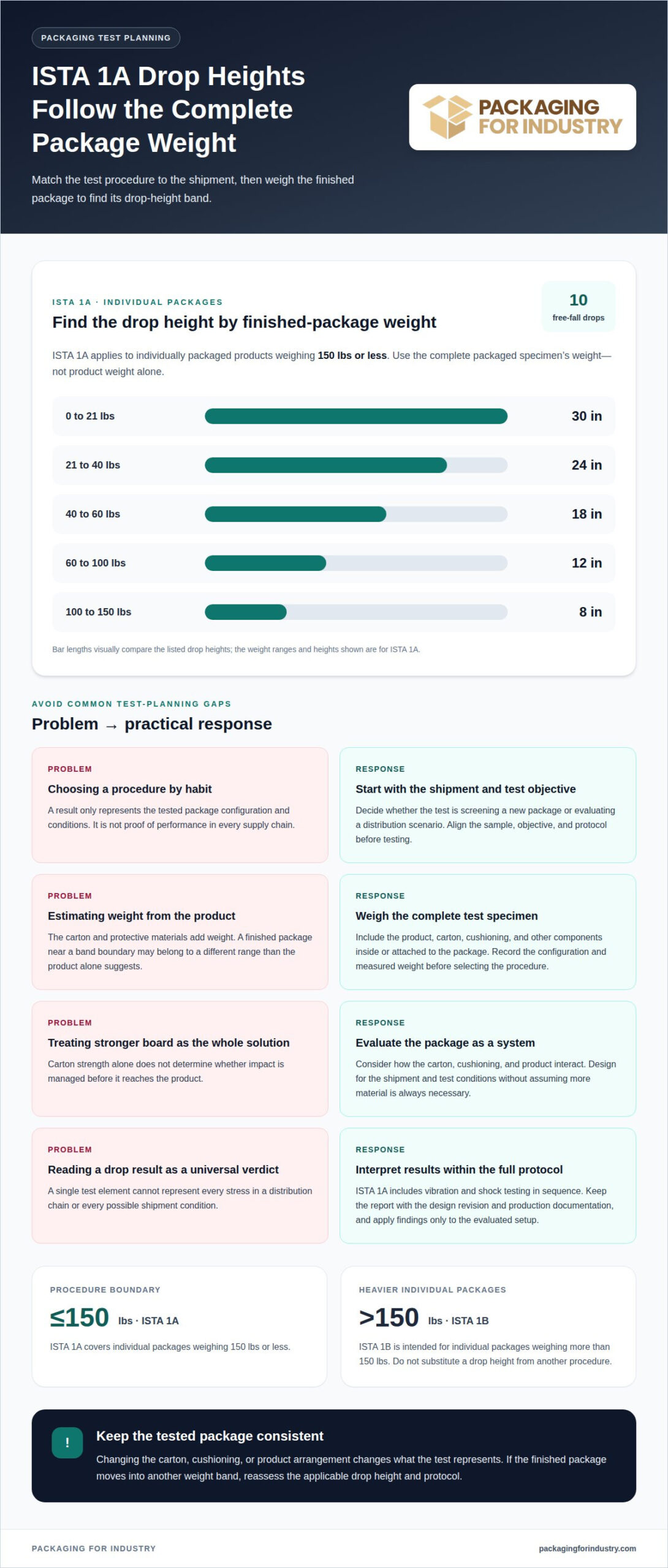
For ISTA 1A, package weight determines the drop height used in the test. The specified bands step down from 30 inches for lighter packages to 8 inches for packages near the procedure’s upper weight limit. This makes accurate weighing part of test preparation, not an estimate based on product weight alone.
Drop heights vary according to package weight.
- 0 to 21 lbs: 30 inches
- 21 to 40 lbs: 24 inches
- 40 to 60 lbs: 18 inches
- 60 to 100 lbs: 12 inches
- 100 to 150 lbs: 8 inches
These bands apply to ISTA 1A, which covers individual packages weighing 150 lbs or less. ISTA 1B is intended for individual packages weighing more than 150 lbs. The procedure selection matters because a weight range and test protocol work together; a drop height from one procedure should not be substituted for another.
Use the complete packaged specimen’s weight to identify its applicable band. Weigh the shipment as prepared for testing, including the product, carton, cushioning, and other components inside or attached to the package. A product near a band boundary may fall into a different range once the carton and protective materials are included.
For manufacturers, this distinction affects how the package responds during a drop test. A greater drop height increases impact energy, while a heavier package is assigned a lower height within the listed sequence. The test evaluates how the carton, cushioning, and product interact, not height as a stand-alone indicator of success.
Weight also affects decisions beyond the drop itself. A shipment can face compression, vibration, and handling forces along its route, so package design should account for the full distribution context. ISTA 1A includes vibration and shock testing in sequence, while general simulation procedures address broader transport conditions. A weight-based drop result therefore answers a defined question, not every possible shipment-risk question.
Record the package configuration and measured weight before selecting a procedure. Keep the same configuration for testing and production: changing the carton, cushioning, or product arrangement changes what the test represents. If a revised design moves the finished package into another weight band, reassess the applicable drop height and protocol before relying on earlier results.
Accurate weight data gives teams a practical starting point for packaging design and test planning. To align package requirements with a test-ready design, request a packaging quote with the shipment configuration and target procedure.
Packaging preconditioning and conditioning
Conditioning exposes a packaged product to a defined atmosphere before testing, so the package is evaluated after environmental exposure. In ISTA 2A, atmospheric conditioning is recommended for 72 hours at 120°F and 85% relative humidity. Those conditions can affect the materials’ response before a drop, vibration, or compression test.
Preconditioning and conditioning describe different stages in test preparation. Preconditioning brings the sample toward the required starting environment; the subsequent conditioning period holds it under specified conditions. For ISTA 2A, atmospheric preconditioning may typically last around 6 hours. The duration and sequence matter because a sample tested before reaching its required condition may not represent the protocol’s intended setup.
Humidity and temperature can influence corrugated board and other packaging materials. Moisture can change board stiffness, while temperature can affect how packaging components respond to handling. A carton tested after conditioning may behave differently from one stored in a dry, controlled warehouse. The test sequence assesses performance under defined conditions, not every environment a shipment might encounter.
ISTA 2A is a partial simulation procedure. It combines basic test elements with environmental testing, such as temperature conditioning. That makes it relevant when the test objective includes environmental exposure alongside physical handling. A drop-only test would not provide the same assessment of how conditioning interacts with package integrity.
Conditioning also affects the test workflow. Keep the sample configuration consistent through preparation and testing, including the product, carton, closures, and internal protection. If a component changes after conditioning, the result no longer represents the same package design. Documenting the sample and conditioning sequence helps keep results useful for design decisions and production control.
Test order matters. ISTA procedures use defined sequences, so conditioning should occur at the stage the selected protocol requires, before the relevant physical tests. For instance, a package intended for an ISTA 2A evaluation must follow that procedure’s sequence rather than an improvised temperature or humidity exposure. This keeps the test aligned with its stated objective.
A conditioned sample represents only its tested configuration and environment. Distribution may include vibration, compression, and handling conditions beyond those used in a particular test. Connect conditioning choices to the shipment route and the materials’ expected environment. This helps teams interpret results accurately and avoid treating a partial simulation as a complete account of transit hazards.
For packaging design decisions, ask whether conditioning belongs in the protocol and how it affects the package’s protective performance. A planned sequence helps separate environmental effects from damage caused by drops or vibration, giving teams clearer evidence about where a design needs adjustment.
Packaging specifications and corrugated carton strength
Set carton strength based on the product’s weight, geometry, and transit hazards, not appearance. Protective design pairs a suitable corrugated carton with cushioning that limits movement and absorbs impact.
Defining Carton Performance Requirements
A packaging specification records the carton’s construction and performance requirements so teams can evaluate whether it suits the shipment. For heavier or demanding loads, 2-ply or 3-ply cardboard may be considered. A specification may call for double-wall 5-ply cartons with minimum bursting strength of 200 lbs/sq inch or ECT-32. These values are alternatives, not interchangeable descriptions.
Define the product, packed weight, closure method, and expected distribution hazards before setting requirements. Random vibration, compression, and drop sequences stress different parts of a carton. A clear specification connects board strength to the shipment and test objective, rather than treating a stronger carton as a complete protection plan.
Protective Packaging Design Features
Protective features keep the product from striking carton walls and reduce concentrated forces during a drop. Cushioning should support vulnerable surfaces, limit shifting, and keep the product separated from the carton. For an item with exposed corners, shaped supports can protect those areas while holding the product securely.
Placement matters as much as material selection. A heavy product that shifts inside its carton may transfer impact to one edge, even if the board is strong enough. Evaluate the packed configuration, including voids, contact points, and how the closure holds during handling.
Carton strength must also account for stacking and compression forces. In a palletized shipment, surrounding cartons and load arrangement can affect the demands on each box. Test the carton configuration intended for transit, because changes to dimensions, board, or internal supports can alter performance.
Use acceptance criteria tied to the specific test rather than a general visual judgment. One stated compression-test criterion treats carton distortion exceeding 5 mm as outside acceptance; that threshold belongs to that criterion, not every ISTA test. Inspect both the carton and product after testing, then document any crushing, separation, movement, or damage against the agreed requirements.
Balance protection with material use. Heavier board may add strength, but it cannot correct poor internal fit or unsupported product areas. Design around the product’s weak points and the shipment’s hazards, then evaluate the complete package through the selected test sequence. This gives engineering, purchasing, and production teams useful carton specifications.
ASTM and ISTA roles in packaging tests
ASTM and ISTA offer different frameworks for packaging tests. ASTM develops methods for evaluating materials and package performance, while ISTA organizes procedures around distribution environments and shipment types. Match the framework to the decision the test needs to support.
An ASTM method can define a particular test, such as compression or vibration. ISTA procedures combine test elements into sequences intended to represent specified distribution conditions. A single test result answers a narrower performance question, while an ISTA sequence assesses a package through several stresses associated with a shipping path.
ISTA’s 3 Series includes general simulation procedures. For example, ISTA 3A addresses North American parcel delivery for packages weighing 150 pounds or less, while 3B covers less-than-truckload shipments. ISTA 3E applies to unitized loads of similar packaged products shipped by full truckload. Those distinctions help teams connect a protocol with the route and handling model under review.
Amazon-related testing shows why the named procedure matters. ISTA 6-Amazon.com-Over Boxing addresses products placed inside a master shipping container for parcel delivery. That differs from selecting a general parcel procedure simply because both involve parcel shipment. Retailer or customer requirements can shape the protocol, so teams should identify the requested test outcome before packaging validation begins.
ISTA has been recognized by the American National Standards Institute as an ANSI Accredited Standards Developer since 2014. This describes ISTA’s standards-development status, not a certification of every package that completes an ISTA test. A test result applies to the specimen and configuration evaluated under its selected procedure. It should not be treated as blanket approval for other package designs, routes, or supply chain conditions.
Use ASTM methods when the question concerns a defined performance property, such as carton compression behavior. Use an ISTA procedure to evaluate a package through a distribution-focused sequence. Some validation plans use both: an individual method examines a particular property, while a broader protocol evaluates the packaged product under a shipment simulation.
Before testing, document the intended market, parcel or freight route, package configuration, and requested protocol. Compare the sequence with the actual supply chain, including handling and palletization where relevant. This prevents a global distribution plan from relying on a result designed for a different shipment type. Distinguishing ASTM methods from ISTA procedures helps purchasing and engineering teams interpret results and avoid mismatched testing.
Packaging For Industry (PFI): Custom Packaging Design Services
Packaging For Industry (PFI) helps manufacturers turn product and shipment requirements into practical packaging designs. Its Custom Packaging Design Services can address fit, cushioning, and material choices for a package being prepared for an ISTA test. Bring the product, shipment details, and target procedure into the design discussion so the packaging reflects the actual use case.
When product movement or impact protection is a concern, Packaging For Industry can provide protective foam packaging tailored to the package design. PFI also offers stretch film and Vendor Managed Inventory for Packaging to support packaging supply and planning. These services address protection and supply needs, but the design still needs evaluation against its intended test protocol.
Contact Packaging For Industry to discuss a packaging design for your shipment and testing requirements.
Turn Test Results Into a Production-Ready Design
When a test result informs a packaging change, treat the next step as an operational handoff. Align engineering, purchasing, and warehouse teams on the same approved package configuration, so sourcing choices and packing practices match the design evaluated in testing.
Planning packaging design to pass ISTA drop tests also means deciding how to review design updates. Changes to product fit, closures, or internal arrangement can affect how the packed unit behaves. A defined review process helps teams identify when a change calls for fresh evaluation.
The best next step is not automatically adding more material. Use test evidence to guide a targeted design decision, then share the resulting specifications with the teams that pack and ship the product. This gives your operation a practical way to manage revisions and keep packaging decisions connected to shipping needs.
If you’re developing a new package or revising a design, discuss the product, shipment profile, and test objective with Packaging For Industry.
A clear next step can help move your packaging project forward with confidence.
Frequently Asked Questions
What different ISTA test procedures are there?
ISTA procedures range from screening tests to distribution simulations and specialized evaluations. Series 1 tests assess package integrity without simulating environmental events. Series 2 combines basic testing with partial simulation, while Series 3 procedures represent broader distribution conditions. Series 4 offers customizable enhanced simulations, and Series 7 addresses thermal performance. Choose based on shipment type and the question the test must answer, not simply the most familiar procedure name.
What Are the Benefits of ISTA 1A Certification?
ISTA 1A is a test procedure, not a certification awarded to every package that passes. Its value is a defined screening evaluation for an individually packaged product weighing 150 lbs (68 kg) or less. Results can help identify weaknesses in the tested configuration before a production rollout. However, Series 1 tests aren’t designed to simulate environmental conditions, so a 1A result doesn’t establish performance under every distribution environment.
What if your package fails the tests?
A failed result points to a weakness to investigate, not an automatic need to replace every packaging component. Review where damage occurred and at which stage, then determine whether the cause involves carton collapse, product movement, or inadequate cushioning. Where practical, change one design factor at a time, such as support placement or internal clearance. Retest the revised configuration under the same protocol to see whether the adjustment addressed the observed failure.
What is ISTA 3A and Amazon SIOC/FFP?
ISTA 3A is a general simulation procedure for North American parcel delivery of packages weighing 150 pounds or less. Amazon-related testing uses separate Project 6 protocols: Over Boxing evaluates a retail-packaged product inside a master shipping container, while SIOC addresses a product shipped in its own container. FFP refers to Frustration-Free Packaging. Identify the requested shipment configuration, since overboxing and SIOC describe different package setups.
When should you test your packaging?
Test after the package design reflects the actual product, materials, and shipment configuration, and before mass production begins. Sourcing and testing packaging approximately 2-3 months before mass production starts allows time to review results and adjust the design. Testing is also useful after a meaningful change, such as a different carton, product arrangement, or cushioning layout, because earlier results apply to the configuration that was evaluated.
Which ISTA drop-test procedures apply to different package types and shipping methods?
Match the procedure to how the shipment moves. ISTA 3A covers North American parcel packages weighing 150 pounds or less; 3B addresses less-than-truckload shipments. For pallet loads, 3E applies to similar packaged products shipped by full truckload, while 3F addresses individual products shipped in mixed pallet configurations. Retailer-specific programs, such as Amazon Project 6, may call for a different protocol.
What are the drop heights, orientations, and sequence requirements for common ISTA tests?
Requirements vary by procedure and package weight. ISTA 1A uses weight-based heights, from 30 inches for packages weighing 0 to 21 lbs to 8 inches for 100 to 150 lbs. Its shock test includes 10 free-fall drops, with six flat-face drops covering the top, bottom, and four sides. Other procedures specify their own orientations and sequences, so don’t transfer one protocol’s sequence to another.
How do package weight, dimensions, and distribution environment affect ISTA drop-test requirements?
Weight can determine the applicable procedure and drop height, while dimensions and shape affect which faces, edges, or corners need evaluation. The distribution environment influences whether a parcel, freight, pallet-load, or retailer-specific simulation fits the shipment. Environmental exposure can also matter: partial simulation procedures such as Series 2 may include conditioning. Consider the complete packaged unit and route, since product weight alone doesn’t describe the package’s test conditions.