
A shipping tube can protect a product and still be the wrong fit if its size or appearance does not suit the job. For custom-sized shipping tubes in Orange County, start with the item’s dimensions, the space needed for end closures, and how the package will be handled in transit.
Include printing or color requirements alongside dimensions when requesting a quote. Fit, material, wall thickness, and order details all shape the specification. A stock tube may work for a standard product, while a custom size can better accommodate items that do not fit common dimensions.
This guide explains how custom and stock tubes compare, which measurements affect usable capacity, and what information helps define a packaging requirement. It also covers delivery planning for Orange County businesses, so you can consider the packaging choice and logistics together.
Key Takeaways
- Compare stock and custom tubes based on product fit, material, wall thickness, and how the package will be handled in transit.
- Account for end closures when evaluating a tube’s usable interior space, especially when the item needs a close fit.
- See how manufacturers, electronics businesses, and retailers use tubes to support commercial packaging and shipping needs.
- Plan specifications and purchasing around product protection, shipping workflows, and a dependable supply of packaging.
- Learn how PFI’s custom packaging design, foam packaging, stretch film, and vendor managed inventory can support broader packaging needs.
Custom and Stock Shipping Tubes: Sizes, Materials, and Options
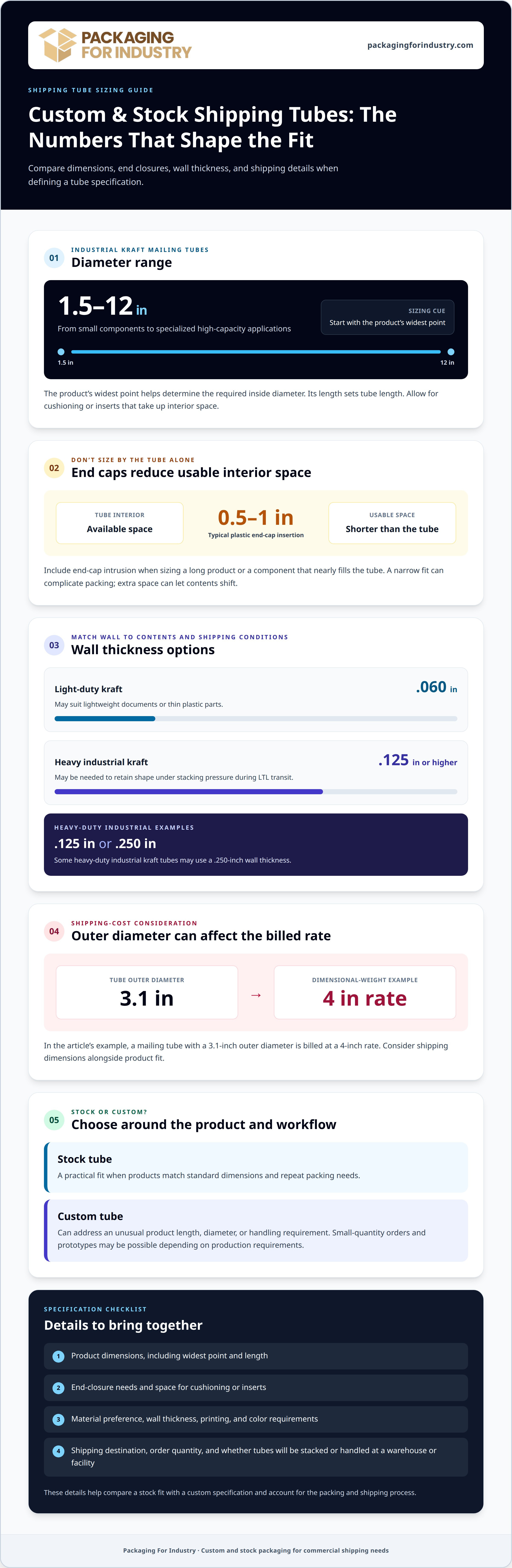
Stock tubes suit products that fit standard dimensions and packaging needs. They can simplify packing when a manufacturer ships repeat items that match available sizes. Custom tubes address specific needs, such as an unusual product length, diameter, or handling requirement. A long industrial component, for example, may need a tube that limits movement without leaving excess space. The choice affects fit, material use, storage, and cost.
Can custom shipping tubes be ordered in small quantities or as prototypes? Small-quantity orders and prototypes may be possible, depending on the production requirements. A prototype can help assess product fit and end-closure placement before a larger production run. Retail and electronics businesses may find this useful when a product’s shape or protection needs differ from standard stock.
Diameter and usable interior space both matter. Industrial kraft mailing tube diameters range from 1.5 inches for small components to 12 inches for specialized high-capacity applications. The product’s widest point helps determine the required inside diameter, while its length sets the tube length. Dimensions should account for cushioning or inserts that occupy space. A narrow container can complicate packing, while an oversized tube can allow shifting in transit.
End closures also change fit. Plastic end caps typically insert 0.5 to 1 inch into a mailing tube, shortening its internal usable space. Include that intrusion when sizing a long product or a component that nearly fills the tube. Shipping dimensions can affect transportation pricing, too. In the 2026 dimensional-weight example, a mailing tube with a 3.1-inch outer diameter is billed at a 4-inch rate.
Material and wall thickness should match the contents and shipping conditions. Light-duty kraft mailing tubes may have a wall thickness of .060 inches for lightweight documents or thin plastic parts. Heavy industrial kraft mailing tubes may require wall thicknesses of .125 inches or higher to retain their shape under stacking pressure during LTL transit. Heavy-duty industrial kraft tubes typically use wall thicknesses of .125 inches or .250 inches; some may have a wall thickness of .250 inches.
Kraft paper is used for many mailing and industrial applications. A heavier wall may suit more demanding shipping conditions, while a lighter wall may work for documents or thin parts. Specify printing and color requirements along with dimensions and material needs, so the packaging matches its intended use and presentation. Stock options may suit routine packing; custom packaging can better fit a specialized product or process.
For a useful comparison, organize the product dimensions, end-cap needs, material preference, shipping destination, and order quantity. Include whether the tube will be stacked or handled at a warehouse or facility. These details help distinguish a stock fit from a custom specification. A packaging quote request can capture these requirements for review alongside the tube dimensions.
Industries Served
Manufacturers use shipping tubes to move long, narrow products through production and distribution. A metal profile, plastic extrusion, or rolled drawing can be awkward to pack in a standard carton, which may leave excess space or complicate handling. A tube encloses the item and can be labeled alongside other industrial packaging. For packaging for manufacturers, specifications should reflect how staff pack the item, where it is stored, and how it travels.
Electronics companies may ship cable assemblies, antenna components, rolled technical documents, and other elongated parts. Packing requirements vary: a cable assembly may need restraint to limit movement, while a document needs a tube that keeps it rolled and enclosed. Account for any protective material inside the tube and how the package will be handled with other electronics shipments. These details help match the tube to the product and shipping process.
Retailers and distributors use tubes for long, cylindrical, or rolled commercial goods, such as posters, display graphics, trim, and rolled materials sent to stores or business customers. A retailer handling several product types may need different tube dimensions or packing configurations to keep orders organized. Clear labels and a repeatable packing method help warehouse teams identify shipments and move them through fulfillment without mixing product lines.
Aerospace and construction suppliers also handle long components and project materials. An aerospace supplier may ship a technical drawing or narrow component between facilities, while a construction supplier may package profiles or plans for a job site. Each shipment has its own route and receiving process. Choose packaging based on the item’s shape, handling needs, and how receiving staff will identify and unpack it.
For distribution centers and fulfillment operations, consistent packaging supports repeatable work across picking, packing, staging, and dispatch. A tube specification that suits the product can help keep packing steps orderly; a mismatch can create extra handling or leave the contents free to shift. Teams evaluating packaging for manufacturing operations often consider how tube selection fits with cartons, cushioning, labels, and the broader line-side supply process.
Industries use shipping tubes for different operational reasons, not only because an item is cylindrical. A manufacturer may prioritize stable movement between facilities, an electronics company may focus on product-specific protection, and a retailer may need straightforward order handling. In each case, the specification should start with the item and shipment workflow. It should also suit order volume and replenishment patterns, helping purchasing and warehouse teams plan supplies without unnecessary complexity.
Benefits of Custom-Sized Shipping Tubes
A tube specification tied to production can make packing more repeatable. A manufacturer, for example, can use one approved setup for a recurring component. Documenting the specification helps purchasing and operations teams coordinate orders and reduce substitutions when schedules change. Custom sizes can address items that do not fit a standard packing process.
What packaging and carrier requirements apply when shipping items in mailing tubes? Use secure closures, readable shipping labels, and dimensions that comply with the selected carrier’s requirements. Consider the carrier’s handling process and the destination’s receiving workflow, especially when tubes travel with other freight.
What are the minimum order quantities for custom-sized shipping tubes in Orange County? Minimum quantities depend on the production setup, tube specifications, and order pattern. Prototype needs may differ from recurring production orders. Purchasing teams can account for these details in demand plans before deciding how much inventory to carry.
Quote timing depends on how clearly the order defines its requirements. Include the product use, approved specifications, quantity, delivery destination, and any production deadline. Changes during review may require an updated quote. Complete information gives the supplier a clearer basis for evaluating the request and helps buyers compare equivalent packaging requirements.
Order planning connects packaging availability with production schedules. A manufacturer preparing a seasonal run, for example, can align tube orders with planned output rather than react to a shortage. Packaging for warehouses also benefits from clear item identification and replenishment plans. These details help receiving teams put materials where packers can access them.
A well-planned specification can support efforts to reduce packaging costs by matching orders to operating needs. Teams can review order frequency, storage capacity, and packing steps at each facility. For packaging used across distribution centers, coordinated specifications can help keep products moving through packing, staging, and dispatch with fewer changes to routine.
Shipping coordination starts with the destination and receiving schedule. Orange County teams can plan space and labor around expected local deliveries. Businesses shipping to multiple facilities can share each destination and its packaging needs during order planning. This helps align purchasing records, delivery instructions, and internal receiving processes.
Custom tube orders work best when procurement, production, and shipping teams use the same approved details. Buyers can document the packaging specification, order quantity, destination, and replenishment trigger in one purchasing record. That record provides a consistent reference for future orders and helps teams identify when a product or workflow change calls for a packaging review.
Which Orange County, California Companies Make Custom-Sized Shipping Tubes?
Orange County buyers can source custom-sized shipping tubes through packaging manufacturers or industrial packaging distributors. A manufacturer may produce tubes directly, while a distributor may coordinate custom production alongside other packaging supplies. The right option depends on specifications, order patterns, and delivery needs. A business shipping long metal profiles, for example, may need a different production setup from one packing rolled plans.
Start by identifying whether the supplier manufactures tubes or coordinates production with a manufacturing partner. This clarifies who handles design revisions, sample review, production scheduling, and order updates. Ask how the company turns product dimensions and shipping conditions into a tube specification. Tube length, inner diameter, wall construction, end closures, and packing process should be considered together.
Production capability matters when a standard tube will not fit the product or workflow. A manufacturer should explain how it handles custom dimensions and repeat orders; a distributor should explain how specifications are shared with the production facility. The quote should state the agreed dimensions, materials, closure requirements, quantity, and delivery destination. These details give purchasing and receiving teams a useful reference.
Before comparing suppliers, organize the information that affects design and ordering. A company shipping electrical cable assemblies, for instance, can describe how the product is packed and what needs protection in transit. Share item dimensions, packing materials, expected order frequency, and destination. This lets suppliers assess the tube as part of the actual shipping process, rather than as an isolated packaging component.
- Production scope: Clarify whether the supplier manufactures tubes or coordinates custom production.
- Specification review: Confirm that the proposal identifies dimensions, material, wall construction, and closures.
- Order planning: Compare the proposed quantity and repeat-order process with purchasing needs.
- Delivery coordination: Include the Orange County receiving location and shipping schedule in the order discussion.
Quote comparisons are most useful when each supplier considers the same requirements. If one proposal uses a different wall construction or closure, its price may not represent an equivalent package. Align specifications before comparing total order costs. For manufacturers and warehouses, a clear specification can also support receiving checks and future replenishment planning.
Businesses seeking custom-sized shipping tubes in Orange County should assess production responsibility and specification management. A capable supplier can explain how product details become a production-ready order, how revisions are handled, and how tubes are prepared for delivery. This helps purchasing teams choose a source that fits their product, workflow, and supply requirements.
Orange County packaging manufacturers and industrial packaging distributors can provide custom-sized shipping tubes. Manufacturers may produce them directly, while distributors may coordinate production with a manufacturing partner.
Packaging For Industry (PFI): Custom Packaging Design Services
Packaging For Industry (PFI) helps businesses assess packaging design needs and coordinate protection with production and shipping workflows. If a tube is part of your packaging plan, the shipment may also need cushioning or stabilization. PFI’s Custom Packaging Design Services can help assess how packaging components work together around the product, packing process, and operating requirements.
A design review can account for the product, how staff pack it, and where shipments go. A manufacturer handling a delicate component, for example, may need cushioning in addition to an outer package. Warehouse teams may also need a consistent packing method across orders. Sharing product information and workflow requirements helps keep the design focused on the actual operation.
Custom Packaging Design Services address how packaging fits a product and its workflow. Foam Packaging can support cushioning needs, while Stretch Film can help secure packaged goods during handling and shipment. These offerings may complement a tube-based shipping setup when they answer a specific requirement in the broader packaging plan.
Supply planning matters alongside design. For businesses with recurring packaging needs, PFI’s Vendor Managed Inventory (VMI) for Packaging can coordinate replenishment with operating requirements. This can suit teams that want purchasing and inventory planning connected to regular usage, making packaging supply part of production and warehouse planning.
For Orange County businesses, the next step depends on the operational challenge. A company addressing product movement inside a shipment may focus on protective materials. A warehouse handling recurring orders may prioritize replenishment planning. A manufacturer reviewing a packaging change may need design input that considers packing and shipping workflows together.
PFI offers Custom Packaging Design Services, Foam Packaging, Stretch Film, and VMI for Packaging to address different needs. The right discussion focuses on product protection, purchasing priorities, and supply reliability. Not every shipment requires the same combination of materials or services.
Useful details for that discussion include the product, current packing process, shipping destinations, and order patterns. Describe operational concerns too, such as difficult packing steps or recurring supply gaps. This context helps identify whether design, cushioning, stretch film, or inventory coordination best fits your operation.
To discuss your packaging requirements and request a quote, contact Packaging For Industry (PFI).
Frequently Asked Questions
How Are Mailing Tube Dimensions Selected?
A packaging supplier selects dimensions by recording the product’s packed envelope and intended fit. For irregular items, consider projecting features and the product’s orientation during packing. A specification or drawing should state the measurement reference and revision, so production and receiving teams use the same version. This is especially useful when a product changes or multiple facilities pack it.
What Tolerances Can Be Achieved on Custom Tube Lengths and Diameters?
Acceptable tolerances depend on the manufacturing process and how precisely the tube must fit the item. A supplier can distinguish critical dimensions from those that allow more variation, then record the agreed limits in the approved specification. A product that must load smoothly at a packing station may need a different fit from one that simply needs to be enclosed. A sample can help assess fit before repeat production.
Which End Closure Styles Are Available for Custom Shipping Tubes?
Closure choices depend on the packaging design and how the recipient will access the contents. A removable closure can support routine opening, while a secured closure may suit shipments that should remain closed until receipt. Record the closure type and placement in the packaging specification. For return shipments, consider whether the package needs to be reopened and closed during handling.
What custom tube diameters and lengths are available from local suppliers?
Local suppliers can offer stock options or coordinate a custom specification based on the item and packing arrangement. Available dimensions vary by supplier and manufacturing capability. For repeat shipments, a product drawing can help align purchasing and receiving records, especially when a company handles related items with different packaging needs. Orange County buyers can compare proposed options using the intended use and order pattern.
How long does production and delivery take for custom shipping tubes in Orange County?
Ask the supplier to distinguish design approval, production scheduling, and transit in the delivery plan. These stages help purchasing teams track the order and coordinate receiving with planned operations. For a new design, allow time for specification review before production begins. For repeat orders, reference the approved specification to keep processing aligned with the established design and the facility’s receiving calendar.
How do packaging suppliers measure and specify a custom shipping tube for your product?
A packaging supplier records relevant product measurements and translates them into a production specification. Documentation can identify the measurement reference, product orientation, tube construction, closure details, and drawing revision. For example, a part with an attached fitting should be represented in its packed orientation, not just by its main body. Clear records help purchasing, production, and receiving teams identify the intended tube configuration for repeat orders.