
Your shipping container isn’t just a box; it’s the final line of defense for your company’s bottom line. Many manufacturers treat industrial packaging as a simple procurement expense, yet the real cost surfaces when sensitive equipment arrives damaged or freight bills climb due to inefficient sizing. You’re likely tired of handling inconsistent material supplies or trying to decipher complex MIL-STD-2073-1E requirements for aerospace contracts. With containerboard prices rising by up to $70 per ton this year, it’s a high-stakes environment where any inefficiency can erase your profit margins.
This guide will help you master these complexities to eliminate transit damage, optimize your shipping costs, and streamline your national supply chain. We’ll show you how to move toward a zero-damage transit model while reducing freight expenses through better engineering. We’ll examine the strategic intersection of material durability and logistical economics, covering everything from custom corrugated solutions to mil-spec compliance. You’ll learn how to consolidate your stock and custom needs into a single, reliable source that protects your product and your budget.
Key Takeaways
- Transition from a box-first mentality to a strategic system of industrial packaging that addresses protection, economics, and logistical flow simultaneously.
- Learn to evaluate when custom-engineered foam inserts are necessary to protect fragile electronics and high-value equipment geometries.
- Master material science by comparing the shock absorption of polyethylene and polyurethane to ensure sensitive shipments survive high-impact transit.
- Optimize procurement through bulk ordering and national distribution to maintain consistent pricing and supply reliability across multiple facilities.
- Streamline operations by integrating engineering and distribution into a single-source model that eliminates logistical bottlenecks and reduces freight expenses.
The Strategic Role of Industrial Packaging in Modern Supply Chains
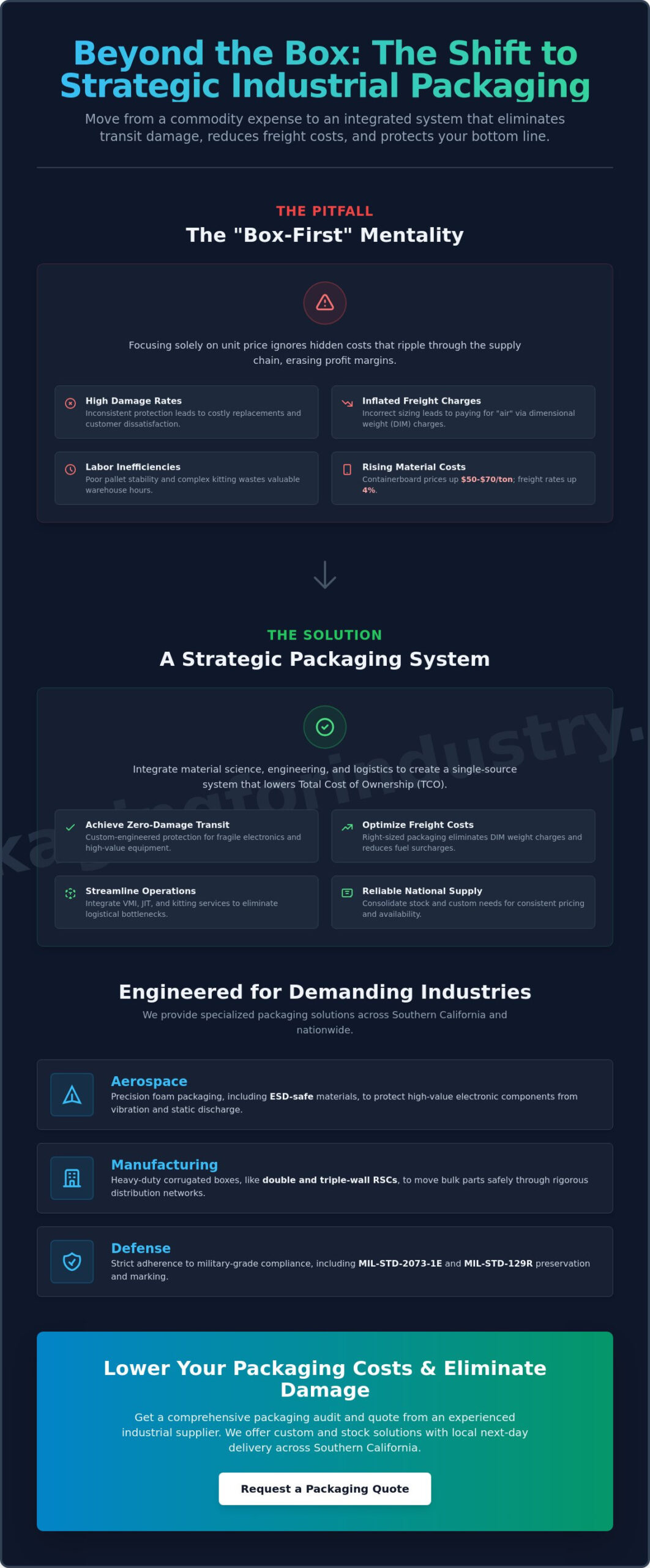
Industrial packaging is far more than a commodity purchase; it’s a critical component of your operational efficiency. Many procurement teams fall into the trap of a “box-first” mentality, focusing solely on the unit price of a container. This narrow view ignores the hidden costs that ripple through a supply chain. When you treat packaging as an afterthought, you risk high damage rates, inflated freight charges, and labor inefficiencies. Industrial packaging is the integration of material science and logistical efficiency. In 2026, the shift from commodity buying to strategic partnership is essential for survival. With containerboard prices increasing by $50 to $70 per ton and freight rates forecasted to rise by 4%, your packaging must work harder to protect your margins.
The broader field of Packaging encompasses everything from retail marketing to heavy-duty industrial transit. However, in an industrial context, the focus is purely on performance and protection. A strategic partner doesn’t just sell you a pallet; they analyze how that pallet interacts with your stretch film and your racking system to ensure total load stability. This holistic approach moves you away from simple procurement and toward a system designed for zero-damage transit.
Beyond the Box: The Total Cost of Ownership (TCO)
Poor packaging choices inflate your Total Cost of Ownership in ways that don’t appear on a standard invoice. If your boxes are sized incorrectly, you’re paying for “air” through increased dimensional weight (DIM weight) charges and fuel surcharges. Additionally, inconsistent protection leads to higher insurance premiums and the massive administrative burden of processing replacement orders. Optimized stabilization also impacts the warehouse floor. Using the right corner and edge protection can reduce the labor hours required for loading and unloading by preventing pallet collapses and streamlining the kitting process.
Industry-Specific Protection Requirements
Different sectors demand specialized engineering to ensure product integrity. We see these challenges daily across Southern California and nationwide:
- Aerospace: Requires precision foam packaging, often utilizing ESD-safe materials to protect high-value electronic components from vibration and static discharge.
- Manufacturing: Relies on heavy-duty corrugated boxes, such as triple-wall RSCs, to move bulk parts through rigorous distribution networks.
- Defense: Demands strict adherence to military-grade compliance. Navigating MIL-STD-2073-1E and MIL-STD-129R requires a supplier who understands preservation levels and specialized marking requirements.
Whether you’re looking to request a packaging quote for a new project or want to compare packaging pricing to lower your current overhead, focusing on these strategic elements is the first step toward a more resilient supply chain.
Engineering vs. Stock Supplies: Choosing the Right Protection Framework
Choosing between stock supplies and custom engineering isn’t a matter of preference; it’s a calculation of risk and transit variables. For many high-volume distribution centers in Los Angeles or Orange County, standardized corrugated boxes and stock supplies are sufficient for moving durable goods. However, when the asset involves sensitive electronics or complex aerospace components, the cost of a single damage claim often exceeds the investment in a custom-engineered solution. As a leading industrial packaging solutions provider, we help you identify the precise threshold where custom protection pays for itself through reduced damage and lower freight costs.
When to Invest in Custom Packaging Engineering
Custom solutions are necessary when you’re dealing with high unit values, fragile components, or non-standard dimensions that don’t fit securely in a standard RSC. A custom packaging supplier uses CAD design and physical stress testing to ensure that internal protection, such as precision foam inserts, accounts for the specific center of gravity and shock requirements of your product. This engineering process eliminates “air-shipping” by tailoring the outer box size to the exact footprint of the product. By reducing the external dimensions, you can often drop a freight class and avoid the steep dimensional weight penalties that carriers are increasingly enforcing in 2026. For international transit, custom foam lined crates provide the structural integrity required for heavy machinery, ensuring your equipment arrives in factory condition regardless of the handling environment. PFI facilitates this transition by offering free prototyping, allowing you to validate a design before committing to a full production run.
The Utility of Wholesale Stock Supplies
While engineering is vital for specialized assets, the backbone of most fulfillment centers remains wholesale stock supplies. Standardized double-wall or triple-wall corrugated boxes provide a reliable framework for high-volume SKU movement. To maintain operational flow, you need a consistent supply of essential stabilization tools, including high-performance stretch film, industrial-grade tapes, and edge protection. Balancing these stock needs with just-in-time (JIT) manufacturing requires a partner who can manage inventory levels for you. If you’re looking to compare packaging pricing for your warehouse, consider how a single-source supplier can consolidate both your custom and stock needs to simplify your procurement cycle. For businesses across the Inland Empire and San Diego, local packaging delivery ensures that high-volume materials like pallets and mailing tubes are available exactly when your production schedule demands them.
High-Performance Materials: From Mil-Spec to Advanced Polymers
Choosing the right materials is where engineering meets economic reality. While Section 2 addressed the choice between custom and stock frameworks, this section focuses on the technical specifications that define performance. High-performance industrial packaging requires a deep understanding of material polymers and structural densities to ensure your assets survive the rigors of the supply chain. Whether you’re moving heavy machinery or fragile sensors, the material science behind your protection determines your damage rate.
Advanced Foam and Cushioning Systems
Foam selection is a science of shock absorption and vibration dampening. Polyethylene (PE) is a closed-cell foam packaging material ideal for heavy or sensitive equipment that needs repeated impact protection. In contrast, Polyurethane (PU) is an open-cell foam best suited for lighter items requiring a softer, more compliant cushion. For electronics, we integrate ESD-safe additives to prevent electrostatic discharge during handling and transit. The effectiveness of these materials depends on their density and their relationship to G-force protection. High-density foams provide superior protection for heavy loads, while lower densities are used for void-fill and light cushioning. When we design custom foam inserts, we calculate the fragility of the component to ensure the product never exceeds its maximum G-force threshold during a drop.
Heavy-Duty Stabilization and Containment
Once the product is protected internally, external stabilization becomes the priority. Corrugated density is a major factor here. While single-wall boxes are common for standard items, heavy industrial parts often require the structural integrity of triple-wall corrugated boxes. These containers provide the stacking strength needed for overseas shipping and long-term warehousing. Stabilization continues with high-performance stretch film and corner and edge protection. These components work together to maximize load containment while minimizing material waste. In high-humidity or extreme-temperature environments, the integrity of your seal depends on industrial adhesive tapes engineered for climate resistance.
For manufacturers managing international supply chains that require high-performance bonding for overseas transit, you can learn more about Fosseway Tapes & Fixings Limited, a specialist distributor of industrial tapes and adhesives.
For defense contractors in San Diego or Anaheim, these material choices aren’t just about efficiency; they’re about compliance. Military packaging must adhere to strict standards like MIL-STD-2073-1E for preservation and MIL-STD-129R for marking. Mil-spec compliance ensures durability in extreme environmental conditions, from desert heat to maritime humidity. By utilizing advanced polymers and heavy-duty corrugated materials, we help you navigate these complex requirements while maintaining supply reliability. Manufacturers shipping sensitive defense components across borders can also benefit from reviewing how precision-engineered custom foam lined crates address G-force sensitivity and ISPM 15 compliance for international transit.
Optimizing Procurement: Fiscal Responsibility in Packaging Logistics
Effective procurement is the bridge between engineering design and fiscal health. In an environment where plastic resins rose 6% to 7% in early 2026 and aluminum prices spiked 47% year over year, treating industrial packaging as a static commodity is a financial risk. Procurement managers must look beyond the unit price of a single box to understand how material choices impact the entire logistical cycle. By leveraging a strategic partnership, you can stabilize your supply chain against market volatility while ensuring that your protection standards never waver. A proactive approach to procurement identifies where custom engineering can actually lower your total spend by reducing material volume and freight expenses.
Bulk Ordering and Inventory Optimization
Wholesale inventory management requires a balance between unit discounts and the carrying costs of warehouse space. To optimize this, we help facilities calculate their Economic Order Quantity (EOQ) for essential shipping supplies like stretch film and corrugated boxes. For companies operating across multiple facilities in Riverside, Los Angeles, or the Inland Empire, standardizing packaging specifications is a primary driver of cost consistency. This allows for bulk packaging pricing that applies across your entire national footprint. To eliminate the burden of storage, we offer Vendor Managed Inventory (VMI) and Just-In-Time (JIT) delivery, ensuring you have the materials you need without cluttering your floor space.
Sustainability as an Economic Driver
Sustainability in the industrial sector is increasingly driven by economic necessity rather than just corporate social responsibility. Precision-engineered custom designs reduce material waste by eliminating excessive void-fill and oversized containers. This process of “right-sizing” directly lowers your shipping volume, which is critical as freight rates continue to climb. By moving toward recyclable corrugated materials and optimized corner and edge protection, you reduce your carbon footprint while simultaneously lowering your disposal fees and material overhead. These efficiencies ensure that your packaging system is both environmentally responsible and fiscally sound.
Specialized vendors like PFI bridge the gap between the raw manufacturer and your specific end-user requirements. We act as a “fixer” for logistical bottlenecks, providing everything from mailing tubes to complex military-spec crates with local next-day delivery across Southern California. If you are ready to refine your procurement strategy and lower your operational costs, you should request a packaging quote to see how an optimized system can protect your bottom line.
The PFI Approach: End-to-End Packaging Solutions
PFI functions as a strategic fixer for manufacturers facing complex logistical bottlenecks. Unlike standard catalog suppliers, we integrate engineering, production, and wholesale distribution into a single operational flow. This model ensures that every component, whether it’s heavy-duty industrial packaging or precision foam packaging, is optimized for both protection and cost-effectiveness. By maintaining oversight of the entire process, we provide a level of accountability that fragmented supply chains cannot match. We don’t just provide materials; we engineer the systems that keep your products safe and your freight costs low.
Custom Prototyping: Eliminating Risk Before Rollout
The PFI free prototyping service acts as a critical bridge between conceptual design and full-scale production. We understand that theory doesn’t always translate to the rigors of transit. We move rapidly from CAD designs to physical samples for immediate testing. This allows your team to validate the fit and durability of corrugated boxes or custom inserts without any initial financial commitment. Our collaborative design process involves working directly with your engineers to solve specific protection challenges. This ensures the final solution is tailored to your product’s unique footprint and fragility. It’s a proactive step that eliminates the risk of damage claims before you ever ship a single unit.
National Reach with Local Service Standards
While we are a nationwide supplier capable of supporting multi-state manufacturing operations, we maintain the responsive service standards of a local partner. For businesses in Orange County, Los Angeles, San Diego, and the Inland Empire, our local next-day delivery ensures that production lines never stop due to material shortages. We provide a comprehensive range of stock and custom materials, from stretch film to corner and edge protection. Our solution-oriented mindset is our ultimate differentiator. We don’t just sell shipping supplies; we build reliable systems that lower packaging costs and reduce shipping damage across your entire network. If you’re ready to secure your supply chain with a partner who understands the intersection of engineering and economics in industrial packaging, you should request a packaging quote to experience the PFI approach firsthand.
Securing Your Supply Chain Through Strategic Packaging Optimization
Mastering the complexities of industrial packaging is a requirement for maintaining profitability in today’s volatile market. You’ve seen how shifting from a commodity mindset to a strategic engineering approach eliminates hidden costs like freight penalties and damage claims. By integrating advanced material science and mil-spec compliance into your logistics, you protect both your product and your professional reputation. Whether you’re navigating the rigid standards of the aerospace sector or managing high-volume distribution across Southern California, the right framework turns a logistical burden into a competitive advantage.
PFI stands ready as your seasoned industrial consultant and proactive problem solver. We offer a national distribution network for wholesale shipping supplies and comprehensive expertise in aerospace and military-grade protection. You can eliminate risk before your next rollout by utilizing our free custom prototyping for specialized designs. Our goal is to ensure your transit is damage-free while your procurement remains fiscally responsible and efficient. We’re here to help you solve your most difficult logistical bottlenecks today.
Explore Custom Industrial Packaging Solutions at PFI and start optimizing your supply chain now.
Frequently Asked Questions
What is the difference between commercial and industrial packaging?
Industrial packaging focuses on protecting products throughout the distribution chain, while commercial packaging is designed for retail appeal and consumer branding. Industrial solutions prioritize durability and structural integrity to survive rigorous handling, stacking, and long-distance transport. These systems utilize heavy-duty corrugated materials and specialized cushioning that meets specific logistical requirements rather than just visual shelf presence.
How do custom foam inserts improve shipping safety for electronics?
Custom foam inserts provide precision-engineered shock absorption tailored to the exact weight and fragility of electronic components. By utilizing materials like anti-static polyethylene, these inserts eliminate movement within the box and prevent electrostatic discharge. This level of protection ensures that sensitive internal circuitry remains intact even during high-vibration transit or accidental drops in the fulfillment center.
What are the requirements for mil-spec packaging compliance?
Mil-spec compliance requires strict adherence to standards such as MIL-STD-2073-1E for preservation and MIL-STD-129R for marking. These regulations specify the exact materials, barrier layers, and labeling necessary for defense contracts. Working with an experienced supplier ensures that your shipments meet these rigorous durability requirements for extreme environmental conditions without risking contract rejection or shipping delays.
Can custom-engineered crates save money on international freight?
Custom-engineered crates reduce international freight costs by optimizing the external dimensions of the shipment to match the product footprint. By eliminating excess volume, you can often lower your dimensional weight charges. Precision engineering also ensures structural integrity with less material, which reduces the gross weight of the shipment and helps lower packaging costs over time.
What materials are best for heavy-duty industrial stabilization?
The most effective materials for heavy-duty stabilization include high-performance stretch film, triple-wall corrugated boxes, and rigid edge protectors. These products work together to maintain load containment and prevent shifting during transit. For heavy machinery, ISPM-15 compliant pallets and heat-treated crates provide the necessary foundation for secure long-distance transport and international compliance.
How does free prototyping work for custom packaging designs?
Free prototyping allows you to validate a custom design with a physical sample before committing to a full production run. We move from CAD drawings to a physical prototype that you can use for fit-testing and drop-testing. This risk-mitigation tool ensures the packaging performs as expected; it helps you avoid costly redesigns or product damage after the final rollout.
Why is edge protection critical for palletized industrial loads?
Edge protection is critical because it prevents the vertical collapse of palletized loads by reinforcing the corners where stress is highest. It also protects the product from damage caused by tight strapping or stretch film tension. By distributing the load weight more evenly, edge protectors allow for higher stacking in the warehouse and increased stability during truck transport.
How can a manufacturer reduce their total packaging spend?
Manufacturers can reduce their total spend by right-sizing their containers and consolidating their supply chain through a single-source provider of industrial packaging. Implementing a vendor-managed inventory system also lowers costs by reducing warehouse storage needs and preventing stockouts. You should request a packaging quote to compare pricing and identify where engineering can reduce material waste and freight expenses.