
A packaging prototype is not a sample; it is a functional insurance policy that validates your engineering and economics before you spend a single dollar on production. For many manufacturers and distributors in Southern California, the cost of transit damage and oversized shipping fees often outweighs the price of the packaging itself. If you’re tired of dealing with high product loss or paying to ship unnecessary air, securing a free packaging prototype Orange County specialists can provide is the most effective way to protect your margins. This is especially critical as California regulations like SB 54 now require businesses to optimize material use and prioritize recyclability by specific 2026 reporting deadlines.
We understand that your operations depend on precision and reliability. You shouldn’t have to guess whether a corrugated box will hold up under the weight of a heavy industrial component or if a custom foam insert will survive a drop. This article explains how a custom prototype eliminates shipping damage and optimizes box dimensions to lower your freight costs. We’ll examine the design process, from CAD engineering to final testing, and show you how a local partner can accelerate your lead times while ensuring your logistics remain both compliant and cost-effective.
Key Takeaways
- Identify the critical differences between generic stock samples and engineered prototypes designed for industrial durability.
- Learn how CAD-driven precision templates eliminate transit damage by addressing specific product vulnerabilities during the design phase.
- Discover how rightsizing your containers reduces dimensional weight and minimizes the need for costly secondary cushioning materials.
- Request a free packaging prototype Orange County operations can use to validate custom designs before investing in bulk production.
- See why high-stakes industries like aerospace and medical manufacturing rely on functional modeling to ensure total supply chain reliability.
What is a Free Packaging Prototype and Why Does Your Business Need One?
A packaging prototype is a physical, functional model of a custom container, engineered to meet the exact specifications of your product. It goes beyond a simple visual aid; it is a working proof-of-concept. For businesses in Southern California, securing a free packaging prototype Orange County experts provide is the first step in moving from a conceptual design to a reliable production run. We offer this service at no cost because it establishes a foundation of trust. It demonstrates our technical capability before you commit to a bulk purchase order.
High-value industrial components, such as those found in medical devices or electronics, require more than just a standard box. They require Packaging engineering that accounts for shock, vibration, and compression. PFI provides a free packaging prototype Orange County manufacturers can use to perform physical drop tests and transit simulations. This ensures the design holds up under real-world conditions before full-scale manufacturing begins.
The Difference Between a Sample and a Prototype
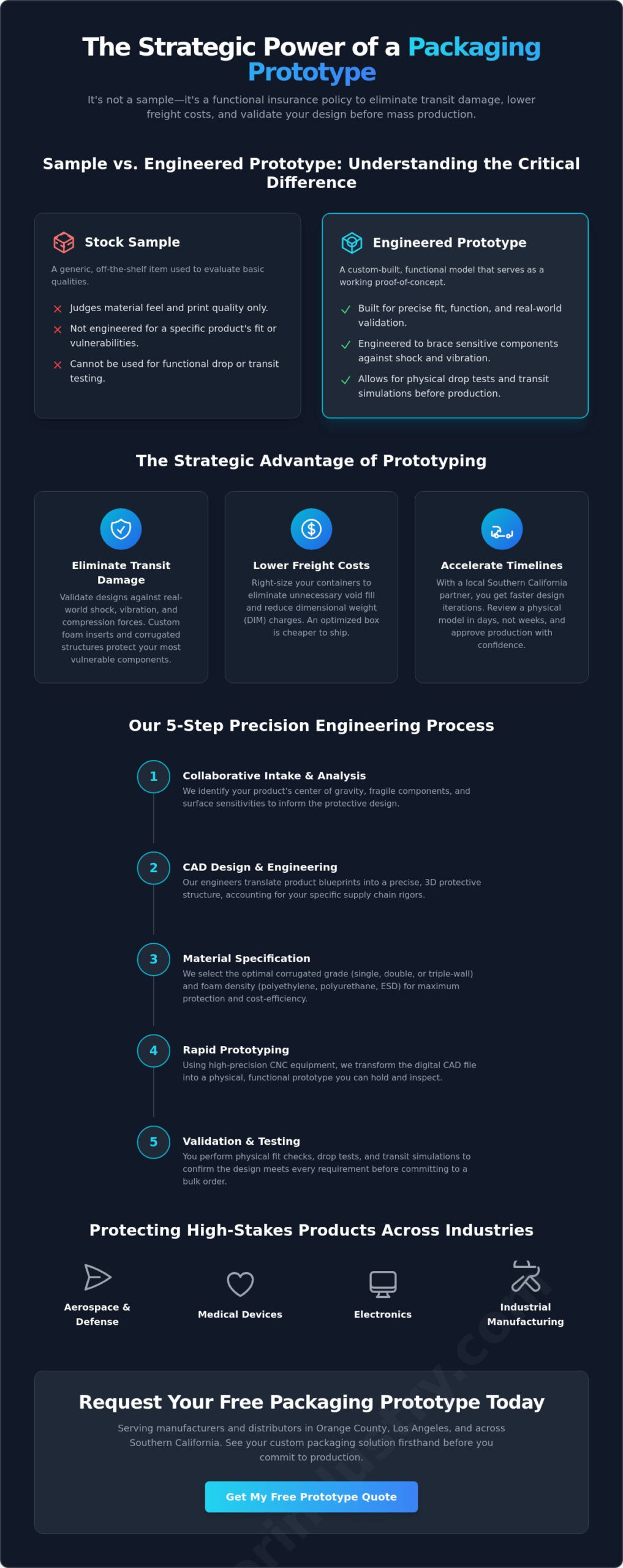
Many procurement officers confuse a stock sample with an engineered prototype. A sample is typically used to judge material feel or print quality. In contrast, a prototype is built for fit and function. If you’re shipping specialized industrial equipment, a generic box often leaves gaps that lead to movement and damage. During the prototyping phase, we integrate custom foam packaging inserts into specific corrugated boxes. This ensures every corner and sensitive surface is braced against impact.
The Strategic Advantage for Southern California Operations
Operating in a high-speed market like Orange County requires agility. By working with a local supplier, you benefit from faster design iterations. You don’t have to wait weeks for a prototype to arrive from overseas. Instead, you can review a physical model, make adjustments, and finalize the design in days. This proximity allows for a more collaborative design process that identifies potential flaws early.
Integrating prototyping into your Just-In-Time (JIT) inventory strategy reduces the risk of bulk order errors. Validation at the prototype stage means you won’t end up with thousands of units that don’t fit your product or fail to protect it during transit. This proactive approach eliminates the stress of shipping delays and helps maintain a lean, efficient supply chain.
The Engineering Process: How Custom Prototypes are Built
The transition from a raw product to a finished protective shell is a methodical engineering journey. It starts with a collaborative intake process where we identify the center of gravity, fragile components, and surface sensitivities. This data informs the Computer-Aided Design (CAD) phase. By utilizing the free packaging prototype Orange County manufacturers can access through PFI, you ensure that every millimeter of the design serves a functional purpose. We use rapid prototyping equipment to generate the first physical iteration, allowing you to hold the solution in your hands before approving the final build.
Material selection is the next critical step. Choosing between corrugated grades and various foam densities is a matter of physics and logistics. We analyze whether your application requires the rigidity of triple-wall corrugated or the shock-absorption of specific polyethylene foam. These choices are aligned with industry standards for sustainable package design to ensure your solution is both high-performing and compliant with modern waste reduction mandates. The transition from a digital CAD file to a high-precision CNC cut represents the core of modern precision packaging.
CAD Design and Material Specification
We translate your product blueprints into protective structures that account for the specific rigors of your supply chain. This isn’t a one-size-fits-all approach. We specify corrugated wall thickness based on stacking requirements and weight. We also engineer foam inserts to provide targeted vibration dampening. If you need to request a packaging quote for different material configurations, our engineers can provide prototypes for multiple options to help you find the most cost-effective balance.
Rapid Prototyping and Iteration
The primary advantage of local prototyping is speed. While overseas alternatives can take weeks, we produce physical iterations in days. By requesting a free packaging prototype Orange County businesses can verify designs in real-time before committing to bulk quantities. We adjust dimensions based on physical fit tests to ensure the product remains stationary during transit. For specialized sectors, we ensure every prototype meets stringent military packaging standards or aerospace specifications. This iterative process guarantees that the final production run is flawless.
Prototypes as a Tool for Packaging Cost Savings
Many industrial operations view packaging as a fixed expense. This perspective overlooks the significant impact that design precision has on the total cost of ownership. By utilizing a free packaging prototype Orange County businesses can identify exactly where they are overpaying for shipping and materials. A physical model allows you to visualize the intersection of engineering and economics. It provides a tangible way to verify that you aren’t paying to ship air or wasting budget on excessive cushioning.
The primary driver of packaging cost savings is the reduction of dimensional weight. Carriers prioritize volume as much as actual weight. If your box is two inches larger than necessary in every dimension, the cumulative cost across a year of shipments is substantial. Securing a free packaging prototype Orange County specialists provide allows you to test these cost-saving measures in a real-world environment. A custom-fit prototype eliminates the need for excessive void fill like bubble wrap or packing peanuts. When the container is engineered to the product’s exact dimensions, the internal components remain secure without the need for secondary materials.
Optimising Dimensional Weight for Freight Efficiency
Oversized boxes are a common inefficiency in warehouse operations. They inflate shipping costs and waste valuable pallet space. Using prototypes helps you find the smallest safe footprint for your product. This optimization has a direct impact on national shipping rates, especially for high-volume distributors. When you reduce the volume of each unit, you increase the number of units that fit on a single pallet or in a shipping container. This maximizes your logistical flow and lowers the per-unit freight cost.
Reducing Transit Damage and Returns
The cost of product damage is rarely limited to the price of the item itself. In industrial sectors like aerospace, “hidden” damage can lead to catastrophic failures and massive liability. Validating protective features with a prototype before committing to a full production run is a form of functional insurance. It ensures that your packaging meets carrier insurance requirements for fragile items. By reducing the rate of returns and replacements, you protect your margins and maintain your reputation for reliability. This proactive approach is far more cost-effective than reacting to a surge in damage claims after a product launch.
Specialised Industries Benefiting from Custom Prototyping
Failure in high-stakes sectors doesn’t just mean a lost product; it often results in a compromised project or a safety violation. For companies managing complex supply chains, securing a free packaging prototype Orange County specialists can engineer is a vital risk-mitigation step. Precision is mandatory when shipping sensitive medical diagnostic equipment or high-value avionics. The cost of a single failure far exceeds the investment in a prototype that validates your protection strategy. This is particularly true for aerospace packaging, where components must survive extreme pressure changes and rigorous handling.
A custom prototype allows you to test the structural integrity of custom shipping crates before they leave the facility. It provides the physical evidence needed to confirm that heavy machinery will remain stationary and protected during international transit. By moving beyond generic solutions, you ensure that every material choice is backed by functional data rather than guesswork.
Aerospace and Aviation Protection
Avionics and engine parts require engineered foam inserts that provide both shock absorption and static protection. During the prototyping phase, we validate protection against moisture and Electrostatic Discharge (ESD) to ensure compliance with strict industry safety standards. These prototypes allow engineers to verify the fit of complex geometries, ensuring that sensitive surfaces aren’t subjected to abrasive movement. By testing the prototype in a simulated transit environment, you confirm that the packaging meets the specific rigors of the aviation supply chain without over-engineering the solution.
Manufacturing and Industrial Equipment
Heavy-duty corrugated boxes for automotive parts and machinery are tested for compression strength and stacking durability. By requesting a free packaging prototype Orange County manufacturers can verify that their heavy-duty corrugated solutions can withstand the stacking pressures of international transit. We also focus on load stabilization for palletized goods, often integrating high-performance stretch film into the testing phase. Custom corner and edge protection validation is essential for oversized items to prevent structural damage during forklift handling. This level of detail ensures your industrial equipment arrives ready for installation, protecting your operational timeline and your bottom line.
Request a custom packaging quote today to see how our engineering can protect your most critical assets: Request a packaging quote.
How to Request Your Free Packaging Prototype from PFI
Securing a free packaging prototype Orange County manufacturers can rely on is a straightforward process designed to minimize your operational risk. We offer this as a no-obligation service because we believe the quality of our engineering should speak for itself. By validating the design before you commit to a bulk order, you ensure that your logistics strategy is both physically sound and fiscally responsible. For businesses across Southern California, we leverage our local presence to provide next-day delivery on many stock items and rapid turnaround on custom designs. While we are a local partner for the SoCal region, we maintain the infrastructure to support nationwide shipping for full production runs once your design is finalized.
The Consultation and Intake Phase
The process begins with a detailed intake phase where our engineers gather the technical specifications of your product. To create an accurate model, we’ll need to understand the weight, exact dimensions, and specific fragility points of your equipment. For complex or oversized industrial components, we often schedule a local site visit to evaluate the product in person. Alternatively, you can send your product to our facility for a custom fit. This hands-on approach allows us to identify potential failure points that a digital blueprint might miss. Because we manage the design and fabrication locally, the turnaround time from your initial request to a physical prototype is significantly faster than dealing with non-local suppliers.
During this phase, we focus on three primary goals:
- Identifying the center of gravity and bracing requirements.
- Specifying the correct foam density for shock absorption.
- Determining the most efficient corrugated grade for stacking strength.
Transitioning from Prototype to Full Production
Once you’ve tested and approved the physical model, scaling to a full wholesale corrugated box order is seamless. We use the approved CAD files to ensure that every unit in your production run matches the prototype’s precision. For businesses looking to streamline their supply chain further, we offer Vendor Managed Inventory (VMI). This service ensures you never face a stockout on critical packaging materials, as we monitor your usage levels and replenish stock automatically based on your production schedule.
The final step is to request a packaging quote for your finalized design. Our pricing is transparent and reflects the efficiency gains we’ve engineered into your custom solution. Whether you’re shipping aerospace components across the country or distributing medical devices locally, our goal is to provide a system of protection that supports your long-term reliability. We don’t just sell boxes; we provide the engineering expertise required to protect your margins and your reputation.
Secure Your Supply Chain with Engineered Validation
Protecting your product during transit requires more than a standard container. It demands a solution engineered for your specific operational challenges. By securing a free packaging prototype Orange County operations can rely on, you eliminate the guesswork that leads to shipping damage and inflated dimensional weight costs. Our process ensures that your custom corrugated and foam solutions meet the rigorous standards of the aerospace and medical sectors before you commit to a bulk production run.
We provide the stability your logistics team needs through local next-day delivery across Southern California and comprehensive inventory management programs like VMI and JIT. This proactive approach allows you to scale with confidence, knowing your packaging is optimized for both protection and profit. Don’t wait for a surge in damage claims to address design flaws. We’re ready to help you build a more resilient and cost-effective supply chain starting today.
Request Your Free Custom Packaging Prototype Today
Frequently Asked Questions
How long does it take to receive a free packaging prototype in Orange County?
Most businesses receive their functional prototype within a few business days after the initial design consultation. Because our engineering and fabrication facilities are local, we avoid the long lead times associated with non-local or overseas suppliers. This speed allows you to move into full production faster while ensuring your protection strategy is validated. The exact timeline depends on the complexity of the engineering required for your specific product and the materials selected.
Is there a limit to the number of prototypes I can request?
We provide prototypes as a necessary step in the engineering process rather than a standalone sampling service. While there isn’t a rigid numerical limit, we focus on providing a free packaging prototype Orange County businesses can use to finalize a specific production design. If your project involves multiple product variations, we work with you to develop the necessary models to ensure every component in your shipment is fully protected and shipping-ready.
Do I need to send my actual product to get a custom foam insert prototype?
Sending your actual product or a high-precision 3D model is recommended to ensure a perfect fit for custom foam inserts. Having the physical item allows our engineers to identify center-of-gravity issues and fragile points that might not be obvious on a 2D drawing. If the product is too large or sensitive to transport, we can often arrange a site visit or work from your detailed CAD blueprints to begin the initial design phase.
Can you provide prototypes for Mil-Spec or aerospace requirements?
Yes, we specialize in engineering prototypes that meet stringent military-spec (mil-spec) and aerospace standards. Our team understands the specific requirements for vibration dampening, moisture resistance, and ESD protection required for high-stakes aviation components. We provide the functional models needed to verify compliance before you invest in wholesale quantities, ensuring your packaging survives the rigors of global defense and aerospace supply chains.
What materials are available for the free prototyping service?
We offer a wide range of industrial materials for prototyping, including various grades of corrugated board and protective foam. You can test single, double, or triple-wall corrugated options alongside polyethylene, polyurethane, or anti-static (ESD) foams. This variety allows you to compare different material combinations to find the most cost-effective balance between durability and shipping weight. We help you select the specific materials that align with your transit requirements.
Is the prototype fully functional for actual shipping tests?
Every prototype we produce is a fully functional model designed for physical testing and transit simulation. You can use these models for drop tests, stacking trials, and carrier insurance validation. Unlike a visual sample, a functional prototype allows you to confirm that the dimensions are optimized for lower freight costs and that the internal bracing effectively eliminates product movement during the shipping process.
Do you provide local delivery for prototypes in Southern California?
We provide local delivery for prototypes throughout Southern California, including Orange County, Los Angeles, and Riverside. Our local presence allows us to offer fast turnaround times and personalized service that national distributors can’t match. Once your free packaging prototype Orange County design is approved, we can also integrate it into our local next-day delivery schedule for your full production runs to keep your operations running smoothly.
What happens if the first prototype doesn’t fit my product perfectly?
Iteration is a standard part of the engineering process, and we adjust the design if the first version requires refinement. If the physical fit isn’t perfect, our engineers modify the CAD templates and produce a revised model based on your feedback. This ensures that the final production run is flawless and that you don’t end up with inventory that fails to protect your product or creates logistical inefficiencies.