
Subjecting a million-dollar industrial 3D printer to just 20G of transit shock can instantly misalign its precision optical galvanometers, turning a high-tech asset into a costly repair project. You understand that shipping additive manufacturing equipment isn’t just about moving a box; it’s about protecting a complex ecosystem of lasers and sensors from the rigors of logistics. Choosing the wrong packaging can lead to catastrophic calibration issues or structural damage that stalls your production line. This guide provides the technical insights you need to secure your investment using custom crating for industrial 3D printers SoCal, ensuring your machinery arrives at its destination ready for immediate operation.
We’ll examine how precision-engineered wood structures and CNC-cut foam inserts work together as a single shock-absorption system. You’ll learn about ISPM-15 compliance for international transit and how working with a local Southern California packaging supplier helps you meet strict delivery milestones without the high cost of generic, poorly fitted crates. By the end of this article, you’ll have a clear framework for selecting a partner that prioritizes both engineering integrity and fiscal responsibility to reduce shipping damage across your supply chain.
Key Takeaways
- Precision-engineered enclosures that combine heavy duty wood crates with custom foam inserts are essential to protect sensitive optical components from transit shocks.
- International shipments require ISPM-15 compliant heat-treated wood to ensure your equipment clears customs without delays or penalties.
- Partnering with a local Southern California packaging supplier in Anaheim allows for free prototyping and faster turnaround on production line moves.
- Using custom crating for industrial 3D printers SoCal helps manufacturers reduce shipping damage and avoid the high costs associated with recalibrating misaligned systems.
- Providing accurate dimensions and weight specifications is the first step to securing an accurate custom packaging quote and optimizing your logistics costs.
The Logistics of High-Precision Assets: Why Industrial 3D Printers Need Custom Crating
Custom crating for industrial 3D printers is a precision-engineered enclosure designed to mitigate vibration, G-force impacts, and environmental factors like humidity. For manufacturers in Southern California, standard logistics solutions often fall short. A generic pallet doesn’t account for the specialized needs of a million-dollar metal laser sintering system or a large-format polymer printer. Utilizing custom crating for industrial 3D printers SoCal ensures that your asset remains within factory tolerances during every mile of transit.
The cost of failure extends far beyond the price of the machine. It includes lost production time, expensive technician call-outs, and the potential voiding of manufacturer warranties. Many OEMs require specific packaging standards for relocations; failing to meet these can leave you liable for any damage. Common risks include the misalignment of build plates, cracked glass housings, and moisture ingress that ruins sensitive electronics or hygroscopic print materials.
Calibration Sensitivity and Vibration Dampening
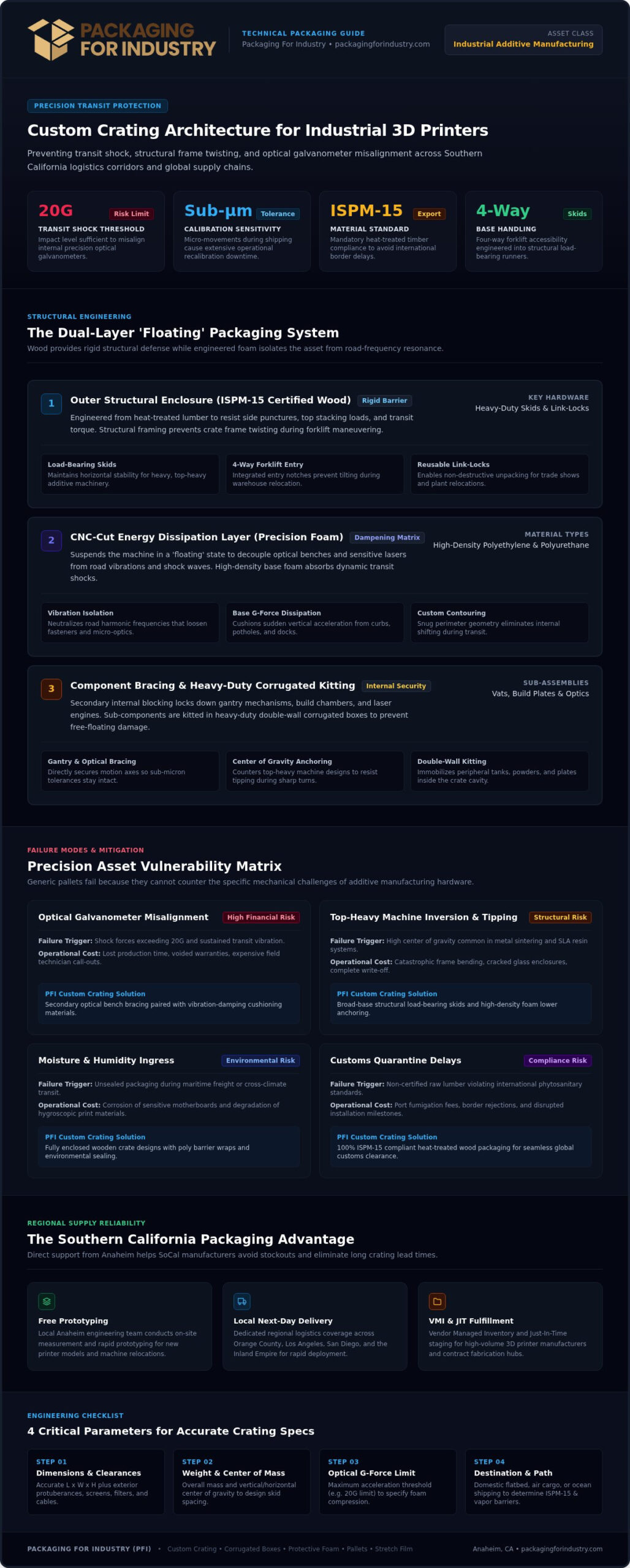
Industrial printers rely on sub-micron accuracy. Micro-movements during shipping can lead to weeks of recalibration downtime once the machine arrives. We identify critical zones like the gantry and optical bench that require secondary internal bracing. Our designs for wooden crates focus on isolating the machine from road-frequency vibrations through advanced cushioning materials. Proper wooden crate construction incorporates structural framing and load-bearing skids to prevent the frame from twisting during handling.
High-Value Component Protection
Protecting laser engines and resin vats requires more than just outer walls. Top-heavy printers present significant center of gravity challenges that can lead to tipping if not properly anchored. We use high-density foam for base support and heavy-duty double-wall corrugated for internal component kitting. This ensures that peripheral items like build plates and resin tanks don’t become projectiles inside the crate. Our custom design packaging solutions address these specific mechanical vulnerabilities, making us a reliable source for custom crating for industrial 3D printers SoCal.
Engineering the Perfect Fit: Integrating Custom Wood Crates and Foam Inserts
Effective protection for additive manufacturing systems relies on a dual-layered engineering approach. While wood provides the rigid structural integrity needed to withstand stacking and mechanical handling, precision-engineered foam acts as the primary energy dissipation layer. This integrated system creates a ‘floating’ environment, where the machine is suspended within the crate to prevent direct vibration transfer. For manufacturers seeking custom crating for industrial 3D printers SoCal, this material synergy is the only way to ensure zero-damage delivery for sensitive optical components.
Structural Wood Crating Specifications
The exterior shell must be designed for the specific logistical path the machine will take. Fully enclosed custom crates offer maximum protection against puncture and environmental debris, while heavy-duty skids might suffice for controlled, short-distance moves between local facilities. We focus heavily on weight distribution, ensuring the crate’s base can handle top-heavy machines without tipping. Forklift accessibility is integrated into the skid design with four-way entry points, allowing warehouse teams to move these heavy assets safely. All our wood products adhere to ISPM 15 wood packaging material standards, which is a critical requirement for any international export to prevent customs delays. For machines moving to trade shows or multiple sites, we integrate reusable hardware like link-locks that allow for uncrating without damaging the timber.
Precision Foam Assemblies
Choosing the right foam density is a matter of physics and asset value. High-density polyethylene foam is used at the base contact points to bear the machine’s static load without bottoming out during a drop. In contrast, softer polyurethane foam is ideal for dampening high-frequency vibrations around sensitive gantries and laser housings. We also incorporate ESD foam packaging to protect electronic control boards from static discharge. Precision die-cut custom foam inserts ensure that removable build plates and resin vats are kitted securely, preventing them from shifting and becoming internal projectiles. Our engineering team specializes in custom crating for industrial 3D printers SoCal, focusing on the specific vibration profiles of additive manufacturing hardware. If you’re planning a production line move, it’s wise to request a custom packaging quote to see how an integrated wood and foam solution can lower your total cost of ownership.
Material Standards and Compliance for Global and Domestic Transit
Regulatory compliance is a critical hurdle in industrial logistics. For companies utilizing custom crating for industrial 3D printers SoCal, adhering to international and domestic standards is the only way to prevent costly customs impounds or shipping delays. When moving industrial additive manufacturing systems, the packaging must meet specific material benchmarks that go beyond simple durability. We focus on ensuring that every enclosure is a compliant vessel for your most sensitive assets.
ISPM-15 certification is non-negotiable for international exports. This standard requires that all solid wood packaging undergo heat treatment to a core temperature of 56°C for at least 30 minutes. Without the official IPPC quality mark, your crate could be quarantined or even destroyed at the border. We ensure every custom crate we manufacture for export is fully compliant. Additionally, for Tier 1 suppliers in Southern California, we align our designs with aerospace and military packaging standards, providing the rigorous documentation required for high-stakes contracts.
Transparency in the shipping process is achieved through shock and tilt indicators. These devices are mounted to the exterior of the crate to provide immediate visual evidence of mishandling during transit. They act as a powerful deterrent for carrier negligence and simplify the insurance claim process if an incident occurs. This level of oversight is essential for maintaining the integrity of the supply chain.
International Export Requirements
IPPC stamps play a vital role in global trade by preventing the spread of wood-borne pests. Beyond compliance, export crates must be engineered to maximize container cube utilization. Efficient dimensions reduce freight costs while maintaining the structural integrity needed for multi-modal transit. Clear labeling and documentation for high-value machinery are integrated into our process to streamline the hand-off between carriers and customs agents, ensuring a smooth logistical flow.
ESD and Environmental Protection
Additive manufacturing electronics are highly susceptible to static discharge. We utilize ESD foam packaging to neutralize this risk during relocation. Environmental factors like humidity can oxidize metal powders or degrade resin components. To mitigate this, we use vapor barrier bags and desiccant packs to create a hermetically sealed environment inside the crate. We also stabilize the load using heavy-duty corner and edge protection under high-performance stretch film. This prevents shifting and ensures the internal environment remains intact. Our expertise in custom crating for industrial 3D printers SoCal covers these micro-level details that generic shipping stores often overlook.
The Southern California Advantage: Local Design, Prototyping, and Delivery
Proximity is a strategic asset in industrial logistics. When you’re moving million-dollar additive manufacturing equipment, you can’t rely on a distant catalog supplier that doesn’t understand the physical demands of the Southern California tech corridor. Being close to your packaging partner reduces lead times and eliminates the communication gaps that often lead to shipping damage. Our central headquarters in Anaheim serves as a proactive hub for manufacturers, providing custom crating for industrial 3D printers SoCal that meets the specific needs of local transit and global export.
We act as a seasoned industrial consultant for your facility. We don’t just provide materials; we provide an entire system of protection. Our team understands that every day your equipment sits in a warehouse is a day of lost production. By utilizing local next-day delivery and rapid response times, we keep your shipping schedule on track and ensure your supply reliability remains high. This local focus allows us to offer specialized support that global corporate entities simply cannot match.
On-Site Design and Consultation
Our engineers don’t work solely from blueprints. We visit your facility in person to perform on-site measurements and identify the specific mechanical vulnerabilities of your hardware. This hands-on approach simplifies the purchasing process for operations managers and ensures that the final product is a perfect fit. We offer free prototyping for custom design packaging, allowing you to test the synergy of wood and foam before the final build. This precision reduces freight costs by optimizing crate dimensions for local LTL carriers, preventing the “air shipping” charges that occur when using generic, oversized containers.
Serving the SoCal Industrial Hub
The Southern California region requires diverse logistical expertise. We provide tailored solutions for the aerospace clusters in Huntington Beach and Long Beach, where flight-grade hardware requires rigorous military packaging standards. In Irvine and Santa Ana, we support medical device manufacturers who need high-precision protective foam packaging for sensitive diagnostic equipment. Our reach extends to the warehouse and distribution hubs in the Inland Empire, including Riverside and San Bernardino. Whether you are moving a single machine across Torrance or shipping from Costa Mesa, our custom crating for industrial 3D printers SoCal provides the peace of mind that comes from local engineering oversight.
Securing Your Quote: How to Specify Your Custom Crating Needs
Accurate pricing for specialized logistics starts with precise data. While generic online platforms might offer instant quotes for 3D printed parts, you can’t accurately price custom crating for industrial 3D printers SoCal without a methodical engineering review. High-value additive manufacturing assets have unique mechanical vulnerabilities that a standard catalog box can’t address. To receive a comprehensive custom packaging quote, you’ll need to provide your equipment’s outer dimensions, total gross weight, and specific fragility ratings, such as maximum G-force tolerances for optical benches.
We recommend a full packaging review to identify opportunities for damage reduction and cost savings. This process evaluates whether your current system relies too heavily on expensive over-packing or if it lacks the necessary protective foam packaging to isolate internal components. For manufacturers with recurring shipping needs, we can integrate your crating requirements into a vendor managed inventory (VMI) packaging program. This ensures you always have just-in-time packaging available for your production line moves, improving your supply reliability without cluttering your warehouse floor.
The Quoting Process for Industrial Crating
Our workflow is designed for speed and technical accuracy. First, you’ll provide your equipment specs and destination details to our engineering team in Anaheim. Second, you’ll receive a custom design proposal and a prototype for fit-testing, ensuring the cushioning materials align perfectly with your machine’s gantry. Finally, we move to production with local next-day delivery options to keep your project on schedule. This consultative approach eliminates the guesswork that leads to shipping damage.
Long-Term Cost Savings and Reliability
Choosing customized crating is a strategic investment that reduces your total cost of ownership. By eliminating the need for post-transit recalibration and preventing structural damage, you avoid the hidden costs associated with equipment downtime. As a local industrial packaging supplier, PFI serves as a cost-saving alternative to large catalog distributors who charge premiums for generic solutions. We help you lower packaging costs by optimizing the crate’s footprint to fit local LTL carrier requirements, preventing dimensional weight penalties. It’s about finding the balance between engineering integrity and fiscal responsibility to ensure your assets are protected throughout their lifecycle.
Optimizing Your Additive Manufacturing Logistics
Protecting high-value additive manufacturing assets requires more than a sturdy box. It demands an integrated engineering approach where custom wood structures and precision foam assemblies act as a single shock-absorption system. By prioritizing custom crating for industrial 3D printers SoCal, you ensure that sensitive optical components remain aligned and that your manufacturer warranties stay intact during relocation or export.
Working with a local partner provides tangible advantages for your bottom line. We offer free prototyping and design support to guarantee a perfect fit before production begins. Our local next-day delivery across Southern California helps you meet strict production milestones without the lead times associated with national catalog suppliers. As specialists in aerospace and industrial equipment, we understand the rigorous standards required for zero-damage delivery.
We look forward to helping you lower your packaging costs and improve your supply reliability through precision-engineered protection.
Frequently Asked Questions
Do I need a custom crate or can I use a standard heavy-duty corrugated box for my 3D printer?
Standard corrugated boxes, even triple-wall versions, typically lack the structural rigidity required for heavy industrial machinery. While they’re suitable for kitting peripherals, the main printer unit requires a custom wood crate to prevent frame twisting and gantry misalignment. We design crates that provide a rigid outer shell while incorporating foam layers to dissipate energy. This combination ensures your equipment remains within factory calibration during transit throughout Southern California.
What is the difference between polyethylene and polyurethane foam for crating?
Polyethylene foam is a durable, closed-cell material used for load-bearing applications and base cushioning. It resists moisture and provides excellent support for heavy equipment. Polyurethane foam is a softer, open-cell material designed to absorb high-frequency vibrations and protect delicate internal components like laser housings. We often use a multi-density approach, placing polyethylene at the base and polyurethane around sensitive printer gantries to create a comprehensive protection system.
How do I ensure my 3D printer crate is compliant for international export from California?
To clear customs for international export, your crate must be manufactured from heat-treated wood that meets ISPM-15 standards. This process involves heating the wood to a specific core temperature to eliminate pests. Every export crate we build features the official IPPC stamp, which is mandatory for international transit. Failing to use compliant materials can result in your shipment being quarantined or rejected at the destination port, causing significant production delays.
Can PFI provide on-site measurements for custom crating in Orange County?
Yes, our engineering team provides on-site design consultations and precision measurements for facilities across Orange County and the Inland Empire. This service allows us to identify critical no-contact zones and center-of-gravity challenges before the build begins. By performing these measurements locally, we ensure that custom crating for industrial 3D printers SoCal provides a perfect fit. This hands-on process simplifies procurement and reduces the risk of shipping damage.
How much does custom crating for an industrial 3D printer cost?
Project pricing is based on the specific dimensions, gross weight, and fragility of your additive manufacturing hardware. Factors such as the requirement for ISPM-15 export certification or ESD foam inserts will also influence the final cost. We aim to be a cost-saving alternative to generic catalog suppliers by engineering crates that minimize dimensional weight surcharges. You can request a custom packaging quote to receive an accurate estimate tailored to your production needs.
What are shock and tilt indicators, and do I need them for my shipment?
Shock and tilt indicators are small, highly sensitive devices attached to the exterior of your crate. They change color if the unit experiences a mechanical impact or is tilted beyond a safe angle during transit. For million-dollar 3D printers, these indicators are essential for maintaining accountability. They act as a deterrent for carrier mishandling and provide immediate visual evidence if you need to file a damage claim with your insurance provider.
Does PFI offer next-day delivery for custom crates in Southern California?
We offer local next-day delivery for our Southern California customers, including those in Anaheim, Irvine, and Los Angeles. This service is supported by our regional manufacturing hub and is particularly effective for clients enrolled in our vendor managed inventory programs. By keeping your crates and foam inserts in our local stock, we ensure that your shipping schedule never stalls due to packaging shortages. This reliability is a cornerstone of our local service model.
How can I reduce shipping damage for sensitive additive manufacturing equipment?
The most effective way to reduce damage is to move away from generic pallets and toward an integrated engineering solution. This involves using custom crating for industrial 3D printers SoCal that combines rigid wood framing with multi-density foam inserts. Adding environmental protections like vapor barrier bags and desiccant packs prevents oxidation of metal powders. These combined layers address mechanical shock, vibration, and environmental factors, ensuring your equipment arrives ready for immediate production.