
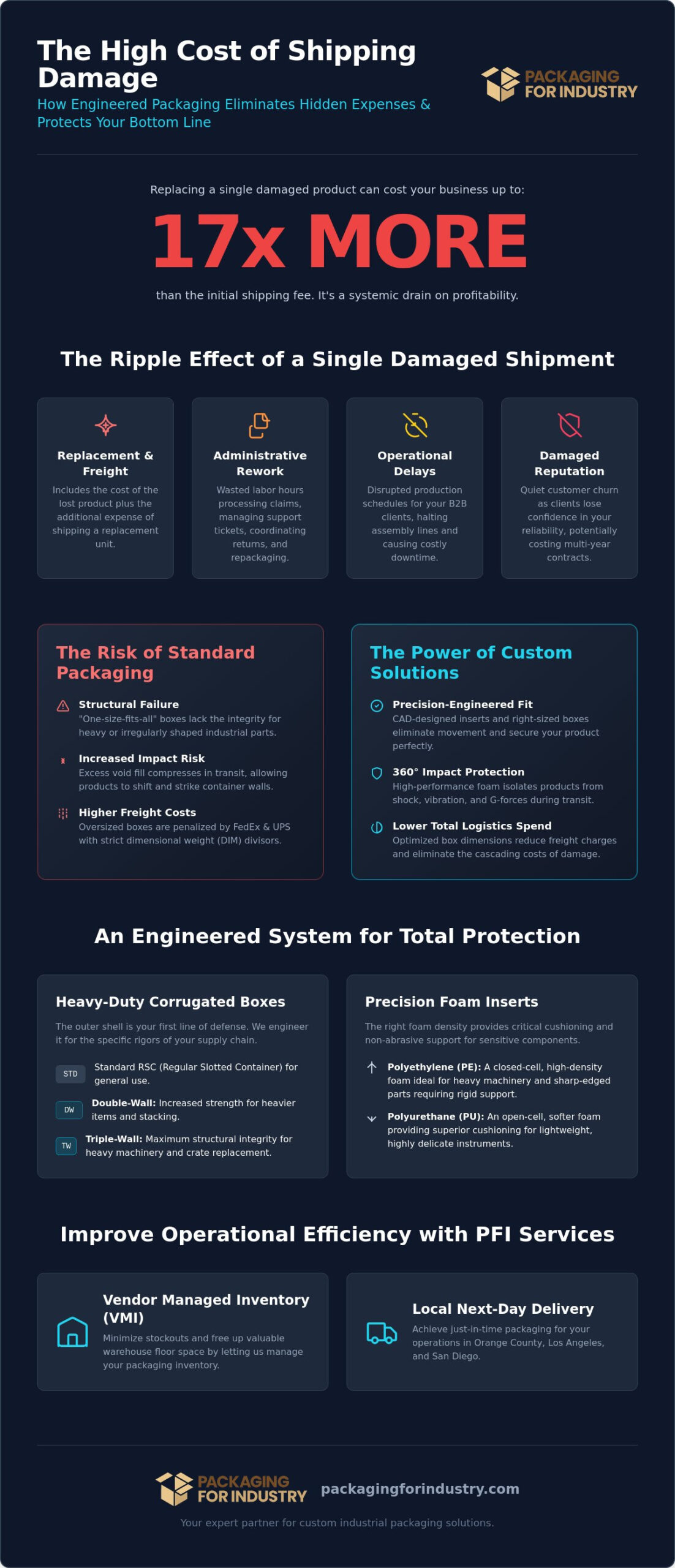
Did you know that replacing a single damaged product can cost your business up to 17 times more than the initial shipping fee? For manufacturers in high-stakes sectors like aerospace and electronics, a single cracked housing or failed component doesn’t just mean a lost sale; it triggers a cascade of replacement labor, freight claims, and a damaged reputation. You likely already realize that standard catalog boxes aren’t cutting it, especially as FedEx and UPS continue to penalize bulky, inefficient shipments with a strict 139 dimensional weight divisor.
This industrial guide demonstrates how custom packaging reduces product damage costs by aligning protective engineering with your specific logistics profile. We’ll show you how to eliminate the financial drain of shipping damage while optimizing your total logistics spend. We’ll explore technical strategies like right-sizing corrugated boxes and implementing precision CAD-cut foam inserts. You’ll also learn how local next-day delivery and Vendor Managed Inventory (VMI) help our partners in Orange County, Los Angeles, and San Diego achieve lower damage-per-shipment rates and more efficient warehouse operations without the overhead of excess stock.
Key Takeaways
- Identify the hidden financial drains of shipping damage, including replacement freight, administrative rework, and quiet customer churn.
- Discover how custom packaging reduces product damage costs through 360-degree protection using high-performance polyethylene and polyurethane foam inserts.
- Eliminate unnecessary freight expenses by right-sizing your corrugated boxes to align with the 2026 dimensional weight standards used by major carriers.
- Improve operational efficiency with Vendor Managed Inventory (VMI) and local next-day delivery to minimize stockouts and free up valuable warehouse floor space.
- Utilize free prototyping and technical CAD/CAM engineering support to validate your packaging design for a perfect fit before moving to bulk production.
Analyzing the True Cost of Product Damage in Industrial Shipping
Industrial shipping damage is rarely a simple line-item expense. It’s a systemic drain on your operational efficiency and profitability. When a shipment fails, the financial impact extends far beyond the physical value of the item. To understand how custom packaging reduces product damage costs, we must first define the “Total Cost of Damage.” This figure encompasses the cost of the lost product, replacement freight charges, and the extensive administrative rework required to process claims and satisfy frustrated buyers.
Beyond these direct expenses lie “hidden” costs that erode your bottom line over time. Quiet customer churn is a significant risk for distributors and manufacturers. If a medical device or a precision-machined part arrives compromised, the client doesn’t just ask for a refund; they often lose confidence in your reliability as a supplier. In high-stakes B2B relationships, a single failure can lead to the loss of a multi-year contract, making the price of a standard box look incredibly expensive in hindsight.
At PFI, we take a “fixer” approach to these logistical failures. Instead of simply selling you more supplies, we help you audit your current damage rates to identify specific engineering gaps. This process reveals whether your losses stem from material fatigue, improper box sizing, or inadequate internal support.
The Ripple Effect of a Single Damaged Shipment
Every damaged unit triggers a cascade of wasted labor hours. Your team must manage support tickets, coordinate returns, and repackage replacements instead of focusing on new orders. This administrative overhead directly impacts your margins. For sensitive industries, the damage isn’t always obvious. Constant transit vibration can cause micro-fractures in sensitive electronics or solder joint failures that only manifest after the product is installed. Utilizing professional Package cushioning is the only reliable way to mitigate these high-frequency shocks that standard shipping methods ignore. Shipping damage also disrupts production schedules for B2B clients in sectors like aerospace, where a delayed or broken component can halt an entire assembly line.
Why ‘Off-the-Shelf’ is Often a Financial Risk
Standard catalog boxes are designed for the average shipment, not for heavy industrial parts or irregularly shaped components. Relying on “one-size-fits-all” corrugated boxes for heavy or irregularly shaped parts is a gamble that often results in structural failure. When you use boxes that don’t fit your product precisely, you’re forced to use excess void fill. This actually increases movement and impact risk during LTL transit because loose fill compresses under weight, allowing the product to shift and strike the container walls.
Choosing the right material grade is essential for durability. Our specialized industrial corrugated boxes offer options like double-wall and triple-wall construction to provide the structural integrity required for heavy-duty applications. By moving away from generic catalog options, you ensure your packaging is engineered for the specific rigors of your supply chain.
Engineering Custom Protection: Foam Inserts and Heavy-Duty Corrugated
Understanding how custom packaging reduces product damage costs requires a shift from viewing boxes as simple containers to viewing them as engineered protection systems. While a standard RSC (Regular Slotted Container) is the industry workhorse for many distributors, its protective capacity is ultimately defined by the internal engineering. A basic box provides a barrier against dust, but it offers zero defense against the G-forces experienced during a drop or the constant vibration of a long-haul truck. Custom-engineered protection solves this by creating a controlled environment for the product, utilizing 360-degree impact protection to ensure internal components remain isolated from external forces regardless of package orientation.
Material selection is the foundation of this strategy, and we compare densities based on the weight and fragility of your specific industrial component. Polyethylene (PE) is a closed-cell, high-density foam ideal for heavy machinery or sharp-edged parts that require rigid, non-abrasive support. In contrast, Polyurethane (PU) is an open-cell, softer foam that provides superior cushioning for lightweight, highly delicate instruments. For businesses shipping high volumes of smaller components, custom partitions and dividers are essential to prevent part-on-part damage, which is a leading cause of finish scratches and structural fatigue in bulk industrial orders.
When the product weight exceeds the limits of standard fiberboard, we move to double-wall or triple-wall corrugated solutions. These heavy-duty materials provide the structural integrity required for warehouse stacking and the puncture resistance necessary for LTL (Less-Than-Truckload) shipping. If you aren’t sure which material grade fits your specific application, you can request a packaging quote to have our team evaluate your load requirements and transit profile.
The Science of Shock Absorption
We use CAD/CAM technology to design precision foam end caps that suspend your product in the center of the container. This “suspension packaging” ensures the product never makes contact with the outer walls, even if the corrugated exterior is crushed during handling. For the electronics and semiconductor sectors, we implement ESD (Anti-Static) foam to prevent electrostatic discharge from compromising sensitive circuits. You can explore our various custom foam packaging options to see how these specialized inserts protect high-value assets from both physical and electrical damage.
Integrated Material Solutions
The most effective damage reduction strategies often combine multiple materials into a single system. For international transit, we integrate foam inserts with heavy-duty corrugated and custom crates to provide maximum durability against rough handling. We also utilize weather-resistant corrugated coatings to protect against humidity and moisture damage during sea freight. To stabilize palletized loads, we incorporate corner and edge protection. These additions prevent the vertical compression and strap-cutting that often occur when pallets are double-stacked in a crowded trailer.
Right-Sizing Strategies to Lower Freight and Damage Costs
Right-sizing is often viewed as a space-saving tactic, but in the current logistics environment, it’s a critical financial strategy. As of 2026, all major carriers including FedEx, UPS, and the USPS utilize a dimensional weight (DIM) divisor of 139. If your packaging is larger than necessary, you aren’t just paying for the weight of your product; you’re paying for the volume of the box. Oversized stock boxes leak revenue every month through these surcharges, effectively forcing you to pay for “the cost of air.”
Beyond freight surcharges, oversized packaging is a primary driver of transit failure. When a product has room to move within its container, it gains momentum during handling. This kinetic energy is what leads to crushed corners and internal structural failures. This is precisely how custom packaging reduces product damage costs; by eliminating the internal void, you remove the possibility of product shifting. Eliminating the need for excessive dunnage like air pillows or foam peanuts also reduces your ongoing operational expenses and minimizes your environmental footprint by cutting material waste.
Optimizing the Pallet Footprint
In the world of industrial shipping, the pallet is the unit of measure. Custom box dimensions allow you to maximize every square inch of a standard 48×40 pallet. When boxes are engineered to fit perfectly, they create a unified, stable block that is far more resistant to the vibrations of LTL (Less-Than-Truckload) transit. This stability prevents the “pyramid stacking” or pallet overhang that often leads to crushed bottom layers. Once your boxes are right-sized for the pallet, securing them with high-performance stretch film solutions ensures the load remains intact from your warehouse in Orange County to its final destination across the country.
Case Study: Custom vs. Stock Box ROI
Many procurement managers hesitate at the unit price of a custom box compared to a mass-produced stock box. However, the true ROI is found in the total landed cost. A “cheap” stock box often requires three times the labor to assemble and fill with dunnage, plus it carries a higher statistical probability of damage claims. In contrast, custom die-cut boxes eliminate the need for excessive tape and dunnage, streamlining the pack-out process on your production line. When you factor in the 17x replacement cost of a single damaged unit, the engineered solution pays for itself almost immediately. To see the specific math for your operation, we encourage you to request a packaging audit. Our team can help you identify exactly where stock packaging is failing your bottom line.
Operational Efficiency via VMI and Packaging Kitting
Operational efficiency is the often overlooked link in a comprehensive damage reduction strategy. Many industrial facilities experience high damage rates simply because they run out of their engineered custom boxes and are forced to use generic alternatives from a local hardware store or a national catalog. This “emergency packaging” rarely provides the necessary protection level for precision components. By understanding how custom packaging reduces product damage costs through consistent availability, you can stabilize your entire supply chain and eliminate the risk of ad-hoc shipping decisions.
To achieve this stability, we recommend a five-step approach to packaging management:
- Step 1: Implement Vendor Managed Inventory (VMI) to eliminate stockouts of critical protective materials.
- Step 2: Use Just-in-Time (JIT) delivery to free up expensive warehouse floor space in high-rent Southern California industrial hubs.
- Step 3: Utilize packaging kitting, such as pre-assembled boxes with foam inserts, to reduce assembly labor and errors.
- Step 4: Consolidate your packaging vendors to simplify procurement and leverage bulk pricing across your entire SKU list.
- Step 5: Schedule recurring packaging reviews to ensure your custom designs adapt as your product lines evolve.
Consolidating these steps allows your operations team to focus on production rather than managing corrugated inventory. If you are ready to streamline your process, you can request a packaging quote to begin an efficiency audit of your current workflow.
The VMI Advantage for Southern California Manufacturers
For manufacturers in Orange County and LA, floor space is at a premium. Storing months of bulky corrugated inventory is a poor use of capital. Our Vendor Managed Inventory services provide local next-day delivery that keeps your production lines moving without the clutter. This model reduces the “hidden cost” of emergency rush orders from national catalog suppliers, which often carry exorbitant freight fees and lack the specialized protection your products require. We act as your local warehouse, ensuring your custom-engineered protection is always staged and ready for pack-out.
Kitting and Labor Reduction
Labor is one of the highest expenses in any fulfillment or manufacturing operation. Packaging kitting significantly lowers this cost by delivering components in a ready-to-use format. When your team in San Bernardino or Riverside receives boxes with pre-inserted foam, they save valuable minutes on every package. This efficiency scales quickly; saving just 60 seconds per unit across a shipment of 5,000 parts results in over 80 hours of reclaimed labor. Our packaging kitting services simplify the pack-out process, making it nearly impossible for warehouse staff to skip critical protective steps. This consistency is a primary reason why custom-engineered kits are more reliable than loose dunnage.
Why Choose PFI for Your Damage Reduction Strategy?
Selecting the right partner is the final step in securing your supply chain against the financial drain of transit failures. As a specialized custom box manufacturer, PFI goes beyond simply filling orders for supplies. We act as an industrial consultant and a proactive fixer for your most persistent logistical headaches. We understand that how custom packaging reduces product damage costs is a matter of both engineering precision and economic strategy. Our team focuses on identifying the specific failure points in your current shipping cycle and providing a tailored system that prioritizes both durability and fiscal responsibility.
To eliminate the uncertainty of transitioning to a new design, we offer free prototyping for all custom industrial projects. This allows your team to validate the fit and structural integrity of our corrugated and foam solutions before you commit to a full production run. By testing a physical sample with your actual product, you ensure that the final solution meets your internal quality standards and carrier requirements. This risk-mitigation step is essential for complex components where even a minor design flaw can lead to catastrophic failure during LTL transit.
Our local Southern California presence provides a significant advantage for facilities in Anaheim, Los Angeles, and San Diego. Being a local custom box manufacturer allows us to offer faster response times and lower lead times than national catalog distributors. Our local next-day delivery ensures your production lines remain operational without the need to store months of bulky inventory on your own warehouse floor.
Custom Engineering for Specialized Industries
We bring technical expertise to sectors where the cost of a single damaged shipment can reach tens of thousands of dollars. For defense contractors and electronics firms, we provide specialized Mil-Spec packaging and ESD-safe materials that meet rigorous regulatory standards. We also understand the unique cleanliness and precision requirements of the medical device and semiconductor industries. You can explore our dedicated aerospace packaging solutions to see how we manage the high-stakes protection requirements of the aviation and defense sectors.
A Partnership for Long-Term Savings
Our goal is to move your operation away from a reactive “buying boxes” mindset toward managing a comprehensive protection system. We provide the oversight necessary to prevent the shortages and last-minute packaging compromises that often lead to shipping damage. Through scheduled inventory reviews and a focus on end-to-end accountability, we help you maintain a steady, reliable flow of protective materials. If you are ready to stop the revenue leak caused by ineffective shipping containers, request your custom packaging quote and cost-reduction audit today. Our team is ready to help you build a more durable and cost-effective shipping operation.
Optimizing Your Supply Chain for Zero-Damage Logistics
Transitioning from generic catalog supplies to custom-engineered protection is a strategic move that pays dividends in both freight savings and reduced return rates. This guide has demonstrated how custom packaging reduces product damage costs by suspending fragile components in precision-cut foam and right-sizing corrugated containers to eliminate the “cost of air.” By focusing on the intersection of engineering and economics, your business can stop paying for carrier surcharges and start investing in long-term reliability.
PFI provides the technical CAD/CAM support and free prototyping required to validate your industrial designs before a full production run. Our local next-day delivery throughout Southern California ensures that your aerospace, medical, or Mil-Spec packaging is always available when your production line needs it. We’re ready to help you eliminate the professional stress of shipping failures while reclaiming valuable warehouse floor space.
Request a Custom Packaging Quote and Cost-Reduction Analysis today to begin optimizing your logistics spend. Our team is standing by to help you build a more durable and profitable shipping operation.
Frequently Asked Questions
How much can I realistically save by switching to custom-sized boxes?
As an experienced custom box manufacturer, PFI focuses on reducing your total landed cost rather than just the price per unit. You’ll save by eliminating the financial drain of shipping damage and avoiding the labor hours previously spent on administrative rework. Most industrial clients find that the reduction in freight surcharges and shipping damage provides an immediate ROI compared to using generic catalog boxes.
Will reducing packaging materials increase my product damage rates?
No, reducing material volume won’t increase damage if you use engineered protection. Custom-sized boxes stop product shifting, which is the primary cause of transit failure. By using precision CAD-designed foam inserts, we provide 360-degree protection using fewer overall materials than traditional methods like loose-fill peanuts. This strategic reduction actually stabilizes the load and prevents the internal momentum that leads to crushed corners.
How do I find a packaging supplier near me that can handle specialized industrial needs?
To find a reliable packaging supplier near me in Southern California, look for a partner that understands how custom packaging reduces product damage costs through technical engineering. PFI serves Los Angeles, Orange County, and San Diego with local next-day delivery and CAD/CAM expertise. Choosing a local partner reduces lead times and eliminates the high freight costs associated with shipping empty boxes from national distributors.
Can a custom box manufacturer help me avoid UPS and FedEx dimensional weight surcharges?
Yes, a specialized custom box manufacturer is the best resource for avoiding DIM weight penalties. Since major carriers use a strict 139 divisor, any excess air in your package results in higher shipping fees. We engineer your containers to the exact dimensions of your product, ensuring you’re billed for actual weight rather than the volume of an oversized stock box.
What factors influence bulk packaging pricing for industrial orders?
Bulk packaging pricing is influenced by material grade, order volume, and the complexity of the internal protection. We leverage our high-volume production to offer competitive rates on everything from RSC corrugated boxes to custom-cut polyethylene foam inserts. Investing in the right material grade lowers the long-term cost of damage, providing a better ROI than cheap, inadequate stock options.
How does Vendor Managed Inventory (VMI) reduce my operational costs?
VMI reduces your costs by shifting inventory management and storage responsibilities to us. This model prevents the “hidden cost” of emergency rush orders when you run out of critical protective materials. It also frees up expensive warehouse floor space in areas like Irvine or Anaheim, allowing you to use that square footage for production rather than storing bulky corrugated inventory.
Is custom foam always more expensive than bubble wrap or peanuts?
Custom foam is often more cost-effective when you factor in pack-out labor and damage reduction. While the initial material cost might be higher than bubble wrap, a pre-cut foam insert installs in seconds and provides repeatable protection. This saves significant labor hours on the production line and eliminates the variability that often leads to shipping damage when using loose-fill materials.
Does PFI provide local delivery for bulk orders in Southern California?
We offer local next-day delivery throughout the Southern California region, including San Bernardino and Riverside. Our dedicated fleet ensures your bulk orders arrive exactly when needed to support your just-in-time production schedules. This local service is a cornerstone of our reliability, helping you avoid the stockouts and shipping delays common with national catalog vendors.