
In the high-stakes industrial landscape of the Pacific Southwest, corner protection is a calculated engineering strategy to minimize fiscal loss rather than just a simple packing material. You likely understand that even a minor dent on a finished edge can lead to a total product rejection, costly returns, and strained client relationships. These operational failures often stem from inconsistent material quality or the long lead times associated with out-of-state suppliers, especially as global foam prices saw double-digit hikes in April 2026.
By integrating high-density foam corner protectors Southern California manufacturers can effectively eliminate transit damage while stabilizing their supply chain against market volatility. This article outlines how precision-engineered polyethylene foam secures your shipments and reduces procurement costs through smarter material selection. We’ll also explore how transitioning to a local supplier allows for reliable, next-day delivery across Orange County and Los Angeles, ensuring your operations remain lean and your shipping cycles reach a zero-damage standard.
Key Takeaways
- Identify the technical differences between Polyethylene and Polyurethane foam to ensure your material density matches your product’s specific fragility and weight requirements.
- Minimize fiscal loss from transit damage by implementing high-density foam corner protectors Southern California manufacturers use to secure vulnerable edges during LTL shipping.
- Evaluate the cost-benefit ratio of utilizing stock protectors versus custom-engineered CNC-cut foam solutions for specialized aerospace or medical applications.
- Streamline your local supply chain by leveraging next-day delivery and just-in-time inventory services available throughout Los Angeles and Orange County.
The Role of Foam Corner Protectors in Industrial Logistics
Foam corner protectors are precision-engineered components designed to mitigate the physical risks inherent in heavy-duty logistics. Unlike light-duty consumer alternatives, these industrial cushions use high-density polyethylene or polyurethane to absorb and dissipate kinetic energy at a crate’s most vulnerable points. In the rigorous environment of Southern California freight hubs, the demand for reliable stabilization is constant. Standard cardboard edge guards often fail when protecting high-value machinery because they lack the resilience to survive repeated impacts. While cardboard provides structural rigidity, it collapses under a single significant strike; foam recovers and continues to protect.
Southern California serves as a primary gateway for international trade, with freight moving constantly between the Port of Long Beach and the Inland Empire. This regional transit often involves multiple “touches” in LTL (Less-than-Truckload) shipping cycles. Every time a pallet is moved by a forklift or reloaded at a terminal, the risk of a corner strike increases. High-density foam corner protectors Southern California manufacturers utilize act as a critical buffer, ensuring that the structural integrity of the packaging remains intact even when subjected to the vibrations and shifts common in regional freight transport.
Impact Absorption and Surface Protection
Industrial shipping involves complex physical stressors. When a pallet is dropped or shifts abruptly during transit, the resulting force is concentrated on the edges. High-quality foam corner protectors Southern California distributors provide are designed to distribute this G-force across a wider surface area. This prevents the energy from reaching the product itself. This protection is critical for sectors like aerospace and medical manufacturing where even microscopic marring of a finish can lead to a non-conformance report. Understanding the mechanics of package cushioning materials helps operations managers choose the correct density to balance soft cushioning with rigid structural stabilization.
The Economics of Damage Prevention
The true cost of transit damage extends far beyond the price of a replacement part. It includes the administrative labor of processing returns, the freight costs of reverse logistics, and the potential loss of future contracts due to a tarnished brand reputation. Smart procurement officers view packaging as an investment in risk management. By calculating the ROI of high-performance corner protection against the cost of a single damaged shipment, the fiscal choice becomes clear. Reducing insurance claims through verified protective standards isn’t just about safety; it’s about maintaining a predictable, profitable supply chain. Using professional-grade materials signals to your clients that you prioritize quality throughout the entire lifecycle of the product.
Selecting the Right Foam Material: PE vs. PU vs. PP
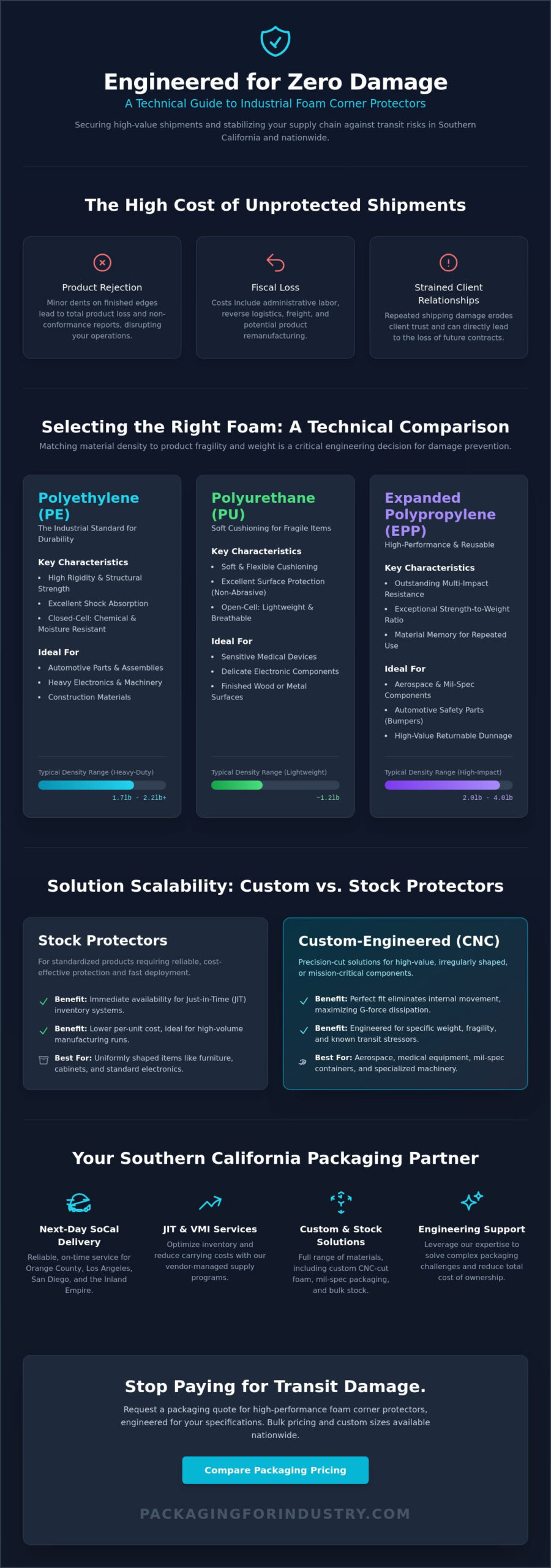
Selecting the correct material for your packaging is a technical decision that directly impacts your operational bottom line. While many suppliers offer generic cushioning, industrial applications require a specific match between material density and product weight. Polyethylene (PE) foam serves as the industry standard for durability due to its closed-cell structure, which provides superior moisture resistance and structural rigidity. In contrast, Polyurethane (PU) is an open-cell foam that offers a softer touch for highly fragile, lightweight items. For extreme environments, Expanded Polypropylene (EPP) provides high-performance, multi-impact protection for heavy loads that must endure significant stress without material fatigue.
Density is a critical specification in this selection process. A 1.7lb density foam is common for general cushioning, but a 2.2lb density is often necessary for heavy machinery or sharp-edged components. If the density is too low, the product will “bottom out” during an impact, rendering the protection useless. When sourcing foam corner protectors Southern California distributors provide, engineers must specify the required density to ensure the material can withstand the specific weight of the cargo. If you need to compare packaging pricing for different material grades, starting with a clear density requirement prevents costly over-engineering.
Polyethylene (PE) for Heavy Industrial Use
PE foam is the preferred choice for automotive parts, construction materials, and heavy electronics. Its closed-cell nature makes it resistant to chemicals, mold, and rot, ensuring that it doesn’t degrade during long-term storage or sea freight. Polyethylene foam maintains its structural memory through multiple compression cycles in long-haul transit. This resilience makes it the primary material for the foam corner protectors Southern California manufacturers rely on to secure heavy pallets during multi-stop shipping cycles. It provides a reliable barrier against environmental factors while maintaining the spacing necessary to prevent product-to-product contact.
ESD Foam for Electronics and Medical Devices
For the aerospace and medical device sectors in the Los Angeles and Orange County tech corridors, anti-static (ESD) foam is a regulatory necessity. This specialized foam packaging is treated with antistatic agents to prevent electrostatic discharge from damaging sensitive circuit boards. In a busy warehouse environment, this material is easily identified by its distinct pink color coding. Using compliant ESD materials ensures you meet strict industry standards and avoid the catastrophic failure of high-value electronic shipments. It’s a proactive step that protects both the product and your reputation for reliability.
Custom Engineered vs. Stock Corner Protectors
Deciding between stock and custom corner protection is a matter of balancing immediate availability with long-term shipping efficiency. Stock corner protectors are ideal for standard corrugated boxes where the product dimensions align with common industry sizes. These off-the-shelf components provide a cost-effective solution for rapid fulfillment. However, high-value or irregularly shaped items often require a more sophisticated approach. Custom-engineered foam corner protectors Southern California manufacturers utilize are often CNC-cut or custom-molded to match the exact geometry of a product. This precision is vital for box-within-a-box strategies, where maintaining a consistent buffer zone between the inner and outer containers is the only way to prevent impact damage during heavy-duty transit.
Our engineering process begins with a technical assessment of your product’s weight distribution and fragility. We use CNC technology to create precise foam packaging inserts that lock the product into place. To ensure total reliability, we provide prototyping services that allow you to verify the fit and performance of the design before committing to high-volume production runs. This consultative approach eliminates the guesswork from your procurement process and ensures your packaging meets the specific demands of your supply chain.
Optimizing Box Space with Custom Foam
Reducing the overall carton dimensions is one of the fastest ways to lower dimensional weight (DIM) costs. Custom foam corners eliminate the need for excessive void fill, allowing you to use the smallest possible outer box without sacrificing protection. This is particularly effective for oversized aerospace components or heavy medical equipment. By using a “fit-to-product” design, you reduce material waste and optimize pallet density. These marginal gains in shipping efficiency accumulate into significant operational savings over high-volume fulfillment cycles. If you’re looking to refine your current designs, you can request a packaging quote for custom-sized inserts tailored to your specific SKUs.
Stock Solutions for Rapid Fulfillment
For businesses in Anaheim or Los Angeles, having access to local stock is a logistical advantage. We maintain an extensive inventory of common sizes available for immediate dispatch. Standard shapes like 3-way corners and edge channels provide versatile protection for furniture, cabinetry, and industrial panels. Bulk procurement strategies for high-volume distribution centers often rely on these stock corner and edge protection materials to maintain steady operations. This ensures your packing lines never stop due to lead time delays from out-of-state suppliers. Whether you require a single pallet of standard protectors or a custom-engineered solution, we provide the logistical support needed to keep your Southern California facility running at peak efficiency.
Logistics and Procurement in Southern California
Operating within the Southern California industrial corridor requires a logistics partner that understands the specific pressures of the Long Beach to Inland Empire freight route. High-volume manufacturers often face the dual challenge of limited warehouse space and the need for immediate supply availability. Sourcing foam corner protectors Southern California facilities require shouldn’t involve waiting for cross-country shipments that are prone to weather delays or rail congestion. By partnering with a local supplier, you gain the agility to adjust your inventory levels based on real-time production demands rather than speculative forecasting.
Vendor Managed Inventory (VMI) and Just-in-Time (JIT) delivery models are essential for optimizing your operational footprint. With industrial real estate costs in Orange County and Los Angeles remaining high, dedicating large areas to bulk packaging storage is often an inefficient use of capital. We provide stocking programs that ensure you never run out of critical corner and edge protection materials. This approach reduces your on-site overhead while maintaining the security of your supply chain. It’s a pragmatic way to keep your production lines moving without the burden of excess inventory.
Regional Delivery and Lead Times
Local procurement offers a distinct advantage in both speed and cost. While national distributors often pass on significant freight surcharges, a Southern California based supplier can provide next-day delivery to Anaheim, Irvine, and San Diego. This proximity doesn’t just lower shipping costs; it also reduces the carbon footprint of your procurement cycle. Short-haul deliveries minimize the logistical complexity of your operations, allowing you to focus on production rather than tracking distant shipments. When your supply chain is local, your lead times are measured in hours, not weeks.
Specialized Sector Requirements: Aerospace and Medical
Precision industries like the aerospace hub in El Segundo and medical device firms in Irvine have zero tolerance for non-compliance. These sectors require materials that meet strict quality control standards and, in many cases, military-spec (mil-spec) packaging requirements. We understand the documentation and material specifications necessary for defense contractors and specialized manufacturers. This includes the use of anti-static foam packaging for sensitive electronic components. If you need to verify compliance for your specific industry, you can request a packaging quote to discuss your technical requirements with our engineering team.
Why PFI is Your Southern California Packaging Partner
PFI operates as a strategic extension of your manufacturing and operations team. Based in Anaheim, our facility provides the specialized engineering and production capabilities required for high-stakes industrial logistics throughout the Pacific Southwest. We don’t just sell materials. We design protective systems that lower your total cost of ownership. This fiscal optimization is achieved by balancing the cost of foam corner protectors Southern California businesses procure with the long-term savings of zero-damage shipping cycles and maximized pallet density. By reducing the volume of returns and repairs, your bottom line remains protected alongside your products.
Our expertise in complex industrial logistics allows us to address the specific needs of the Southern California market directly. We understand that a delay at the Port of Long Beach or a missed delivery in the Inland Empire can disrupt an entire production schedule. Because we maintain our own production and warehousing in Anaheim, we offer a level of responsiveness that national distributors can’t match. Our inventory includes a comprehensive range of stock foam, heavy-duty corrugated boxes, and stretch film, allowing you to source your entire protective kit from a single, reliable partner. This consolidated approach simplifies procurement and ensures material consistency across every order.
From Prototype to Production
The PFI design process is built on technical precision and real-world testing. We move from initial concept to physical prototyping quickly, ensuring that every insert or corner guard fits your specific SKU perfectly. For qualified industrial projects, we offer free prototyping to verify performance before you commit to bulk packaging pricing. This rigorous approach is why we’re a preferred supplier for custom foam packaging in the aerospace, medical, and electronics sectors. We analyze the G-force requirements and surface sensitivities of your components to select the ideal material density before the first production run begins.
Streamlining Your Supply Chain
Reliability is the foundation of a successful logistical partnership. PFI integrates directly with your existing operations through Vendor Managed Inventory (VMI) and Just-in-Time (JIT) delivery. This ensures your warehouse in Los Angeles or Orange County remains lean while maintaining a constant supply of corner and edge protection. We handle the logistical heavy lifting so your team can focus on manufacturing excellence. Our goal is to eliminate the professional stress caused by out-of-stock events and inconsistent material quality. Request an industrial packaging quote today to begin optimizing your protective strategy and supply chain reliability.
Secure Your Supply Chain with Precision Engineering
Optimizing your packaging strategy is a direct investment in your company’s operational reliability. By selecting the correct material density and leveraging custom-engineered designs, you reduce the fiscal impact of transit damage while lowering dimensional weight costs. Transitioning to a local procurement model allows you to maintain a leaner inventory through just-in-time delivery. This ensures your facility in Los Angeles or Orange County never faces production stoppages due to supply shortages or inconsistent material quality. Implementing high-performance foam corner protectors Southern California manufacturers trust is the most effective way to achieve a zero-damage shipping cycle.
PFI provides Anaheim-based engineering and production to solve your most complex logistical challenges. We offer free prototyping for custom designs and reliable local next-day delivery to keep your operations moving at peak efficiency. Our team is ready to help you refine your protective standards and lower your total cost of ownership through smarter material selection. Request a custom foam corner protector quote for your Southern California facility to stabilize your logistics and secure your high-value cargo. We look forward to engineering a solution that meets your specific industrial requirements.
Frequently Asked Questions
What is the difference between polyethylene and polyurethane foam corner protectors?
Polyethylene (PE) is a closed-cell foam providing structural rigidity and moisture resistance; polyurethane (PU) is an open-cell foam designed for soft cushioning. PE is generally preferred for heavy industrial parts because it doesn’t bottom out under weight. PU is better suited for lightweight, highly fragile items like glassware or sensitive instruments. Choosing between them depends on your product’s fragility and the total weight the corner must support during transit.
Can foam corner protectors be reused for multiple shipping cycles?
Yes, high-density PE foam is specifically designed for multi-impact resilience and can be reused across several shipping cycles. Unlike cardboard or polystyrene, PE foam maintains its structural memory after compression. This durability makes it an excellent choice for closed-loop logistics or internal transfers between manufacturing facilities. Reusing these protectors helps lower your total packaging spend while maintaining a high standard of edge protection for your cargo.
Do you provide custom-sized foam corner protectors for oversized equipment?
We provide custom-engineered foam solutions tailored to the exact dimensions of your oversized or irregularly shaped machinery. Our Anaheim facility utilizes CNC cutting to create precise fits that standard stock sizes can’t achieve. This eliminates the need for excessive void fill and ensures that heavy equipment remains stabilized within its crate. You can request a packaging quote for custom prototypes to verify the fit before full production.
How do I choose the right foam density for my product’s weight?
Foam density is selected by calculating the weight-per-square-inch load your product places on the cushioning material. A 1.7lb density is standard for many applications, but heavier industrial SKUs often require 2.2lb density to prevent the foam from fully compressing. If the foam bottoms out, the impact energy is transferred directly to your product. Our engineering team helps you compare packaging pricing for different densities to find the most cost-effective protection level.
What are the benefits of sourcing packaging supplies locally in Southern California?
Sourcing foam corner protectors Southern California facilities need from a local supplier reduces lead times and eliminates high cross-country freight surcharges. Local procurement allows for Vendor Managed Inventory (VMI) and just-in-time delivery, which frees up valuable warehouse space in high-cost areas like Orange County. Working with an Anaheim-based partner also means you can access rapid prototyping and face-to-face engineering support to resolve shipping damage issues quickly.
Are your foam corner protectors compliant with ESD standards for electronics?
We offer specialized anti-static (ESD) foam corner protectors designed specifically for sensitive electronics and medical devices. These protectors are typically color-coded pink for easy identification in your warehouse and are treated to dissipate static charges. This is a critical requirement for tech manufacturers in the Irvine and El Segundo corridors to prevent latent component failure. Using ESD-compliant materials ensures your shipments meet strict industry quality standards and regulatory requirements.
Do you offer next-day delivery for businesses in Orange County and Los Angeles?
We provide reliable next-day delivery for stock packaging materials to businesses located throughout Orange County and Los Angeles. Our central location in Anaheim allows us to integrate seamlessly with your daily operations and respond to urgent inventory needs. This proximity supports a lean supply chain by reducing the amount of safety stock you need to hold on-site. Whether you need bulk packaging pricing or a single pallet, we prioritize rapid regional fulfillment.
Can foam corner protectors help reduce my overall shipping insurance premiums?
Using verified protective packaging standards significantly reduces the frequency of damage claims, which helps maintain lower shipping risks. Consistently delivering products in perfect condition improves your standing with freight carriers and can lead to more favorable terms over time. Professional-grade foam protection demonstrates a commitment to risk management that helps stabilize your logistical costs. Reducing the administrative burden of processing returns is a direct way to improve your operational bottom line.