
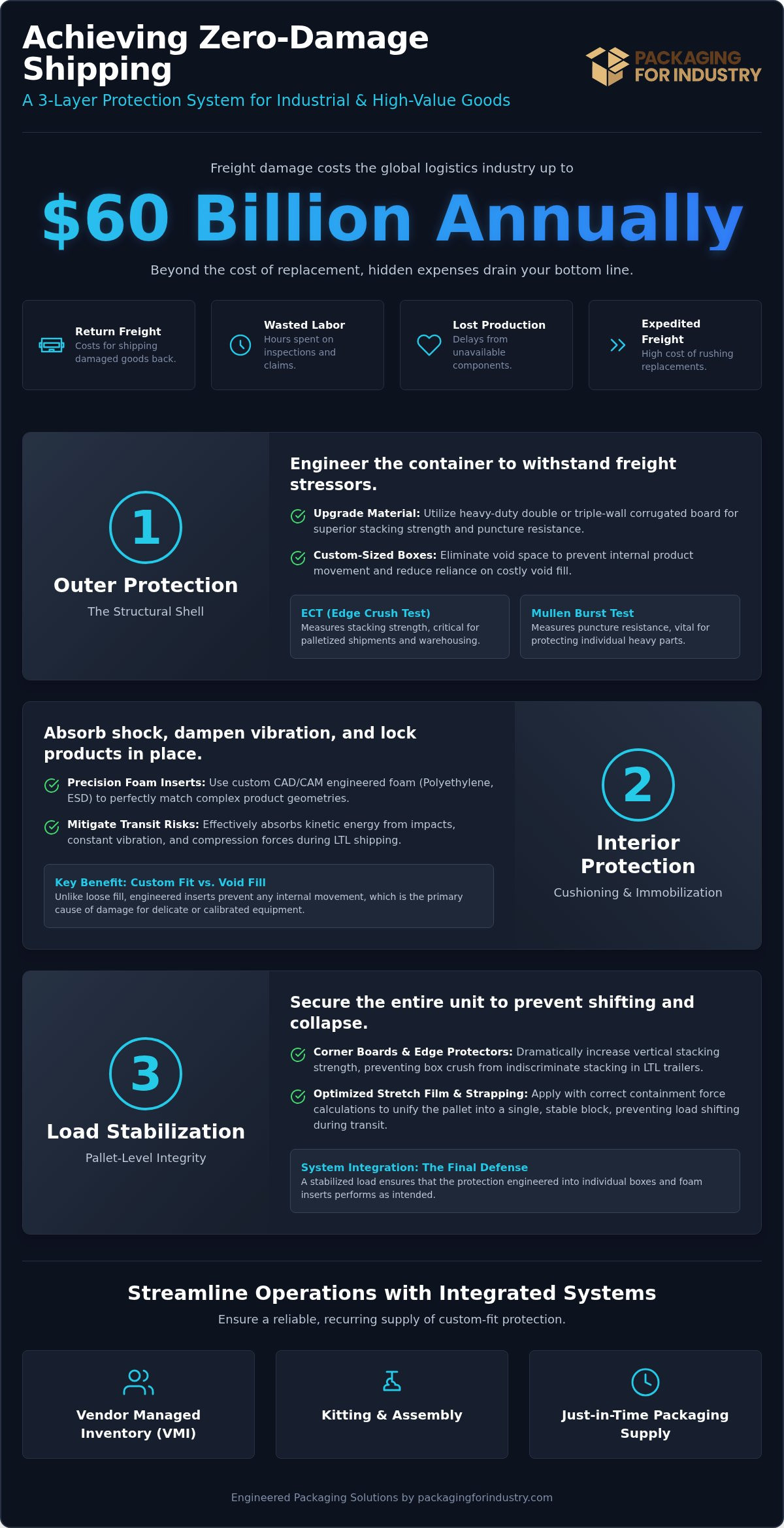
Did you know that freight damage costs the global logistics industry up to $60 billion every year? For manufacturers in specialized sectors like aerospace and medical devices, even a single broken component can trigger a cascade of expensive delays and lost contracts. Implementing robust packaging solutions to prevent shipping damage isn’t just about adding more tape; it’s a precise engineering challenge. With 2026 carrier surcharges increasingly targeting non-standard or bulky parcels, your choice of protection now directly impacts both your equipment’s safety and your total logistics spend.
You’ve likely dealt with the headache of filing insurance claims or rushing replacement parts to a frustrated client. It’s an inefficient cycle that drains your bottom line and slows down your production line. This guide will teach you how to achieve zero-damage shipping cycles by utilizing engineered custom boxes, precision foam inserts, and optimized load stabilization. We’ll examine how a three-layer protection system transforms your logistics from a liability into a competitive advantage, ensuring your products arrive in factory condition while minimizing unnecessary carrier fees.
Key Takeaways
- Identify the hidden fiscal impact of transit damage, including the high cost of labor for inspections and expedited freight for replacement parts.
- Evaluate the structural requirements of your cargo to determine when to upgrade from standard RSC boxes to heavy-duty double or triple-wall corrugated shells.
- Implement precision-engineered packaging solutions to prevent shipping damage by utilizing custom CAD/CAM foam inserts designed for complex industrial geometries.
- Master pallet-level stabilization techniques using corner boards and containment force calculations to prevent box crush and load shifting.
- Streamline operations through integrated kitting and Vendor Managed Inventory (VMI) to ensure a recurring supply of custom-fit protection.
Understanding the Real Costs of Shipping Damage in 2026
Shipping damage in an industrial context is rarely the result of a single catastrophic event. It is more accurately defined as a triad of mechanical and physical stressors: impact, vibration, and environmental stress. While a dented retail box is a nuisance, a fractured aerospace casting or a misaligned medical laser is a professional crisis. Standard catalog boxes are often designed for light-duty parcel transit; they lack the structural rigidity required for the high-stress freight environments common in 2026. When these generic options fail, the financial fallout extends far beyond the replacement price of the box itself.
The true financial burden includes “hidden costs” that rarely appear on a single line item. You must account for the freight costs of returning damaged goods, the labor hours required for detailed inspections, and the cascading lost production time when critical components are unavailable. Logistical impact is the primary driver of industrial damage costs, representing the total operational disruption caused by a single transit failure. Relying on inadequate materials often leads to higher long-term logistics expenses compared to investing in engineered protection.
Common Transit Risks: Vibration, Compression, and Shock
Long-haul trucking introduces constant, low-frequency vibration that can gradually loosen precision industrial components or cause surface abrasion. In Less-Than-Truckload (LTL) shipping, compression damage is a frequent byproduct of indiscriminate stacking as carriers maximize trailer volume to offset rising fuel costs and capacity constraints. These market pressures mean your pallets are handled more frequently, increasing the risk of “last mile” shock during forklift transitions and warehouse movements. To mitigate these forces, engineers must select specialized Interior cushioning materials that absorb kinetic energy before it reaches the product.
The Environmental Factor: Humidity and Temperature
Environmental variables can be just as destructive as physical impact. High humidity levels often compromise the structural integrity of standard corrugated boxes, causing them to lose a significant portion of their stacking strength and leading to pallet collapse. For sensitive electronics, temperature fluctuations and static discharge pose invisible threats that require specialized ESD foam or sealed poly bags. Integrating weather-resistant materials and moisture barriers into your packaging solutions to prevent shipping damage ensures that your cargo remains stable regardless of the climate or transit duration. This proactive approach is essential for maintaining supply reliability in global distribution networks.
Outer Protection: Engineering the Structural Shell
The outer shell is your first line of defense. Standard RSC boxes are ubiquitous, but they often fail when supporting heavy industrial loads. A custom-sized box eliminates the void space that allows products to gain damaging momentum during transit. By right-sizing the container, you reduce the reliance on excessive void fill and lower your dimensional weight surcharges. Weight dictates design. For heavy-duty applications, double-wall or triple-wall corrugated is essential to provide the vertical stacking strength required for LTL freight. Implementing these packaging solutions to prevent shipping damage starts with a rigorous material analysis of your cargo’s weight and fragility.
Selecting the Right Corrugated Grade
Selecting the right material involves choosing between the Edge Crush Test (ECT) and the Mullen Burst Test. ECT measures the stacking strength of the board, which is critical for warehouse storage and palletized shipments. Mullen testing measures the force required to puncture the box wall, making it a better metric for individual heavy parts that might shift during handling. You can find detailed material specs on our custom corrugated boxes page. It’s also helpful to review FedEx packing guidelines to see how carrier standards influence box selection. Die-cut designs offer even greater structural rigidity for complex shapes, ensuring a precise fit that prevents internal movement. Custom-engineered packaging solutions to prevent shipping damage reduce the risk of structural failure under extreme load.
Custom Wood Crates and Heavy-Duty Skids
When cargo exceeds the weight limits of corrugated or requires high-value export protection, you should transition to custom shipping crates. Aerospace components often require zero-deflection transit to maintain calibration; this is only achievable through rigid wood construction and heavy-duty skids. These crates often feature foam-lined interiors for a multi-material protection strategy. For international logistics, all wood packaging must comply with ISPM-15 heat-treatment standards to avoid costly customs delays at the border. If you’re unsure which grade of protection your product requires, you can request a packaging quote to consult with an engineering specialist about your specific application.
Interior Protection: Custom Foam vs. Standard Void Fill
While the structural shell resists external forces, the interior system is responsible for energy absorption and deceleration. Precision-engineered protective foam packaging is the standard for high-value industrial goods. Polyethylene (PE) foam is a closed-cell material prized for its durability and moisture resistance, making it ideal for heavy machinery or sharp components. In contrast, Polyurethane (PU) is an open-cell, softer foam used for lightweight, delicate items that require gentle cushioning. For sensitive electronics, Anti-Static (ESD) foam is non-negotiable to prevent catastrophic static discharge during handling. These materials are often integrated into a “box-in-a-box” configuration, where foam end caps suspend the product in the center of the container, far outperforming loose void fill in packaging solutions to prevent shipping damage.
The Engineering of Die-Cut Foam Inserts
CAD/CAM design allows for precision-cut foam inserts that match the complex geometries of medical lasers or aerospace valves. Engineers calculate foam density based on the product’s static load and G-factor fragility. This scientific approach ensures that the cushioning doesn’t bottom out during an impact. We utilize ASTM D4169 performance testing standards to simulate the rigors of the distribution cycle, ensuring the design holds up under real-world stress. Free prototyping is a critical step in this process; it allows you to verify the fit and protection level before committing to a full production run. For versatile, lightweight protection of irregular surfaces, convoluted foam (egg crate) provides a cost-effective alternative that adapts to various product shapes without requiring custom tooling.
Void Fill Alternatives for High-Volume Shipping
For high-volume shipping where custom foam might not be feasible, selecting the right void fill is a matter of containment and cost. Paper dunnage is an excellent choice for bracing industrial parts, as it provides high compression resistance and is easily recyclable. Bubble wrap offers versatile surface protection but can fail if used to support heavy loads that pop the air cells. Packing peanuts are generally unsuitable for industrial applications because they settle during transit, leaving the product vulnerable to internal shifting. The goal is always to achieve total containment force, ensuring the item cannot move within the box once sealed. Choosing the right packaging solutions to prevent shipping damage requires matching the cushioning material to the specific weight and fragility profile of your inventory.
Load Stabilization: Preventing Damage at the Pallet Level
Even the most robust outer shell and precision foam insert can fail if the palletized unit shifts during transit. Load stabilization is the final engineering layer in comprehensive packaging solutions to prevent shipping damage. When individual containers are unitized, they must act as a single, rigid block to survive the lateral forces of long-haul trucking and the abrupt movements of LTL freight. For manufacturers in Southern California distribution hubs like Irvine or Carson, achieving this stability requires a precise balance of containment force and surface protection.
The Role of Cardboard Edge Protectors
Stretch film requires significant tension to be effective, but that same tension often leads to “box crush” on the corners of your load. High-quality corner and edge protection acts as a structural frame for the pallet. These cardboard protectors distribute the compression force of the film and strapping across the entire height of the load, preventing indentation on high-value finished products. Beyond damage prevention, corner boards significantly improve vertical stacking strength. This allows for safer warehouse optimization and higher pallet stacking without the risk of the bottom layers collapsing under the weight of the base.
Optimizing Stretch Film Application
The science of containment force is what keeps a load from sliding off its base. Selecting the right stretch film depends on your specific application and volume. Blown stretch film offers superior puncture resistance and high “cling,” making it ideal for heavy, irregular industrial loads with sharp edges. Cast film provides excellent clarity and a quieter unwind, which is often preferred for high-speed machine applications. To ensure a proper “pallet bond,” the film must be wrapped several inches below the top of the pallet base; this prevents the entire load from shifting during sudden braking or sharp turns.
For heavy industrial machinery or aerospace parts, film alone may not be sufficient. Securing these loads requires industrial-grade strapping and high-tack adhesive tapes to anchor the cargo to the pallet. Opaque stretch film can also be used to provide an extra layer of security and UV protection for goods stored in outdoor transit yards. By integrating these stabilization methods, you ensure that your engineered protection arrives exactly as it was packed, regardless of the distance traveled.
The PFI Advantage: Integrated Damage Prevention Systems
PFI provides more than individual supplies; we deliver an integrated ecosystem where every component is engineered to work in unison. Effective packaging solutions to prevent shipping damage require a holistic approach where the structural box, internal foam, and pallet stabilization are designed as a single unit. We specialize in packaging kitting, combining all necessary materials into a single, optimized shipment. This integrated strategy is a proven way to lower packaging costs by streamlining procurement and reducing the labor hours spent on assembly. Our team conducts custom packaging reviews to identify failure points in your current supply chain, helping you transition from generic catalog options to precision-engineered systems.
To ensure total supply reliability, we offer Vendor Managed Inventory (VMI). This service removes the burden of tracking stock levels, as we monitor and replenish your inventory based on actual usage. This proactive oversight prevents production line shutdowns and ensures you always have the right protective materials on hand without tying up excessive warehouse capital. By combining engineering expertise with inventory management, we provide a steady, recurring supply of protection that supports your bottom line.
Industries Served: Aerospace, Medical, and Defense
We specialize in high-value, mission-critical sectors that demand zero-deflection transit. For aerospace suppliers, we engineer mil-spec packaging that protects sensitive avionics and machined components from low-frequency vibration. In the medical device industry, our solutions ensure that delicate lasers and diagnostic equipment arrive fully calibrated and ready for clinical use. We also serve the defense, automotive, and electronics sectors, providing heavy-duty crates and ESD foam for complex assemblies. By understanding the unique regulatory and durability requirements of these specialized fields, we act as a technical consultant rather than a simple commodity supplier.
Custom Engineering and Southern California Support
Our engineering team utilizes CAD/CAM support to develop protection for the most complex industrial geometries, with custom sizes available for any production volume. We believe in verifying performance before a full rollout, which is why we provide free prototypes for your custom design packaging. This technical oversight is backed by a robust local logistics network that understands the needs of regional manufacturers.
We serve businesses in Anaheim, Irvine, and throughout Orange County and the Inland Empire. With just-in-time delivery and local next-day shipping, we keep your production moving without the lead-time delays of national catalog retailers. To analyze your damage reduction opportunities and request a packaging quote, contact our Anaheim-based team today.
Optimizing Your Industrial Supply Chain for Zero Damage
Effective damage prevention is a calculated investment in your operational stability. By integrating heavy-duty structural shells with precision-engineered foam and rigid pallet stabilization, you move beyond the limitations of standard catalog supplies. This three-layer engineering approach is essential for high-value sectors like aerospace, medical, and defense, where calibration and integrity are non-negotiable. Implementing these packaging solutions to prevent shipping damage doesn’t just protect your product; it eliminates the hidden costs of returns and production delays that erode your bottom line.
PFI supports your team with expert CAD/CAM design and free prototyping to ensure every component fits perfectly before a full rollout. We provide local next-day delivery to Anaheim, Irvine, and Los Angeles, alongside nationwide shipping capabilities to keep your logistics moving. It’s time to replace inefficient void fill with a system designed for the rigors of 2026 freight environments.
Our team is ready to analyze your current failure points and help you build a more resilient, cost-effective supply chain.
Frequently Asked Questions
What are the most effective packaging solutions to prevent shipping damage for heavy parts?
Protecting heavy industrial components requires a combination of high-strength RSC boxes and structural reinforcement. We utilize heavy-duty corrugated board reinforced with corner boards to maintain vertical stacking strength and prevent box crush during transit. For high-value defense or aerospace components, implementing packaging solutions to prevent shipping damage often involves following mil-spec packaging standards to ensure the cargo survives the extreme mechanical stressors of long-haul LTL freight environments.
How do I choose between custom foam inserts and standard bubble wrap?
The choice depends on the fragility and geometry of your product. Standard bubble wrap is suitable for basic surface protection, but it often fails under the weight of industrial parts. Custom foam inserts are engineered for energy absorption and precision fit, making them essential for high-value machinery. When integrated into a kitting process, custom foam provides repeatable protection that bubble wrap cannot match, ensuring every component remains suspended and secure.
Can custom-sized corrugated boxes really lower my shipping costs and damage rates?
Custom-sized boxes significantly lower costs by reducing the “air” in your shipments, which directly lowers dimensional weight (DIM) surcharges. Beyond freight savings, right-sizing your containers is one of the most effective packaging solutions to prevent shipping damage because it eliminates the void space where products gain momentum. A tighter fit reduces the need for excessive void fill and ensures the structural shell provides maximum resistance against external impacts.
What is the difference between double-wall and triple-wall corrugated boxes?
The difference lies in the number of fluted layers, which dictates the box’s burst strength and stacking capacity. While standard RSC boxes are often single-wall, industrial applications require double-wall or triple-wall board to support heavy loads. Triple-wall corrugated is exceptionally rigid and is frequently used as a lightweight, cost-effective alternative to wood crates for domestic shipping. It provides superior puncture resistance and can withstand the intense compression of fully loaded pallets.
How does Vendor Managed Inventory (VMI) help prevent shipping delays?
Vendor Managed Inventory (VMI) ensures your production line never stops due to a lack of protective materials. We monitor your usage of everything from RSC boxes to specialized mil-spec packaging, replenishing stock before it reaches critical lows. This service eliminates the need for emergency orders and rush shipping fees. By managing your inventory levels for you, we ensure that the right custom-fit protection is always available when your products are ready to ship.
Is custom crating necessary for domestic shipping, or only for international exports?
Custom crating is necessary for any high-value or exceptionally heavy item that requires zero-deflection protection, regardless of the destination. While international shipments must meet ISPM-15 heat-treatment standards, domestic crating protects against the frequent handling and mechanical shocks of the US freight network. Crates are often the only way to safely transport large aerospace assemblies or medical imaging equipment that cannot be reliably secured in standard corrugated containers.
How can I get a prototype for a custom foam insert before ordering in bulk?
We provide free prototyping as part of our engineering and kitting services. Our team uses CAD/CAM design to create a precise sample of your foam insert, allowing you to verify the fit and protection level with your actual product. This physical testing phase is critical for identifying potential failure points before a full-scale rollout. It ensures that your finalized packaging solutions to prevent shipping damage are optimized for both performance and material efficiency.
What local areas in Southern California does PFI provide next-day delivery to?
PFI offers local next-day delivery to manufacturers and warehouses throughout Southern California. Our primary service areas include Anaheim, Irvine, Santa Ana, and Huntington Beach in Orange County, as well as Los Angeles and Long Beach. We also provide consistent support to the Inland Empire, including Riverside and San Bernardino. This local proximity allows us to offer just-in-time replenishment, helping you reduce on-site storage needs while maintaining a reliable supply of packaging materials.