
A single non-compliant label or an unapproved moisture barrier bag can result in a rejected government contract and thousands of dollars in lost revenue. For manufacturers in Los Angeles and Orange County, the stakes of choosing the wrong partner are simply too high to ignore. You likely already know that meeting MIL-STD-2073-1E requirements is a non-negotiable part of your workflow, but compliance shouldn’t come at the expense of your profit margins. Finding the right mil-spec packaging suppliers is about more than just sourcing materials. It’s about finding a partner who understands the intersection of engineering and economics.
In this article, you’ll learn how to select a supplier that ensures 100% DoD compliance while simultaneously reducing shipping damage and operational costs. We’ll examine why custom engineering is superior to catalog-standard solutions and how stocking programs can eliminate the lead time delays that stall your deliveries. From specialized ESD foam to MIL-STD-129R marking requirements, we’ll provide the roadmap you need to streamline your logistical flow and secure your supply chain.
Key Takeaways
- Understand the critical role of MIL-STD-2073 and MIL-STD-129R in ensuring 100% contract compliance and avoiding costly shipment rejections.
- Discover how weather-resistant V3C corrugated and custom-engineered foam inserts provide maximum protection for sensitive aerospace and electronic components.
- Learn how to evaluate mil-spec packaging suppliers based on their ability to offer Vendor Managed Inventory (VMI) that lowers your total operational costs.
- Identify the logistical advantages of sourcing from a Southern California partner to secure next-day delivery and reduce regional freight expenses.
- Explore how custom-tailored packaging designs optimize package sizing to improve shipping density and eliminate wasted shipping spend.
What is Mil-Spec Packaging and Why is Supplier Selection Critical?
Mil-spec packaging refers to specialized materials and methods engineered to meet rigid Department of Defense (DoD) performance standards. Unlike commercial shipping, which focuses on short-term transit, military-grade protection must survive long-term storage in extreme tactical environments. The history of mil-spec packaging reflects a shift from simple wooden crates to sophisticated, multi-layered preservation systems designed to withstand moisture, salt spray, and high-impact drops. This level of engineering ensures that critical equipment remains functional whether it is stored in a humid jungle or a sub-zero warehouse.
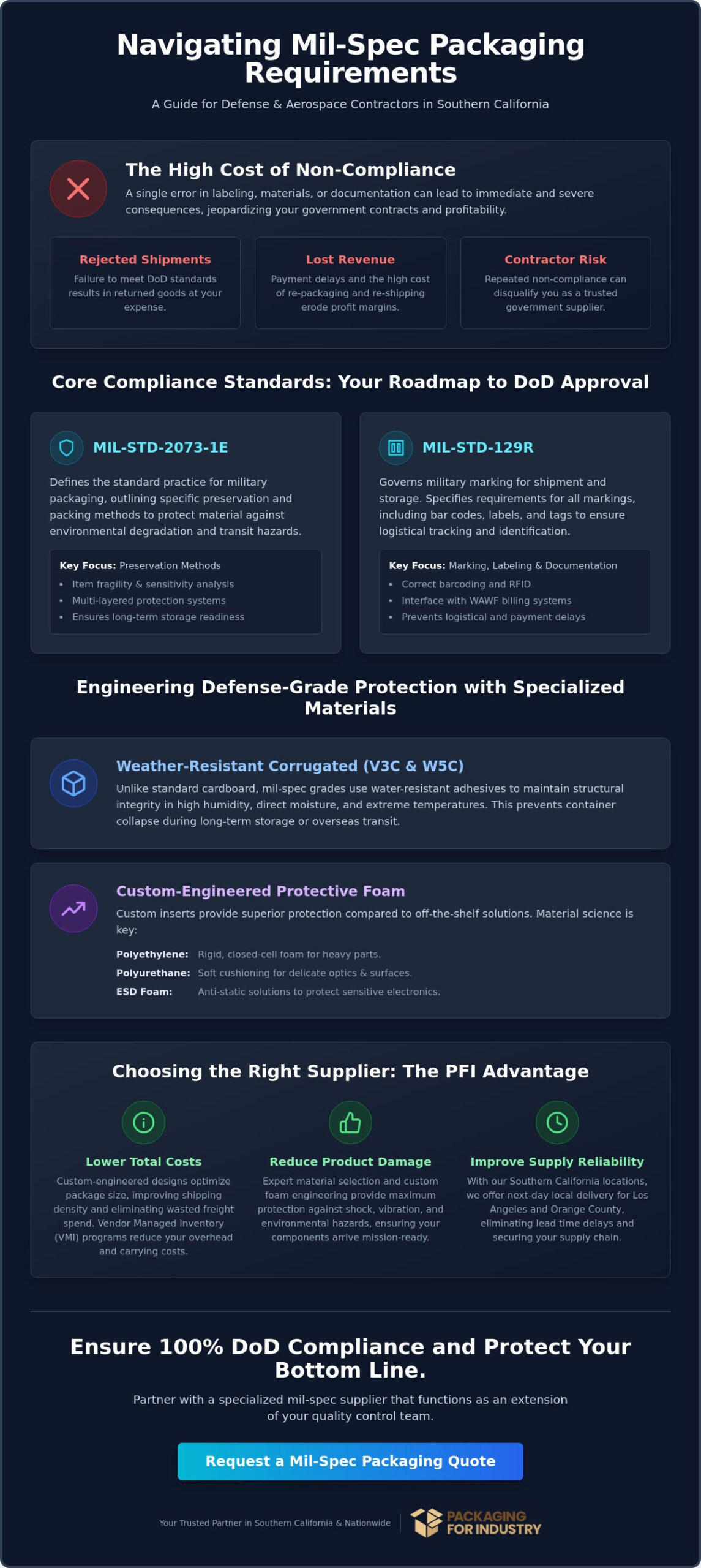
For manufacturers in Southern California, selecting the right mil-spec packaging suppliers is a critical business decision. Compliance is non-negotiable because the DoD utilizes these standards to ensure mission readiness. If a shipment of critical components arrives damaged or fails to meet labeling requirements, the financial impact is immediate. You face rejected shipments, payment delays, and the high cost of re-packaging and re-shipping. In many cases, repeated non-compliance can jeopardize your standing as a qualified government contractor, making your choice of packaging partner a matter of long-term viability.
Core Standards: From MIL-STD to ASTM
Navigating government “boilerplate” requirements requires deep technical knowledge. The primary governing standard is MIL-STD-2073-1E, which outlines specific preservation methods based on an item’s fragility and sensitivity. While some military standards have transitioned to commercial equivalents, such as ASTM D5118 for corrugated boxes, the underlying performance expectations remain high. Professional suppliers act as your technical guide, ensuring that every material aligns with the latest revisions of these complex regulations. They don’t just provide a box; they provide a compliant system.
The Risk of Using Non-Specialized Suppliers
Using a generic catalog supplier for a military contract is a dangerous gamble. Standard shipping containers often fail the rigorous military drop tests and environmental stress simulations required for defense logistics. Beyond physical protection, specialized mil-spec packaging suppliers understand the intricacies of marking and documentation. Incorrect barcoding or failure to properly interface with the Wide Area Workflow (WAWF) system will stall your billing process. A specialized partner functions as an extension of your quality control team, catching potential compliance errors before the product ever leaves your facility. This proactive oversight eliminates professional stress and protects your bottom line.
Engineering Defense-Grade Protection: Materials and Custom Design
Military logistics demand materials that outperform standard commercial grades. While typical shipping uses standard RSC boxes, mil-spec packaging suppliers utilize heavy-duty weather-resistant corrugated like V3C and W5C. These grades use specialized water-resistant adhesives that maintain structural integrity even when exposed to high humidity or direct moisture. This engineering prevents the box from collapsing during overseas transit or outdoor storage at a forward operating base. For heavy industrial equipment or aviation components, these materials are often integrated into custom wood crates to provide a rigid exterior shell that meets strict performance standards.
Protecting sensitive electronics requires a deeper understanding of material science. Polyethylene foam provides rigid, closed-cell protection for heavy parts, while polyurethane offers the soft cushioning needed for delicate optics. When shipping semiconductors, ESD (electrostatic discharge) control becomes paramount. Specialized mil-spec packaging suppliers don’t just provide generic foam; they engineer anti-static and static-dissipative solutions that prevent catastrophic failure caused by triboelectric charging. If you’re unsure which material fits your current contract, you can request a packaging quote to see how custom-engineered inserts improve your protection profile.
Custom Foam Engineering for Aerospace
Aerospace components often feature complex geometries that standard packaging can’t accommodate. We utilize CAD/CAM support to create precision-cut foam packaging that mirrors the exact dimensions of your parts. This eliminates movement during transit, which is the primary cause of surface abrasion and mechanical damage. By offering free prototyping, we ensure a perfect fit before you commit to mass production. This methodical approach reduces the risk of contract rejection and keeps your production line moving without delays for manufacturers in Orange County and Los Angeles.
Barrier Materials and Environmental Protection
Long-term storage requires more than just physical cushioning. It requires a controlled environment. Adhering to Defense Logistics Agency (DLA) packaging standards involves the use of moisture barrier bags and desiccants to prevent corrosion. For precision metals and optics, chemically neutral wraps are essential to prevent oxidation. These weather-resistant systems are designed for the rigors of overseas transit, ensuring that your products arrive in the same condition they left your facility. Whether you’re shipping from San Diego or the Inland Empire, these barrier solutions are essential for mission-critical reliability.
Beyond the Box: Inventory Management and Supply Reliability
Many manufacturers focus solely on the unit price of a box. However, the true cost of military-grade materials includes the floor space they occupy and the working capital tied up in slow-moving stock. Specialized mil-spec packaging suppliers recognize that a pallet of weather-resistant boxes or bulky polyethylene foam inserts takes up significant warehouse real estate. Managing these specialized SKUs alongside standard operational supplies can quickly lead to logistical bottlenecks and inventory shortages. If your warehouse is overflowing with bulky packaging, you’re losing valuable floor space that could be used for production.
By implementing a Vendor Managed Inventory (VMI) program, you shift the burden of stock monitoring to your partner. This proactive approach ensures that your high-volume defense manufacturing lines never stop due to a lack of compliant materials. We utilize just-in-time packaging to provide only what you need for current production cycles, freeing up your facility for core manufacturing activities. Consolidating your procurement; combining boxes, foam, stretch film, and pallets into a single managed program; streamlines your operations and simplifies your vendor landscape.
Implementing a VMI Program for Mil-Spec Items
A successful VMI cycle begins with regular usage reviews. We establish weekly or monthly cycles to monitor your actual consumption rates of critical items. This visibility allows us to anticipate your needs, effectively eliminating emergency rush orders for custom-engineered crates or specialized barrier materials. Expert mil-spec packaging suppliers act as a buffer against market volatility and lead time delays. By maintaining the inventory at our facility and delivering it as needed, you significantly improve your cash flow. You pay for materials as you use them, ensuring your capital doesn’t sit idle on a warehouse shelf. Adhering to the Standard Practice for Military Packaging requires precision, and VMI provides the logistical framework to maintain that precision without the overhead.
Streamlining the Procurement Process
Managing a military contract is administratively heavy. Reducing the number of purchase orders and invoices your team handles every month provides immediate operational relief. A recurring stocking program ensures that every batch of material meets the same rigorous quality standards, providing peace of mind for your quality control team. For assembly lines requiring multiple components, packaging kitting is a game-changer. We deliver pre-assembled kits containing the box, foam inserts, and required labels, which dramatically improves line efficiency. This end-to-end oversight ensures your team focuses on production while we handle the complexities of defense-grade logistics.
Finding a Mil-Spec Packaging Supplier in Southern California
Southern California serves as a global epicenter for defense and aerospace manufacturing. For contractors in Anaheim, Los Angeles, and San Diego, the proximity of your packaging partner directly impacts your operational speed. Sourcing from local mil-spec packaging suppliers isn’t just a matter of convenience; it’s a strategic move to eliminate the high freight costs associated with shipping bulky crates and large volumes of protective foam across state lines. When your supplier is just a short drive from your facility, you gain the agility needed to meet tight government delivery windows without the burden of long-distance logistics.
Proximity also enables next-day delivery for manufacturers in Orange County and the Inland Empire. This rapid response is vital when a production schedule shifts or a new contract requires immediate specialized materials. While we provide robust support for regional hubs, we also maintain the infrastructure for nationwide shipping. This ensures that multi-location government contractors receive the same level of precision and compliance across all their facilities, regardless of geography. By reducing the physical distance between production and packaging, you secure a more reliable and cost-effective supply chain.
Local Service Areas and Industry Hubs
We specifically support the dense aerospace corridor stretching through Los Angeles and Orange County, where precision is the baseline requirement. Our logistics network extends to defense manufacturers in Riverside and San Bernardino, providing the heavy-duty corrugated and ESD protection required for modern tactical equipment. In the South, we offer custom solutions for San Diego’s naval and maritime electronics sectors, where moisture barrier protection and salt-spray resistance are critical. This regional expertise allows us to act as a local “fixer” for complex logistical challenges.
Criteria for Vetting a Local Partner
When evaluating potential partners, look beyond a basic product catalog. A true industrial partner should offer on-site packaging reviews to identify opportunities for damage reduction and cost savings. Ensure they have in-house CAD/CAM design capabilities for rapid prototyping; this is the only way to guarantee that a custom foam insert or crate will perform as expected before mass production begins. Finally, confirm their commitment to industrial-grade standards. You need a supplier that understands the rigors of a military supply chain, not a retail-focused shop that lacks the technical depth required for DoD compliance. To begin optimizing your regional logistics, you can request a packaging quote today.
Why PFI is the Preferred Partner for Military and Aerospace Packaging
Choosing between mil-spec packaging suppliers often comes down to the balance between technical precision and fiscal responsibility. At PFI, we don’t just sell boxes; we provide a consultative partnership that bridges the gap between complex DoD regulations and your bottom line. While large catalog suppliers often push one-size-fits-all solutions that lead to wasted material and excessive freight costs, we focus on custom-tailored responses. Our goal is to act as a “fixer” for your logistical challenges, ensuring that every component, from heavy-duty crates to delicate electronics, is protected by a system designed specifically for its unique geometry and fragility.
Our deep experience with high-value aerospace packaging and precision electronics gives us a distinct advantage. We understand that in the defense sector, a minor design flaw can lead to a major contract delay. That’s why we maintain a focus on the end-to-end experience. From the initial design phase to the final delivery at your facility in Los Angeles or Orange County, we take total accountability for the performance and compliance of your packaging. This comprehensive oversight eliminates professional stress and allows your operations team to focus on production rather than troubleshooting shipping damage.
Engineering Economics: Reducing Damage and Costs
We believe that superior engineering should pay for itself through operational efficiency. One of the most overlooked costs in defense logistics is “dimensional weight” surcharges from carriers like UPS and FedEx. By utilizing optimized box sizing, we help you eliminate these unnecessary fees and improve shipping density. Our approach isn’t just about adding more foam; it’s about using the right materials in the right places. We’ve seen numerous cases where upgrading to a higher-performing cushioning material allowed for a smaller exterior box, significantly lowering total freight spend. To see how these principles apply to your specific operation, you can request a packaging cost-savings analysis from our engineering team.
Start Your Custom Mil-Spec Project
The PFI process is built on three pillars: Assessment, Prototyping, and Production. We begin by evaluating your current contract requirements and identifying potential vulnerabilities in your supply chain. Next, we move to rapid prototyping, using CAD/CAM technology to create precision samples for your approval. Once the design is validated, we move into production, often integrating your custom items into a Vendor Managed Inventory program to ensure reliable supply. If you’re ready to secure your next government contract with 100% compliant materials, you can request a custom packaging quote today. Our Southern California industrial operations team is ready to provide the technical expertise and dependable service your business demands.
Secure Your Supply Chain with Compliant Packaging Solutions
Maintaining 100% compliance with MIL-STD-2073 and MIL-STD-129R is the only way to protect your government contracts and your professional reputation. By moving beyond generic catalog solutions and embracing custom engineering, you eliminate the risk of shipping damage and the high costs of rejected materials. The most effective mil-spec packaging suppliers don’t just provide boxes; they offer a comprehensive system of protection that integrates CAD/CAM design with fiscal responsibility. This approach ensures your components are secure without the burden of unnecessary freight surcharges.
PFI is specialized in Aerospace & Defense compliance, ensuring your most sensitive components reach their destination mission-ready. We provide free prototyping for custom engineering projects to guarantee a perfect fit before mass production begins. With local next-day delivery available across Southern California, we provide the speed and reliability your industrial operations team requires to stay on schedule. It’s time to stop worrying about contract rejections and start focusing on your core production goals.
Request a Custom Mil-Spec Packaging Quote today to streamline your logistics and lower your total packaging costs. We look forward to partnering with you to optimize your defense-grade supply chain.
Frequently Asked Questions
What are the most common mil-spec packaging requirements for defense contracts?
MIL-STD-2073-1E is the primary standard governing military preservation methods and materials. It mandates specific protocols for cleaning, drying, and wrapping items based on their fragility and susceptibility to environmental damage. These requirements ensure that mission-critical parts remain functional after long-term storage or transit through extreme tactical zones. Following these rigid protocols is essential to avoid contract rejection.
How do I know if I need V3C or W5C corrugated boxes for my shipment?
V3C is a heavy-duty, weather-resistant corrugated grade used for high-impact protection, while W5C is a lighter-weight weather-resistant option. You’ll typically need V3C for heavier loads or overseas shipments where maximum stacking strength and moisture resistance are required. W5C is often sufficient for smaller components that still require protection from humidity and outdoor exposure during transit.
Can you provide custom foam inserts that meet anti-static (ESD) military standards?
We provide custom-engineered foam inserts using anti-static and static-dissipative materials that meet strict military standards. These ESD solutions are essential for protecting semiconductor components and sensitive electronic assemblies from triboelectric charging. As specialized mil-spec packaging suppliers, we use CAD/CAM technology to ensure these inserts provide both mechanical cushioning and electrical protection for your high-value assets.
Does a mil-spec packaging supplier also handle the required labeling and barcoding?
A comprehensive supplier handles all marking and labeling in accordance with MIL-STD-129R. This includes the application of 2D PDF417 barcodes and ensuring all documentation is ready for the Wide Area Workflow (WAWF) system. Proper labeling is critical because even a minor barcode error can lead to shipment rejection and significant payment delays from the DoD. Our team manages this technical process to ensure your shipments aren’t stalled by administrative errors.
What is the benefit of a Vendor Managed Inventory (VMI) program for military packaging?
A Vendor Managed Inventory program eliminates the risk of stockouts while freeing up valuable warehouse floor space. Instead of tying up capital in bulky packaging materials, you only pay for what you use as it’s delivered to your production line. This improves cash flow and allows your team to focus on manufacturing rather than monitoring inventory levels for custom crates or specialized barrier bags.
How quickly can I get a prototype for a custom mil-spec crate or foam assembly?
We typically provide prototypes for custom mil-spec crates or foam assemblies within a few business days depending on the complexity of the design. Rapid prototyping allows your engineering team to verify the fit and protection profile before committing to a full production run. This proactive step reduces the risk of mechanical damage and ensures your final packaging system meets all contract specifications without delay.
Do you offer nationwide shipping for government contractors outside of Southern California?
We offer nationwide shipping to support government contractors with facilities outside of Southern California. While we have deep roots as mil-spec packaging suppliers for the Los Angeles and Orange County aerospace hubs, our logistics network ensures consistent quality across all your locations. This allows multi-state manufacturers to consolidate their procurement and maintain uniform compliance standards across their entire organization.
How can a packaging review help reduce our current shipping damage rates?
A professional packaging review identifies structural weaknesses in your current design that contribute to shipping damage. By analyzing your transit environment and product fragility, we can recommend optimized materials or sizing that improves protection while lowering freight costs. This consultative process often uncovers hidden inefficiencies, such as carrier surcharges caused by oversized boxes that lack proper internal cushioning.