
A strong carton seal starts with tape suited to the shipment and packing process. Water-activated tape is moistened before application, activating its adhesive so it bonds to the carton.
For high-volume shipping operations, material choice and consistent application are important purchasing considerations. Kraft paper and plant-derived adhesive options can support packaging goals, while reinforcement adds strength to the tape structure.
This guide explains how reinforced water-activated tape works, what Los Angeles shipping operations should consider when choosing it, and how roll and case quantities affect purchasing. Learn how kraft paper, adhesive activation, carton requirements, and packing volume shape a practical tape specification and whether this format fits your workflow.
Key Takeaways
- Compare kraft and white paper options, adhesive materials, and reinforcement to find a tape format that fits your carton-sealing process.
- Water-activated adhesive needs water before application, so the activation step matters when planning a high-volume packing workflow.
- Use roll and case formats to estimate purchasing needs, then weigh order size and delivery requirements when comparing quotes.
- Bulk orders may qualify for a discount, while custom case quantities offer another way to align supply with shipping demand.
- Packaging For Industry can support broader packaging operations with foam, stretch film, VMI, and just-in-time packaging inventory management.
Kraft paper and plant-derived adhesive materials
Kraft paper forms the visible backing of water-activated carton tape, providing a printable surface that covers the carton seam. Reinforced versions add strengthening threads within the paper. The result combines a paper exterior with added reinforcement for shipping use.
Color is one purchasing choice. Custom water-activated kraft tape is available in KRAFT and WHITE. A warehouse can match kraft tape to brown corrugated cartons, or choose white for a different presentation. Printed versions can use up to 3 colors, allowing shipping teams to add identifying graphics or handling information.
Adhesive selection matters as much as the paper backing. Water-activated tape uses plant-derived adhesive materials, but requires water before application. Moisture activates the adhesive, which then bonds to the carton. This differs from pressure-sensitive tape, which sticks when pressed onto a surface.
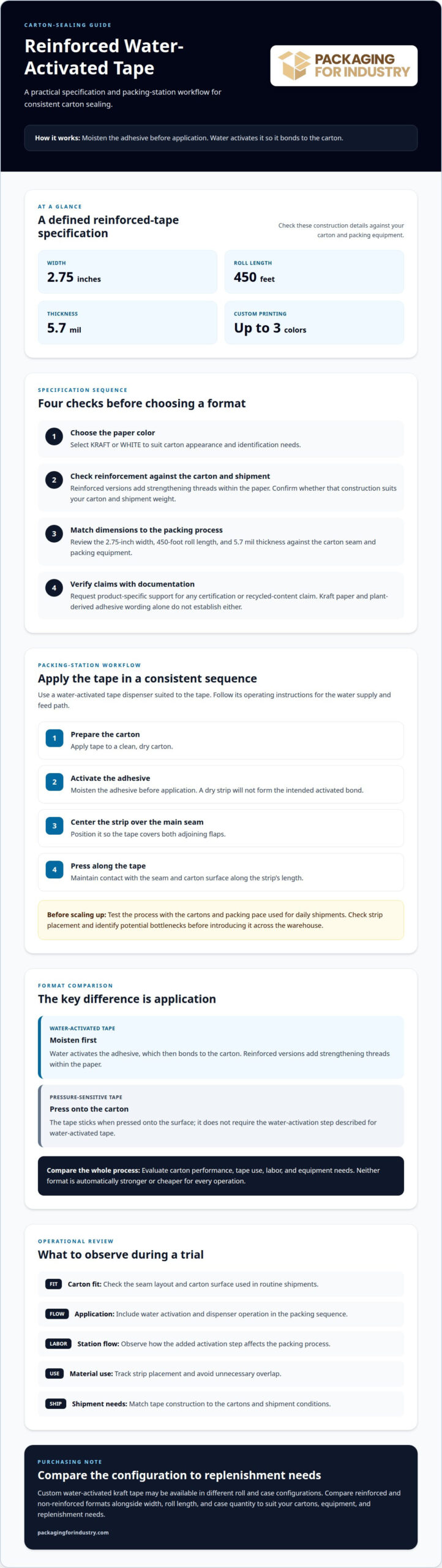
For procurement, treat “plant-derived” as a material description, not a certification. A tape specification should separate measurable construction details from environmental claims. The reinforced tape specifications include a 2.75-inch width, 450-foot roll length, and 5.7 mil thickness.
Support certifications and recycled-content claims with product-specific documentation. Do not infer them from kraft paper or plant-derived adhesive wording alone. Construction details describe the tape’s dimensions and rating, but do not establish a certification or recycled-content percentage.
Match those details to the carton and packing equipment before placing a bulk order. A wider strip covers more of the carton seam, while roll length affects replacement frequency. The 2.75-inch reinforced format gives purchasing teams a defined width and roll length for evaluating packing stations.
Use this practical sequence when comparing options:
- Choose KRAFT or WHITE based on carton appearance and identification needs.
- Confirm whether reinforcement suits the carton and shipment weight.
- Review the 2.75-inch width, 450-foot length, and 5.7 mil thickness against the packing process.
- Request documentation for any certification or recycled-content claim used in purchasing decisions.
Los Angeles shippers can also consider custom printing when cartons need consistent identification. Up to 3 printing colors are available for custom water-activated kraft tape. Aligning the print, paper color, adhesive activation process, and carton dimensions gives purchasing and warehouse teams a clearer specification to evaluate.
STM-WAT Water-Activated Reinforced Kraft Paper Tape is primarily used as a replacement for plastic-backed pressure-sensitive adhesive tapes. This makes it an option for shippers seeking a paper-backed alternative for carton sealing. Custom water-activated kraft tape may be available in different roll and case configurations.
The non-reinforced custom water-activated kraft tape is available in different configurations to suit packing needs. Comparing reinforced and non-reinforced formats alongside width, roll length, and case quantity helps buyers choose a configuration suited to their cartons, packing equipment, and replenishment needs.
Reinforced water-activated tape for high-volume shipping
On a busy shipping line, consistent sealing matters as much as tape selection. Reinforced water-activated tape must be moistened before application, adding an activation step to the packing process. Once activated, its adhesive bonds to the carton, while the reinforcement strengthens the paper tape for routine carton sealing.
Compared with plastic pressure-sensitive tape, the main difference is how each is applied and bonds. Plastic tape sticks when pressed onto a carton; water-activated tape must first be moistened. Neither format is automatically stronger or cheaper for every operation. Compare carton performance, tape use, labor, and equipment needs rather than judging by material type alone.
For a high-volume line, a water-activated tape dispenser helps manage activation and feed consistent lengths. Choose a manual or powered dispenser designed for this tape, and set it up according to its operating instructions. At the packing station, the operator moistens the adhesive, positions the strip over the carton seam, and presses it firmly into place.
Apply tape to a clean, dry carton. Center the strip over the main seam so it covers both adjoining flaps, then press along its length to maintain contact with the seam and carton surface. The adhesive must be moistened before application; a dry strip will not form the intended activated bond. Follow the dispenser instructions for its water supply and feed path.
Before introducing the process across a warehouse, test it with the cartons and packing pace used for daily shipments. A trial can reveal whether operators need a different dispenser setting, more workspace, or a smoother handoff between closing and sealing cartons. Check that strips land consistently and stay centered over the seam. This can expose bottlenecks before the method reaches every station.
Review these operational factors when comparing tape formats:
- Carton fit: Check the seam layout and carton surface used in routine shipments.
- Application: Include water activation and dispenser operation in the packing sequence.
- Labor: Observe how the added activation step affects station flow.
- Material use: Track strip placement and avoid unnecessary overlap.
- Shipping needs: Match the tape construction to the cartons and shipment conditions.
For Los Angeles operations, purchasing decisions should account for both tape consumption and packing-station requirements. A packaging quote for your shipping setup can help assess related carton and protective-packaging needs alongside the sealing workflow.
Reinforced Water-Activated Tape Prices in Los Angeles
Reinforced water-activated tape is sold as a single roll or a case of 10 rolls. The right purchase format depends on how your Los Angeles operation manages supplies, storage, and replenishment. A single roll can suit a limited requirement, while a case may fit a warehouse with recurring carton-sealing demand.
Pricing depends on the order and is provided after a quote request. Factors include quantity, tape construction, and delivery requirements. Compare quotes for the same configuration and order format; otherwise, a lower total may simply reflect fewer rolls or different specifications.
For a case quote, assess more than the roll count. Case dimensions help warehouse teams plan receiving, shelf placement, and handling. Factor storage capacity into the purchase, especially if the receiving area also handles corrugated cartons, stretch film, or other packaging supplies.
Individual roll dimensions also affect storage and dispenser fit. Each roll has a 6-inch diameter and a 1.6-inch core. These measurements help a packing team assess how rolls fit its dispenser and where operators can keep backup stock. Confirming compatibility before ordering can prevent a mismatch between the incoming roll and the equipment used at the sealing station.
To compare a single roll with a 10-roll case, calculate the quoted case amount per roll. Then consider how frequently the operation uses tape and how much space it can allocate to backup inventory. A per-roll comparison gives procurement a consistent unit, while usage and storage determine which order format works better for the warehouse.
Los Angeles buyers can make quote comparisons clearer by specifying the expected quantity, delivery destination, and packing application. Note whether the tape is for a production line, warehouse, or distribution operation. This context helps match the quote to purchasing needs rather than treating tape as an isolated unit cost.
Before approving an order, review these points:
- Compare the single-roll and 10-roll case options using a per-roll calculation.
- Account for case weight and dimensions when planning receiving and storage.
- Check roll diameter and core size against the packing station’s dispenser.
- Include destination and order quantity in the quote request.
This review gives purchasing and warehouse teams a practical basis for evaluating tape orders. Connecting the quoted amount with how the product will be received, stored, and used helps buyers choose an order format that fits their operation.
Bulk and wholesale pricing for reinforced gummed paper tape near Los Angeles
Bulk pricing can change the economics of recurring carton sealing. Buyers purchasing 5 to 9 rolls receive a 5% bulk discount. That tier gives smaller operations a defined quantity range for comparing replenishment needs and purchase timing. It does not mean every larger order follows the same discount structure.
Use the discount against your expected tape consumption, not an arbitrary stock target. For example, a Los Angeles warehouse can review its recent purchasing pattern and determine whether 5 to 9 rolls cover its planned use. The right quantity depends on shipment volume, strip usage, storage space, and replenishment frequency. Buying more than the operation can use ties up inventory and shelf space.
Compare bulk offers on equal terms. Identify the roll quantity and tape construction, then compare the quoted total after any applicable discount. Calculate cost per roll for internal purchasing analysis, keeping specifications consistent across quotes, including reinforcement, roll format, and printing requirements. This is more useful than comparing discount percentages alone.
Wholesale purchasing also calls for an inventory plan. Assign a standard storage location, record incoming roll quantities, and track use at the packing station. A reorder trigger based on actual consumption can help avoid emergency orders and excess stock. If different lines use different carton sizes or sealing routines, track tape inventory by line.
Bulk quantities also affect receiving and handling. Decide who will receive the order, where cases will be stored, and how warehouse staff will issue rolls. If storage is full when a shipment arrives, the discount may not offset the operational disruption. Coordinate the order with available floor space and expected shipping demand.
When requesting bulk pricing, share the intended quantity, delivery location, and any custom-printing needs. Custom water-activated kraft tape can use up to 3 printing colors, so include the print requirement in the same request. A quote can then reflect the purchase configuration being considered. The price depends on the order and is provided after a quote request, with quantity, construction, printing, and delivery needs shaping the quoted terms.
Use these checks to assess a wholesale order:
- Confirm whether the planned purchase falls within the 5-to-9-roll discount range.
- Compare the same tape specification and quantity basis across quotes.
- Match the order size to observed consumption and available storage.
- Include printing and delivery requirements in the pricing request.
This approach helps Los Angeles buyers assess bulk packaging costs alongside the effort of managing inventory. Ordering a measured quantity can support predictable purchasing without assuming a larger order automatically saves money.
Request a quote with the order quantity, tape construction, printing requirements, and delivery location to determine the case total and cost per roll.
Minimum order quantities and shipping costs from Los Angeles tape suppliers
Custom water-activated kraft tape can be ordered in case quantities of 5, 10, 25, 60, or 84 cases. These options help Los Angeles buyers plan orders around purchasing cycles and warehouse capacity. The case quantity affects how much tape arrives together, so match the order to expected use and available storage.
Minimum order requirements and case quantities are not the same. A listed case option describes an order format, not necessarily a minimum for every tape configuration. In a purchasing request, specify the tape construction, whether printing is needed, and the intended case quantity. Clear details help suppliers prepare comparable quotes.
Shipping costs depend on the shipment details. Destination, number of cases, shipment weight, and delivery requirements can affect the total. A small order going to one Los Angeles address may have different handling needs from a larger shipment for multiple locations. Include the delivery address and order quantity when requesting a quote.
Compare landed costs rather than tape prices alone. Add the quoted shipping charge to the product amount, then divide by the total rolls received. Compare quotes only after confirming that case quantities and roll counts match. This gives purchasing a more useful basis for assessing the overall order cost.
Custom water-activated kraft tape case orders may involve substantial inventory. Before selecting 25, 60, or 84 cases, estimate usage from recent packing activity and check available storage. Consider how long the stock will remain usable in the warehouse’s normal conditions, and how frequently the operation wants to replenish. A larger shipment can reduce order frequency, but it also requires more receiving space and inventory control.
For a multi-location business, clarify whether the shipment goes to one receiving point or several destinations. Separate delivery locations can change shipping arrangements and complicate receiving records. A Los Angeles distribution center ordering for multiple facilities should specify each destination and its requested quantity before comparing quotes. This helps align the shipment plan with actual inventory needs.
Use these steps to prepare a practical request:
- Choose a case quantity from the available options: 5, 10, 25, 60, or 84.
- State the tape construction and any printing requirements.
- Provide the delivery address and receiving requirements.
- Compare total order cost and cost per roll across matching configurations.
- Check storage capacity before approving a large case order.
Shipping charges and product pricing are provided after a quote request. Order quantity, tape specification, destination, and delivery requirements shape the total. Providing these details together helps buyers review supply needs and shipping costs at the same time.
Packaging For Industry (PFI)
Packaging For Industry (PFI) supports manufacturers, aerospace companies, and distribution operations with packaging for product protection and shipping workflows. For teams reviewing carton sealing alongside broader packaging needs, PFI offers foam packaging and stretch film for product protection and load preparation.
Warehouses and manufacturers with recurring packaging needs can use Packaging For Industry’s Vendor Managed Inventory (VMI) and Just-In-Time (JIT) inventory management services. These programs coordinate supply planning with usage patterns, purchasing schedules, and available storage space.
Contact Packaging For Industry to discuss your industrial packaging needs.
Build a More Reliable Packaging Plan
Choosing a reinforced water-activated paper tape supplier in Los Angeles is one part of a dependable shipping operation. Connect carton-sealing decisions with the wider packaging workflow, including product protection, pallet preparation, and inventory planning. Reviewing these needs together can help purchasing teams identify supply gaps and improve coordination across packing stations.
Packaging For Industry (PFI) supports related requirements with foam packaging, stretch film, and Vendor Managed Inventory for Packaging. These services can help when your operation is reviewing protective materials, stabilizing shipments, or coordinating replenishment. Share the issues your team wants to address, such as supply consistency or unnecessary packaging complexity, to start a focused discussion.
A clear next step makes packaging decisions easier to manage. Start with the needs of your shipping floor and build a plan that supports steady operations.
Frequently Asked Questions
Can Los Angeles businesses buy reinforced gummed paper tape with local pickup?
Local pickup for reinforced gummed paper tape depends on the seller’s fulfillment arrangements, and no pickup option can be promised here. Packaging For Industry (PFI) supports Los Angeles operations with related packaging needs, including foam packaging, stretch film, and packaging inventory management. If tape pickup is essential, make that requirement part of your purchasing plan alongside the tape specification and required quantity.
Which Los Angeles packaging suppliers have reinforced water-activated paper tape in stock?
Stock status varies by supplier and tape configuration. This article does not establish which Los Angeles suppliers currently have reinforced water-activated paper tape available. PFI can help with related industrial packaging planning, including foam packaging, stretch film, and Vendor Managed Inventory for Packaging. For broader supply planning, identify recurring material needs and coordinate inventory around actual warehouse and shipping use.