
The cheapest foam on your quote often becomes the most expensive line item on your balance sheet once transit damage and dimensional weight surcharges are calculated. Selecting polyethylene vs polyurethane foam for packaging isn’t just about material feel; it’s a calculated engineering decision that impacts your entire logistical flow. Whether you’re shipping aerospace components from Los Angeles or medical devices nationwide, the wrong choice can lead to a 20% loss in cushioning thickness under moderate load. This isn’t just a technical spec. It’s a direct threat to your bottom line and supply chain reliability.
We understand the pressure of managing rising shipping costs while maintaining a zero-damage transit record. You’ve likely felt the frustration of bulky packaging that triggers heavy surcharges or materials that fail to protect fragile parts during the “last mile.” This guide helps you master the technical and economic differences between these two materials to select the ultimate protection for your industrial components. We’ll analyze the performance of closed-cell versus open-cell structures, address the impact of August 2026 market price shifts, and demonstrate how precision-engineered foam inserts can reduce dimensional weight and improve your shipping efficiency.
Key Takeaways
- Identify the critical functional differences between open-cell polyurethane for vibration dampening and closed-cell polyethylene for heavy-duty shock absorption.
- Evaluate the total landed cost impact of polyethylene vs polyurethane foam for packaging by optimizing material density to reduce dimensional weight surcharges.
- Select the appropriate foam grade for specialized sectors, including cleanroom-compatible solutions for medical devices and high-density support for aerospace components.
- Utilize custom CAD/CAM engineering and free prototyping to ensure a precision fit that eliminates the risk of transit damage and reduces material waste.
- Streamline your supply chain by leveraging local Southern California logistics and vendor-managed inventory for reliable, next-day delivery.
Understanding Open Cell vs. Closed Cell Foam for Shock Absorption
The fundamental choice between polyethylene vs polyurethane foam for packaging starts at the microscopic level. Every foam material is classified by its cell structure, which dictates how it reacts to pressure, impact, and environmental exposure. For industrial buyers, choosing between open-cell and closed-cell structures isn’t a matter of preference; it’s a matter of physics. Your decision impacts everything from transit damage rates to the total landed cost of your goods.
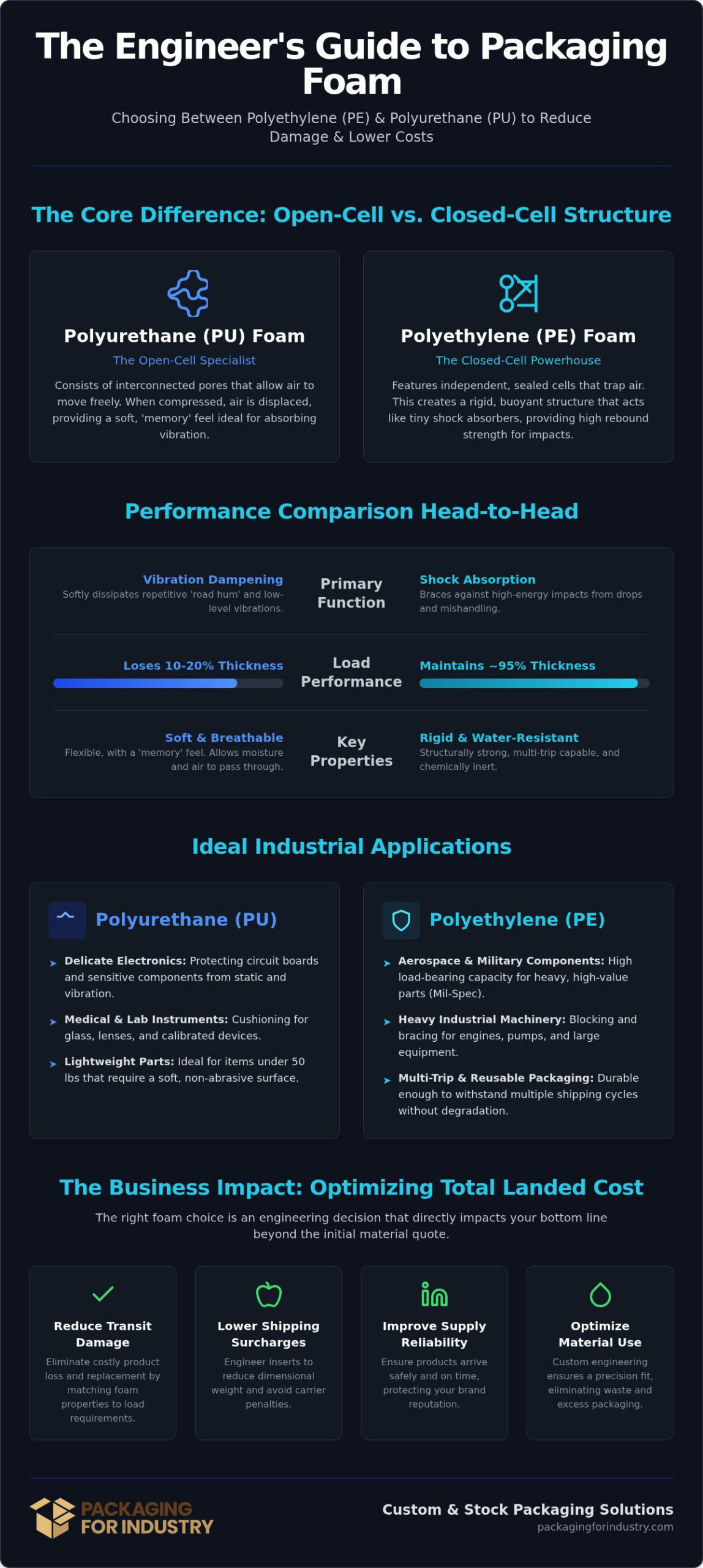
Open-cell foam, like Polyurethane foam, consists of interconnected pores that allow air to move freely between cells. When compressed, the air is displaced, providing a soft, “memory” feel that excels at light-duty cushioning. Conversely, closed-cell foam, such as polyethylene, features independent, sealed cells. These cells trap air inside, creating a much more rigid and buoyant structure. This trapped air acts as a series of tiny shock absorbers that provide high energy return and rebound strength. Understanding this distinction is the first step toward selecting foam packaging that actually protects your components.
The core trade-off centers on the memory versus rebound effect. If a product is lightweight and prone to damage from repetitive vibration, the soft dissipation of PU is superior. However, if the product is heavy and requires rigid support to prevent it from crushing the packaging, the rebound strength of PE is mandatory. Standard polyurethane foam can lose 10-20% of its thickness under moderate load, while polyethylene foam maintains roughly 95% of its original thickness under similar conditions. This performance gap is why material selection is an engineering decision, not just a procurement task.
Polyurethane (PU) Foam: The Open-Cell Specialist
Polyurethane is the go-to choice when your primary goal is vibration dampening for delicate components. Because the cells are open, the material is highly breathable and flexible. It’s often found in convoluted “egg crate” formats or as soft custom inserts. PU foam is ideal for protecting lightweight items that require a soft touch, such as delicate electronics or glass instruments. It absorbs energy by allowing air to escape upon impact, which effectively minimizes the force transferred to the product during shipping.
Polyethylene (PE) Foam: The Closed-Cell Powerhouse
Polyethylene provides the structural integrity needed for blocking and bracing heavy industrial equipment. Its independent cell structure makes it naturally water-resistant and chemically inert, which is critical for aerospace and military-spec applications. Unlike PU, PE foam doesn’t “bottom out” under heavy loads. For manufacturers shipping heavy turbine parts or medical machinery, PE foam offers the high load-bearing capacity required to prevent shifting inside the crate. It’s a durable, multi-trip solution that maintains its protective properties even after multiple impacts.
Performance Comparison: Polyethylene vs. Polyurethane Foam
Choosing between polyethylene vs polyurethane foam for packaging requires a deep understanding of how your product interacts with the stresses of the supply chain. While both materials provide cushioning, they solve different logistical problems. High-energy impacts, like a box falling off a sorting belt, require a different material response than the constant, low-level vibration of a long-haul truck. Misidentifying these forces often leads to high transit damage rates and inflated insurance claims.
Shock Absorption vs. Vibration Dampening
Heavy industrial machinery and high-value components rely on the high compressive strength of polyethylene (PE) foam. Because PE is a closed-cell material, it doesn’t “bottom out” under significant weight. It excels at absorbing the energy of a single, high-impact drop and can survive multiple shipping cycles without losing its structural integrity. In fact, standard PE foam maintains roughly 95% of its original thickness after repeated loads, making it a reliable choice for multi-trip crates and military-spec applications.
Sensitive electronics and delicate instruments require the softer touch of polyurethane (PU) foam to dampen the “road hum” or repetitive vibration experienced during transit. PU foam is the preferred choice for protecting expensive equipment that might be internally damaged by vibration even if the outer casing remains intact. The G-level protection provided by foam is determined by the material’s density and its ability to decelerate an object over a specific distance. While PU is gentler, it lacks the multi-trip durability of PE; it’s often a single-use solution for high-energy shocks because it can lose 10-20% of its thickness after a major impact.
Chemical and Moisture Resistance
The environmental conditions of your shipping route should dictate your material choice. Polyethylene is naturally non-absorbent and chemically inert. This makes it the standard for medical and aerospace environments where exposure to oils, fuels, or sterilization fluids is a risk. It won’t harbor mold or bacteria, providing peace of mind for cleanroom-compatible shipments. If you’re shipping via ocean freight, PE’s moisture resistance prevents the packaging from becoming heavy or losing its shape in high-humidity containers.
Polyurethane, while gentler on finished surfaces and less likely to cause micro-scratching on polished metals, is susceptible to moisture absorption. In humid environments, PU can degrade over time, potentially off-gassing or losing its cushioning properties. For electronics, both materials are available in anti-static (ESD) variants, usually identified by their pink color. To ensure you’re using the most cost-effective material for your specific environment, you can compare packaging pricing for custom-engineered inserts that balance surface protection with long-term durability.
Industrial Applications: From Aerospace to Electronics
The selection between polyethylene vs polyurethane foam for packaging isn’t a generic choice; it’s an industry-specific engineering requirement. Manufacturers in precision sectors don’t just look for basic cushioning. They look for compliance, cleanliness, and electrostatic safety. Each sector leverages the inherent features of these polymers to solve unique logistical challenges while maintaining strict quality control standards.
Aerospace and Defense Logistics
In the aerospace sector, protecting high-value flight hardware requires materials that meet rigorous Mil-Spec standards. High-density PE foam is the primary choice for heavy turbine components and engine parts due to its exceptional load-bearing capacity. It provides the rigid blocking and bracing necessary to prevent shifting during international transit. For specialized requirements, Aerospace Packaging Solutions often incorporate custom-cut PE inserts into heavy-duty crates to ensure multi-trip durability. This closed-cell structure doesn’t just absorb energy; it resists the hydraulic fluids and fuels common in hangar environments without degrading or losing its shape.
Electronics and Sensitive Part Protection
The electronics industry presents a different set of challenges, specifically concerning vibration and electrostatic discharge (ESD). While PE foam is available in pink anti-static variants, delicate circuit boards and semiconductor components often require the dampening properties of ESD-safe PU foam. PU’s open-cell structure effectively neutralizes the high-frequency vibrations that can loosen internal solder joints during long-haul shipping. Custom Foam Inserts designed with ESD-safe polyurethane provide a soft, non-abrasive nest for sensitive silicon. In e-commerce fulfillment, foam-lined boxes have become the standard for shipping consumer electronics, balancing low material weight with maximum surface protection to reduce return rates.
Medical and Automotive Applications
Medical device manufacturers prioritize cleanliness and sterilization. PE foam is the preferred material for cleanroom environments because it’s non-dusting and chemically inert. It won’t harbor bacteria and can withstand harsh sterilization processes without off-gassing. In the automotive sector, Tier 1 suppliers often utilize multi-material kitting for complex logistics. This strategy combines PE for heavy structural parts and PU for finished interior components that require scratch-free surface protection. This integrated approach ensures that complex assemblies arrive at the production line ready for immediate installation, helping manufacturers lower packaging costs by reducing the need for secondary protective wraps.
Lowering Packaging Costs through Foam Optimization
The economic impact of selecting polyethylene vs polyurethane foam for packaging extends far beyond the per-unit material price. While polyurethane (PU) typically offers a lower upfront material cost per board foot, it often requires a larger volume of foam to achieve the same level of protection as high-density polyethylene (PE). This increased volume forces you into larger shipping containers, which triggers expensive dimensional weight surcharges from carriers like UPS and FedEx. True cost optimization requires looking at the total landed cost, where material efficiency and freight savings intersect.
Custom foam engineering directly improves your material yield. By using CAD/CAM design and precision die-cutting, we reduce scrap waste and lower the per-unit price for high-volume orders. Every square inch of foam is utilized to create a tight, repeatable fit that eliminates the need for secondary wraps or excessive void fill. This precision doesn’t just save on material; it significantly reduces damage rates, which is a direct contributor to your bottom line. A single transit damage claim can often wipe out the savings from months of using “budget” packaging materials.
Reducing Dimensional Weight (DIM) Charges
Carriers charge based on the space a package occupies, not just its actual weight. Because PE foam has a higher energy-to-thickness ratio, thinner inserts can often replace bulky, low-density PU foam without compromising safety. This reduction in foam thickness allows for the use of smaller, more efficient Corrugated Boxes. Reducing your box size by even one inch in each dimension can lead to a 15-20% reduction in DIM weight surcharges over a year of high-volume shipping. We recommend a comprehensive packaging review to identify areas where over-packaging is leading to freight waste and unnecessary shipping spend.
Bulk Ordering and Supply Chain Reliability
Procurement efficiency is the final pillar of cost reduction. Relying on expensive catalog suppliers like Uline for stock foam often leads to inflated costs and inconsistent supply. Moving to a custom-engineered assembly with recurring orders allows for better price stability and reliable lead times. To further streamline operations, many manufacturers utilize Vendor Managed Inventory (VMI). This system prevents stockouts and ensures you have the exact foam inserts you need for just-in-time production without tying up excessive capital in warehouse floor space. It’s a proactive approach that prioritizes long-term fiscal responsibility over short-term material savings.
Custom Foam Engineering and Local SoCal Support
Selecting the correct polyethylene vs polyurethane foam for packaging is a strategic business decision that requires more than just a material comparison. The real value lies in how that material is engineered to fit your specific component. At Packaging For Industry (PFI), we move beyond the generic “cut-to-size” approach offered by catalog suppliers. Our process integrates advanced engineering with logistical efficiency to ensure your choice of polyethylene vs polyurethane foam for packaging performs exactly as intended in the field. By providing a holistic system that includes custom corrugated boxes and heavy-duty crates, we eliminate the fragmentation that often leads to supply chain delays.
The Prototyping and Design Process
Precision begins with digital design. We utilize CAD/CAM support to translate your product’s dimensions into a custom-engineered foam nest. This isn’t a theoretical exercise. We provide free prototyping to ensure a perfect product fit before you commit to a full production run. Transitioning from a digital file to a physical die-cut sample allows your team to verify clearance, ease of packing, and structural integrity. We encourage rigorous “drop testing” of these prototypes to simulate real-world transit shocks. This proactive step identifies potential failure points early, saving you from the professional stress of mass-scale transit damage. If you’re ready to optimize your current setup, you should Request a Quote for a comprehensive packaging review.
Serving the Southern California Industrial Hub
For manufacturers in Anaheim, Los Angeles, and across Orange County, proximity is a competitive advantage. We provide local next-day delivery to keep your production lines moving without the need for massive on-site storage. This local presence supports Just-In-Time (JIT) inventory management, allowing you to synchronize packaging delivery with your manufacturing schedule. While we are a local powerhouse, our nationwide shipping capabilities ensure that multi-location manufacturers receive the same precision-engineered foam assemblies across all their US facilities. Whether you’re shipping aerospace parts from the Inland Empire or medical devices from Irvine, our integrated solutions provide the stability your supply chain requires. We don’t just sell products; we manage the entire system of protection from design to final delivery.
Optimize Your Industrial Protection Strategy
Optimizing your industrial protection strategy requires balancing material performance with logistical efficiency. You now understand that selecting polyethylene vs polyurethane foam for packaging involves more than a simple price comparison. It’s about matching the cell structure to your product’s specific vulnerability, whether that’s high-energy impact or repetitive transit vibration. By leveraging precision CAD design and choosing materials that minimize dimensional weight, you can protect your bottom line as effectively as you protect your components.
Our team is ready to assist with specialized aerospace and Mil-Spec expertise to ensure your packaging meets every regulatory and functional requirement. We offer free prototyping and CAD support to verify your design and provide local next-day delivery throughout Southern California to maintain your just-in-time production schedules.
We’re committed to helping you achieve zero damage and total supply chain reliability.
Frequently Asked Questions
Is polyethylene or polyurethane foam better for shock absorption?
Polyethylene foam is superior for high-energy shock absorption because its closed-cell structure doesn’t bottom out under heavy loads. It maintains roughly 95% of its thickness after impact. Polyurethane foam excels at dampening repetitive vibrations and low-level road hum during transit. When evaluating polyethylene vs polyurethane foam for packaging, the choice depends on whether your component is heavy and rigid or lightweight and delicate. PE is the standard for heavy industrial equipment.
What is the main difference between open cell and closed cell foam?
The main difference is the connectivity of the pores. Open-cell foam, like polyurethane, has interconnected cells that allow air to flow through, creating a soft and breathable cushion. Closed-cell foam, like polyethylene, consists of independent, sealed cells that trap air. This trapped air provides the rigidity, buoyancy, and moisture resistance required for heavy-duty industrial applications. Understanding this physical structure is essential for selecting the correct protection level for specialized aerospace or medical equipment.
Can I get anti-static (ESD) versions of PE and PU foam?
Yes, both polyethylene and polyurethane foams are available in anti-static (ESD) versions. These materials are typically dyed pink to signify their dissipative properties. ESD-safe foam prevents the buildup of electrostatic discharge that can permanently damage semiconductors, circuit boards, and other sensitive electronics. Manufacturers should request a packaging quote for custom-engineered ESD inserts to ensure their electronic components are protected from both physical impact and invisible electrical threats during fulfillment.
Which foam material is more cost-effective for bulk shipping?
Polyethylene is often more cost-effective for bulk shipping when you factor in dimensional weight (DIM) surcharges. While polyurethane has a lower per-unit material price, its lower density often requires thicker padding to achieve the same protection. This increases box sizes and freight costs. By using thinner, high-density polyethylene vs polyurethane foam for packaging, you can utilize smaller corrugated boxes and lower packaging costs across your entire supply chain. It’s a strategic way to optimize logistics.
How do I determine the correct foam density for my product weight?
Determining the correct density requires analyzing dynamic cushioning curves and the fragility (G-level) of your product. Heavier items require high-density polyethylene to prevent the material from crushing during transit. Lightweight, fragile items benefit from the low-density vibration dampening of polyurethane. Our team provides CAD/CAM support and free prototyping to test these densities before you commit to a full production run. This engineering-first approach ensures your product remains secure without over-spending on unnecessary material.
Does polyethylene foam absorb water or chemicals?
Polyethylene foam is naturally non-absorbent and resistant to most chemicals, oils, and fuels. Its sealed, closed-cell structure creates a barrier that prevents moisture from penetrating the material. This makes PE the ideal choice for maritime shipping, aerospace environments, and medical applications where sterilization or fluid exposure is a concern. Unlike polyurethane, which can degrade or harbor mold in high-humidity containers, polyethylene maintains its structural integrity and protective performance in harsh environmental conditions without failing.
What are the lead times for custom die-cut foam inserts?
Lead times for custom die-cut foam inserts vary based on the complexity of the design and order volume. For manufacturers in Southern California, we offer local next-day delivery for recurring needs. To ensure your production line never stops, we provide Vendor Managed Inventory (VMI) and just-in-time inventory management. These services allow us to stock your custom foam assemblies and deliver them exactly when they’re needed, providing a reliable supply chain that outperforms large catalog suppliers regularly.
Is foam packaging recyclable or eco-friendly?
Polyethylene foam is a 100% recyclable thermoplastic, making it a more eco-friendly option for manufacturers focused on sustainability. It can be melted down and repurposed into new products, reducing warehouse waste. Polyurethane is more difficult to recycle and often ends up in landfills, though it can be shredded for carpet padding. When you compare packaging pricing, consider the long-term impact of material disposal. Choosing PE can help your business meet environmental compliance goals while providing superior industrial protection.