
Stock packaging can work well until its standard size or protection no longer suits your product or workflow. Knowing when to transition from stock to custom packaging depends on whether a tailored design can solve a recurring fit, protection, presentation, or handling problem. If standard packaging does the job, there’s no need to customize simply for its own sake.
Stock packaging can help a business start shipping without committing to a custom design before demand is clear. But as orders repeat, a poor fit can mean extra cushioning, awkward assembly, or unnecessary product movement in transit. Consider these operating costs and risks alongside the packaging unit price.
This guide explains when stock packaging remains practical, which signs point to a custom solution, and how to compare options based on fit, protection, branding, volume, and timing. Custom packaging is not an all-or-nothing decision: a standard structure with tailored graphics can be a useful middle ground. Use these criteria to choose packaging that protects products and supports efficient operations as your business grows.
Key Takeaways
- Stock packaging can be a practical starting point when standard dimensions protect the product and meet current order needs.
- Consider a custom design when poor fit, added cushioning, product movement, or inefficient packing creates a recurring operational problem.
- Compare the complete packaging and handling costs, not just the unit price, and weigh demand, reorder frequency, and future product changes.
- A standard package with custom graphics can bridge the gap between plain stock packaging and a fully custom structure.
- Packaging For Industry supports packaging decisions with custom design services, foam packaging, stretch film, and inventory management options.
Should a Product Brand Use Custom Packaging or Stock Packaging?
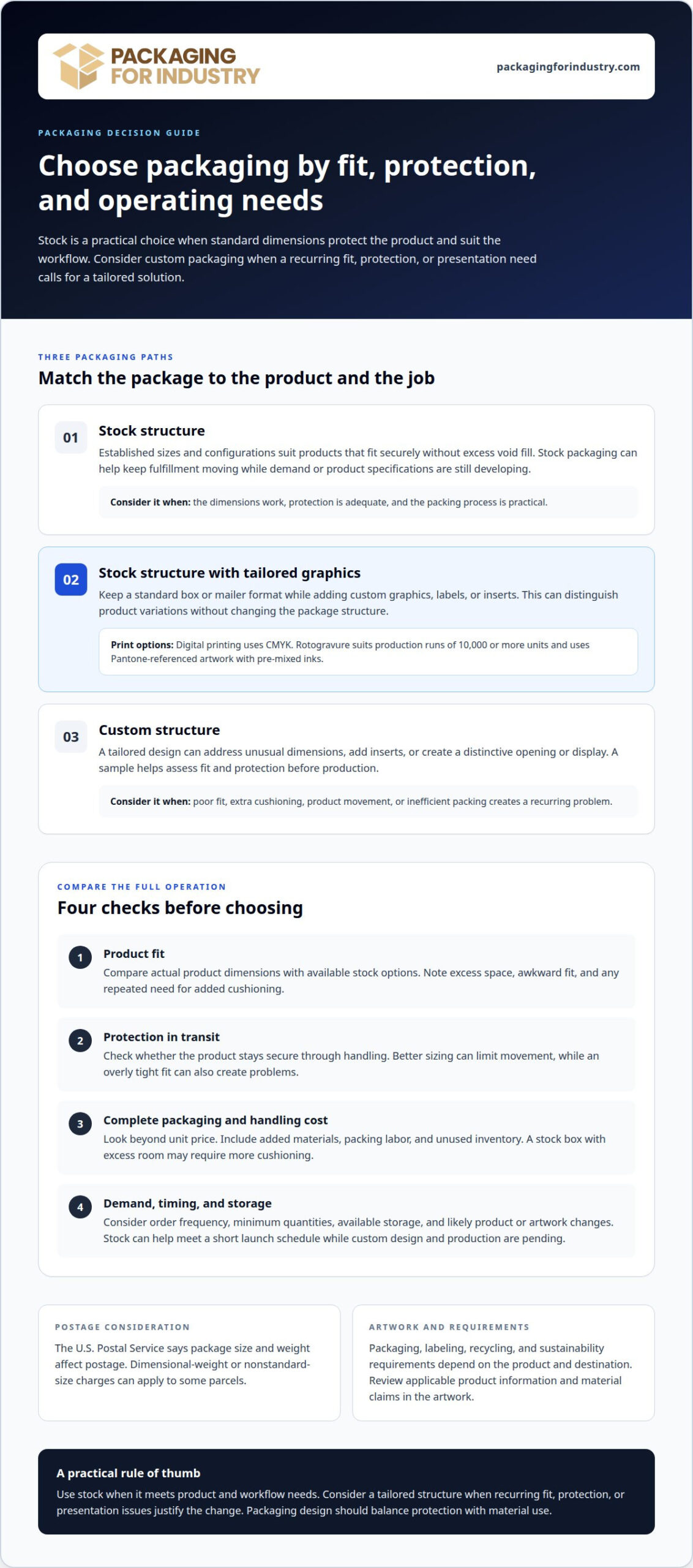
Stock packaging suits products that fit standard dimensions; custom packaging addresses specific fit, protection, or branding needs. Compare the package with the product and shipping requirements before choosing.
Stock Packaging
Stock packaging uses established sizes and structures, making it a practical fit when a product sits securely without excess void fill. It also supports a middle ground: print custom graphics on a standard structure. Digital printing uses CMYK, while rotogravure suits production runs of 10,000 or more units and uses Pantone-referenced artwork with pre-mixed inks.
Custom Packaging
Custom packaging can match unusual dimensions, add inserts, and create a distinctive opening or display. A sample helps assess fit and protection before production. Better sizing can limit product movement, though an overly tight fit can create problems. The U.S. Postal Service says package size and weight affect postage, and dimensional-weight or nonstandard-size charges can apply to some parcels. A custom structure can also support consistent branding and a more considered customer experience. Custom packaging design can align structure and function.
Packaging Requirements
U.S. packaging, labeling, recycling, and sustainability requirements depend on the product and its destination. Custom packaging alone does not establish a universal label. Include applicable product information and material claims in the artwork review. The U.S. Environmental Protection Agency’s materials management hierarchy prioritizes source reduction and reuse over recycling. Packaging design should balance protection with material use.
| Option | Fit and protection | Print approach |
|---|---|---|
| Stock structure | Standard dimensions | Plain or custom print |
| Custom structure | Product-specific fit | Designed for the format |
Choose stock when it meets the product’s needs; consider custom when fit, protection, or presentation calls for a tailored solution.
Stock Packaging as a Starting Option for Emerging Businesses
For an emerging business, stock packaging can get a product into distribution without a lengthy design process. A standard carton or mailer makes sense when its format suits the product and protects it during handling. Low minimum orders and minor modifications can help a team test demand before investing in a dedicated design.
Consider a new industrial component with stable dimensions but uncertain sales volume. A stock box lets the business pack early orders while learning which specifications matter in practice. Staff can record fit issues, cushioning needs, and assembly steps. These observations give future design work a practical foundation instead of relying on assumptions.
Stock formats can also suit a short launch schedule. If a product must ship before custom design and production are complete, an available standard package can keep fulfillment moving. Consistent availability matters for repeat orders, but the right choice still depends on product fit, protection requirements, and how much packaging the business can store.
Before committing to customization, compare the product’s actual dimensions with stock options, assess transit protection, and note any extra packing steps. For example, if a standard carton needs added cushioning but still keeps the product secure, it may remain practical while demand develops. If the format repeatedly causes fit or workflow problems, use those findings to guide a future custom design.
Stock Packaging Availability, Affordability, and Customization
Stock packaging comes in established dimensions, shapes, and configurations. That standardization can make a familiar carton or mailer easier to source than a newly designed structure. For example, a distributor shipping components in a standard corrugated box can keep using the same format as orders repeat. Compare stock corrugated boxes with the product’s actual fit and packing process.
Stock options usually have a lower initial cost than custom packaging and can avoid dedicated tooling. Minimum order quantities vary by format and supplier, so match the order to expected use and available storage space. A startup shipping one product line, for example, may prefer a modest stock order to investing in a custom structure before demand is established.
Branding doesn’t always require a new package structure. A standard box can carry custom graphics, or labels and inserts can identify product variations. This keeps the package format consistent while giving each product a distinct presentation. It can also suit a business whose artwork changes more often than its product dimensions.
Compare the full cost of each option, including packaging, added materials, packing labor, and unused inventory. A stock box with excess room may need more cushioning; a custom size may eliminate that extra step. Consider order frequency, minimum quantities, and likely design changes together. For a seasonal product, stock formats with simple branding may avoid leftover printed packaging after the campaign.
Stock Packaging for Startups, Small Volumes, and Temporary Needs
A startup can use stock packaging while testing a product with limited sales history. For example, a small industrial parts business may ship early orders in standard cartons before repeat volume becomes clear. This avoids committing to a custom format before product dimensions, packing steps, and customer demand stabilize.
Stock packaging can also suit a short launch schedule. If a distributor needs to ship a seasonal product before custom artwork and production are ready, a standard box or mailer can keep fulfillment moving. Simple labels or inserts can identify the product without leaving the business with printed packaging after the campaign.
For small-volume orders, storage space is part of the decision. A startup with limited warehouse capacity may prefer smaller purchases of standard packaging to holding a large quantity of a dedicated design. Stock works when it protects the item, supports the packing process, and can be replenished as needed.
Temporary needs call for a similar review. A manufacturer handling a pilot run, replacement shipment, or short-term promotion can use a standard package when its dimensions and protection suit the shipment. For food products, standard stand-up pouches with a Doyen gusset or flat bottom have no mould fee. Match the package to the product and its intended use, then assess whether changing volume or recurring fit problems justify custom packaging later. If a standard size repeatedly requires extra cushioning or slows assembly, record the issue across orders. Those observations can show whether another format would improve the next production run.
Transitioning from Stock to Custom Packaging
Custom packaging is worth considering when stock formats repeatedly fail to meet a defined requirement. For example, a component that shifts inside its carton may need extra cushioning or a tighter fit. If the issue recurs across shipments, changing the packaging addresses a documented operating problem rather than adding novelty.
Assess demand using order frequency, volume forecasts, and the product’s expected life. Then compare projected custom usage with the supplier’s minimum order and the inventory your warehouse can hold. A product with steady repeat orders may use a custom run efficiently; a short-lived product with uncertain demand may leave packaging unused after a change.
Compare complete costs, not just the carton price. Include added cushioning, packing labor, storage, and shipping effects. For instance, an oversized stock box may need void fill and take up more space in transit. A custom size could reduce those needs, but design work and minimum quantities also affect the decision.
Follow a practical sequence: document problems with stock packaging, forecast demand, compare minimum quantities with expected use, then evaluate a physical sample. Check fit, protection, and packing steps before committing to production. Plan around launch or reorder dates because artwork setup, proofing, production, and shipping take time. Deciding when to transition from stock to custom packaging means weighing operational improvements against likely demand and inventory exposure.
Packaging Products and Services
Packaging For Industry (PFI) helps businesses assess stock and custom packaging based on product fit, protection, and operating needs. Its Custom Packaging Design Services address recurring packaging challenges with designs tailored to the product and its handling requirements.
For products that need cushioning or separation, foam packaging can provide protective support. A custom insert can position a part and limit movement during handling and transit. This can help when a standard arrangement leaves components exposed to contact or complicates packing.
Stretch Film helps secure unit loads during storage and movement through a warehouse or distribution operation. The right approach depends on the load and how teams handle it. Packaging needs can also change with production schedules and order patterns, making supply planning part of the decision.
Vendor Managed Inventory (VMI) for Packaging supports businesses with recurring packaging use and replenishment. It helps purchasing and operations teams coordinate inventory with actual consumption. For a business assessing package design alongside ongoing supply needs, PFI’s offerings address both the packaging and its role in daily operations.
Industries Served
Packaging For Industry supports manufacturers, warehouses, distributors, and fulfillment operations with packaging suited to their workflows. Each operation has different product dimensions, handling steps, storage conditions, and shipping patterns. These details help determine whether stock is adequate or a custom design could improve fit and protection.
Manufacturers may need packaging that protects parts and supports repeatable packing on the production floor. Custom Packaging Design Services can address recurring fit or assembly challenges, while Foam Packaging can cushion products that need it. For warehouse and distribution teams, Stretch Film helps secure unit loads, and Vendor Managed Inventory (VMI) for Packaging supports ongoing supply planning.
PFI also serves aerospace, food, medical, electronics, and construction businesses. An aerospace component, for example, may have a different shape and handling path from building materials moving through a distribution center. Aerospace packaging needs can involve assessing how a product is handled and protected through its shipping process, while other industries have their own product and workflow requirements.
Industry alone doesn’t determine whether custom packaging is justified. A food company with stable product dimensions may use a suitable standard format, while an electronics operation may need a tailored fit to limit movement between components. A construction supplier may prioritize efficient handling of bulky goods. Across these sectors, PFI’s packaging design, foam, stretch film, and VMI services address specific protection and supply needs. Matching packaging to the product and operating process helps teams avoid treating every shipment as if it had the same requirements.
Benefits of Choosing the Right Packaging
Suitable packaging can lower total costs by reducing excess material, added cushioning, and unnecessary packing steps. A stock carton may be efficient when it fits securely and protects the product. If teams routinely add void fill or handle awkward dimensions, a custom format may reduce those extra tasks. Compare material use, labor, storage, and shipping effects together.
Protection also depends on how the product moves through packing, storage, and transit. A component that shifts inside a box can hit other parts or the package walls. A closer-fitting structure or cushioning arrangement can limit movement and help reduce shipping damage. For fragile or irregular items, assess contact points and the handling path, not just the outer carton.
Consistent packaging supports repeatable work. When a package is easier to load and close, employees can follow the same steps across orders. This matters for manufacturers shipping parts to distributors and warehouses preparing recurring outbound shipments. A practical design should suit both the product and packing process without adding unnecessary complexity.
Supply reliability matters too. A suitable stock format can support routine replenishment, while a justified custom design can standardize recurring packaging needs. Vendor Managed Inventory for Packaging helps coordinate supply with usage and replenishment requirements. Review packaging consumption alongside production and shipping schedules so purchasing supports operations without creating excess stock or interruptions. The right choice balances protection, workflow, inventory, and the full cost of getting each product safely to its destination.
Why Choose Packaging For Industry (PFI)
Packaging For Industry (PFI) helps businesses weigh stock packaging against a custom design based on product fit, protection, and operating needs. If a standard format works, it can remain the practical choice. When a recurring packaging issue calls for a tailored solution, PFI’s Custom Packaging Design Services can address the product and its handling requirements.
Protective materials can serve different stages of shipping. Foam Packaging can cushion products inside a package, while Stretch Film helps secure loads during storage and movement. Selecting materials for the shipment connects product protection with how teams pack, store, and transport goods.
Supply planning matters for businesses with recurring packaging needs. Vendor Managed Inventory (VMI) for Packaging helps coordinate consumption and replenishment. This can benefit purchasing and operations teams working to align recurring supplies with production and shipping activity.
PFI provides local next-day delivery in Orange County, Los Angeles, and San Diego, with nationwide shipping for businesses beyond Southern California. This supports local facilities as well as companies coordinating packaging for multiple destinations. Its custom and stock options help buyers match packaging to product requirements and operating priorities, whether they need a tailored design or an established format. Packaging decisions can also account for ongoing supply needs, connecting product protection with purchasing and distribution workflows.
Request a packaging quote from Packaging For Industry (PFI).
Frequently Asked Questions
How much longer is the lead time versus pulling stock off a shelf?
There is no fixed lead-time difference for every custom package. Timing depends on the design, production requirements, approval process, and shipping plan; stock packaging depends on availability and replenishment. For a useful comparison, align the custom delivery estimate with the date your current packaging will run out. This shows whether existing stock can cover the changeover without disrupting shipments.
What’s the lowest-risk way to make the move?
Roll out the new package for one product or operating location first, while keeping the current format for other orders. This limits the impact if the new package needs adjustments during routine use. Record packing issues, product condition, and employee feedback during the initial rollout. Once the process works consistently, expand to other products or locations using revised instructions.
Should minimum order quantity determine the choice?
Treat minimum order quantity as a planning constraint, not the only reason to choose stock or custom packaging. Consider whether orders can be divided across planned releases, product variants, or operating locations without creating excess inventory. Account for storage capacity and design changes too. A minimum that fits the purchasing plan may be workable; one that exceeds expected use can create avoidable inventory exposure.
When is custom ecommerce packaging worth it?
Custom ecommerce packaging can be worthwhile when it serves a clear purpose in repeatable, customer-facing shipments. For example, a consistent format may make fulfillment instructions easier to standardize across orders. Consider presentation alongside how warehouse staff pack and label parcels. A design that slows fulfillment or complicates shipping may not support the operation effectively.
What are the signs a business should switch from stock packaging to custom packaging?
Recurring SKU confusion, inconsistent packouts, or difficulty fitting product variations into the same standard format can signal a need to reassess. Deciding when to transition from stock to custom packaging means considering these workflow issues, not just appearance. For example, if employees regularly choose different materials for the same item, a defined package format may help standardize the process and instructions.
How many orders or units are needed to make custom packaging cost-effective?
There is no universal order count. If custom packaging has a lower unit cost, a useful starting point is to divide setup costs by the per-unit difference between custom and stock packaging. This estimates the volume needed to offset setup. If the custom unit cost is higher, assess whether improvements in protection or workflow justify the difference. When to transition from stock to custom packaging depends on both factors.
What is the cost comparison between stock and custom packaging?
Compare the complete landed and handling cost of each option. A quote comparison should include package structure, materials, printing, tooling or setup, freight, and any added labor or packing components. Custom packaging may have different cost drivers from stock, so compare both options using the same order quantity and delivery assumptions. This makes the comparison more useful for purchasing decisions.
What are the risks of switching to custom packaging, including inventory waste and supplier dependence?
One transition risk is mixing old and new package versions on the same production line or in the same warehouse. Clear revision labels and a planned run-out process help employees identify which design applies to each product. Manage supplier dependence with documented specifications and controlled artwork files. These make future replenishment or design changes easier to coordinate without relying on informal instructions.