
What if the greatest threat to your precision-engineered cargo isn’t a storm at sea, but the air trapped inside your own shipping container? As logistics managers search for how to prevent condensation damage in sea freight, they must contend with global schedule reliability that reached only 62.6 percent in June 2026. These extended transit times, combined with rising global humidity, mean your high-value industrial parts are at a higher risk of “container rain” than ever before.
We recognize the frustration of dealing with corroded metal components or moldy corrugated packaging upon arrival. These unpredictable losses disrupt production schedules, damage your professional reputation, and inflate insurance costs. You need a pragmatic, engineering-minded approach to moisture control that moves beyond guesswork and into a repeatable system of protection.
This guide provides a professional protocol to eliminate moisture damage and safeguard your assets during long-haul transit. You’ll learn how to integrate moisture-barrier packaging, high-capacity calcium chloride desiccants, and custom-engineered crates into your shipping workflow. By following these steps, you can reduce replacement costs and secure a more reliable supply chain for your manufacturing operations.
Key Takeaways
- Understand the mechanics of “container rain” and how temperature shifts during sea transit turn trapped humidity into a direct threat to your precision-engineered cargo.
- Learn how to prevent condensation damage in sea freight by upgrading from standard silica gel to high-capacity calcium chloride desiccants that absorb significantly more moisture.
- Discover why closed-cell foam packaging and custom-engineered crates provide superior moisture resistance compared to standard corrugated materials in high-humidity environments.
- Establish a repeatable shipping protocol using moisture-barrier bags and mil-spec standards to reduce insurance claims and protect your bottom line.
- Leverage Southern California local support and VMI programs to ensure your facility in Anaheim or Los Angeles is always stocked with essential moisture-prevention supplies.
What is Container Rain? The High Cost of Moisture Damage in Sea Freight
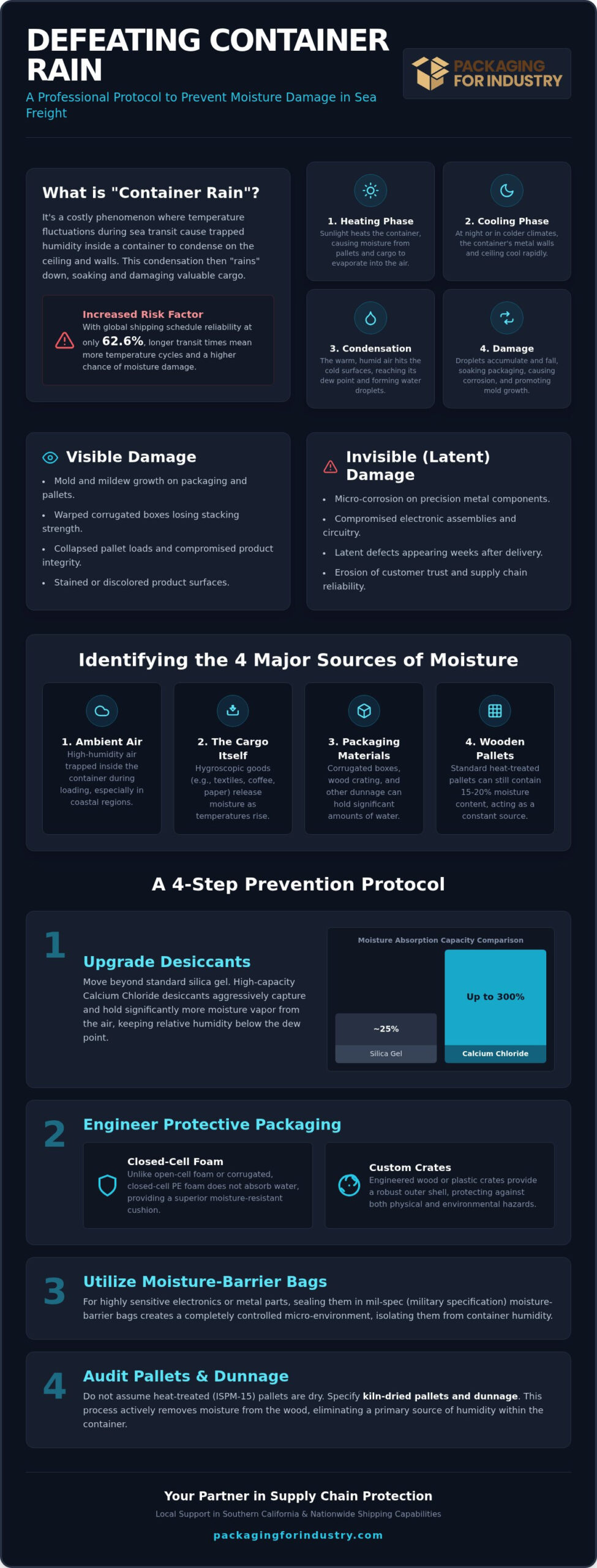
Container rain occurs when moisture-laden air inside a sealed steel box cools and releases its water vapor directly onto the cargo. This phenomenon is a primary reason why manufacturers prioritize learning how to prevent condensation damage in sea freight. As a vessel moves through varying climate zones, the temperature inside the container fluctuates wildly. When the temperature of the container’s ceiling or walls drops below the dew point, the air can no longer hold its moisture. This leads to heavy droplets that mimic a rainstorm inside the hold, often soaking the very top layers of your most valuable products.
The financial consequences of these events extend far beyond the immediate loss of goods. Logistics managers must account for the high costs of salvage operations, labor-intensive re-sorting, and the long-term erosion of customer trust. For high-value sectors like aerospace and electronics manufacturing, even a small amount of moisture can trigger micro-corrosion that renders precision-engineered components useless. These industries don’t just lose a shipment; they lose production time and face potential liability issues if compromised parts reach the assembly line.
The Science of Humidity and Temperature Cycles
Steel containers act like industrial greenhouses. During the day, the sun beats down on the metal, causing internal temperatures to soar and allowing the air to absorb massive amounts of water vapor from wooden pallets, organic cargo, or the ambient air trapped during loading. This is driven by the process of condensation, where water changes state based on rapid thermal shifts. Nightfall at sea is the most dangerous time for your cargo. As the ambient temperature drops, the container skin cools faster than the air inside, reaching the saturation point. This cycle repeats daily, effectively pumping moisture onto your products throughout a multi-week voyage.
Visible vs. Invisible Damage
Moisture damage presents in two distinct forms. Visible damage is easy to spot: mold growth on pallets, warped corrugated boxes that lose their stacking strength, and collapsed pallet loads. These issues are immediate red flags during offloading. However, invisible damage is often more costly for industrial suppliers. While using specialized foam packaging helps mitigate some risks, moisture can still penetrate electronic assemblies if not properly sealed. Latent damage is defined as corrosion that appears weeks after arrival, often after the product has already been integrated into a larger system. Understanding how to prevent condensation damage in sea freight is the only way to ensure these hidden defects don’t compromise your supply chain reliability.
Identifying the 4 Major Sources of Moisture in Your Container
Container rain doesn’t appear out of nowhere. It’s the result of moisture sources already present when the doors are sealed. To understand how to prevent condensation damage in sea freight, you must first audit the four primary contributors to internal humidity. The first is the ambient air. If you’re loading in coastal Southern California regions like Los Angeles or San Diego, the high relative humidity during the loading process becomes trapped. Once the ship hits colder waters, that air reaches its dew point. The second source is the cargo itself. Hygroscopic goods, such as cocoa, coffee, or even certain textiles, release moisture as temperatures rise, creating a localized micro-climate that accelerates condensation.
The third and fourth sources are often overlooked: the pallets and the packaging materials themselves. These components can hold surprising amounts of water that release slowly over a multi-week voyage. By identifying these reservoirs before they enter the container, you can implement proactive measures to keep the internal environment stable and dry.
The Pallet Trap: Heat-Treated vs. Kiln-Dried
A common misconception in the warehouse is that heat-treated pallets are dry. While ISPM-15 heat treatment is a legal requirement for international shipping to kill pests, it doesn’t necessarily remove moisture from the wood. Standard “green” wooden shipping pallets can contain more than ten pounds of water per unit. As the container heats up during the day, this water evaporates into the air. Switching to kiln-dried timber is a critical operational step. Kiln-drying reduces moisture content to specific industrial levels, preventing the pallets from acting as a massive water reservoir during long-haul sea transit.
Packaging Materials as Moisture Reservoirs
Standard industrial corrugated boxes are inherently hygroscopic. They act like sponges, absorbing ambient vapor until they reach a saturation point. When the box becomes wet, it loses its structural integrity and stacking strength, leading to collapsed loads and damaged products. Paper-based dunnage and void-fill materials often exacerbate this problem by holding moisture directly against your cargo. Even stretch film can be a liability if applied incorrectly. While it’s vital for load stability, tight wraps without proper ventilation can trap moisture against the product, leading to “sweating” and corrosion.
Identifying these sources is the first step toward a moisture-free supply chain. If you’re concerned about how these materials impact your shipping reliability, you can request a packaging quote to explore weather-resistant alternatives tailored to your specific route.
5 Proven Methods to Prevent Condensation Damage
Transitioning from identifying moisture sources to active mitigation requires an integrated approach. While many shippers rely on a single method, learning how to prevent condensation damage in sea freight effectively involves layering multiple defenses. You must move beyond passive observation and engineer a shipping environment that actively manages humidity levels throughout the voyage. Implementing these five proven methods will significantly reduce the risk of cargo loss.
- Rigorous Container Selection: Perform a “light test” by stepping inside the container and closing the doors. Any visible light indicates a compromised seal that will allow moist sea air to enter. Ensure the floorboards are bone dry before loading.
- High-Capacity Desiccants: Replace standard silica gel with calcium chloride desiccants. These industrial-grade tools can absorb up to 200-300 percent of their own weight in moisture, providing long-lasting protection.
- Moisture Barrier Bags: Use vacuum-sealed, foil-lined bags for precision parts. This creates a hermetic seal that isolates the product from the container’s internal atmosphere.
- Volatile Corrosion Inhibitors (VCI): Integrate VCI materials into your packaging. VCI molecules form an invisible protective layer on metal surfaces to inhibit the electrochemical process of corrosion.
- Load Stabilization: Pack the container tightly to prevent the “chimney effect.” This phenomenon occurs when gaps between pallets allow warm, moist air to rise rapidly to the ceiling, accelerating the condensation cycle.
Strategic Desiccant Placement
Effective moisture control depends on calculating the correct volume of desiccant based on container size, cargo type, and transit duration. For most 40-foot containers, hanging desiccant poles are superior to floor-placed bags because they are positioned near the ceiling where condensation first forms. These poles capture rising vapor before it can reach the dew point and drip onto your goods. For added security, container liners can protect the entire load from ceiling drips while providing an additional thermal barrier.
Advanced Material Barriers
For high-value industrial goods, standard plastic wraps are often insufficient. Specifying custom poly bags with moisture-vapor proof properties ensures a higher level of protection during long-haul transit. In the defense and aerospace sectors, adhering to MIL-spec standards, such as MIL-DTL-117, is essential for moisture-sensitive shipments. These specialized materials are engineered to withstand extreme temperature fluctuations without losing their barrier integrity. By combining these advanced materials with VCI technology, you create a fail-safe environment that ensures your cargo arrives in factory-fresh condition, regardless of the shipping route.
Engineering Your Packaging for Moisture-Sensitive Logistics
Engineering a shipment for international transit requires more than just picking a box. It involves a technical assessment of how materials interact with the environment, particularly during trans-Pacific routes where humidity is a constant threat. When determining how to prevent condensation damage in sea freight, the design of your secondary packaging is just as critical as the desiccants inside the container. For many industrial applications, we recommend a choice between a ventilated crate design, which allows for airflow, or a completely hermetic seal using moisture-barrier liners.
The choice of cushioning material is a common failure point in moisture-sensitive logistics. While open-cell foams are excellent for shock absorption, they can trap humidity against the product. We prioritize closed-cell foam packaging because it is non-hygroscopic. It provides a consistent thermal barrier without absorbing the ambient vapor that leads to corrosion. This ensures that even if the internal container temperature fluctuates, your cargo remains insulated and dry.
Structural integrity is another concern. High humidity often softens standard corrugated materials, leading to crushed corners and unstable loads. By integrating cardboard edge protectors, you maintain the vertical stacking strength of your pallets even if the ambient air becomes damp. This level of detail is a hallmark of Engineering Custom Crates for International Transit, where every component is selected for its performance under stress.
Custom Crating for Aerospace and Heavy Machinery
Aerospace components and heavy machinery require specialized crating strategies to survive long-haul sea freight. We design our custom crates with raised skids to elevate the cargo off the container floor, which is often the dampest part of the unit. Integrating foam end caps provides necessary shock protection while allowing for strategic gaps that prevent vapor entrapment. This proactive engineering is refined through prototyping in our custom design packaging phase, ensuring every component fits securely and remains protected from moisture.
The Role of Load Stabilization
Load stabilization serves as a final line of defense against moisture-related failure. High-performance stretch film creates a secondary moisture barrier that keeps individual boxes tight and secure. When combined with corner protection, it prevents the “slumping” often seen in high-humidity tropical routes. For manufacturers in Anaheim, Irvine, and Los Angeles, we also offer packaging kitting services. This allows you to group moisture-sensitive components into a single protected assembly, simplifying the loading process and improving overall supply chain reliability.
Why Choose PFI for Your International Shipping Protection
PFI operates as an industrial consultant rather than a simple wholesaler. We understand that knowing how to prevent condensation damage in sea freight is only half the battle; the other half is having the right materials exactly when your operations team needs them. Our specialists engineer comprehensive logistical protection systems that integrate heavy-duty corrugated boxes, mil-spec barrier materials, and high-capacity desiccants into a single, cohesive workflow. This methodical approach ensures that every component of your shipment is shielded from the volatile humidity cycles of sea transit.
For manufacturers in Anaheim, Irvine, and Los Angeles, we provide the advantage of local support backed by nationwide shipping capabilities. We solve the common disconnect between moisture prevention and inventory management through Vendor Managed Inventory (VMI). This service ensures your facility never runs out of critical moisture-vapor proof bags or desiccant poles during peak shipping seasons. By maintaining your stock levels for you, we eliminate the risk of last-minute substitutions that could compromise the safety of your cargo.
Our approach balances engineering with economics. We perform detailed cost-reduction analyses to identify where you can save by optimizing material density and box sizing. By reducing the volume of trapped air in your packaging, we lower the amount of desiccant required and decrease your overall freight costs. This focus on efficiency helps you maintain a leaner supply chain while significantly improving your shipping reliability.
Your Partner in Damage Reduction
We take a proactive, consultative approach to solving shipping damage before it impacts your bottom line. Our clients gain access to high-performance industrial materials, including MIL-DTL-117 compliant barriers and specialized foam packaging for aerospace components. For repeat industrial orders, we offer free prototyping and comprehensive packaging reviews. This allows us to stress-test your shipping configurations and ensure they meet the rigorous demands of trans-Pacific transit. We don’t just provide supplies; we provide the peace of mind that comes from a well-engineered protection strategy.
Ready to Secure Your Sea Freight?
Securing your supply chain starts with a technical evaluation of your current methods. Contact our team today for a custom moisture-protection audit to see exactly how to prevent condensation damage in sea freight for your specific product line. We will help you identify hidden vulnerabilities in your palletization and crating strategies, helping you lower your freight costs and damage rates simultaneously. Our experts are ready to help you optimize your logistics from the initial design phase to final delivery.
Secure Your Global Shipments Against Moisture Risks
Protecting high-value industrial assets requires a shift from reactive salvage to proactive engineering. By identifying moisture sources like green wood pallets and trapped ambient air, you can implement the barrier strategies and high-capacity desiccants needed to maintain cargo integrity. Establishing a repeatable protocol for how to prevent condensation damage in sea freight is an operational requirement for any manufacturer shipping high-value assets across the Pacific. These measures don’t just protect your products; they safeguard your professional reputation and your bottom line.
PFI provides the specialized expertise and mil-spec materials required to eliminate container rain and reduce shipping damage. With our local next-day delivery in Southern California and comprehensive Vendor Managed Inventory programs, your facility in Los Angeles or Orange County will always have the right moisture-prevention supplies in stock. We are specialists in aerospace and industrial manufacturing packaging, focusing on custom-engineered solutions that lower packaging costs and improve long-haul reliability.
Our team is ready to help you engineer a more resilient and cost-effective shipping strategy today.
Frequently Asked Questions
How much desiccant do I need for a 40ft sea container?
You typically need 6 to 12 high-capacity desiccant poles for a standard 40ft container. The exact amount depends on your cargo’s hygroscopic nature and the specific transit route. For high-moisture routes or organic cargo like wood and textiles, you should increase this count to ensure the dew point is never reached. Our team can help you calculate the precise volume needed to effectively manage how to prevent condensation damage in sea freight based on your specific logistical data.
Is heat-treated wood safe for moisture-sensitive cargo?
No, heat-treated wood is not a guarantee of dryness. While ISPM-15 heat treatment kills wood-boring pests, it doesn’t necessarily reduce the moisture content of the timber. Green wood pallets can still release significant amounts of water vapor as temperatures rise inside a container. For moisture-sensitive industrial cargo, you should specify kiln-dried pallets with a moisture content below 20 percent to minimize the risk of “container rain” during long voyages.
What is the difference between silica gel and calcium chloride desiccants?
The primary difference lies in absorption capacity and duration. Silica gel is generally effective for small, sealed packages but saturates quickly in the high-volume environment of a shipping container. Calcium chloride desiccants are the industry standard for sea freight because they can absorb up to 300 percent of their own weight. This makes them significantly more efficient for multi-week transits where long-term moisture control is essential for protecting high-value metal parts and electronics.
Can stretch film prevent condensation damage?
Stretch film provides a secondary barrier against external drips, but it doesn’t stop the internal condensation process. If moisture is trapped inside the wrap during the loading process, temperature shifts can cause the product to “sweat” under the plastic. To prevent damage, you should use stretch film in conjunction with internal desiccants or VCI materials. This integrated approach ensures that any moisture present is absorbed before it can cause corrosion on your precision-engineered components.
How do I know if my container has a moisture problem before it ships?
You can identify potential moisture issues by performing a thorough pre-loading inspection. Start with a “light test” to check for door seal leaks and use a moisture meter to verify that the container’s wooden floorboards are dry. If you’re loading in high-humidity areas like Los Angeles or San Diego, you’re already introducing moisture-laden air. Understanding these environmental factors is the first step in learning how to prevent condensation damage in sea freight before the vessel even leaves the port.
What are VCI bags and how do they work for sea freight?
VCI (Volatile Corrosion Inhibitor) bags release specialized molecules that create an invisible, protective layer on metal surfaces. This molecular barrier prevents oxygen and moisture from reacting with the metal, effectively stopping the electrochemical process of rust and corrosion. These bags are essential for sea freight because they provide continuous protection even if the external packaging becomes damp. They are a pragmatic choice for aerospace and automotive manufacturers who need to ensure parts arrive in factory-ready condition.
Does PFI provide custom-sized moisture barrier bags in Southern California?
Yes, PFI provides custom-sized moisture barrier bags with local delivery throughout Southern California. We specialize in tailoring packaging solutions for manufacturers in Anaheim, Orange County, and the Inland Empire. Our team can produce bags that meet specific mil-spec standards or custom dimensions for large industrial machinery. By sourcing locally, you reduce lead times and can leverage our Vendor Managed Inventory programs to keep your production lines moving without interruption.
What is the best type of foam for international shipping in high humidity?
Closed-cell polyethylene (PE) foam is the superior choice for high-humidity international shipping. Unlike open-cell foams, which can act like a sponge and trap moisture against your product, closed-cell foam is non-absorbent. It maintains its structural integrity and cushioning properties even in damp environments. This makes it an ideal material for custom inserts and end caps when shipping sensitive electronics or aerospace components through tropical climate zones where humidity levels are consistently high.