
With California’s ag-tech market reaching a projected $31.26 billion in 2026, the hardware powering modern farms has never been more sophisticated or more vulnerable. High-value robotics and sensitive sensors require more than standard shipping supplies to survive the rigors of the agricultural supply chain. Finding specialized industrial packaging for ag-tech companies in California is now a critical operational requirement rather than a simple procurement task. You’ve likely dealt with the frustration of sensors arriving damaged or the sting of “Additional Handling” surcharges due to inefficient crate dimensions.
We understand that every minute of downtime caused by shipping damage is a direct hit to your bottom line. This guide provides actionable strategies to protect your equipment, reduce total cost of ownership, and ensure compliance with new California SB 54 packaging mandates. We’ll examine how custom-engineered foam inserts and heavy-duty corrugated boxes prevent transit failure. You’ll also learn how local vendor-managed inventory programs can eliminate lead-time delays and free up valuable warehouse space. From rapid prototyping in Southern California to navigating new carrier dimensional weight rules, this resource covers the essential logistics of protecting innovation.
Key Takeaways
- Protect sensitive electronics from rural road vibration using custom-engineered foam inserts and triple-wall corrugated boxes.
- Reduce shipping expenses by utilizing custom-sized packaging to minimize dimensional weight and avoid 2026 carrier surcharges.
- Secure specialized industrial packaging for ag-tech companies in California through local partners offering free prototyping and next-day delivery.
- Reclaim warehouse floor space and improve logistical flow with Vendor Managed Inventory and just-in-time delivery programs.
- Navigate California SB 54 compliance requirements while maintaining high-performance protection for specialized agricultural robotics.
The Unique Logistics Challenges for California Ag-Tech Hardware
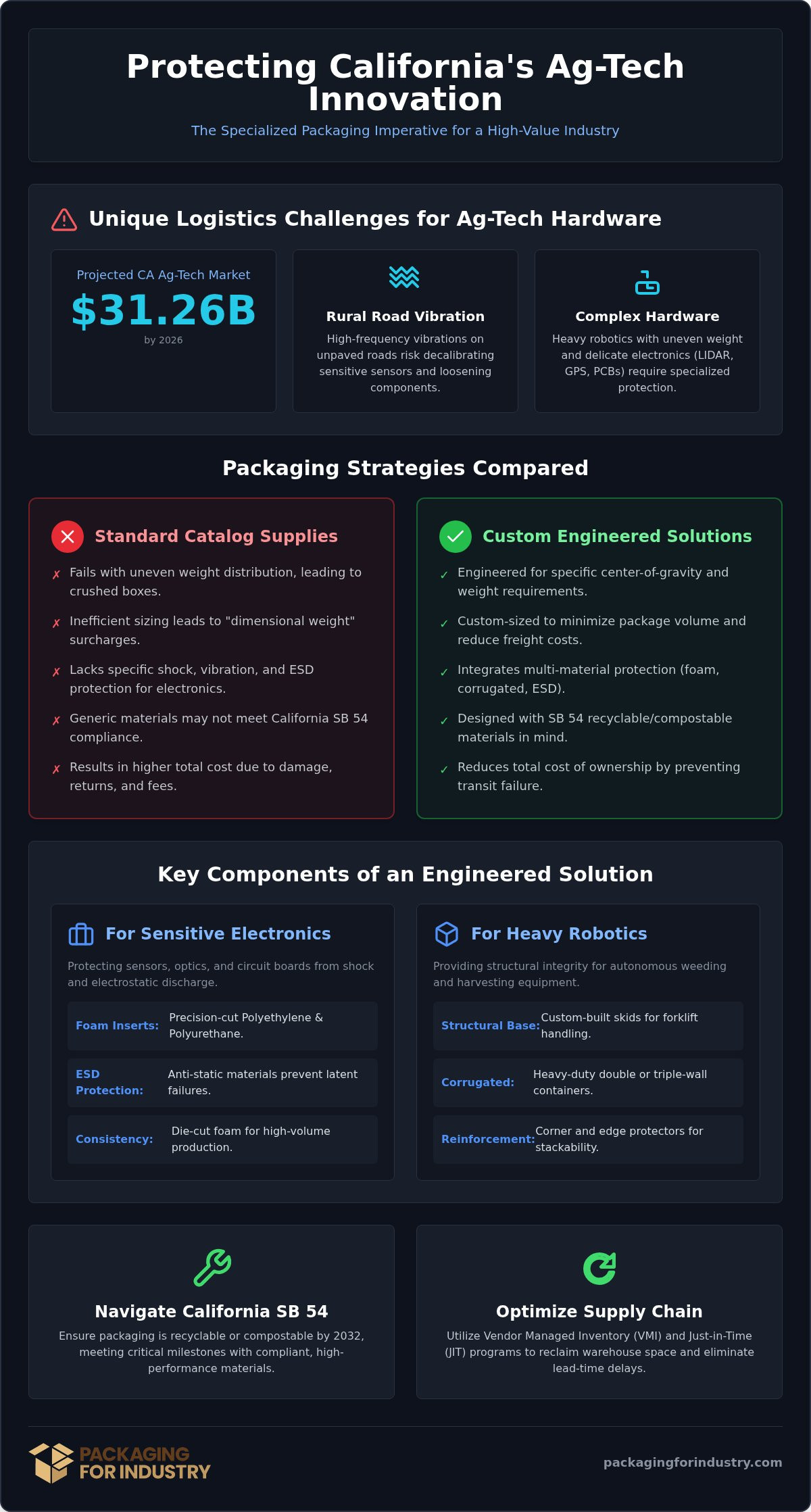
California leads the nation in agricultural output, generating over $59 billion in cash receipts. However, the hardware enabling this productivity often faces a perilous journey from the manufacturing floor to the field. Providing effective industrial packaging for ag-tech companies in California requires understanding the science, art, and technology of enclosing or protecting products against unique regional stressors. The “Central Valley Transit” problem is a primary example. While a sensor might survive a cross-country flight, the final ten miles on unpaved rural roads in Fresno or Kern County introduce high-frequency vibrations that can loosen internal connections or decalibrate optics.
Beyond physical protection, California’s SB 54 mandates that all single-use packaging be recyclable or compostable by 2032, with significant implementation milestones already in effect as of May 2026. This adds a layer of complexity for firms scaling production in Irvine or Los Angeles. You need heavy-duty protection that also meets strict environmental standards. Standard catalog supplies rarely account for these specific regulatory and geographic hurdles.
Protecting Sensitive Sensors and Autonomous Systems
Ag-tech relies on precision instrumentation like LIDAR and GPS modules that are sensitive to shock and electrostatic discharge (ESD). Transit through dusty environments or high-humidity coastal regions requires specialized barriers to prevent contamination. We use custom-engineered foam packaging to isolate these components from impact. For field-deployed PCBAs, ESD-safe materials are mandatory to prevent latent failures that don’t appear until the equipment is activated on-site. Precision-cut polyethylene inserts ensure that even the smallest components remain seated during turbulent transport.
Shipping Heavy-Duty Field Robotics
Autonomous weeding and harvesting robots present different logistical hurdles. These units are often heavy and have uneven weight distributions, making standard corrugated boxes insufficient. Transitioning from R&D to commercial scale requires custom design packaging solutions that prioritize structural integrity. Key components for these systems include:
- Custom-built skids: Engineered to support heavy chassis and facilitate forklift handling.
- Heavy-duty corrugated: Utilizing double-wall or triple-wall containers to prevent bulging under load.
- Corner and edge protection: Reinforcing vertical strength to allow for safe stacking in the warehouse.
Standard catalog supplies often fail because they aren’t engineered for the specific center of gravity of a robotic harvester. This leads to crushed boxes and expensive repairs. By focusing on the intersection of engineering and logistics, we help you avoid these common failure points.
Custom Engineered Solutions: Beyond the Standard Shipping Box
While many agricultural suppliers focus on cardboard for produce, hardware manufacturers need a different level of engineering. Providing effective industrial packaging for ag-tech companies in California means moving away from stock catalog items. High-value robotics and autonomous systems require a multi-material approach that integrates shock absorption with structural rigidity. Standard boxes don’t account for the unique center of gravity found in field equipment, which often leads to transit damage and increased freight costs.
Precision Protective Foam Packaging
For high-volume production, die-cut foam offers superior consistency compared to foam-in-place methods. It ensures every unit fits perfectly within its protective envelope, reducing the risk of human error during kitting. We design custom foam inserts using polyethylene for its closed-cell durability or polyurethane for softer, more delicate cushioning. These materials are essential for optical sensors and cameras that cannot tolerate even minor surface abrasions. If your hardware includes sensitive circuit boards, anti-static (ESD) foam is a critical safeguard against latent electrical damage that can occur during handling. This precision-engineered cushioning is a primary defense against the vibrations found on rural transit routes.
Custom Crates and Heavy-Duty Corrugated
Choosing between custom corrugated boxes and wood crates often comes down to weight and transit duration. Triple-wall corrugated provides industrial-strength protection while significantly reducing dimensional weight. This helps you avoid the high cubic volume surcharges carriers like UPS and FedEx implemented in early 2026. For example, packages exceeding 10,368 cubic inches now trigger automatic “Additional Handling” fees. Custom sizing ensures your footprint is as small as possible without sacrificing safety.
For larger field equipment or international expansion, custom shipping crates remain the gold standard. We ensure all wood packaging complies with the strict ISPM 15 hyphen requirements enforced by APHIS as of January 2026. This attention to detail prevents your shipments from being rejected at international borders due to formatting errors on the heat-treatment mark. By combining foam, corrugated, and stretch film into a single SKU, we streamline your assembly line and reduce the number of vendors you manage.
If you’re looking to optimize your current design or move from a prototype to commercial scale, you can request a packaging quote to see how an integrated solution lowers your total cost of ownership. We focus on the intersection of engineering and economics to ensure your hardware arrives intact and your shipping budget stays under control.
Comparing Packaging Strategies: Custom Engineering vs. Catalog Supplies
Procurement teams often lean toward catalog supplies for speed and perceived simplicity. However, the one-size-fits-all approach is rarely compatible with the high-precision requirements of ag-tech hardware. When you select industrial packaging for ag-tech companies in California, you must weigh the upfront cost of stock boxes against the long-term expenses of shipping damage and wasted freight capacity. Catalog items often require excessive void-fill, which increases assembly time and adds unnecessary volume to every shipment.
Carrier rules in 2026 make box dimensions as important as actual weight. UPS and FedEx round every fractional inch up to the next whole number and utilize a 139 divisor for domestic dimensional weight. If your packaging is even slightly oversized, you’re paying to ship air. Custom-engineered solutions eliminate this “air tax” by ensuring the box footprint is optimized to the millimeter. This precision is the most effective way to avoid the cubic volume surcharges that now trigger automatically for packages exceeding 10,368 cubic inches.
The Cost of Shipping Damage in Ag-Tech
A single damaged unit represents a logistical nightmare that goes far beyond a simple repair bill. You have to account for the cost of expedited return freight, the labor for diagnostic testing, and the potential loss of a seasonal window for your customer. Conducting packaging reviews for damage reduction helps identify exactly where stock cushioning fails under the specific stresses of agricultural transport. For high-ticket robotics, the ROI of specialized packaging is realized the moment it prevents a single field failure. It’s about protecting your reputation as much as your hardware.
Prototyping and CAD/CAM Support
Ag-tech firms require a “measure twice, cut once” approach to logistics, especially during the transition from R&D to commercial scale. We provide free prototyping to ensure that your newest hardware rollouts have a perfect fit from day one. Using CAD design, we translate the complex geometry of your assemblies into precision-cut foam and corrugated structures. This iterative design process allows you to refine your packaging alongside your product development. Moving from alpha units to mass production becomes a seamless transition rather than a secondary hurdle. This level of support is essential for startups in Irvine or San Diego that need to scale rapidly without risking product integrity.
Optimizing the Ag-Tech Supply Chain with VMI and JIT
Scaling an ag-tech startup in competitive markets like Irvine or Los Angeles often leads to the “warehouse squeeze.” As production ramps up for robotic weeding or autonomous harvesting systems, floor space becomes a premium asset. Dedicating vast areas to bulk-purchased corrugated boxes or oversized foam inserts is an inefficient use of capital. By transitioning to a more agile supply chain, you can reclaim this space for manufacturing and R&D activities. Efficient logistics management ensures that your industrial packaging for ag-tech companies in California supports growth rather than hindering it.
Implementing Vendor Managed Inventory (VMI)
Traditional procurement often results in either costly stockouts or bloated inventory. Packaging VMI programs solve this by shifting the responsibility of stock management to your supplier. We conduct regular inventory reviews in Southern California manufacturing hubs to ensure your levels are always aligned with current demand. This automated replenishment model reduces the administrative burden on your procurement team, allowing them to focus on high-value hardware sourcing rather than counting boxes. It’s a pragmatic approach that prioritizes operational uptime and eliminates the stress of last-minute supply gaps.
Kitting and Assembly Services
Speed is essential when you’re meeting seasonal agricultural deadlines. Packaging kitting streamlines your production line by delivering pre-assembled components directly to your pack-out station. Instead of your team wasting hours folding RSC boxes or hand-fitting foam inserts, they receive a single kit ready for the product. These integrated material solutions reduce labor costs and eliminate the bottleneck often found at the end of the assembly line. It turns a complex packaging process into a simple, repeatable task.
Just-In-Time (JIT) delivery further optimizes this process by synchronizing packaging arrival with your specific production schedule. This approach improves cash flow by eliminating the need for bulk-buy storage and reducing the risk of inventory obsolescence if a hardware design changes. You only pay for what you need, when you need it. This fiscal responsibility is vital for scaling firms that need to maintain liquidity while expanding their market footprint.
Choosing a California Partner for Ag-Tech Packaging
Selecting a logistics partner in the ag-tech sector requires more than a simple price comparison. It’s a strategic decision that affects your product’s survival and your company’s fiscal health. High-value agricultural hardware is unique. It demands the precision of aerospace-grade protection combined with the ruggedness needed for Central Valley transit. When you evaluate industrial packaging for ag-tech companies in California, look for a partner who treats your hardware with the same rigor as medical or aviation equipment. A consultative approach identifies hidden risks in your supply chain that a standard catalog transaction will always miss.
A seasoned partner acts as a “fixer” for your operational bottlenecks. Instead of just selling you a box, they should analyze your entire logistical flow. This includes everything from the initial CAD design of a foam insert to the final stretch film application that secures a pallet for international export. Expertise in specialized sectors is a strong indicator of capability. If a supplier can meet mil-spec requirements or protect sensitive medical optics, they’re well-equipped to handle the sensors and robotics powering modern farms. While we provide local support, our nationwide shipping capabilities ensure you stay protected as you scale beyond the West Coast.
Local Expertise in Southern California
Operating within the primary innovation hubs allows for a level of agility that out-of-state suppliers can’t match. We provide dedicated support to ag-tech firms in Irvine, Anaheim, and the Inland Empire. This local presence is vital when production schedules shift or urgent needs arise. In the fast-paced environments of Los Angeles and Orange County, having access to next-day delivery can prevent a minor supply delay from becoming a major production halt.
For local manufacturing facilities, on-site packaging reviews are a significant advantage. A physical walkthrough of your assembly line often reveals opportunities for kitting or VMI that aren’t apparent over a phone call. We’re not just a vendor; we’re a local extension of your operations team, helping you navigate the intersection of engineering and economics.
Requesting a Quote and Moving Forward
The transition to optimized packaging begins with a comprehensive audit of your current hardware specs and shipping data. To ensure an accurate quote, prepare details such as unit dimensions, weight distribution, and typical transit destinations. We’ll use this data to create a custom protection strategy that balances material costs with freight efficiency. Our process focuses on tangible outcomes, utilizing rapid prototyping to verify fit and function before you commit to a full production run. This “measure twice” philosophy is how we help you eliminate shipping damage and reclaim warehouse space.
We look forward to helping you optimize your logistics and drive the next generation of agricultural technology forward with confidence.
Frequently Asked Questions
What is the best packaging for sensitive Ag-Tech sensors?
Custom-engineered polyethylene foam inserts provide the most reliable protection for delicate optical sensors. These closed-cell materials absorb high-frequency vibrations common on rural transit routes. When paired with heavy-duty double-wall corrugated boxes, they create a rigid protective envelope. This setup prevents internal component shifting and protects against moisture or dust ingress. It’s a superior alternative to loose-fill materials that settle during transport and leave sensitive instrumentation vulnerable.
How can California Ag-Tech companies reduce their shipping costs?
Reducing dimensional weight is the most effective way to lower shipping costs. Carrier updates in 2026 penalize oversized boxes with significant cubic volume surcharges. Utilizing industrial packaging for ag-tech companies in California ensures your box is only as large as necessary. This optimization eliminates the “air tax” and prevents automatic “Additional Handling” fees for packages exceeding 10,368 cubic inches. It’s a strategic move that directly improves your bottom line.
Does PFI offer custom foam inserts for small-batch Ag-Tech prototypes?
Yes, we offer free prototyping to ensure your specialized hardware has a perfect fit from the initial alpha units. We use CAD design to create precision foam assemblies and custom-sized corrugated structures. This iterative process allows you to refine your packaging alongside your hardware development. Once you’re ready to scale, we transition your design into high-volume production without engineering delays. It’s a “measure twice, cut once” approach for your logistics.
What are the benefits of Vendor Managed Inventory (VMI) for Ag-Tech startups?
Vendor Managed Inventory (VMI) allows ag-tech startups to reclaim valuable warehouse floor space for production and R&D. By letting your supplier manage stock levels, you eliminate the need for bulk-buy storage and reduce the risk of inventory obsolescence. This program prevents stockouts during peak production cycles and improves cash flow. It’s a pragmatic solution for scaling firms in Irvine or Los Angeles that need to maintain liquidity and operational agility.
Can PFI handle heavy-duty packaging for large autonomous field robots?
We specialize in heavy-duty packaging solutions for oversized autonomous field equipment, including triple-wall corrugated boxes and custom wood crates. These structures are engineered to support uneven weight distributions and heavy chassis. For international expansion, we ensure all wood packaging complies with the strict ISPM 15 hyphen requirements enforced as of January 2026. This prevents transit delays at borders and ensures your robotics arrive intact regardless of the shipping distance.
Do you provide ESD-safe packaging for Ag-Tech electronics?
We provide a full range of ESD-safe materials, including anti-static foam and shielding bags, specifically for ag-tech electronics. Sensitive PCBAs and GPS modules are vulnerable to latent electrical damage during handling and transport. Using ESD-safe polyethylene foam ensures your components are protected from static discharge while maintaining high-performance cushioning. This level of protection is critical for ensuring field reliability and reducing the rate of expensive and time-consuming warranty returns.
How quickly can PFI deliver custom boxes to Southern California locations?
We offer local next-day delivery for stocked items and rapid turnaround times for custom-engineered orders. Our facilities are strategically located to serve Southern California hubs like Anaheim, San Diego, and the Inland Empire. This proximity allows us to respond quickly to urgent production needs or sudden shifts in demand. Whether you need a standard RSC box or a complex kitting assembly, our local manufacturing ensures your supply chain remains uninterrupted.
Is custom-engineered packaging more expensive than buying from a catalog?
Custom-engineered packaging often provides a lower total cost of ownership than catalog supplies. While the per-unit price of a stock box might seem lower, the hidden costs of damage and excessive void-fill quickly add up. Custom solutions use less material and reduce dimensional weight, which lowers your freight expenses. When you compare packaging pricing, the reduction in transit damage alone often justifies the investment in specialized engineering and precision materials.