
Every ounce of excess weight on a shipping platform is a direct hit to your bottom line when moving high-value cargo through one of the world’s busiest hubs. For manufacturers in Carson, Torrance, and across Southern California, the challenge isn’t just getting goods to the terminal; it’s ensuring they don’t get grounded by weight surcharges or compliance issues. Using standard, heavy pallets often means paying to ship unnecessary lumber, which quickly erodes your profit margins. Finding the right custom pallets for air freight from LAX is essential for maintaining both fiscal responsibility and operational flow.
We understand that navigating international export regulations while trying to lower shipping costs can feel like an impossible balancing act. You need a solution that guarantees durability without the bulk. This guide will show you how to specify custom, ISPM 15 compliant pallets that reduce air freight weight and ensure seamless transit through LAX. We’ll examine engineering strategies that minimize chargeable weight, the critical importance of heat-treated wood for global compliance, and how precision-built platforms protect sensitive aerospace and medical components from airport handling damage. By the end of this article, you’ll have a clear roadmap for optimizing your air cargo logistics.
Key Takeaways
- Learn how custom engineering reduces pallet weight to lower air freight surcharges while maintaining the strength needed for heavy industrial loads.
- Discover how to specify custom pallets for air freight from LAX that meet mandatory ISPM 15 heat treatment standards for seamless international export.
- Identify why standard pallet sizes often lead to wasted space in air cargo containers and how custom dimensions improve volume efficiency.
- Understand how local Southern California manufacturing and VMI programs reduce lead times and ensure your facility never faces a shipping delay.
- See how custom pallet systems integrated with protective foam inserts safeguard high-value aerospace and electronics components during airport handling.
Air Freight Logistics at LAX: Why Standard Pallets Fail
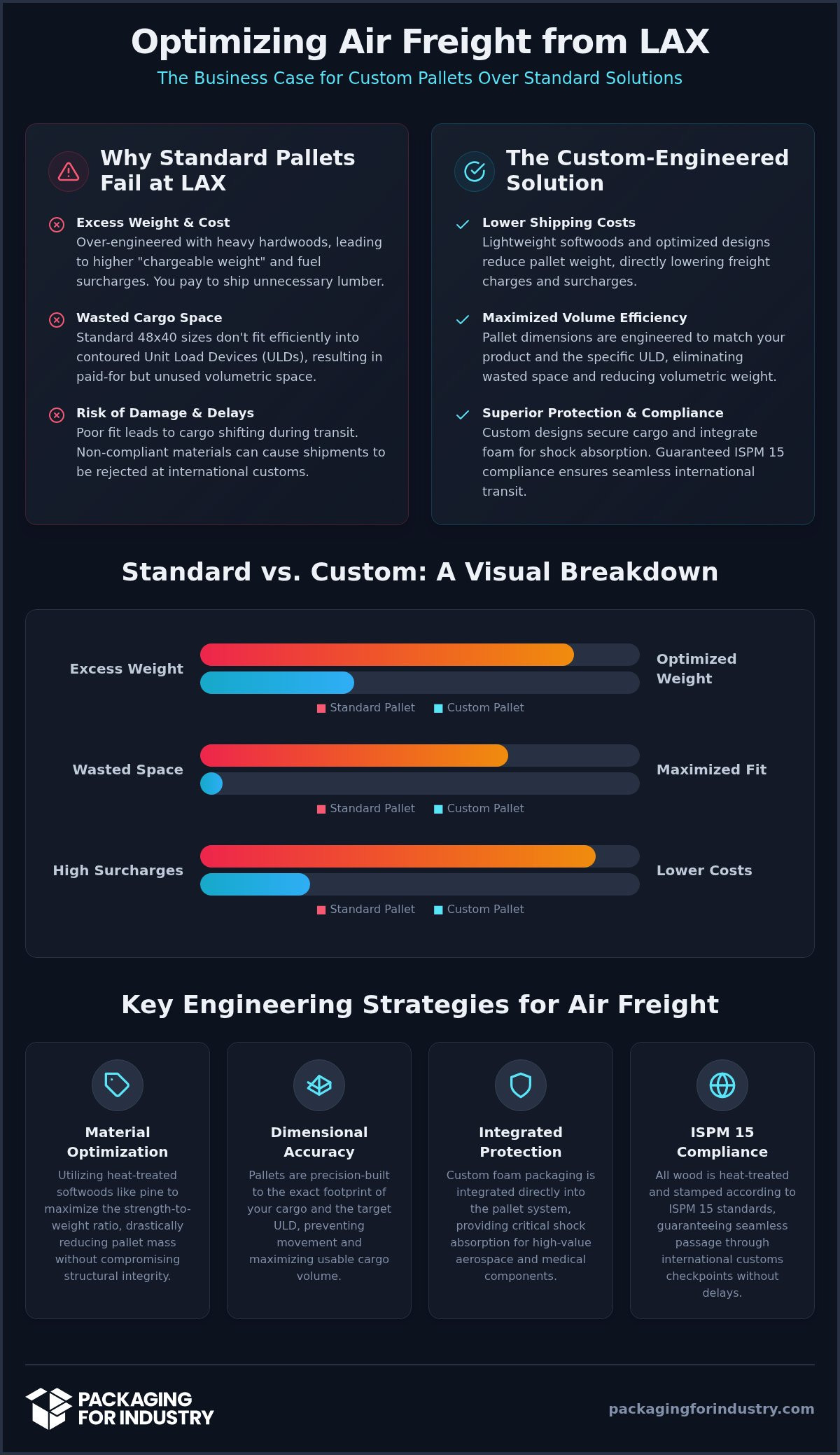
Moving cargo through Los Angeles International Airport (LAX) requires a level of precision that standard warehouse equipment simply can’t provide. While a traditional 48×40 pallet works well for domestic trucking, it’s often a liability in the air cargo environment. The high speed of terminal handling and the strict dimensions of aircraft holds mean that off-the-shelf solutions frequently result in damaged goods or rejected shipments. Standard pallets are built for static storage, not the dynamic forces and space constraints of flight.
Understanding the LAX Cargo Environment
For manufacturers in Carson and Torrance, proximity to the airport is a major logistical advantage. However, that advantage is lost if your freight forwarder has to repack your shipment because the pallets don’t fit into Unit Load Devices (ULDs). These specialized containers are contoured to fit aircraft fuselages, and standard square pallets often leave significant wasted space. When you utilize custom pallets for air freight from LAX, you can match the base dimensions to specific ULD footprints. This maximizes volume efficiency and prevents cargo from shifting during transit. This is especially vital for aerospace components that require specialized footprints for stability.
The Financial Impact of Pallet Weight
In the world of air logistics, you pay for every ounce. Carriers calculate rates based on “chargeable weight,” which is whichever is higher: the actual weight or the volumetric weight. If your pallet is over-engineered with heavy hardwoods, you’re paying a premium to ship excess lumber. Reducing pallet weight by even a small margin can help lower packaging costs significantly over hundreds of annual shipments.
We see many businesses over-engineer their wood packaging because they fear transit damage. However, modern engineering allows for lightweight softwood designs that maintain high weight capacities. Avoiding unnecessary weight doesn’t just save on the base rate; it also helps you bypass expensive fuel surcharges. To see how a lighter, more efficient design can affect your bottom line, request a packaging quote tailored to your specific shipping lanes.
Engineering Custom Pallets: Balancing Weight and Strength
Designing a pallet for air cargo is fundamentally different from building one for a warehouse rack. The primary objective is to maximize the strength-to-weight ratio. High-density hardwoods provide immense durability, but their mass can significantly inflate shipping costs. Most custom pallets for air freight from LAX utilize heat-treated softwoods, such as pine, which offer sufficient structural integrity at a fraction of the weight. By selecting materials based on the specific load profile, manufacturers can avoid paying for over-engineered lumber that doesn’t add protective value.
Material Optimization for Air Cargo
Softwood is the industry standard for air freight because it’s lightweight and easily compliant with international standards. For heavy industrial machinery, we might specify a hybrid skid that uses hardwood only for the primary load-bearing stringers while keeping the rest of the deck in softwood. This targeted use of materials keeps the actual weight low. It’s also important to consider the “chargeable weight” gap. Air carriers calculate rates based on volume or weight, whichever is higher. A pallet that is too large for the cargo increases the volumetric weight, while one that is too heavy increases the actual weight. Engineering the footprint to be the exact size of the cargo ensures you aren’t paying for empty air or excess wood.
Structural Integrity for High-Value Goods
Protecting sensitive components requires more than just a sturdy base. We often integrate custom foam packaging directly into the pallet system to provide shock absorption during airport handling. This is critical for aerospace and medical electronics that can’t tolerate the vibrations of flight or the jolts of forklift transfers. Strategic engineering features include:
- Custom stringer configurations: We place supports strategically to align with the heaviest points of your product.
- Integrated blocking and bracing: This feature secures the product to the pallet, eliminating the need for complex internal crating.
- 4-way entry designs: These provide essential accessibility for forklift and pallet jack operators in the confined spaces of cargo holds.
Our process starts with free prototyping to verify the fit and performance of your design before full production. This ensures that your custom pallets for air freight from LAX perform exactly as needed under real-world conditions. If you’re looking to optimize your current design for better weight efficiency, you can compare packaging pricing for a custom-engineered solution that meets your specific load requirements.
ISPM 15 Compliance and International Export Standards
Exporting goods internationally through Los Angeles requires strict adherence to global phytosanitary standards. ISPM 15 is a mandatory regulation designed to prevent the spread of wood-boring pests through timber packaging. For any business utilizing custom pallets for air freight from LAX, ensuring every piece of wood is properly heat-treated and certified is a requirement for border entry. Without the official IPPC mark, your shipment faces immediate risks:
- Cargo rejection at the destination port
- Mandatory quarantine and associated storage fees
- Costly de-palletization and repacking requirements
- Potential destruction of the wood packaging at the shipper’s expense
Non-compliance doesn’t just stall a single shipment; it can damage your reputation with international partners and lead to increased scrutiny from customs officials on future exports. We prioritize regulatory certainty so your logistics team can focus on delivery rather than damage control, while Cargo Insure Online offers the specialized coverage needed for international logistics.
The certification hinges on the Heat Treatment (HT) process. This involves heating the wood core to a minimum temperature of 56 degrees Celsius for at least 30 minutes. This thermal intervention eliminates larvae and insects without the use of chemicals, which is vital for sensitive electronics and medical devices that could be affected by fumigants. Once treated, the wood receives a permanent IPPC stamp. This mark includes the country code, a unique manufacturer ID, and the “HT” designation. If you modify a recycled pallet by replacing boards, the entire unit must be re-certified to maintain its legal status for export.
Compliance for Aerospace and Electronics
In the aerospace sector, compliance must coexist with extreme structural precision. It’s common to integrate these compliant bases with custom shipping crates for total protection. This holistic approach ensures that while the base meets international law, the enclosure protects against the physical rigors of flight. We ensure that the heat treatment process doesn’t compromise the moisture content or strength of the wood, providing a stable platform for your most critical assets. By managing the certification in-house, we help you avoid the delays that often plague manufacturers who rely on uncertified local suppliers. Using custom pallets for air freight from LAX that are pre-certified allows for faster terminal processing and lower packaging costs over time.
Procurement Strategies for Southern California Manufacturers
Procuring the right shipping platforms is only half the battle; managing that supply effectively is what ensures long-term operational success. For manufacturers in Carson and Torrance, proximity to LAX means logistics move fast. You can’t afford to wait weeks for specialized wood packaging. Local manufacturing and strategic inventory management are the keys to maintaining a steady flow of custom pallets for air freight from LAX without ballooning your overhead costs.
Optimizing Your Pallet Supply Chain
Implementing a Vendor Managed Inventory (VMI) program is one of the most effective ways to streamline your operations. Instead of dedicating valuable floor space to stacks of empty pallets, we manage the stock levels for you. We monitor your usage patterns and provide scheduled replenishment based on your actual air freight volume. This proactive approach prevents production stops caused by unexpected pallet shortages. It also allows your warehouse team to focus on fulfillment rather than inventory tracking.
This system works perfectly with just-in-time (JIT) delivery models. Because we manufacture locally in Southern California, we can provide next-day delivery to LAX-adjacent facilities. You get the benefit of custom-sized footprints and ISPM 15 compliance without the lead times associated with national catalog suppliers. By utilizing off-site stocking programs, you effectively expand your warehouse capacity without increasing your rent.
Lowering Total Packaging Costs
Many businesses mistakenly believe that large national catalog suppliers offer the best value. However, when you lower packaging costs, you must look at the total cost of procurement. Catalog companies often have “hidden” costs, including high shipping fees for bulky items and a lack of custom engineering that leads to the “chargeable weight” issues discussed earlier. PFI provides a cost-saving alternative by engineering the pallet to the specific load, reducing both the material cost and the eventual freight bill.
Consolidating your supplies is another major opportunity for efficiency. Beyond pallets, we supply essential secondary materials like stretch film and corner and edge protection. Ordering these together reduces administrative work and ensures that all your packaging components are designed to work as a single, cohesive system. Whether you need bulk quantities or tiered replenishment, our pricing is structured to support your specific business scale.
Why PFI is the Preferred Choice for LAX Air Freight
Choosing a packaging partner involves more than just finding a supplier; it’s about securing a consultant who understands the high stakes of international logistics. At PFI, we’ve built our reputation on providing industrial reliability for the most demanding sectors in Southern California. Our proximity to the airport allows us to offer next-day local delivery to Carson, Torrance, and the Inland Empire. This speed, combined with our technical expertise, makes us the logical choice for businesses that can’t afford shipping delays or damaged cargo.
Tailored Solutions for Specialized Industries
We recognize that a standard base isn’t sufficient for high-value components. Our custom pallets for air freight from LAX are engineered to meet the specific requirements of the aerospace and defense industries. For example, we design heavy-duty platforms specifically for fragile turbine engines that require unique weight distribution and vibration dampening. For the electronics sector, we integrate ESD-safe foam packaging with our pallet systems to prevent static discharge during transit. We also support the medical device industry by providing packaging that adheres to strict cleanliness protocols, ensuring your products arrive ready for use in sterile environments. By combining pallets with custom foam and crates, we provide a single-source solution for complex logistical challenges that many catalog suppliers simply can’t address.
Get a Custom Pallet Quote
Our process is rooted in precision and accountability. We don’t just sell wood; we provide engineered protection. Every project begins with a detailed CAD design phase where we map out the structural requirements of your load to ensure the base can handle the dynamic forces of flight. We then offer free prototyping for custom designs, allowing you to verify the fit and performance of your custom pallets for air freight from LAX before committing to a full production run. This proactive approach is designed to help you lower packaging costs by eliminating material waste and reducing the risk of expensive transit damage. If your current shipping system is resulting in high freight surcharges or damaged goods, it’s time for a professional packaging review to identify areas for optimization.
Working with a local expert ensures that your supply chain remains resilient against global disruptions. We’re committed to your operational efficiency and long-term fiscal responsibility. To see how our engineering can improve your bottom line, take the first step today.
Optimize Your Air Cargo Logistics for Global Success
Optimizing your air cargo logistics requires a strategic approach that balances weight reduction with structural integrity. Throughout this guide, we’ve explored how engineering specifically for the LAX environment eliminates the waste associated with standard pallet sizes. By utilizing custom pallets for air freight from LAX, your business can significantly lower shipping surcharges while ensuring high-value aerospace and medical components remain protected during rapid terminal handling.
Operational success in global trade depends on regulatory certainty and a reliable supply chain. Our ISPM 15 certified heat treatment processes guarantee that your wood packaging meets all mandatory international standards, effectively preventing customs rejections. We combine this compliance with specialized expertise and local next-day delivery to provide a steady partnership that eliminates professional stress. It’s time to move beyond one-size-fits-all platforms and embrace a system built for precision.
We’re ready to help you streamline your operations and ensure your shipments move through LAX without delay. Let’s build a more efficient logistics future together.
Frequently Asked Questions
What are the standard dimensions for air freight pallets at LAX?
While the 48×40-inch GMA pallet is a warehouse standard, air freight often requires custom sizes to fit the contours of aircraft Unit Load Devices (ULDs). Common ULD-compatible footprints include 96×125 inches or 88×125 inches, but cargo often needs unique bases to maximize aircraft floor space. Custom sizes are available to match your specific product footprint while adhering to the internal dimensions of the aircraft used for the shipment.
Do custom pallets for air freight need to be ISPM 15 certified?
Yes, all wood packaging material used for international exports from LAX must be ISPM 15 certified. This regulation requires the wood to undergo heat treatment to eliminate wood-boring pests. Every certified pallet must display the IPPC mark, which includes the country code and the manufacturer’s unique ID. Using non-compliant wood can lead to rejected shipments at the destination port. We provide ISPM 15 certified heat treatment for all our custom-engineered wood products.
How does pallet weight affect my air freight shipping costs?
Pallet weight directly impacts your “chargeable weight,” which is the higher value between actual weight and volumetric weight. Because air carriers charge by the pound, every ounce of excess lumber increases your freight bill. By using lightweight heat-treated softwoods and precision engineering, we help you lower packaging costs. Reducing a pallet’s weight by even a small margin can result in significant annual savings for high-volume shippers moving cargo through Southern California hubs.
What is the difference between a pallet and a heavy-duty skid?
A pallet typically has both a top and bottom deck, allowing for double-stacking and stability in a warehouse. A heavy-duty skid is a single-deck loading platform that lacks a bottom deck. Skids are often used for oversized or exceptionally heavy industrial machinery because they are easier to drag and take up less vertical space in an aircraft hold. We offer both custom pallets for air freight from LAX and heavy-duty skids tailored to your equipment’s weight.
Can I get custom pallets delivered next-day in Southern California?
Yes, we provide local next-day delivery for many of our stock and recurring custom items throughout Southern California. Our manufacturing facilities are strategically located to serve businesses in Carson, Torrance, and the Inland Empire. By maintaining a local presence, we eliminate the long lead times associated with national catalog suppliers. This proximity allows your operations to remain agile and respond quickly to urgent air freight demands without facing production bottlenecks or supply chain gaps.
Does PFI offer prototyping for new custom pallet designs?
We offer free prototyping for all new custom designs to ensure the structural integrity and fit of your packaging. Our engineering team utilizes CAD software to create a digital model before building a physical sample for testing. This process is essential for aerospace and electronics manufacturers who need to verify shock absorption and load distribution. Prototyping allows you to compare packaging pricing and performance before committing to a full production run, ensuring fiscal responsibility.
How do I know if my pallets are ISPM 15 compliant?
Compliant pallets are identified by a permanent IPPC stamp branded into the wood on at least two sides. This mark contains a two-letter country code, a unique manufacturer number, and the “HT” symbol indicating the wood has undergone heat treatment. If the stamp is missing or illegible, customs officials will likely treat the shipment as non-compliant. We maintain strict documentation and quality control to verify the certification of every unit we produce for international transit.
What industries benefit most from custom air freight pallets?
The aerospace, medical device, and electronics sectors benefit most from custom-engineered platforms. These industries often ship high-value, fragile, or oddly shaped components that require precise footprints and integrated protective foam packaging. Custom designs allow these manufacturers to reduce shipping damage and optimize space within expensive air cargo containers. By tailoring custom pallets for air freight from LAX to the specific product, these businesses ensure safety while maintaining cost-effectiveness in their global supply chains.