
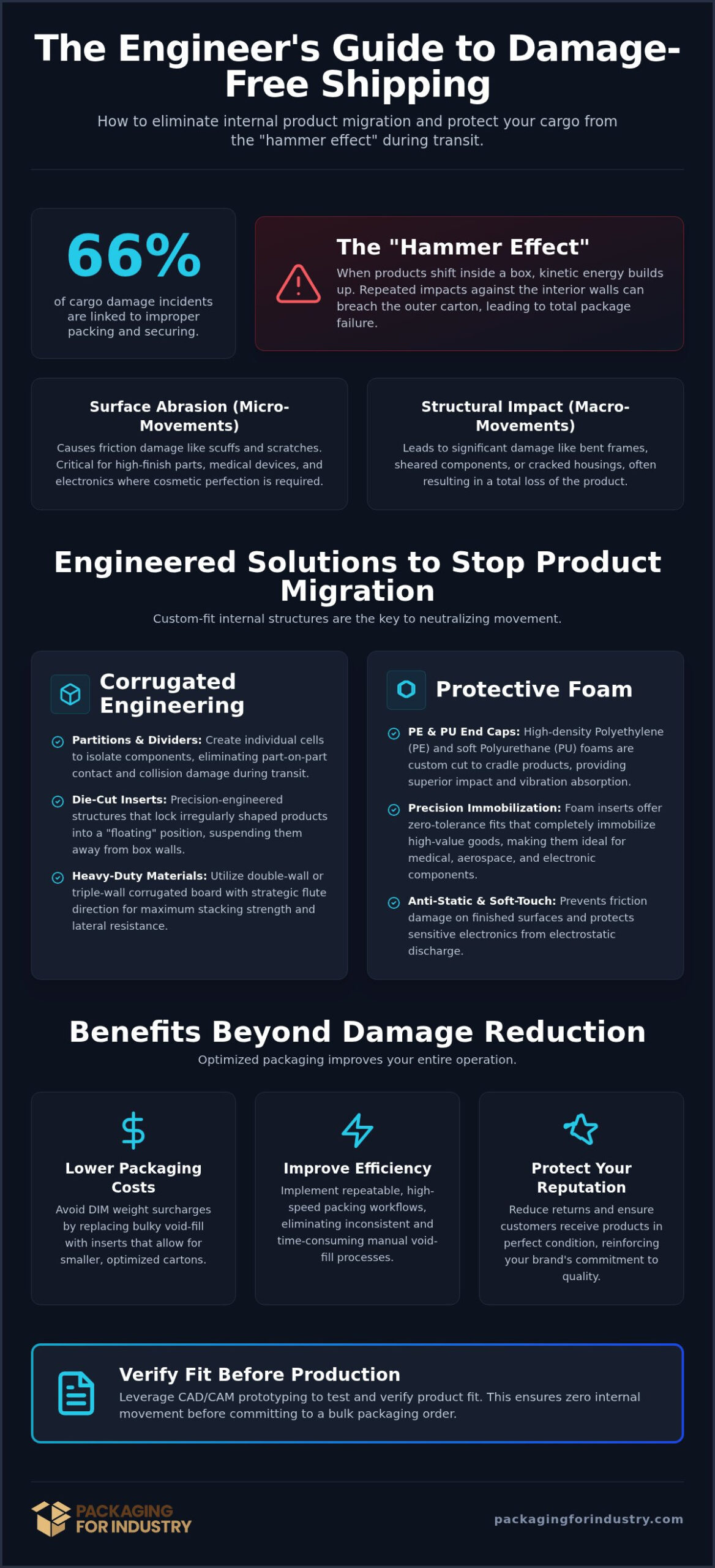
Did you know that as of late 2026, approximately 66% of all cargo damage incidents are directly linked to improper packing and securing within the shipping vehicle? If you manage logistics for a warehouse or manufacturing plant, you’ve likely seen the results of internal shifting firsthand. High return rates due to surface abrasion and outer carton failure are common when your current packaging design to prevent product migration in the box relies on guesswork rather than engineering. It’s frustrating to pay for shipping only to have a customer receive a damaged unit because the product bounced during LTL transit.
We understand that operational efficiency and fiscal responsibility are your top priorities. You’ll learn how to eliminate internal movement and transit damage through custom-engineered corrugated structures and precision foam inserts. We’ll also show you how to lower packaging costs by optimizing your designs to meet the strict 2026 carrier dimensional weight rules. This guide provides a technical roadmap for implementing repeatable, high-speed packing workflows that protect your products and your reputation. From aerospace components in Los Angeles to medical devices in Orange County, securing your cargo starts with a precision-fit interior.
Key Takeaways
- Understand how kinetic energy causes the “hammer effect” and why structural bracing is required to prevent heavy components from breaching outer corrugated walls.
- Implement advanced packaging design to prevent product migration in the box using custom die-cut corrugated partitions to eliminate part-on-part contact.
- Learn to utilize polyethylene (PE) and polyurethane (PU) foam end caps to suspend high-value products and provide superior impact absorption.
- Lower packaging costs and avoid DIM weight surcharges by replacing bulky, manual void-fill with precision-engineered inserts that allow for smaller carton sizes.
- Leverage free CAD/CAM prototyping to verify product fit and ensure zero internal movement before committing to a bulk packaging order.
The Logistics of Product Migration: Why Internal Shifting Causes Damage
Product migration is the conversion of transit vibrations into kinetic energy within the shipping container. When a product moves inside its box, that energy must be absorbed or redirected. If your internal geometry allows for gaps, the item gains momentum during every turn, stop, or drop. This momentum leads to the “hammer effect,” where heavy industrial components repeatedly strike the interior walls of the box. Without proper immobilization, these items will eventually breach the outer corrugated structure, leading to total package failure and exposed contents.
The financial consequences of these failures are severe. Global cargo damage caused by poor packaging results in an estimated $6 billion in annual losses. For manufacturers, this translates to high return rates, costly reshipping, and complex insurance claims that drain administrative resources. The fundamentals of packaging dictate that containment and protection are primary functions, yet many standard setups ignore the specific physics of internal shifting. Effective packaging design to prevent product migration in the box addresses these risks by neutralizing movement at the source.
Surface Abrasion vs. Structural Impact
We distinguish between micro-movements and macro-movements. Micro-movements cause surface abrasion, which is a critical concern for high-finish aerospace parts or sterile medical equipment where even a hairline scratch can lead to a quality control rejection. Macro-movements lead to structural impact damage, such as bent frames, sheared bolts, or cracked housings. High-finish parts require soft-touch foam or anti-static barriers to prevent friction damage during transit. Product migration is the primary cause of internal packaging fatigue.
The Role of Industrial Packaging in Damage Reduction
Standard RSC (Regular Slotted Container) boxes often lack the inherent rigidity to stop internal shifting on their own. Relying on oversized boxes filled with loose-fill peanuts or excessive bubble wrap creates an unstable environment where products can still settle and shift over long distances. Effective industrial packaging solutions utilize an integrated approach, where the outer carton and inner structures work as a single unit. By prioritizing a custom packaging design to prevent product migration in the box, you ensure that the product remains stationary regardless of the shipping orientation. This level of precision reduces shipping damage and simplifies your warehouse workflows by eliminating the need for manual void-fill processes.
Corrugated Engineering: Using Partitions and Die-Cut Dividers
Effective corrugated engineering starts with material selection. For high-migration loads, we specify heavy-duty double-wall or triple-wall boxes to provide the necessary tensile strength. The direction of the “flute” (the wavy middle layer) is a critical technical detail. Vertical flutes provide stacking strength. Horizontal or cross-directional flutes in internal inserts provide lateral resistance to shifting. This structural foundation is essential for any industrial packaging design to prevent product migration in the box.
Custom Partitions and Dividers
For manufacturers handling multi-part shipments or kitting operations, corrugated partitions are the most efficient way to eliminate part-on-part contact. These dividers create individual cells that isolate components. They prevent items from colliding during transit. We design these with zero-clearance tolerances to ensure a snug fit. This level of precision aligns with Defense Logistics Agency standards, which emphasize compartmentization as a method to mitigate mechanical damage from shock and vibration. Choosing the right custom corrugated boxes with integrated dividers streamlines your assembly line while significantly reducing shipping damage.
Die-Cut Inserts for Complex Geometry
When a product has an irregular shape or a heavy center of gravity, standard partitions aren’t enough. We use CAD-designed die-cut inserts to lock the product into a central “floating” position. These folds act as structural bracing. They suspend the item away from the box walls to absorb impact. From a cost perspective, corrugated inserts are often superior to plastic void-fill or excessive foam. They offer several operational advantages:
- Reduced Storage Costs: Die-cuts ship flat, taking up significantly less warehouse space than pre-formed materials.
- Assembly Speed: Custom folds allow for faster, more repeatable packing workflows in high-volume distribution centers.
- Sustainability: 100% recyclable materials help you meet corporate waste reduction goals.
Our custom design packaging services focus on creating these high-tolerance structures for specialized industrial parts. Replacing generic bubble wrap with a single engineered packaging design to prevent product migration in the box helps you lower packaging costs. It also improves the throughput of your fulfillment team. If you are struggling with internal shifting, you can request a packaging quote to see how a custom-engineered divider can stabilize your shipments.
Protective Foam Solutions: Precision Immobilization for High-Value Goods
While corrugated structures provide the necessary bracing, high-value industrial goods often require the specialized damping properties of protective foam. We utilize polyethylene (PE) and polyurethane (PU) foams to create a custom packaging design to prevent product migration in the box for sensitive equipment. PE foam is a closed-cell material known for its durability and high load-bearing capacity, making it ideal for heavy industrial components. In contrast, PU foam is an open-cell, softer material that provides superior cushioning for delicate instruments that cannot withstand high G-forces during transit.
A common engineering failure in industrial shipping is the “bottoming out” of a product. This occurs when the foam density is insufficient for the product weight, allowing the item to compress the foam fully and strike the outer container wall. We solve this by calculating the static loading of your product to ensure the foam maintains its structural integrity throughout the shipping cycle. For the electronics and semiconductor industries, we integrate anti-static and ESD (Electrostatic Discharge) foam. These specialized materials prevent the buildup of static electricity that can destroy sensitive circuitry, even if the physical packaging remains intact.
Precision immobilization is best achieved through die-cut foam inserts that provide a friction-fit. This design locks the product into place, eliminating even minute vibrations that lead to surface wear. For heavy or bulky items, we often specify foam end caps. These caps fit over the ends of the product and suspend it in the center of the carton, ensuring it never makes contact with the box walls. This “floating” method is a highly effective packaging design to prevent product migration in the box for high-value assets.
Selecting the Right Foam Density
The success of your protective strategy depends on matching foam density to the fragility of your cargo. Using a foam that is too rigid for a lightweight part can be just as damaging as using one that is too soft, as the shock will be transferred directly to the component rather than being absorbed by the material. We help you compare material performance to ensure your protective foam packaging meets the specific requirements of your hardware. This technical precision helps you reduce shipping damage and lower packaging costs by avoiding over-engineering.
Die-Cut Foam and Foam-Lined Boxes
For aerospace and aviation components, we often recommend foam-lined crates or boxes. These provide a secondary layer of protection against both impact and internal shifting. Kitting with custom foam inserts also simplifies your warehouse operations. When every part has a dedicated, labeled slot in a foam tray, your team can pack faster and with fewer errors. This organized approach is a cornerstone of professional logistics management. For more complex international requirements, see our guide on Engineering Custom Crates for International Transit to understand how foam and wood work together to protect global shipments.
The Prototyping Process: Ensuring Fit Before Full Rollout
Digital modeling serves as the first line of defense against transit damage. We utilize CAD/CAM support to translate your product dimensions into a precise structural blueprint. This stage allows us to eliminate the “looseness” often found in stock boxes, which is the root cause of internal shifting. By creating a custom packaging design to prevent product migration in the box at the digital level, we can adjust tolerances by fractions of an inch before a single sheet of corrugated material is cut. This precision ensures that every component is immobilized from the moment it leaves your facility.
Once the digital design is finalized, we move to physical prototyping. Packaging For Industry (PFI) provides free prototyping to our industrial clients to ensure the fit is perfect before you commit to a high-volume order. This phase includes rigorous validation through drop test and vibration test simulations. These tests replicate the harsh conditions of LTL shipping and parcel transit, ensuring that the internal structures, whether they are die-cut corrugated or PE foam, maintain their grip on the product. Validating the design under stress prevents the “hammer effect” from compromising the outer carton during long-haul transit.
CAD/CAM Support for Custom Sizes
Rapid adjustments are a key benefit of digital design. If your product specifications change during the manufacturing cycle, we can update the packaging geometry instantly. This precision ensures that there is no void space for the product to gain momentum. Prototyping is the only way to guarantee damage reduction and verify that your custom solution performs as intended.
Packaging Reviews and Damage Analysis
Many of our clients come to us after experiencing recurring failures with off-the-shelf solutions. Packaging For Industry (PFI) performs comprehensive packaging reviews to analyze exactly where your current system is failing. By examining crushed corners or abraded surfaces on returned goods, we can re-engineer the internal protection to address specific stress points. This consultative approach is essential for logistics teams looking to lower packaging costs and reduce shipping damage simultaneously.
A successful packaging design to prevent product migration in the box also considers the person on the assembly line. We conduct kitting and assembly reviews to ensure that our custom inserts are easy to fold and load. If a design is too complex, it slows down your fulfillment speed and increases labor costs. Our goal is a repeatable, high-speed workflow that provides maximum protection with minimal manual effort. We focus on the intersection of engineering and economics to ensure your packaging is as efficient to pack as it is effective at protecting.
Lower Packaging Costs Through Optimized Migration Control
Reducing product damage is only one half of the industrial engineering equation. The other half is fiscal optimization. When you implement a precise packaging design to prevent product migration in the box, you eliminate the need for excessive void-fill materials like peanuts or air pillows. This allows for the use of the smallest possible shipping carton. In the 2026 shipping environment, where carriers like UPS and FedEx use a dimensional weight divisor of 139 and round all fractional measurements up to the next whole inch, even a one-inch reduction in box size provides significant packaging cost savings.
Reducing Freight and Surcharge Issues
An optimized internal design directly impacts your freight efficiency. By replacing bulky loose-fill with slim, high-strength corrugated or foam inserts, you can often fit more units per pallet. This increases your pallet density and lowers the total number of shipments required. For high-volume distribution centers, this results in a lower cost per shipped unit. Precision engineering also helps you stay below critical volume thresholds, such as the 10,368 cubic inch limit that triggers additional handling surcharges. Eliminating internal shifting ensures the outer carton retains its shape. This prevents the bulging that often leads to oversized package penalties at the carrier hub.
Local Support in Southern California
Reliability in the supply chain depends on proximity. As a local Anaheim packaging supplier, Packaging For Industry (PFI) provides next-day delivery across Orange County, Los Angeles, and the Inland Empire, including Irvine and Long Beach. This proximity allows for rapid design changes and immediate prototyping when new product lines launch. We also offer Vendor Managed Inventory (VMI) services to ensure your custom inserts are always stocked and ready for the production line. By keeping inventory levels aligned with your actual usage, we help you avoid warehouse clutter and stockouts.
The long-term ROI of custom inserts is clear when compared to the recurring costs of manual void-fill. While stock materials from large catalog suppliers may seem cheaper upfront, the labor time required for manual wrapping and the high cost of shipping damage quickly erode those margins. A custom packaging design to prevent product migration in the box is a one-time engineering investment that pays dividends in every shipment. It ensures a professional unboxing experience for your customer and a predictable, high-speed workflow for your warehouse team. Request a custom packaging quote to compare packaging pricing today.
Secure Your Supply Chain with Engineered Protection
Internal shifting is a structural failure that requires a precision response. By integrating custom corrugated geometry with high-density foam inserts, you eliminate the kinetic energy that causes transit damage. This approach doesn’t just protect your high-value aerospace or industrial components; it also optimizes your shipping footprint to lower freight costs and avoid DIM weight surcharges. Implementing a professional packaging design to prevent product migration in the box ensures your items arrive in factory condition every time.
PFI provides the technical expertise you need through free prototyping and CAD/CAM support. Our team specializes in aerospace and industrial protection, ensuring your most sensitive equipment remains stationary throughout the entire shipping cycle. With local next-day delivery available across Southern California, we help you maintain a reliable and efficient production line without the stress of recurring shipping failures.
We’re ready to help you solve your most complex logistical challenges with stability and precision.
Frequently Asked Questions
What is the most effective packaging design to prevent product migration?
The most effective packaging design to prevent product migration in the box is a custom-engineered integrated system. By combining structural corrugated bracing with precision-cut foam inserts, we neutralize movement in all directions. This approach is superior to loose-fill because it creates a fixed interior geometry. Packaging For Industry (PFI) uses CAD modeling to ensure the internal components and the outer carton work as a single unit to absorb and redirect transit energy.
How do I choose between corrugated partitions and foam inserts?
Your selection depends on the fragility and surface finish of your product. We recommend corrugated partitions for multi-part industrial kits where part-on-part contact must be eliminated at a lower price point. Protective foam inserts are necessary for high-value assets, such as aerospace sensors or medical electronics, that require impact damping. Many of our most successful designs use both materials, leveraging corrugated for structural bracing and foam for delicate surface protection.
Can custom packaging design help lower my shipping costs?
Custom engineering is a primary driver for lowering packaging costs. By implementing a precise packaging design to prevent product migration in the box, you can often move to a smaller outer carton. This reduction helps you avoid the steep dimensional weight surcharges and volume-based penalties enforced by major carriers. Additionally, engineered inserts reduce the labor time your warehouse team spends on manual wrapping and void-fill, improving total operational throughput.
Does Packaging For Industry (PFI) offer local delivery for custom boxes in Southern California?
Packaging For Industry (PFI) provides local next-day delivery throughout Southern California, covering Anaheim, Orange County, Los Angeles, and the Inland Empire. Our regional presence allows us to offer more dependable lead times than national catalog distributors. Local delivery ensures your production line remains active, especially when utilizing our stocking programs. We manage your custom inventory so that engineered inserts are ready for immediate dispatch from our Anaheim facility.
How long does it take to get a prototype for a custom foam insert?
The timeline for a custom foam prototype depends on your product’s complexity, but our CAD/CAM support allows for rapid turnaround. Packaging For Industry (PFI) offers free prototyping to validate fit and performance before full-scale production. This stage is critical for ensuring zero migration in high-value shipments. We typically move from digital design to a physical sample quickly, allowing your team to perform real-world testing and assembly reviews without delaying your rollout.
What industries benefit most from migration-prevention packaging?
Any industry shipping high-value, heavy, or sensitive components benefits from migration control. We specialize in providing solutions for aerospace, medical device manufacturing, and the semiconductor industry where precision is mandatory. Industrial equipment manufacturers also rely on our heavy-duty double-wall and triple-wall boxes to secure heavy parts. These sectors require a higher level of protection than standard retail packaging can provide, particularly when meeting military or international shipping standards.
How do I request a custom packaging quote for bulk quantities?
You can request a packaging quote by contacting our team with your product dimensions and shipping requirements. Packaging For Industry (PFI) focuses on buyer-intent needs for manufacturers and warehouses, providing bulk packaging pricing that remains competitive with large catalog suppliers. We’ll review your current damage rates and shipping volumes to design a custom program that improves reliability. Our goal is to provide a comprehensive quote that covers design, production, and delivery.
Can you re-engineer my current box to reduce shipping damage?
We frequently help clients who are experiencing high return rates due to inadequate internal protection. Packaging For Industry (PFI) performs detailed packaging reviews to identify why your current box is failing. Whether the issue is the “hammer effect” from heavy components or surface abrasion on finished parts, we can re-engineer the interior with die-cut inserts or foam end caps. This process fixes the root cause of damage while often reducing the total volume of materials used.