
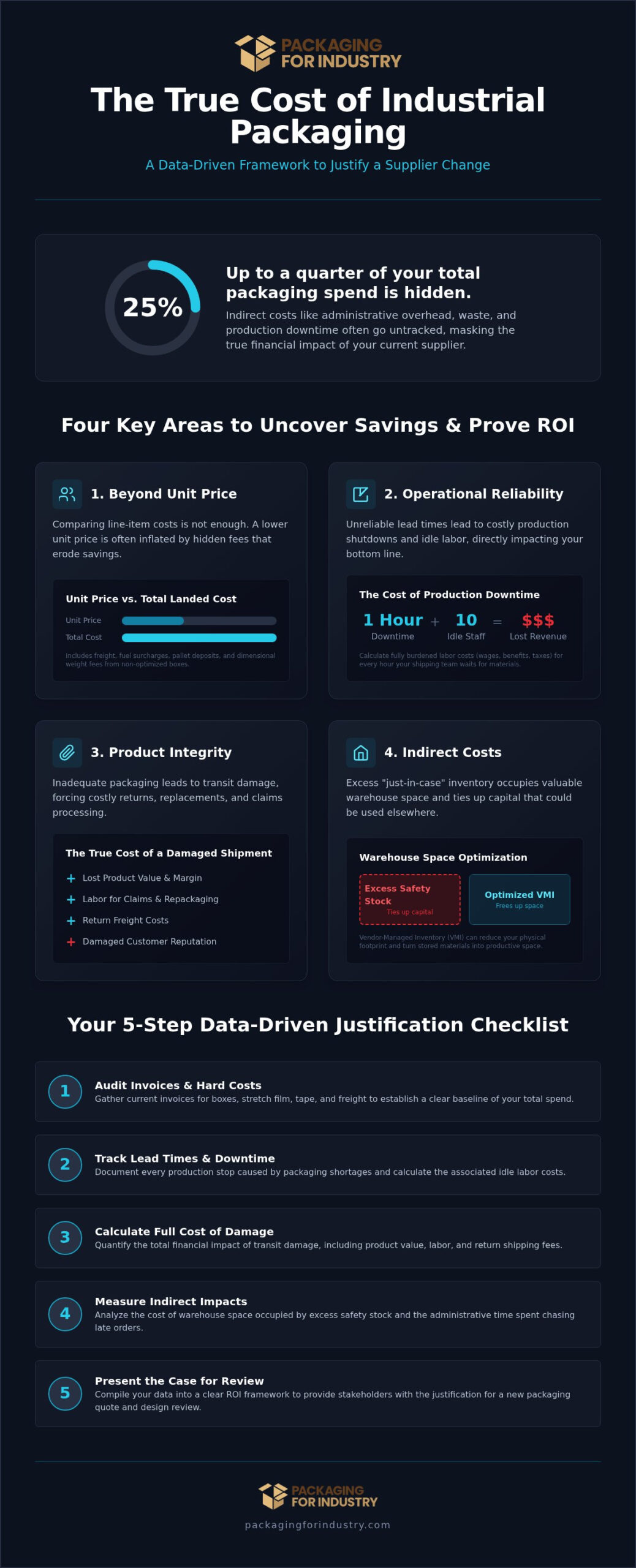
Did you know that indirect packaging costs, such as administrative overhead and waste, can account for up to 25% of your total spend? It’s a staggering figure that often stays hidden until production stops or shipping damage rates climb. You’ve likely dealt with the stress of frequent line shutdowns due to packaging shortages or the sting of unexpected FedEx surcharges. While these operational headaches are clear to you, your executive team needs hard numbers before approving a new vendor.
To secure buy-in, you must present the specific data needed to justify a packaging supplier change. We understand that procurement isn’t just about unit price; it’s about protecting your bottom line through engineering and logistics. This article equips your team with a comprehensive ROI framework to prove that switching to a more reliable industrial packaging partner reduces your total cost of ownership. We’ll preview the essential metrics for auditing current performance, calculating the true cost of shipping damage, and documenting the fiscal benefits of vendor-managed inventory. By the end of this checklist, you’ll have a data-driven case that turns a logistical necessity into a strategic financial win.
Key Takeaways
- Establish a baseline for hard costs by auditing current invoices for corrugated boxes and stretch film to identify volume-based pricing opportunities.
- Quantify the labor costs associated with warehouse teams waiting for materials and learn how reliable lead times prevent expensive production shutdowns.
- Gather the specific data needed to justify a packaging supplier change by calculating the full cost of transit damage, including product value and claims processing labor.
- Measure the fiscal impact of warehouse space occupied by excess safety stock and how optimizing your inventory footprint can reduce your total cost of ownership.
- Follow a structured 5-step checklist to request a packaging quote and design review, providing stakeholders with a clear path toward improved supply reliability.
Benchmarking Hard Costs: Analyzing Unit Price vs. Total Spend
Most procurement managers start by comparing the line-item price on a quote. While unit cost matters, it’s only a fraction of the total economic impact on your supply chain management. To build a solid business case, you must first establish a baseline by gathering current invoices for corrugated boxes, stretch film, and tapes. This audit often reveals that what looks like a bargain in a catalog is actually inflated by hidden fees, fuel surcharges, and pallet deposits. Comparing these “all-in” costs against a direct industrial distributor like PFI provides the foundational data needed to justify a packaging supplier change.
The Freight and Surcharge Audit
Shipping costs for packaging materials can quickly erode any savings gained through a lower unit price. If you’re ordering from out-of-state catalog suppliers, track the specific freight costs on every delivery. Additionally, analyze your UPS and FedEx invoices to identify surcharges triggered by non-optimized box dimensions. Often, stock boxes that are “close enough” in size lead to excessive dimensional weight fees. PFI helps manufacturers avoid these costs through custom engineering and local next-day delivery across Southern California, including Orange County, Los Angeles, Anaheim, and the Inland Empire. Eliminating long-distance freight and reducing carrier surcharges is essential for proving ROI to your stakeholders.
Volume and Bulk Tier Comparisons
Identify the items where you’re currently paying a premium for small, frequent orders. Catalog suppliers thrive on high-margin, low-volume sales, but industrial operations require a different approach. Calculate the ROI of moving to bulk wholesale shipping boxes for your high-volume production lines. By consolidating your spend with a direct industrial distributor like Packaging For Industry, you can access tiered bulk packaging pricing that isn’t available in standard catalogs. You can use our packaging cost savings framework to guide your analysis of how volume shifts affect your bottom line. Moving away from “just-in-case” small orders to a strategic bulk program often provides the most immediate proof of ROI for stakeholders. This specific data needed to justify a packaging supplier change demonstrates a commitment to fiscal responsibility and operational efficiency.
Operational Reliability: Tracking Lead Times and Production Downtime
A low unit price on a corrugated box quote means very little if the supplier fails to deliver on time. When your shipping dock goes dark because you’ve run out of custom foam inserts or heavy-duty RSC boxes, the financial impact is immediate and severe. Documenting every instance of production downtime caused by packaging shortages provides the most compelling data needed to justify a packaging supplier change. You should track the gap between your current supplier’s promised delivery date and the actual arrival time. Frequent variances indicate a lack of process control that puts your entire operation at risk.
Calculating the true cost of these delays requires looking at your labor overhead. In California, where the minimum wage is $16.90 per hour as of 2026, having a crew of warehouse workers standing idle while waiting for a pallet of stretch film is an expensive oversight. Beyond the hourly wages, you must account for the fully burdened cost of labor, including benefits and taxes. If your team is “waiting” instead of “packing,” you’re burning capital. Using a structured supplier inspection guide can help you audit these reliability metrics and hold your current vendor accountable for their performance failures.
The Cost of Stockouts
Stockouts do more than just idle your workforce; they defer revenue and damage customer relationships. Estimate the revenue loss per hour when your shipping department is forced to halt operations. This isn’t just about the products sitting on the floor; it’s about the administrative time your purchasing managers waste chasing late orders and managing backlogs. Implementing Vendor Managed Inventory (VMI) eliminates these variances by shifting the burden of stock monitoring to your partner. This proactive approach ensures you never hit a critical shortage, allowing your team to focus on production rather than procurement fires.
Emergency Procurement vs. Just-In-Time
When a primary supplier fails, many businesses turn to “spot buys” from expensive catalog retailers to keep lines moving. Track the price premium you pay for these emergency rush orders, including expedited freight fees. You should contrast these volatile expenses with the stability offered by Just-In-Time inventory management. For industrial manufacturers, VMI serves as a critical risk-mitigation strategy that stabilizes the supply chain by ensuring materials are staged and ready before they’re needed on the line. If your current vendor can’t support this level of precision, it may be time to request a packaging quote from a partner capable of managing your local next-day delivery needs.
Product Integrity Data: Measuring Damage and Return Rates
High damage rates are often the clearest indicators that your current packaging strategy is failing. While a standard RSC box might seem cost-effective on a purchase order, it’s a liability if it can’t withstand the rigors of LTL shipping. Research indicates that up to 11% of unit loads experience some level of damage during transit, costing the global logistics industry billions annually. To gather the data needed to justify a packaging supplier change, you must audit your return rates specifically due to shipping failures. This involves looking past the unit price and analyzing the structural integrity of your current materials, especially when moving heavy industrial parts or sensitive electronics.
Calculating the true cost of a damaged shipment requires a comprehensive view of your operational expenses. It isn’t just the value of the product that’s lost. You must also account for the original shipping cost, the freight for the return, the labor required to process the claim, and the cost of the replacement item. For many manufacturers, a single damaged shipment can wipe out the profit margin of ten successful deliveries. If your current foam packaging or corrugated solution results in a damage rate higher than the industry-wide LTL average of 1.24%, your supplier is failing to protect your bottom line.
Engineering for Damage Reduction
Switching from standard single-wall boxes to heavy-duty double-wall or triple-wall corrugated can often pay for itself through damage savings. For high-value aerospace or medical equipment, standard boxes are rarely sufficient. In these cases, data needed to justify a packaging supplier change should highlight the need for custom crates or specialized internal bracing. You should also evaluate the role of corner and edge protection in maintaining pallet stability. These components are essential for preventing the “crushing” that occurs when pallets are stacked in a warehouse or trailer, yet they’re often overlooked by catalog suppliers who focus on high-volume, generic sales.
Prototyping and Performance Testing
One major weakness of large catalog suppliers is the lack of physical prototyping. They sell what’s in the book, not what’s best for your specific part. A sophisticated custom design packaging process ensures that your inserts and boxes fit perfectly before you commit to a full production run. This proactive approach is a core part of a formal supplier assessment process, where quality and engineering capability are weighted as heavily as unit cost. By documenting the failures of “off-the-shelf” materials, you can build a persuasive case for an engineered solution. This is especially critical for international shipments, as detailed in our guide on Engineering Custom Crates for International Transit, where the risks of damage are significantly higher.
Indirect Cost Analysis: Warehouse Space and Administrative Labor
Warehouse storage is a significant portion of supply chain spend, yet many procurement teams overlook the cost of storing unused packaging. In 2026, the national average for storage space sits at $1.73 per square foot per month. If your current supplier requires you to order six months of inventory to hit a price break, you’re essentially paying a high-interest loan on your floor space. Measuring the square footage occupied by “safety stock” and calculating the carrying cost for inventory sitting longer than 30 days provides vital data needed to justify a packaging supplier change. This analysis often reveals that a “cheap” bulk order is actually costing you more in overhead than a more frequent, local delivery program.
Optimizing Warehouse Floor Space
Every pallet of unused boxes in your facility represents lost opportunity. In high-rent industrial hubs like Irvine, Anaheim, or Santa Fe Springs, that floor space could be repurposed for revenue-generating production equipment or finished goods. PFI addresses this by offering local next-day delivery across Southern California, including Orange County and the Inland Empire. Our stocking programs are designed to keep the right packaging available at the right time, allowing you to slash on-site inventory requirements. By shifting from a “just-in-case” storage model to a responsive supply chain, you can reclaim valuable square footage and lower your total cost of ownership.
Streamlining Procurement Workflows
Administrative labor is another hidden factory that erodes profitability. Managing multiple vendors for boxes, foam inserts, and stretch film forces your purchasing and accounts payable teams to process a mountain of invoices and purchase orders. Research suggests that consolidating from multiple suppliers to a single integrated partner can reduce total packaging operations costs by 18-25%. This reduction in administrative friction is compelling data needed to justify a packaging supplier change. Beyond invoice consolidation, packaging kitting services further improve efficiency by delivering pre-assembled components directly to your packing lines. PFI simplifies purchasing for industrial operations teams by acting as a single, dependable point of accountability for all logistical needs.
The Transition Plan: A 5-Step Justification Checklist
Transitioning to a new industrial partner requires more than a casual price comparison. It demands a methodical approach that aligns your procurement goals with operational realities. By following this structured checklist, you can gather the specific data needed to justify a packaging supplier change and present a bulletproof case to your leadership team. Moving away from a legacy vendor isn’t just about finding a lower price; it’s about building a foundation for long-term operational stability.
- Step 1: Perform a 3-month audit. Document your total spend, including freight and surcharges. Track every instance of transit damage and production downtime caused by material shortages to establish a baseline of failure costs.
- Step 2: Request a design review. Engage a specialist like Packaging For Industry to evaluate your current specs. A professional review often identifies over-packaging or material mismatches that a generic catalog salesperson would miss.
- Step 3: Compare Total Cost of Ownership (TCO). Look beyond the unit price. Factor in the labor costs of assembly, the carrying cost of warehouse space, and the administrative burden of managing multiple invoices.
- Step 4: Conduct a pilot program. Use free prototyping for custom items to verify performance. Testing a high-value or high-volume line provides a low-risk proof of concept before you commit to a full production run.
- Step 5: Present the ROI case. Compile your findings into a concise report for your Operations or Finance Director. Focus on how the change improves supply reliability and reduces the total cost of doing business.
Building the ROI Presentation
Your stakeholders care about peace of mind and fiscal responsibility. Use visual data to demonstrate the gap between current catalog pricing and the value of a direct industrial supplier. You should emphasize the risk of the status quo; every day you stay with an unreliable vendor is a day you risk a line stoppage or a costly damage claim. Highlighting these vulnerabilities makes the data needed to justify a packaging supplier change impossible to ignore. To start your internal audit, you can request a packaging quote and receive a baseline comparison for your most critical items.
Selecting a Local Partner
For firms in Southern California, geographic proximity is a strategic advantage. Relying on Anaheim packaging suppliers ensures you have access to local next-day delivery and on-site support. This proximity is essential for Vendor Managed Inventory (VMI) programs that require frequent, precise replenishment. Unlike generic catalog sales, PFI offers industrial-focused experience tailored to manufacturers in Los Angeles, Orange County, and the Inland Empire. If you’re ready to lower your packaging costs and improve reliability, contact us today for a custom cost-reduction analysis.
Optimizing Your Industrial Supply Chain
Securing stakeholder approval for a vendor shift requires moving beyond anecdotal frustrations to verifiable economic impact. By analyzing the intersection of engineering and economics, you’ve gathered the data needed to justify a packaging supplier change. You now have a framework to prove that reducing transit damage and reclaiming warehouse floor space provides a much higher ROI than chasing the lowest catalog unit price. This transition is about protecting your bottom line while ensuring your production lines never stop due to material shortages.
Packaging For Industry (PFI) supports this transition with specialists in custom-engineered industrial protection and free prototyping for manufacturers. We prioritize supply reliability through our local next-day delivery across Southern California, including Los Angeles, Orange County, and the Inland Empire. Our goal is to eliminate the professional stress of production delays and hidden freight surcharges through logistical optimization and technical expertise.
Take the first step toward a more efficient operation by auditing your current specifications. We’re ready to help you build a more resilient and cost-effective supply chain.
Frequently Asked Questions
What is the most important metric when justifying a packaging supplier change?
The most critical metric is the Total Cost of Ownership (TCO), which accounts for unit price, freight, labor, and damage rates. Relying solely on unit price often hides the true expense of a low-quality partner. Gathering the data needed to justify a packaging supplier change requires looking at how a vendor impacts your entire supply chain. By quantifying the hidden costs of poor reliability, you can demonstrate a clear ROI that goes beyond simple line-item comparisons.
How much can a business save by switching from a catalog supplier to a direct manufacturer?
While exact savings depend on your volume, research indicates that consolidating with a single integrated partner can reduce total operational costs by 18% to 25%. PFI serves as a cost-saving alternative to large catalog suppliers by eliminating the middleman markup on bulk items. Instead of paying retail-level prices for stock supplies, industrial manufacturers benefit from wholesale pricing tiers and reduced administrative overhead. This consolidation simplifies your accounts payable and improves your overall procurement efficiency.
Can a new supplier help reduce shipping damage for heavy industrial parts?
Yes, a specialized industrial supplier uses custom engineering to address the specific vulnerabilities of heavy or fragile components. Unlike catalog vendors who offer generic sizes, PFI designs heavy-duty double-wall and triple-wall corrugated boxes or custom crates tailored to your product’s weight and fragility. We also provide free prototyping for manufacturers to ensure the solution withstands the 1.24% average LTL damage rate. This proactive design phase is essential for protecting high-value aerospace or medical equipment.
Does switching suppliers require a massive upfront order?
Switching to PFI doesn’t require a massive upfront capital investment because we offer managed stocking programs. Our local next-day delivery throughout Southern California, including Anaheim and Orange County, allows you to maintain leaner on-site inventory. You don’t have to over-order just to secure a price break. Instead, our team ensures you have the right packaging available for your production schedule, improving your cash flow and freeing up valuable warehouse floor space for revenue-generating activities.
How do I track the cost of packaging shortages on my production line?
You should track the fully burdened labor cost of idle workers and the revenue lost per hour when shipping stops. Every instance where a warehouse team is waiting for boxes or stretch film should be documented in your audit. Additionally, record the price premiums and expedited freight fees paid for emergency rush orders. This data needed to justify a packaging supplier change highlights the high cost of unreliability and proves that a steady partner is a financial necessity.
What data do I need to prove the ROI of custom-engineered foam inserts?
To prove ROI, compare the cost of transit damage and the labor time spent on assembly before and after implementing custom foam inserts. Engineered polyethylene or polyurethane foam reduces the need for excessive void fill, which can lower your dimensional weight and shipping surcharges. Documenting the reduction in return rates and the speed of the kitting process provides a clear financial case. Custom foam ensures a precise fit, which is critical for protecting sensitive electronics or aerospace parts.
How does a Vendor Managed Inventory (VMI) program save money?
A VMI program saves money by optimizing your inventory footprint and eliminating the need for safety stock. With warehouse storage averaging $1.73 per square foot in 2026, reclaiming floor space directly impacts your bottom line. PFI monitors your actual usage and replenishes stock based on agreed-upon levels, which prevents expensive stockouts and the administrative burden of constant reordering. This managed approach improves your operational flow and ensures your capital isn’t tied up in obsolete or excessive inventory.