
A reusable shipping container is only as valuable as the material protecting its contents. If your foam inserts lose their structural integrity after just a few shipping cycles, your returnable packaging program is likely costing you more in replacement parts and transit damage than it’s saving in waste reduction. You invested in plastic totes or crates to build a more efficient supply chain, yet finding custom protection that fits your specific inventory can feel like an uphill battle.
It’s a common challenge for manufacturers who need durability that matches the lifespan of their containers. This guide explains how to select and engineer the right foam inserts for reusable shipping containers to ensure your products remain secure through hundreds of trips. We’ll examine the technical differences between polyethylene and polyurethane, the impact of compressive creep on long-term protection, and how local engineering support in Orange County and Los Angeles can help you lower your total cost of ownership through better kitting and design. By focusing on material resilience and precision fit, you can eliminate the professional stress of transit damage and improve your warehouse flow.
Key Takeaways
- Understand why closed-cell polyethylene foam is the industrial standard for durability and long-term protection in returnable shipping loops.
- Learn how custom-engineered foam inserts for reusable shipping containers prevent part-on-part damage and improve warehouse kitting efficiency.
- Explore specialized design strategies like shadow boarding for aerospace tool control and cleanroom-compatible materials for medical device shipping.
- Discover how local Southern California sourcing and Vendor Managed Inventory (VMI) stabilize your supply chain and reduce the high cost of foam replacements.
- Utilize free prototyping to ensure a precision fit for your existing plastic totes, metal crates, or heavy-duty corrugated boxes.
Why Foam Inserts are Critical for Reusable Shipping Container Systems
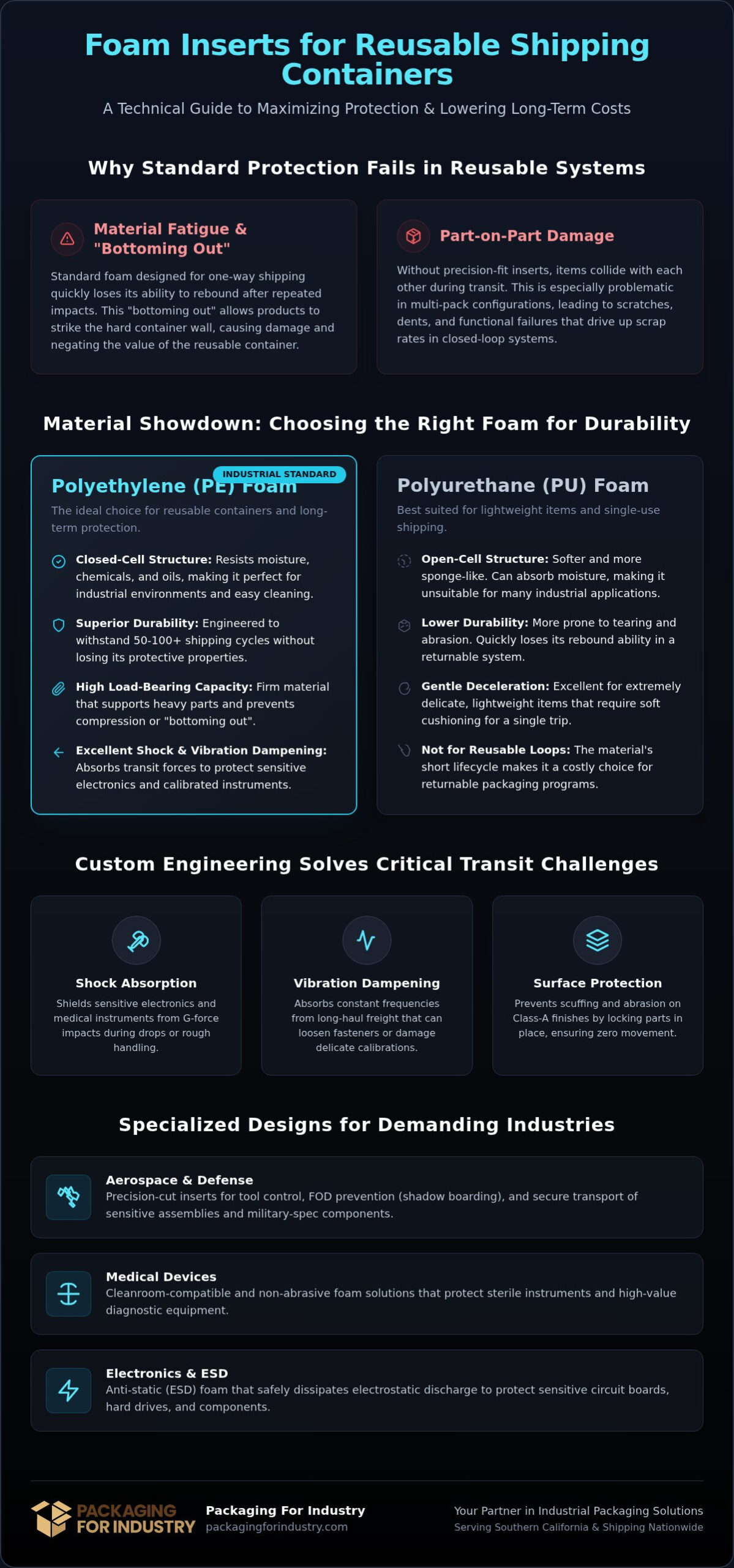
Reusable containers like plastic totes and metal crates provide a durable external shell, but they lack the internal shock absorption required for high-value components. Without precision-engineered foam inserts for reusable shipping containers, parts often experience “part-on-part” damage, where items collide during transit within a multi-pack configuration. This is particularly problematic in “closed-loop” systems where the packaging is intended to survive dozens or even hundreds of trips. If the internal protection fails, the entire investment in a reusable container system is compromised.
Standard “box foam” used for one-way shipping is designed for a single impact and then disposal. In contrast, returnable systems demand materials that resist fatigue and “bottoming out.” Bottoming out occurs when the foam loses its ability to rebound, allowing the product to strike the hard surface of the container during a drop. This material fatigue is the primary reason why low-quality foam fails in industrial environments, leading to high replacement costs that erode the savings of a reusable program. To maintain protection over time, you need a material that maintains its structural memory through repeated loading and unloading cycles.
Defining the Returnable Packaging Loop
A successful returnable loop balances higher upfront engineering costs with significant lifecycle savings. While a custom foam insert costs more than generic bubble wrap or loose fill, its ability to be reused 50 to 100 times drastically lowers the cost-per-trip. This shift from one-way corrugated boxes to reusable plastic totes reduces long-term waste and streamlines warehouse operations through standardized packaging kitting. Products that benefit most from this approach include aerospace assemblies, medical devices, and high-finish automotive parts that require consistent, repeatable protection without the mess of disposable dunnage.
Common Transit Damage Solved by Custom Inserts
Precision-cut foam inserts for reusable shipping containers address three primary types of transit damage that generic solutions can’t handle:
- Shock Absorption: Sensitive electronics and medical instruments are shielded from G-force impacts using high-performance Package cushioning materials that are calculated based on the product’s fragility.
- Vibration Dampening: During long-haul freight, constant vibration can loosen fasteners or damage delicate internal calibrations. Engineered foam absorbs these frequencies before they reach the component.
- Surface Protection: For Class-A finished parts, even minor scuffing against a container wall can result in a rejected shipment. Custom inserts lock the part in place, ensuring zero movement and zero surface abrasion.
By investing in high-quality inserts, manufacturers reduce their scrap rates and ensure that their returnable packaging system remains a profit center rather than a logistical headache. It’s about building a system of protection that’s as reliable as the products you’re shipping.
Selecting the Right Foam Material: Polyethylene vs. Polyurethane for Reusables
The success of a returnable packaging program depends on the foam’s ability to maintain its shape over dozens of shipping cycles. While many suppliers offer generic cushioning, foam inserts for reusable shipping containers must be selected based on their specific recovery properties. Polyethylene (PE) foam is the industrial standard for these applications. It’s a closed-cell material that provides high-load bearing capacity and excellent vibration dampening. Because it resists moisture and most chemicals, PE foam is ideal for containers that require periodic cleaning or exposure to industrial environments.
Polyurethane (PU) foam serves a different purpose. This open-cell material is significantly softer and more flexible, making it the preferred choice for lightweight or highly fragile items that require a “gentle” deceleration. However, PU foam has a shorter lifecycle in returnable systems. It’s more prone to tearing and loses its rebound faster than polyethylene. For high-value medical or aerospace components, Cross-linked Polyethylene (XLPE) offers a premium alternative. XLPE provides a smooth surface that won’t scratch delicate finishes and is chemically inert, which is a requirement for cleanroom-compatible packaging.
When evaluating materials, don’t assume that higher density automatically equals better protection. Effective engineering focuses on the “fragility” of the part and the expected drop height. Using Standard Test Methods for foam cushioning, designers can determine the exact density needed to prevent a product from bottoming out without making the insert unnecessarily heavy or expensive. Over-specifying density can actually increase the G-forces transferred to your product during a shock event.
Comparing Material Longevity and Rebound
The most critical factor in reusable systems is “compressive creep.” This is the tendency of foam to remain compressed after being under a load for an extended period. Low-quality foams often fail after only three or four uses because they lose their ability to “spring back,” leaving the product loose inside the container. Closed-cell foam consists of tiny, non-interconnecting air pockets that prevent water absorption and provide superior structural support. This structure ensures the insert survives the rigors of a multi-year returnable loop. If your containers are exposed to degreasers or hydraulic fluids, ensure your material choice is chemically resistant to prevent premature degradation.
Specialized Foam Grades for Industrial Sectors
Certain industries require more than just physical protection. For electronics and semiconductor manufacturing, anti-static or ESD (Electrostatic Discharge) foam is mandatory to prevent latent component failure. Defense and government contractors often require Mil-Spec compliant materials that meet strict flame retardancy and outgassing standards. Selecting the right grade ensures compliance while protecting your bottom line. If you are unsure which material fits your specific shipping cycle, you can request a packaging analysis to compare the long-term performance of different grades.
By sourcing Custom Foam Packaging from a supplier that understands these technical distinctions, you avoid the hidden costs of transit damage. The goal is to build a kit that lasts as long as the plastic tote it sits in, ensuring your supply chain remains both lean and reliable.
Custom Engineering: Design Strategies for Returnable Foam Packaging
Engineering precision separates a functional shipping kit from a box of scrap. When developing foam inserts for reusable shipping containers, the choice between CNC routing and die-cutting often dictates your project’s lead time and cost-effectiveness. Die-cutting is the standard for high-volume orders with consistent part shapes. It requires an initial investment in steel-rule dies but offers the lowest unit price for large runs. CNC routing, however, allows for intricate three-dimensional cavities and multi-depth pockets without upfront tooling expenses. It’s the superior choice for complex aerospace components or medical kits where a precision fit is non-negotiable.
Effective design also considers the human element. Shadow boarding remains an essential strategy for tool control and inventory management. By using contrasting foam colors to highlight missing items, operators can perform instant visual audits of their kits. Beyond organization, ergonomics play a vital role in the warehouse. We integrate finger slots and pull-tabs into the design to ensure operators can remove parts without prying or damaging the foam walls. This small engineering detail extends the life of the insert and speeds up the kitting process on the production floor.
From CAD Design to Prototype
A 100% fit starts with robust CAD/CAM support. Our engineering team works directly from your 3D models to ensure every contour of your product is supported. Unlike national catalog suppliers that offer one-size-fits-all solutions, PFI provides free prototyping to local Southern California manufacturers in Anaheim, Orange County, and Los Angeles. This allows you to test the fit in your specific plastic totes or crates before committing to a full production run. You can explore our Custom Design Packaging services to see how we bridge the gap between an initial concept and a durable, returnable solution.
Multi-Material Integration
Returnable systems often require a hybrid approach for maximum protection. We frequently combine precision foam with Custom Corrugated Boxes or heavy-duty plastic totes for internal stabilization. For heavier applications, such as aircraft engines or industrial machinery, foam-lined wooden crates provide the necessary structural integrity for long-haul freight. For more information on protecting oversized equipment, see our guide on Engineering Custom Crates. This multi-material strategy ensures every component is locked in place, regardless of the container’s external shell.
Industry-Specific Requirements: Aerospace, Medical, and ESD Protection
Regulated industries demand material performance that goes beyond simple cushioning. For foam inserts for reusable shipping containers, compliance with sector-specific standards is often as important as shock protection. Compliance is key. Whether it’s preventing a microscopic spark in an electronics assembly or ensuring a medical device remains sterile, the choice of foam grade directly impacts your ability to meet quality control audits. Standard materials rarely suffice when high-value components and strict safety protocols are involved.
Aerospace and Aviation Standards
Aerospace logistics require extreme precision to prevent Foreign Object Debris (FOD). In a sector where a single loose particle can compromise an engine, the foam must be non-shredding and precisely routed to the component’s geometry. This ensures that every turbine blade or avionic sensor is locked into place without the risk of material contamination. Precision-cut foam inserts prevent FOD by providing a lint-free environment that eliminates loose debris within the shipping container. Our support for Aerospace Packaging includes using high-density cross-linked polyethylene that maintains its integrity over hundreds of shipping cycles.
Medical device manufacturers require cleanroom-compatible materials that won’t off-gas or shed particulates. Standard foams can contaminate sensitive instruments or react with sterilization chemicals. We utilize specialized medical-grade foams that are inert and resistant to common cleaning agents. Similarly, Automotive Tier 1 suppliers must meet rigid returnable container standards for assembly line kitting. These inserts must be durable enough to withstand the high-frequency “milk run” logistics typical of automotive manufacturing, where parts are constantly moved between the supplier and the plant.
Electronics and ESD Compliance
Preventing latent ESD damage is a critical requirement for semiconductor and PCBA shipping. Standard foam can generate static electricity through friction during transit. To solve this, we use permanent dissipative or black conductive foams that safely bleed off static charges. While pink anti-static foam is common for one-way shipping, black conductive foam is the superior choice for foam inserts for reusable shipping containers because its dissipative properties don’t degrade over time. Protecting sensitive PCBAs requires a deep understanding of these material differences to prevent costly field failures. You can learn more about our specialized Manufacturing Solutions for the electronics sector.
Sourcing Industrial Foam Inserts in Southern California: The PFI Advantage
Sourcing foam inserts for reusable shipping containers from a national distributor often results in inflated freight costs and a lack of technical support. For manufacturers in Anaheim, Orange County, and Los Angeles, the proximity of a specialized supplier is a strategic advantage. PFI serves as a local partner that understands the specific logistical pressures of Southern California’s industrial corridors. By sourcing locally, you eliminate the long lead times associated with cross-country shipping and gain access to on-site engineering consultations that catalog companies simply cannot provide.
Efficiency is built into our delivery model. We utilize Vendor Managed Inventory (VMI) to ensure your warehouse never faces a foam stockout. Our team monitors your usage levels and replenishes stock automatically, allowing your procurement team to focus on higher-level operations. For high-volume manufacturing lines, our Just-in-Time (JIT) delivery ensures that your foam inserts for reusable shipping containers arrive exactly when they’re needed. This reduces the amount of floor space required for packaging storage and keeps your capital from being tied up in excess inventory.
Local Support for Southern California Manufacturers
We provide on-site packaging reviews for facilities in Irvine, Santa Ana, and Long Beach. These face-to-face evaluations allow us to identify inefficiencies in your kitting process that might be missed during a remote consultation. Sourcing from a local hub in the Inland Empire also helps reduce your supply chain’s carbon footprint by minimizing the miles traveled by heavy freight. With next-day delivery capabilities for recurring orders, we provide the responsiveness required to keep your production lines moving without interruption. We’re a steady and dependable partner that values long-term reliability over flashy innovation.
Lowering Total Cost of Ownership
Procurement managers often focus on the “price per piece,” but the true value of an engineered insert lies in the reduction of transit damage and labor costs. A cheaper, non-engineered foam that fails after three trips is far more expensive than a durable PE insert that lasts for a hundred cycles. PFI helps your team save on packaging costs by analyzing the entire lifecycle of your returnable containers. We look at material longevity, kitting speed, and scrap rates to ensure your packaging system is an asset to your bottom line. We don’t just sell a product; we provide an entire system of protection and logistical optimization.
If you’re ready to stabilize your supply chain and eliminate the stress of shipping damage, request a custom quote for your bulk or recurring foam needs. We’re here to engineer a solution that fits your specific totes and your specific budget.
Optimize Your Returnable Packaging Strategy
Transitioning to a returnable loop is a strategic investment that only pays off when the internal protection matches the lifespan of the container. We’ve explored how selecting high-performance polyethylene and utilizing precision CNC routing ensures your components remain secure through hundreds of transit cycles. By prioritizing foam inserts for reusable shipping containers that resist compressive creep, you reduce long-term scrap rates and lower your total packaging spend.
PFI provides the engineering expertise and local support needed to stabilize your supply chain. Our free prototyping and fit testing eliminate the risk of full-scale rollout errors. With local next-day delivery across Southern California, we ensure your manufacturing lines stay operational. Whether you require aerospace-grade FOD prevention or medical compliance, our team delivers the specialized protection your high-value inventory deserves.
We’re ready to help you engineer a more reliable and cost-effective shipping system.
Frequently Asked Questions
What is the best foam for reusable shipping containers?
Polyethylene (PE) is the industrial standard for durability in returnable systems. Its closed-cell structure provides superior load-bearing capacity and prevents the material from absorbing moisture or chemicals. While polyurethane is softer, it lacks the structural memory required for long-term reuse. For high-value components, cross-linked polyethylene offers a premium, non-abrasive surface that protects delicate finishes over dozens of trips without shedding particles.
Can foam inserts be customized for existing plastic totes or crates?
Yes, we engineer custom foam inserts for reusable shipping containers to fit any existing plastic tote, metal crate, or heavy-duty corrugated box. We work from your container’s internal dimensions or a physical sample to ensure a precision fit. This eliminates internal movement and allows you to repurpose your current inventory of totes while significantly improving product protection and organization through standardized kitting and shadow boarding.
How many shipping cycles can a polyethylene foam insert typically survive?
A high-quality polyethylene foam insert can typically survive 50 to 100 shipping cycles, depending on the environment and handling conditions. Unlike cheap, open-cell foams that lose their rebound after a few uses, engineered PE foam resists compressive creep. This durability ensures that your internal cushioning maintains its protective properties for the entire lifespan of your returnable plastic or metal shipping containers, lowering your total cost per trip.
Do you offer ESD-safe foam inserts for electronics?
We provide a full range of ESD-safe foam inserts, including pink anti-static and black conductive grades. Black conductive foam is the preferred choice for foam inserts for reusable shipping containers because its dissipative properties are permanent and won’t degrade over time. These materials are essential for protecting sensitive PCBAs and semiconductor components from latent electrostatic discharge damage during transit between manufacturing facilities and assembly lines.
What is the difference between die-cut and CNC-routed foam?
Die-cutting uses a steel-rule die to punch out shapes and is most cost-effective for high-volume orders with consistent geometries. CNC routing uses a computer-controlled bit to carve intricate, three-dimensional cavities directly into the foam. Routing is ideal for complex parts, multi-depth pockets, and low-volume production because it requires no upfront tooling costs and allows for greater design flexibility during the prototyping phase.
How do I get a custom foam prototype for my product?
You can request a custom foam prototype by contacting our engineering team with your 3D CAD files or a physical product sample. For local manufacturers in Southern California, PFI offers free prototyping to ensure a precision fit before full-scale production begins. This process allows you to verify the ergonomics and protection levels of your kit, preventing costly design errors in your returnable packaging rollout.
Are there local foam packaging suppliers near Anaheim and Orange County?
PFI is a leading industrial packaging supplier with deep roots in Anaheim and Orange County. We provide local next-day delivery and on-site packaging reviews for manufacturers throughout Southern California, including Los Angeles and the Inland Empire. Sourcing locally reduces your freight costs and allows for faster lead times on custom orders compared to national catalog distributors that ship from out-of-state hubs.
Can foam inserts be cleaned or sanitized for medical use?
Yes, closed-cell foams like polyethylene and cross-linked polyethylene can be cleaned and sanitized because they don’t absorb liquids. These materials are chemically resistant to many common industrial disinfectants and medical-grade cleaning agents. This makes them ideal for reusable medical device kits where cleanliness is a priority. You should always verify material compatibility with your specific sterilization protocols to ensure long-term performance in cleanroom environments.