
Your packaging supplier is either the strongest link in your production line or the hidden reason your margins are shrinking through shipping damage and lead-time failures. You likely already know that a single batch of out-of-spec corrugated boxes or poorly engineered foam inserts can halt an entire aerospace or medical assembly line. This is why implementing a rigorous packaging supplier quality audit checklist for manufacturers is no longer optional. It’s a fundamental requirement for operational stability in 2026. If your current vendor can’t meet strict mil-spec standards or handle the latest ISO 9001:2026 updates, your supply chain remains at risk.
We understand that procurement managers need more than just a list of questions. You need a standardized way to evaluate vendor reliability and reduce shipping damage through better material engineering. This guide provides a comprehensive, industrial-focused checklist designed to ensure your vendors are as resilient as the products they protect. We will cover everything from material testing and regulatory compliance to the benefits of local Southern California support and Vendor Managed Inventory (VMI) programs that prevent production-stopping shortages.
Key Takeaways
- Learn how to verify ISO 9001:2026 compliance and evaluate a supplier’s Quality Management System to ensure consistent material standards across your entire inventory.
- Assess vendor engineering capabilities using our comprehensive packaging supplier quality audit checklist for manufacturers, including CAD/CAM support and free prototyping for custom foam inserts.
- Discover the logistical metrics that matter most, from historical on-time delivery performance to the implementation of Vendor Managed Inventory (VMI) programs that prevent production-stopping shortages.
- Identify the critical transition from a transactional catalog vendor to a strategic packaging partner capable of reducing shipping damage and lowering total landed costs through better material engineering.
Why Manufacturers Need a Packaging Supplier Quality Audit
A Quality audit in the industrial packaging sector is a systematic and independent evaluation of a vendor’s quality management system, facility infrastructure, and engineering capabilities. For procurement managers, this process is the only way to ensure that the corrugated boxes or custom inserts you order today will perform exactly the same way six months from now. Relying on a supplier’s word is a risk that often leads to production stops or expensive shipping damage. A robust packaging supplier quality audit checklist for manufacturers identifies these vulnerabilities before they impact your warehouse operations.
The supply chain landscape of 2026 has become increasingly complex. With the expected publication of ISO 9001:2026 in the fall, manufacturers must ensure their partners are prepared for new standards regarding quality culture and risk management. Simultaneously, material costs are rising. Packaging Corporation of America (PCA) announced a $140 per ton price increase for containerboard effective September 1, 2026. When material prices climb, the financial impact of “cheap” packaging that fails in transit becomes unsustainable. Auditing your supplier ensures you are paying for engineered protection rather than just a commodity box.
The Impact of Packaging Quality on Manufacturing ROI
High-quality packaging is a direct contributor to your bottom line. Consistent material quality reduces waste on automated packing lines; boards that are out of spec or warped can cause frequent machinery jams and costly downtime. By utilizing precisely engineered foam packaging and optimized box sizing, you can also lower freight costs. In Southern California logistics hubs like the Inland Empire and Orange County, maximizing pallet density is critical for managing high storage and transport fees. A supplier that passes a rigorous audit will demonstrate the ability to provide corner and edge protection that maintains load integrity without adding unnecessary weight.
When to Schedule Your Supplier Audit
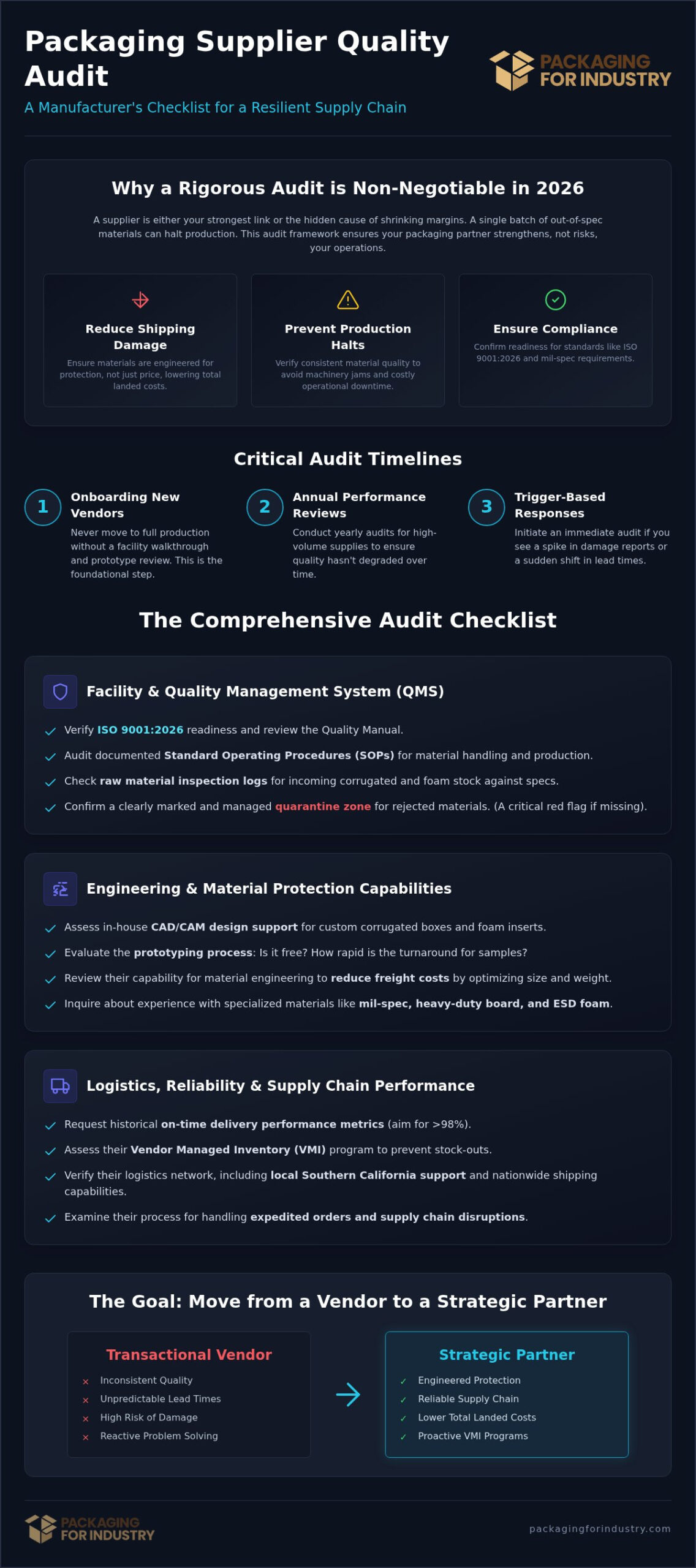
Audits should be integrated into your standard procurement cycle rather than treated as a reactive measure. We recommend scheduling a formal review during these three critical phases:
- Onboarding New Vendors: Never move to full production for custom corrugated or foam solutions without a facility walkthrough and a review of their prototyping process.
- Annual Performance Reviews: Conduct yearly audits for high-volume wholesale shipping supplies to ensure the vendor hasn’t cut corners on material density or adhesive quality.
- Trigger-Based Responses: If you notice a spike in transit damage reports or a sudden shift in lead-time reliability, an immediate audit is required to identify the root cause.
Regularly applying a packaging supplier quality audit checklist for manufacturers helps you transition from a transactional relationship to a strategic partnership. It also allows you to evaluate value-added services like Vendor Managed Inventory (VMI), which can safeguard your production line against the single-source vulnerabilities that often plague un-audited supply chains.
Facility and Quality Management System (QMS) Checklist
A facility walkthrough is the most revealing part of any vendor evaluation. It proves whether a supplier’s documented processes match their daily operations. When using a packaging supplier quality audit checklist for manufacturers, your first priority is verifying their Quality Management System (QMS). With the ISO 9001:2026 update expected between September and November, you must confirm that your partner is transitioning to these new standards, which emphasize risk management and quality culture. Key facility checks during your visit should include:
- Reviewing documented Standard Operating Procedures (SOPs) for all material handling.
- Auditing raw material inspection logs for incoming corrugated and foam stock to ensure they meet your specs.
- Verifying that rejected materials are clearly demarcated in a dedicated quarantine zone.
A lack of designated quarantine areas is a major red flag. It suggests a high risk of cross-contamination between good and defective inventory, which can lead to faulty packaging reaching your assembly line. If you need a partner that already prioritizes these rigorous standards, you can request a packaging quote to see how we align with your specific QMS requirements.
Production Environment and Equipment Maintenance
Calibrated machinery is the backbone of precision. Audit the maintenance logs for die-cutting and CAD/CAM equipment to ensure tolerances remain within mil-spec or aerospace requirements. Housekeeping standards are equally vital. In electronics or medical packaging, dust and debris can render ESD-safe materials or sterile inserts useless. Finally, perform a capacity analysis. Ask if the supplier can handle a 20% surge in your production volume without extending lead times. Reliability during peak seasons is a core component of Supplier Quality Management.
Traceability and Documentation Standards
Traceability ensures accountability when a failure occurs. Every shipment of custom corrugated boxes should be tied to a specific lot number. This allows you to isolate issues to a single production run rather than discarding an entire warehouse of supplies. Review their record retention policies; quality test results should be stored for at least three to five years depending on your industry. A robust Corrective Action and Preventive Action (CAPA) process shows that the supplier doesn’t just fix mistakes, they engineer ways to prevent them from recurring. Implementing a packaging supplier quality audit checklist for manufacturers ensures these documentation standards are verified during every site visit.
Engineering and Material Protection Capabilities
A quality audit that ignores the engineering department is essentially incomplete. While administrative compliance is necessary, the actual protection of your product depends on material science and structural design. When you utilize a packaging supplier quality audit checklist for manufacturers, you must look beyond the warehouse floor to the design lab. You need to know if your supplier can translate complex product dimensions into a protective reality using CAD/CAM software. We provide free prototyping for custom designs because it allows manufacturers to verify fit and function before committing to a high-volume run. This step eliminates the expensive guesswork that often leads to shipping damage.
In-house testing capabilities are another non-negotiable audit item. If a vendor can’t perform drop tests, vibration analysis, or compression testing on-site, they’re relying on theoretical data rather than empirical evidence. This is especially critical when dealing with custom foam packaging. You should audit their ability to integrate multiple materials, such as combining heavy-duty corrugated board with multi-density foam inserts, to solve unique protection challenges. A supplier that can’t demonstrate these technical capabilities isn’t equipped to handle the rigors of a modern industrial supply chain.
Specialized Protection for High-Value Goods
For manufacturers in the electronics sector, specialized protection like ESD and anti-static properties must be verified during the audit. Your checklist should include a check of the vendor’s material density verification process. If a foam insert is too soft, it bottoms out; if it’s too rigid, it transfers shock directly to the component. This level of engineering is also vital for custom shipping crates. A well-engineered crate isn’t just a wooden box; it’s a calculated system designed to withstand the specific stresses of international transit or heavy industrial movement. Audit the supplier’s process for selecting lumber grades and fastening methods to ensure long-term durability.
Aerospace and Defense Compliance
High-stakes industries require even more granular engineering oversight. Your checklist must include specific line items for Aerospace packaging requirements and military-spec standards like Mil-Std-2073. Verify that the supplier has experience with hazardous material (HazMat) regulations and the rigorous documentation required for defense contracts. A supplier that understands the technical nuances of mil-spec packaging isn’t just a vendor; they’re a safeguard against the catastrophic costs of rejected shipments or compromised hardware. By focusing your audit on these engineering capabilities, you ensure your supply chain is built on technical precision rather than just administrative paperwork.
Logistics, Reliability, and Supply Chain Performance
A supplier with the best engineering in the world is a liability if their delivery schedule is unpredictable. Your packaging supplier quality audit checklist for manufacturers should place heavy emphasis on logistical reliability and historical on-time delivery (OTD) performance. In an era where material costs are volatile and lead times can shift overnight, you need a partner with transparent communication protocols. Audit the supplier’s ability to provide real-time updates when material shortages occur, such as the containerboard supply constraints reported in late 2026. If a vendor cannot demonstrate a consistent OTD rate of 98% or higher, they risk stopping your production line.
One of the most effective ways to stabilize your supply chain is through a Vendor Managed Inventory (VMI) program. During your audit, evaluate the vendor’s software and reporting capabilities for VMI. They should be able to track your usage patterns and automatically replenish stock before a shortage occurs. This moves the burden of inventory management from your warehouse team to the supplier, ensuring you always have the right corrugated boxes or foam inserts on hand without tying up excessive capital in floor space.
Evaluating Inventory Management Systems
Modern manufacturing thrives on lean principles. Check if the supplier offers just-in-time (JIT) delivery options to help you save valuable warehouse square footage. You should also audit their safety stock policies for your recurring custom items. A reliable partner will maintain a buffer of your specific custom designs to protect you against sudden demand spikes. Additionally, ask about their experience with packaging kitting. By receiving pre-assembled kits of boxes, inserts, and labels, your production team can move faster and reduce the labor costs associated with manual packing setup.
Southern California Regional Support
Proximity is a strategic advantage in industrial logistics. For manufacturers in Orange County, Los Angeles, and the Inland Empire, working with an Anaheim-based supplier significantly reduces transit times and shipping costs. When refining your packaging supplier quality audit checklist for manufacturers, assess the supplier’s local fleet and their control over the final mile of delivery. Local support allows for next-day emergency deliveries that a nationwide catalog vendor simply cannot match. Being close to your supplier also facilitates rapid prototyping and face-to-face quality reviews, which are essential when launching new aerospace or medical products that require tight tolerances.
Strategic Selection: Moving from Audit to Partnership
Transitioning from a checklist to a contract requires a shift in perspective. A successful packaging supplier quality audit checklist for manufacturers does more than just verify compliance; it identifies which vendors can actually improve your operational efficiency. A standard catalog vendor fulfills orders, but a strategic partner identifies ways to lower overall packaging costs through structural engineering and material optimization. We don’t just meet the criteria on your checklist. We use our expertise to solve the underlying problems that cause shipping damage and production delays.
Choosing a partner based on their ability to pass an audit is the first step toward a more predictable supply chain. When you evaluate a vendor, look for their willingness to engage in the design phase. If a supplier simply provides a price list without asking about your transit hazards or warehouse constraints, they are a commodity provider. A true partner integrates with your manufacturing and logistics teams to ensure every corrugated box and foam insert is purpose-built for its environment.
Why Industrial Leaders Choose Packaging For Industry
Industrial sectors like aerospace, medical, and electronics require a level of precision that generic suppliers cannot provide. We have spent decades refining our processes to meet the most stringent quality and engineering standards. Our approach centers on reducing shipping damage through superior engineering rather than just increasing material thickness. This focus on material science ensures your high-value components arrive intact while keeping your freight and storage costs manageable. By aligning our capabilities with your packaging supplier quality audit checklist for manufacturers, we provide the technical depth needed for high-stakes industrial applications.
Next Steps for Your Procurement Team
The final phase of your vendor evaluation should include a formal site visit. We invite procurement teams to tour our Anaheim facility to see our CAD/CAM prototyping and VMI operations in action. This face-to-face review allows you to verify our QMS and logistics control firsthand. Once you have completed your audit, the next step is to compare technical capabilities and service levels alongside pricing. Contact one of our experts today to schedule a custom packaging review or request a packaging quote to secure your 2026 supply chain.
Secure Your 2026 Supply Chain with Engineered Packaging
Maintaining a resilient supply chain in 2026 requires more than just checking boxes on an administrative form. It demands a partner that can bridge the gap between technical material science and logistical efficiency. By utilizing a comprehensive packaging supplier quality audit checklist for manufacturers, you ensure your vendor is prepared for the transition to ISO 9001:2026 and the challenges of rising material costs. A systematic evaluation identifies the difference between a simple box provider and a strategic partner that can lower your total landed costs.
Our team at Packaging For Industry (PFI) specializes in high-stakes sectors like Aerospace and Defense, ensuring full Mil-Spec compliance and technical precision. We provide free prototyping and custom engineering support to eliminate shipping damage before your products leave the warehouse. With our local Southern California facility, we offer next-day delivery to Los Angeles, Orange County, and the Inland Empire, keeping your operations moving without delay. We are ready to help you optimize your inventory through Vendor Managed Inventory (VMI) and specialized kitting services.
Don’t let poor packaging quality or unpredictable lead times jeopardize your production schedule. Take control of your procurement process today and build a partnership that prioritizes protection, precision, and long-term supply chain performance.
Frequently Asked Questions
What are the most critical ISO certifications for a packaging supplier in 2026?
ISO 9001:2026 is the standard for quality management and risk assessment. For manufacturers in specialized sectors, AS9100 is essential for aerospace compliance, while ISO 13485 is required for medical device packaging. These certifications ensure your vendor has the documented systems to handle precision requirements. Verifying these credentials is a baseline step in any packaging supplier quality audit checklist for manufacturers to ensure consistent material performance.
How often should a manufacturer conduct a quality audit on their packaging vendor?
We recommend a formal facility audit once per year for your primary packaging partners. However, you should trigger a reactive audit if you notice a spike in transit damage or a 5% decline in on-time delivery rates. Regular reviews ensure the supplier’s standard operating procedures (SOPs) haven’t drifted. This proactive approach helps maintain supply chain reliability and prevents minor quality issues from becoming production-stopping failures.
Can a packaging audit help reduce UPS or FedEx shipping surcharges?
Yes, auditing the engineering process allows you to identify opportunities for dimensional weight (DIM) optimization. By reviewing box sizing and material density during the audit, you can often reduce the exterior dimensions of your shipments without sacrificing protection. This directly lowers freight costs and eliminates the expensive surcharges associated with oversized or inefficiently packed industrial goods.
What is the difference between a desk audit and a physical facility audit?
A desk audit is a remote review of a supplier’s certifications, insurance, and quality manuals. A physical facility audit involves a walkthrough to verify that those documented processes are actually followed on the production floor. Physical audits are necessary to inspect housekeeping standards, machine calibration, and the demarcation of rejected materials. You can’t verify a vendor’s true capacity through a PDF alone.
Should I audit my supplier’s raw material sources for corrugated boxes?
Auditing raw material sources is vital for ensuring price stability and supply continuity. With the $140 per ton increase in containerboard prices effective September 1, 2026, you need to know if your supplier has diversified mill relationships. A vendor with a single-source raw material stream is a high-risk partner. Verifying their supply chain resilience helps you avoid unexpected lead-time delays or sudden price spikes.
What are the red flags to look for during a packaging facility walkthrough?
Look for disorganized warehouses, lack of lot number tracking, and uncalibrated die-cutting machinery. A major red flag is the absence of a clearly marked quarantine area for defective stock. If you see dust accumulation in areas producing electronics or medical packaging, it suggests a lack of quality culture. These visual cues often indicate deeper systemic failures in a supplier’s quality management system.
How do I evaluate a supplier’s custom foam engineering capabilities?
Start by reviewing their CAD/CAM prototyping process and asking for empirical material density test results. A capable supplier should offer free prototyping and demonstrate expertise in multi-material integration, such as combining PE and PU foams for specific G-force protection. Evaluating these technical skills within your packaging supplier quality audit checklist for manufacturers ensures your high-value components are protected by science rather than guesswork.
Does a packaging supplier’s location in Southern California affect quality or reliability?
Proximity is a significant factor in logistical reliability for local manufacturers. An Anaheim or Orange County supplier provides next-day local delivery and immediate on-site support for quality reviews. This eliminates the transit risks and long lead times associated with out-of-state vendors. Being close to your supplier also allows for faster rapid prototyping cycles, which is critical for maintaining a predictable and agile supply chain.